
Continuing along in this new series devoted to the best looking boards found in the wargaming world where I will highlight the art and layout of a different board in a wargame that we have played to show you the various talents of the artists and graphic designers involved. In my humble opinion, a well designed and attractive board can make all the difference in the world to me enjoying a wargame. Don’t get me wrong, the game has to be good, but if it’s also good looking it always is a better experience. A board can draw me in. Can make me feel that I’m there. Can set the stage for the thematic immersion that we all crave. And I have found many of these type of boards and I want to make sure that I share them with you.

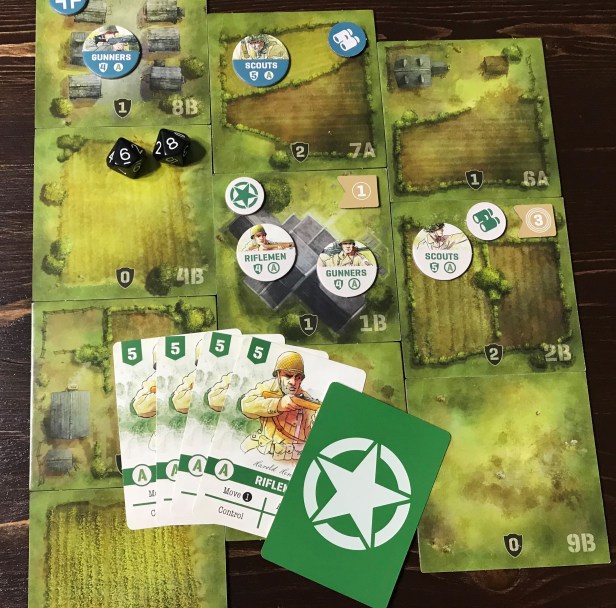
Before we get into my thoughts, I know you might be confused about the above picture where I talk about the beautiful board for Undaunted: Normandy and then you see the title on the box used in the photo (Undaunted: Reinforcements) and are confused. Well, grasshopper, you may not know this but when Reinforcements was released, they provided a new oversized box with a custom insert and it allowed you to place all of the content from both Undaunted: Normandy and Undaunted: North Africa into the new box. For storage reasons, because my shelves are creaking and overcrowded, I took advantage of this and merged them all together in the new box and recycled the other 2 boxes. So there, I hope that clears it up for you!
The board that I chose for this entry in the series is a non-traditional wargame board….but that doesn’t mean that it isn’t worthy of being considered here because it is a work of art and aids the game in being played and enjoyed. The board I chose this time is the modular board used in Undaunted: Normandy from Osprey Games. Undaunted: Normandy is the first entry in the Undaunted Series and is a tactical card based game that uses very interesting mechanics to simulate small platoons of soldiers from the 30th Infantry Division and their enemies the defending Germans. The game consists of 12 varying scenarios that tell the story of the 30th ID’s actions as it travels from Omaha Beach (they arrived a few days after D-Day) to Mortain, which was essentially the division’s conclusion to its actions in Normandy. Over those twelve scenarios, the 30th fights through bocage, participates in Operation Cobra, liberates Tessy-sur-Vire, and eventually defeats Germany’s counter-offensive in Mortain. The game uses deck building to force the action and move unit counters from tile to tile to gain an advantage, take cover from enemy fire and scout new locations as you position yourself to control the area. The game is designed by David Thompson and Trevor Benjamin and illustrated by the very talented Roland MacDonald and it is just special! Special in its theme. In its game play, as it uses deck building. Special in its look and feel and the board is special. Roland has done work on mostly Euro style of traditional board games but does have at least a few wargames to his design credit including Battle Line (2000) from GMT Games, Battle Line: Medieval (2017) from GMT Games and now every ongoing entry in the Undaunted Series such as Undaunted: North Africa (2020), Undaunted: Reinforcements (2021), Undaunted: Stalingrad (2022), Undaunted: Battle of Britain (2023) and the recently announced Undaunted 2200: Callisto (2024) all published by Osprey Games.
Roland has a real talent for making an image seem that it fits into the narrative that is being played out. Both in his character representations on the cards and in the terrain found on the board tiles. What he draws feels like it fits and furthermore it creates an engaging and rich experience that draws you into the struggles of the soldiers on the board. Makes you care. Makes you think of them as individuals and not just a cog in the war machine. But this artistic talent is one of the things that makes the Undaunted Series and I am glad that David, Trevor and Osprey have hitched their wagon to his efforts.
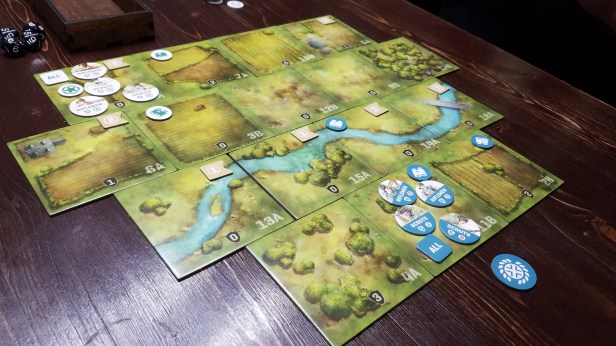
Undaunted: Normandy is played on a modular board that is setup differently for each scenario. The game has 18 different double sided tiles included to create some very interesting terrain. The art in this game is absolutely fantastic and this carries over onto the tiles as they are really evocative of the terrain types being depicted including open fields, heavy woods, rivers, bocage and various small and large buildings.
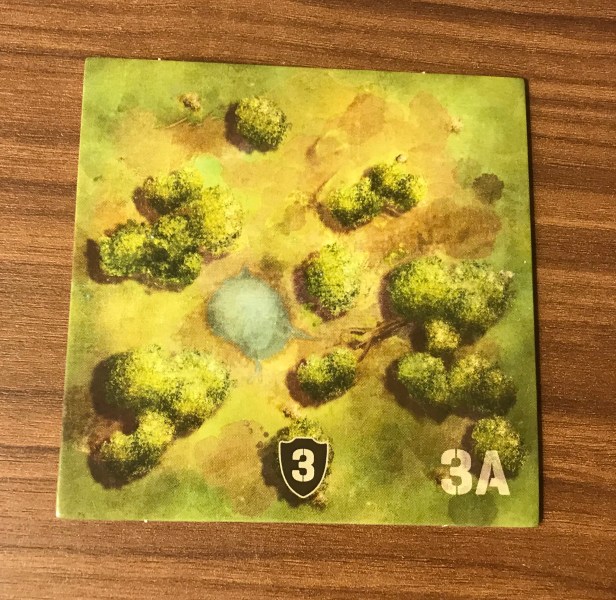
As I mentioned, each tile is double sided and depicts one terrain one one side with a totally different terrain on the other. Each tile has a unique designation always composed of a number and a letter. Pictured below is tile 3A, which depicts a small copse of trees in the middle of a field. You will also notice that there is a small pond found in the center and the ground runs toward it and you can feel the way the water coming down the landscape would scrape and carve away the soil.
On the opposite side of the same tile there is a cultivated field with a parked tractor. This tile is numbered 3B. I don’t know about you but when I look at this tile, I can smell the freshly tilled earth. That musty natural musk of dirt. That is pretty fantastic that I can smell that as my eyes make a connection to my olfactory senses and trigger that sensation. The real strength of this element of the design is its flexibility and the options that are available for differing scenarios. 18 tiles really represent 36 different types of terrain and their combination can create some very interesting and challenging terrain for the players to have to negotiate.
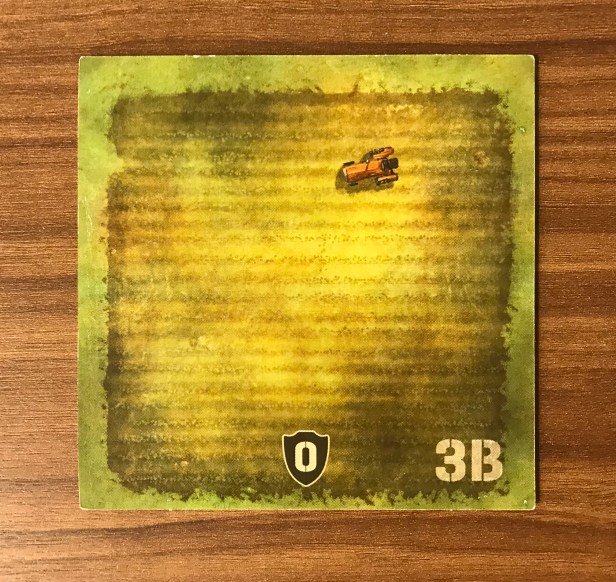
You may notice the chevron at the bottom of the tile that has a number inside it. This is the tile’s Defensive Value and is tied to the type of terrain that is depicted. As you can see in the tile above, a field doesn’t offer any Defensive Bonus as there are no trees, shrubs or other elevation behind which soldiers can hide themselves. This is not a tile you can make a stand in. But let’s now take a look at a few tiles that have been assigned good Defensive Values and I am sure that you will be able to immediately see why.
Some tiles have ‘3/1’ listed as their Cover Bonus. These are Hill Tiles and represent elevation, and they have a variable Cover Bonus. If a combat counter on a Hill Tile is Attacked by another combat counter on a Hill tile (whether the tile is the same or different), the Cover Bonus offered is 1. Otherwise, if being attacked from those combat counters at a lower elevation, the Cover Bonus is a 3. How does a Cover Bonus work in an Attack in the game? Easy. You simply add the Cover Bonus from the terrain tile that the Attacked unit is in to their Defensive Value shown on their counter and add +1 to the number needed to roll on a 10-sided die for each tile between the target and the shooter. Most units have a Defensive Value of between 4-6. Adding in +3 for being on a Hill Tile and you can see pretty quickly that these tiles are pretty important to a defensive strategy.
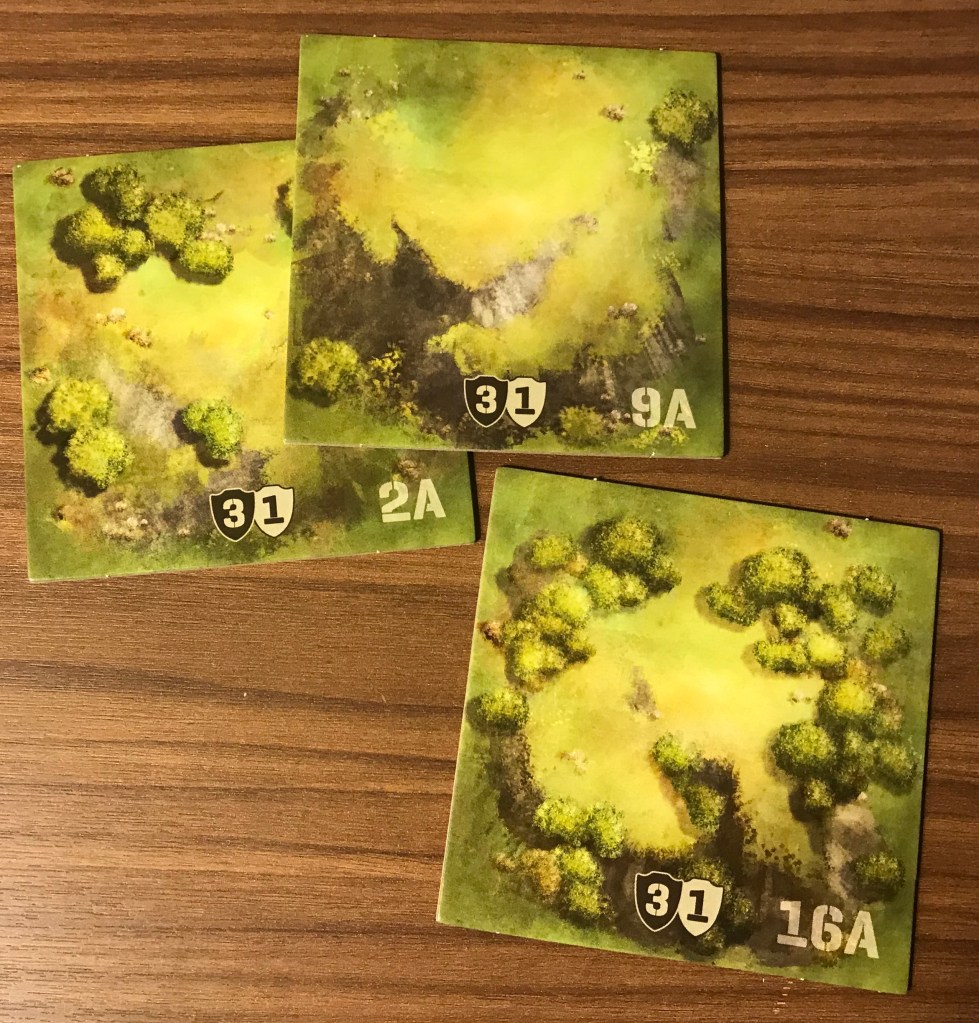
I really like how Roland dealt with elevation in a 2D perspective. He started with flat terrain and then added an elevated lip or cliff on the side of the elevated terrain to differentiate the elevations. Then he uses shading and lines to highlight this difference and it all comes together to create a feeling of security and dominance as this tile is obviously overlooking the rest of the tiles on the battlefield. He used color to differentiate elevation as well as you can see on tile #9A and #2A. He used gray to denote limestone or granite as it rises from the flat earth. This use of color was genius as it gives the image of height without a lot of need for texture and grain. These are very well done.
The next thing we will take a look at is the building tiles that are used. These buildings, including farm homes, outbuildings, sheds and shacks, really feel as if they fit in the Normandy countryside. They feel like they were pulled out of a painting from some French painter and they really add a layer of depth to the board.
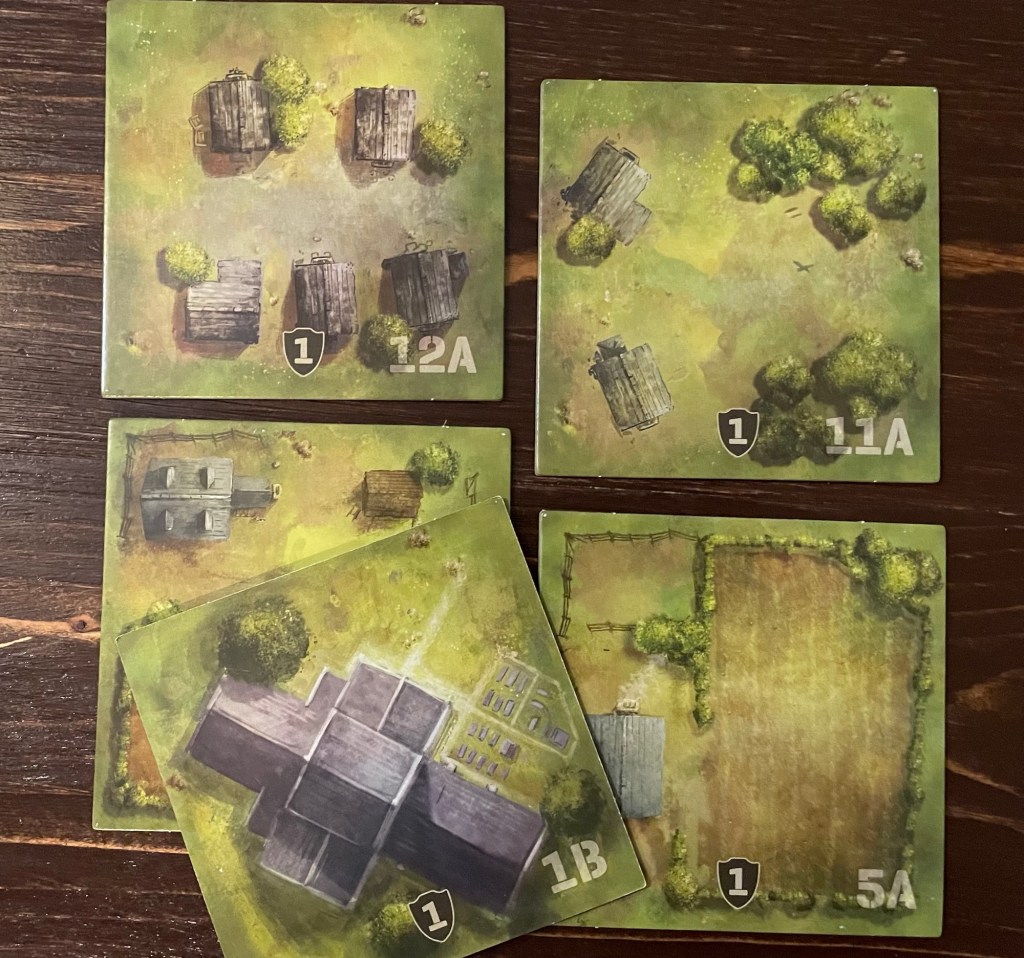
As was mentioned before, the building tiles have a bit of a better defense than tiles that are open although they don’t offer as much bonus as you might think. I particularly like the large farmhouse and the small details included such as the backyard English garden with raised beds and possibly a small covered well. You can also see the well worn path out the back door leading to the yard and can imagine people walking down it as they admire the beautiful flower beds and plants.
The next type of terrain highlighted on the terrain tiles is the infamous Bocage. Bocage is pastureland or fields that are interspersed with groves of trees or long lines of bushes having been trimmed and shaped to create a form of natural wall in the fields. Some of these Bocage rows have been around for 100’s if not a thousand years and have served the farmers well as they attempt to contain their flocks and keep out predators and those who would do harm to their animals.
The Bocage also acts as a pretty formidable defense in combat as you typically cannot hit what you cannot see and seeing through the Bocage is nearly impossible unless there is a break or a gate allowing access through them. I love the 3 representations below of this type of enclosure and really appreciate the added immersion that it provides to the players as they move through these areas to get toward their objectives or take out the enemy against them.
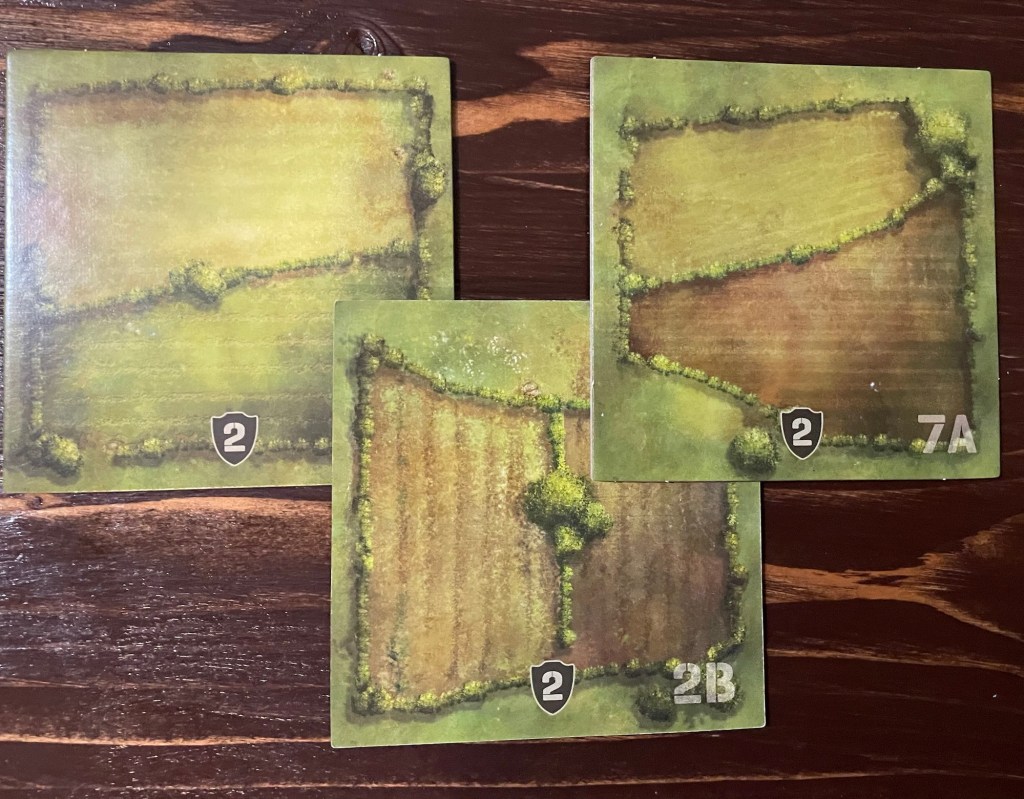
These Bocage tiles have a Cover Bonus of 2 and can be used to great effect by the players. I just really like the use of color here by Roland and also the attention to detail with the drawing of the tilled rows and the various shades of green used to color the Bocage. Just a really nice touch to the terrain and another example of the skill of the artist.
Finally, a word of warning for those unfamiliar with the Undaunted Series and these fantastic terrain tiles with all of these details thinking that this might be like ASL. The game doesn’t take into account Line of Sight for Attacks. As I have played the game this has not bothered me nor has it dampened the enjoyment I have with the game. Not every game has to be a hard and fast totally realistic simulation of combat to be enjoyable. If this lack of Line of Sight rules bothers you, I suggest you go back to the ASL rule book. This game might not be for you!
But with that being said, this game is just absolutely stunningly beautiful! It has a spot in this series and fits with my image of what a beautiful board is. I know that the game uses a non-traditional board with modular tiles but they just work and when you play scenario after scenario you will see more and more beauty as you experience the different combination of tiles and terrain types.
Here is our video review for Undaunted: Normandy:
Here are links to a series of Action Point posts that I wrote on the various aspects of the game:
Action Point 1 – Deck Makeup and Deckbuilding
Action Point 3 – Modular Board
Action Point 4 – Strategy Tips
Here also is a written interview we did with one of the designers David Thompson: https://theplayersaid.com/2019/09/16/interview-with-david-thompson-co-designer-of-undaunted-normandy-from-osprey-games/
The next board that we will take a look at in the series is Traces of War designed by Tetsuya Nakamura and illustrated by Pablo Bazerque.
Here are links to the previous entries in the series:
Kekionga!: A Dark and Bloody Battleground, 1790 from High Flying Dice Games
Campaigns of 1777 in Strategy & Tactics Magazine #316 from Decision Games
Battle Hymn Volume 1: Gettysburg and Pea Ridge from Compass Games
From Salerno to Rome: World War II – The Italian Campaign, 1943-1944 from Dissimula Edizioni
This War Without an Enemy: The English Civil War 1642-1646 from Nuts! Publishing
Holland ‘44: Operation Market-Garden, September 1944 from GMT Games
Maori Wars: The New Zealand Land Wars, 1845-1872 from Legion Wargames
Imperial Struggle: The Global Rivalry – Britain & France 1697-1789 from GMT Games
Stilicho: Last of the Romans from Hollandspiele
Nevsky: Teutons and Rus in Collision, 1240-1242 from GMT Games
A Most Fearful Sacrifice: The Three Days of Gettysburg from Flying Pig Games
Donnerschlag: Escape from Stalingrad from VUCA Simulations
Keep Up the Fire!: The Boxer Rebellion Deluxe Edition from Worthington Publishing
Liberty or Death: The American Insurrection from GMT Games
Lanzerath Ridge: Battle of the Bulge from Dan Verssen Games
Salerno ’43: The Allied Invasion of Italy, September 1943 from GMT Games
Bayonets & Tomahawks: The French and Indian War from GMT Games
-Grant
 The Players' Aid