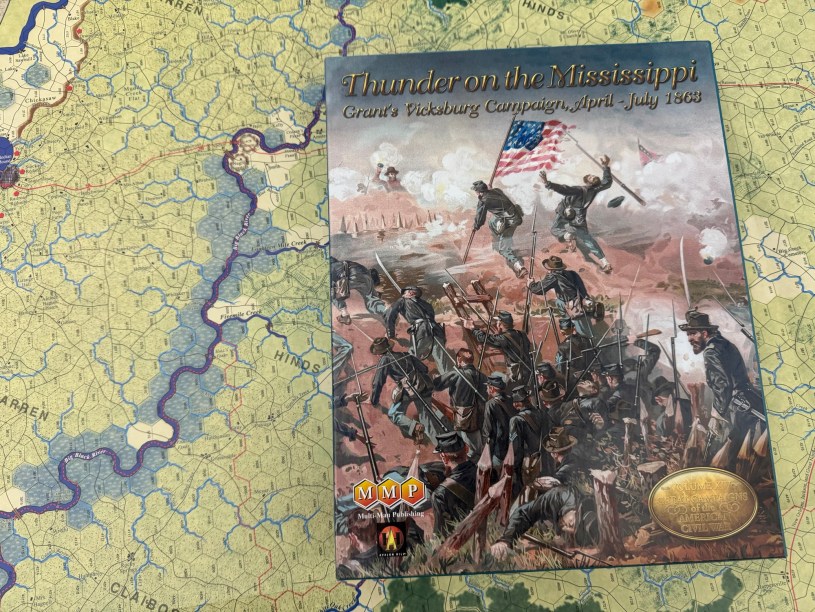
Continuing along in this series devoted to the best looking boards found in the wargaming world where I will highlight the art and layout of a different board in a wargame that we have played to show you the various talents of the artists and graphic designers involved. In my humble opinion, a well designed and attractive board can make all the difference in the world to me enjoying a wargame. Don’t get me wrong, the game has to be good, but if it’s also good looking it always is a better experience. A board can draw me in. Can make me feel that I’m there. Can set the stage for the thematic immersion that we all crave. And I have found many of these type of boards and I want to make sure that I share them with you.
In this entry in the series, we will be taking a look at the fantastic looking board for Great Campaigns of the American Civil War: Thunder On the Mississippi: Grant’s Vicksburg Campaign, April-July, 1863 from Multi-Man Publishing. The board is illustrated by the very talented Charlie Kibler whose work on the Great Campaigns of the American Civil War Series dates back to its creation in 1992. He has done a ton of great looking boards including The Battle for Normandy (2009) from GMT Games, The Day Was Ours: First Bull Run (2021) from Revolution Games, Border Reivers (2023) from GMT Games recently as well as a slew of Advanced Squad Leader boards stretching back through the years and a lot of series games for GMT Games such as Great Battles of the American Civil War and Great Battles of the American Revolution. We have already highlighted a few of his boards in the past like Storm Over Jerusalem from MMP and Battles of the American Revolution Volume II: Brandywine from GMT Games. He is very effective at creating great looking terrain and weaving in very nice details to highlight the main functions of the board and I very much like the simplicity and accurateness of his boards.
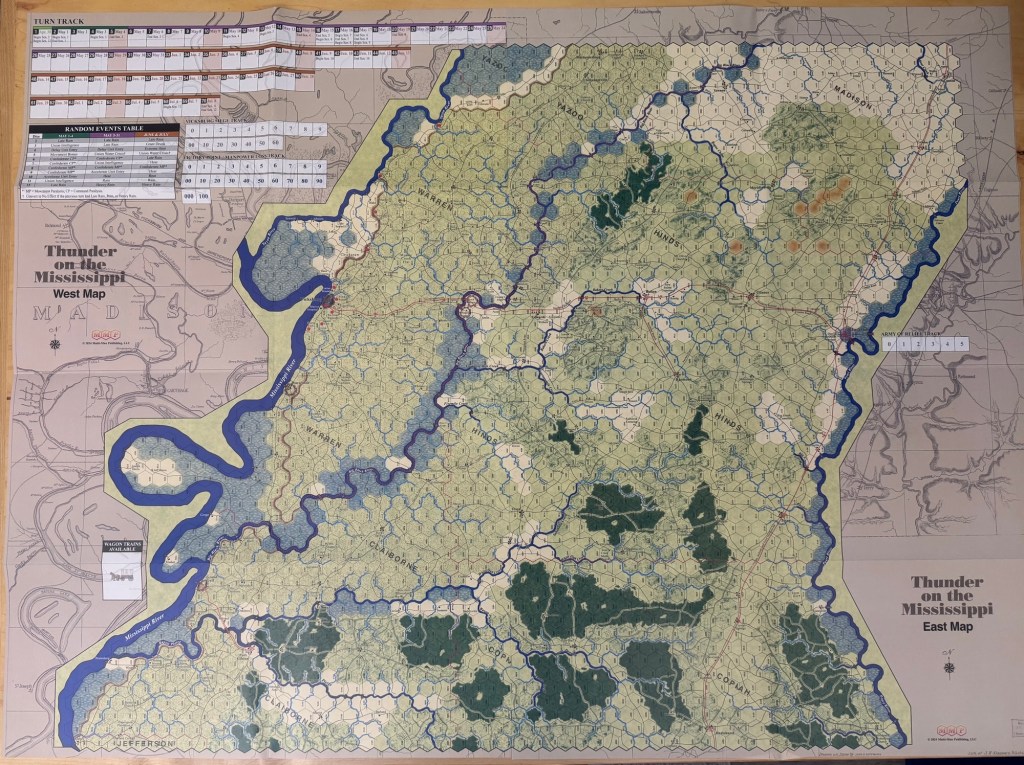
The board consists of 2 separate 22″x 32″ full-color map sheets that when combined create a large playing surface. The borders of the board include off-board information that is related to the geography and locations in and around Vicksburg. When I first saw this, I wasn’t really quite sure how to take it but after playing and also thinking about this decision, I really like how it was used to frame up or provide a significant visual contrast to the main game board. The brown coloring really contrasts well with the colorful terrain features and create a clear distinction for the players. I initially thought this was a poor decision and felt that it was a missed opportunity but it works really well.
Here is a closeup of this part of the board so you can get a good feel for what I am talking about.
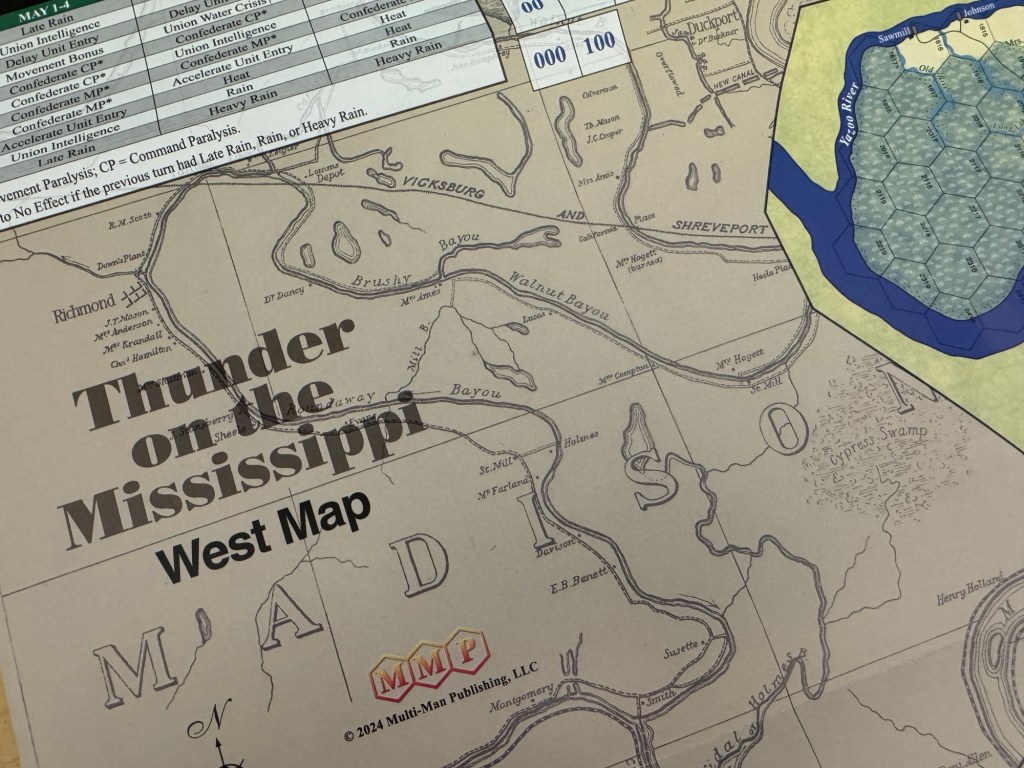
I always like to look at the game title box/area of the board and find these to be really great insights into the mindset and approach of the artist. On the board for Thunder on the Mississippi, we see Charlie used a washed out period look map for the background of this area. The really interesting part is how it transitions from the non-colored portion of the board title box to the game board itself. There is no connection between the 2 and the elements found on the board are not carried over or connected to the period map. I would maybe have liked to see there be a connection for an immersive approach but I understand that this was not the purpose of the use of the period map.
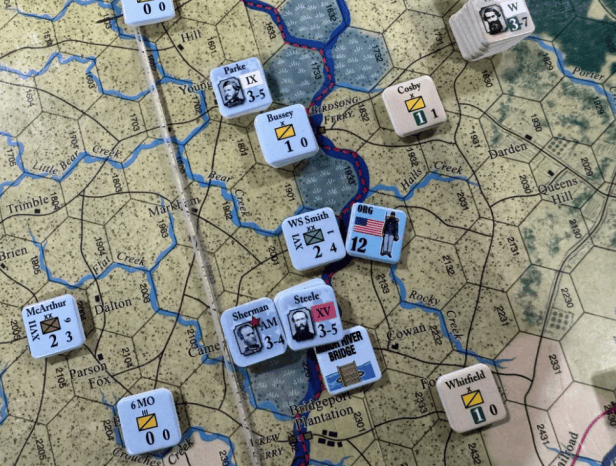
In Thunder on the Mississippi, there are 2 new terrain features unique to the Vicksburg region introduced including loess hills and coastal bluffs. Loess has not been featured before in GCACW Series games. Each loess hex is depicted with many small tan dots superimposed on an olive base color. This stippling gives it a sandy feel and I think really works well as loess is a fine-grained, powdery soil, a wide belt of which runs on the east side of the Mississippi on a southwest – northeast axis. Because loess is highly susceptible to erosion, it is marked by sharp, irregular ravines, many of which were so overgrown with vegetation as to be nearly impassable to military units.
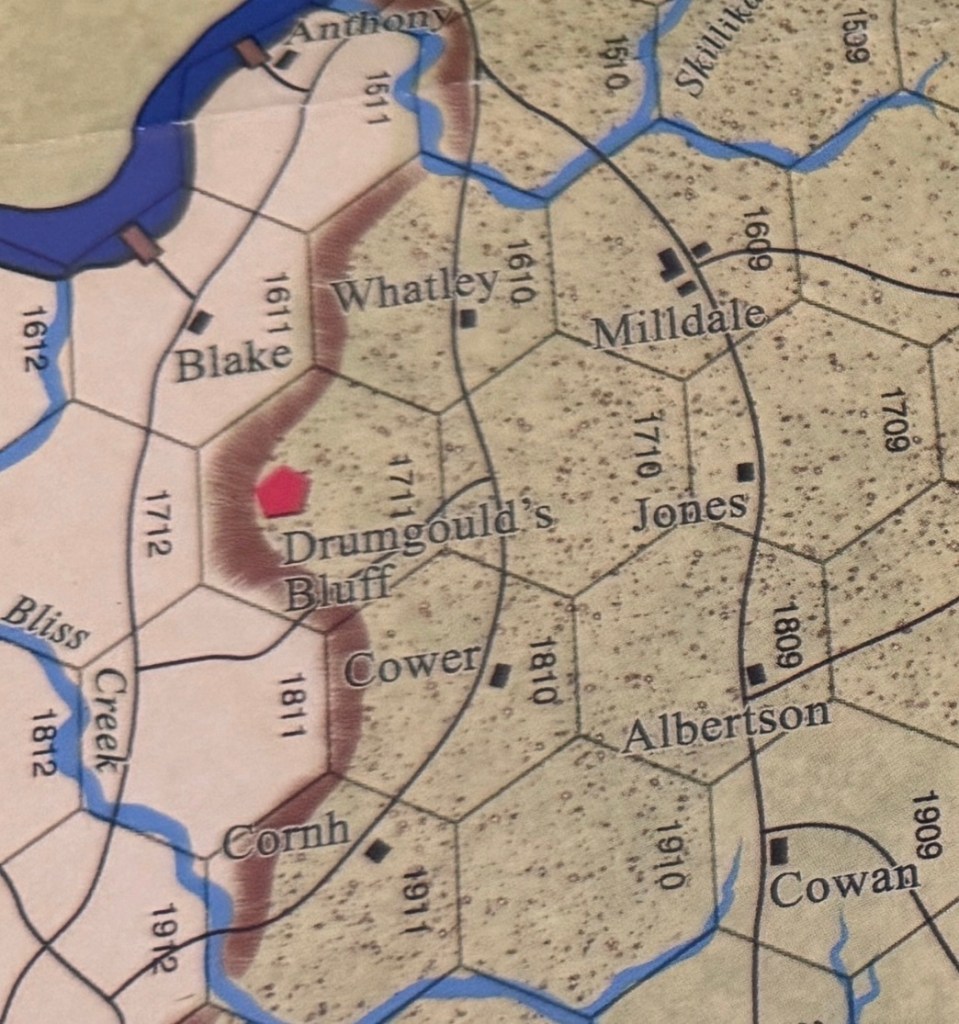
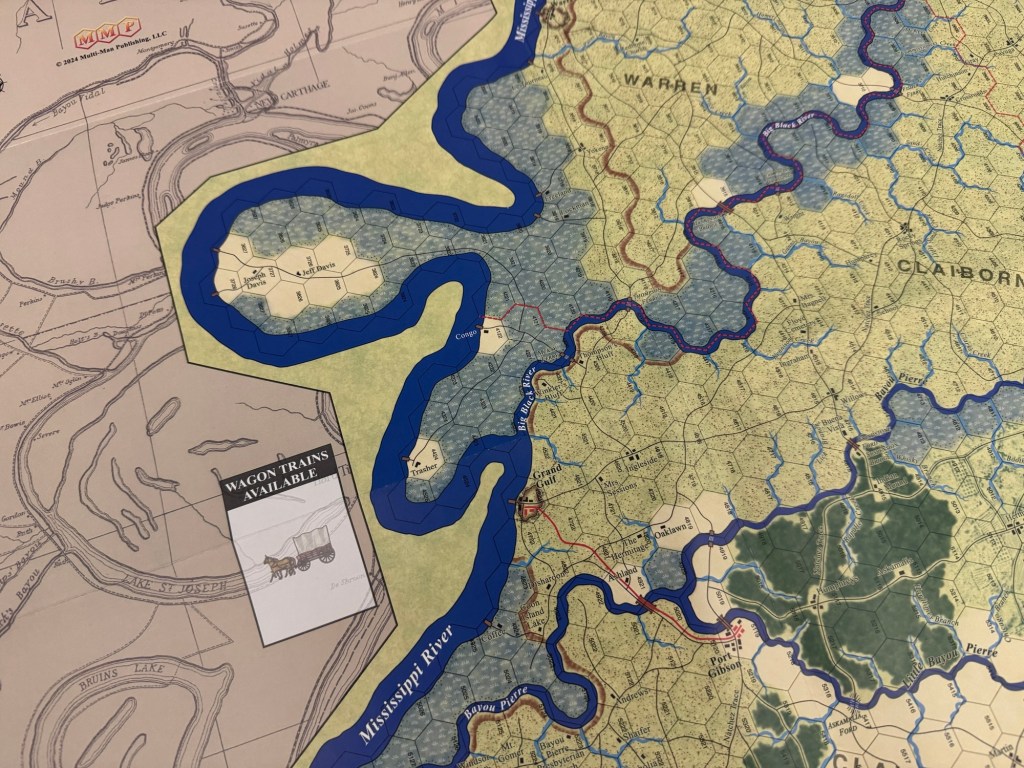
In the game, loess hexes are identical to woods hexes in terms of Movement Point costs and MP penalties to enter a friendly-occupied hex. Also, loess hexsides untraversed by roads or railroads exert a restricted ZOC the same as woods hexsides similarly untraversed. I think that the type of terrain, and what it does to the units that enter, really mimics the soft soil type as it is always hard to run in sand. I very much like the color used as well and it serves to set this specific terrain type apart from the rest of the board. Here is a look at the western portion of the West Map that is up against the Mississippi River.
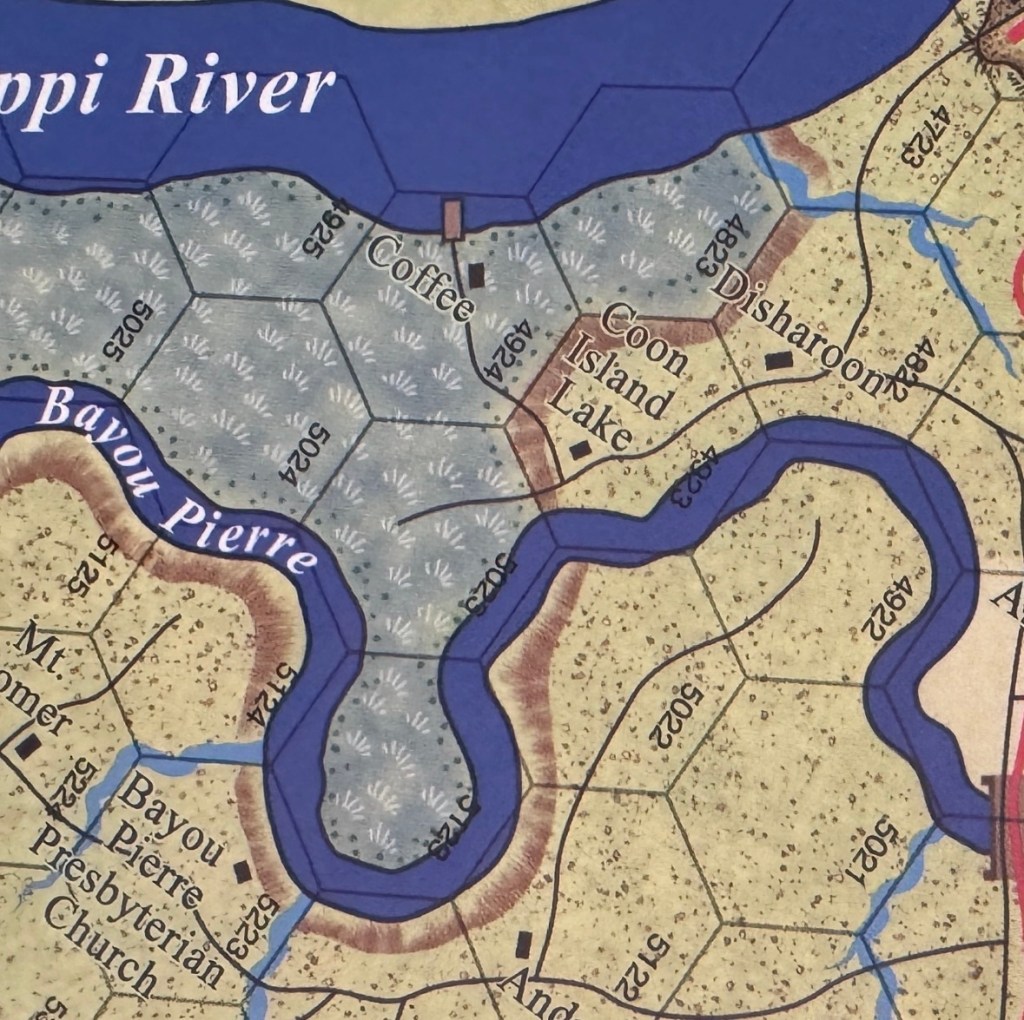
The other new terrain feature is that of coastal bluffs, which has also not been featured before in the series. Each coastal bluff hexside has a downhill side in which the light brown bluff line-pattern is uneven and an uphill side in which the bluff line-pattern is smooth. I know that it might be a bit hard to see in the below picture but the downhill side is found on the left side while the uphill side is on the right. Think of it this way…the uphill is simply a straight line border while the downhill side reflects the ravines from erosion and is made up of multi-length lines pointing out. I very much like this new terrain and also think that Charlie did a great job with the distinction even though it is a bit hard to distinguish from afar.
And that brings me to the portion of the board that I think is my favorite. Not because it is some revolutionary technique but because of the power and permanence that is offers the board, acting as an anchor and a framing of the action to be played out on it, and that is the Mississippi River itself. There is no real use of stylized marks or special features shown on the board but it is just a thick and dark blue line that meanders through the countryside. But the dark blue really gives a sense of size and scope and I very much feel that it is important to the board and what is to transpire on it.
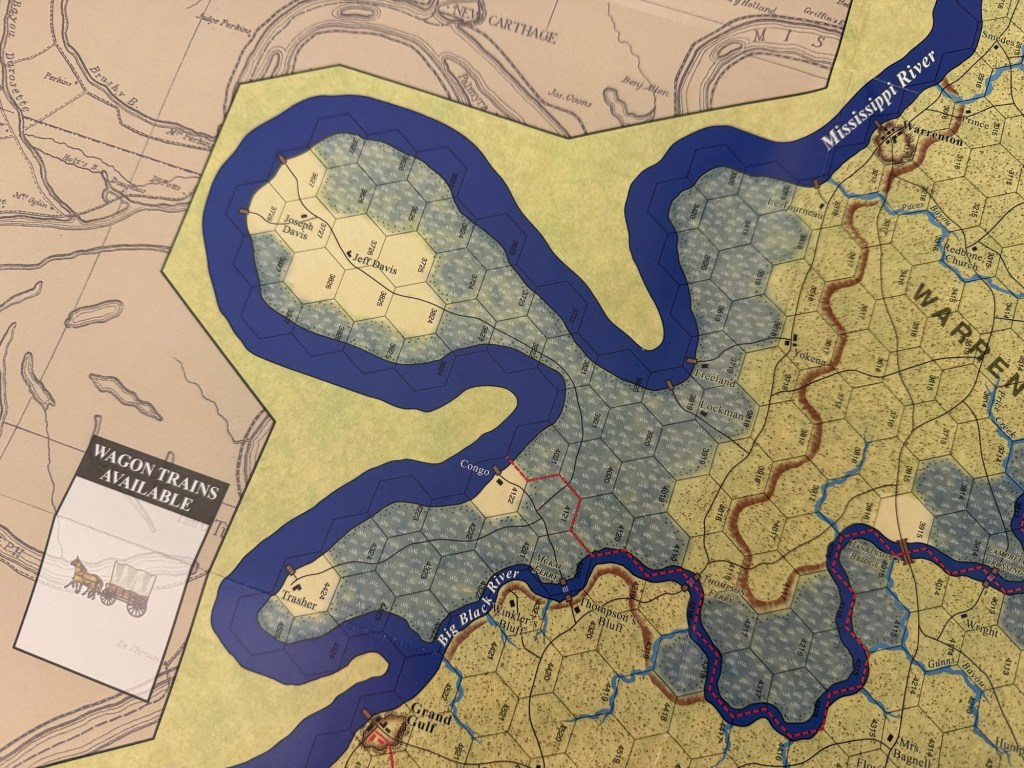
I also very much like how Charlie decided to keep in the exact layout of the river and shows its many twists and turns and oxbows that are found along its length.
The board for Thunder on the Mississippi is really a visual masterpiece. It provides great transition from terrain type to terrain type, frames up the board itself very well and uses very smart and poignant color choices, including the loess terrain color and the dark blue of the Old Man, all to create a fantastic canvas upon which to play out this titanic struggle and key turning point of the American Civil War.
If you are interested, here is a link to our video review:
The next board that we will take a look at in the series is The Marianas Campaign: Volume One: Saipan – The Bloody Rock from Compass Games.
Here are links to the previous entries in the series:
Kekionga!: A Dark and Bloody Battleground, 1790 from High Flying Dice Games
Campaigns of 1777 in Strategy & Tactics Magazine #316 from Decision Games
Battle Hymn Volume 1: Gettysburg and Pea Ridge from Compass Games
From Salerno to Rome: World War II – The Italian Campaign, 1943-1944 from Dissimula Edizioni
This War Without an Enemy: The English Civil War 1642-1646 from Nuts! Publishing
Holland ‘44: Operation Market-Garden, September 1944 from GMT Games
Maori Wars: The New Zealand Land Wars, 1845-1872 from Legion Wargames
Imperial Struggle: The Global Rivalry – Britain & France 1697-1789 from GMT Games
Stilicho: Last of the Romans from Hollandspiele
Nevsky: Teutons and Rus in Collision, 1240-1242 from GMT Games
A Most Fearful Sacrifice: The Three Days of Gettysburg from Flying Pig Games
Donnerschlag: Escape from Stalingrad from VUCA Simulations
Keep Up the Fire!: The Boxer Rebellion Deluxe Edition from Worthington Publishing
Liberty or Death: The American Insurrection from GMT Games
Lanzerath Ridge: Battle of the Bulge from Dan Verssen Games
Salerno ’43: The Allied Invasion of Italy, September 1943 from GMT Games
Bayonets & Tomahawks: The French and Indian War from GMT Games
Undaunted: Normandy from Osprey Games
Traces of War from VUCA Simulations
SCS Ardennes II from Multi-Man Publishing
Almoravid: Reconquista and Riposte in Spain, 1085-1086 from GMT Games
Walking a Bloody Path: The Battle of Fallen Timbers, August 20, 1794 from High Flying Dice Games
All Bridges Burning: Red Revolt and White Guard in Finland, 1917-1918 from GMT Games
Storm Over Jerusalem: The Roman Siege from Multi-Man Publishing
Iron, Blood, Snow & Mud from PHALANX
North Africa ’41: The Western Desert, March to December, 1941 from GMT Games
Battles of the American Revolution Volume II: Brandywine from GMT Games
Ardennes ’44: The Battle of the Bulge from GMT Games
Gandhi: The Decolonization of British India, 1917-1947 from GMT Games
Battles of Napoleon: Volume I – Eylau 1807 from Sound of Drums
Tattered Flags No. 01 – Into the Whirlpool from Blue Panther
Alliance: Multiplayer Napoleonic Wargame from Columbia Games
-Grant


I watched your review. It seems like a big long game. I wish there was a slimmed down version
LikeLiked by 1 person
Replying to Intrafinesse, Thunder on the Mississippi, and all of the Great Campaigns of the American Civil War games include several scenarios for the basic rule set as well as the advanced rules for the campaign scenarios. These basic scenarios provide you with the “slimmed down” version you are looking for.
I have been with this series since the beginning always appreciative of the detail of the map artwork. My favorite is the 3 map depiction of the Shenandoah Valley in the volume Stonewall in the Valley which is now undergoing an update.
Rich J.
LikeLiked by 1 person