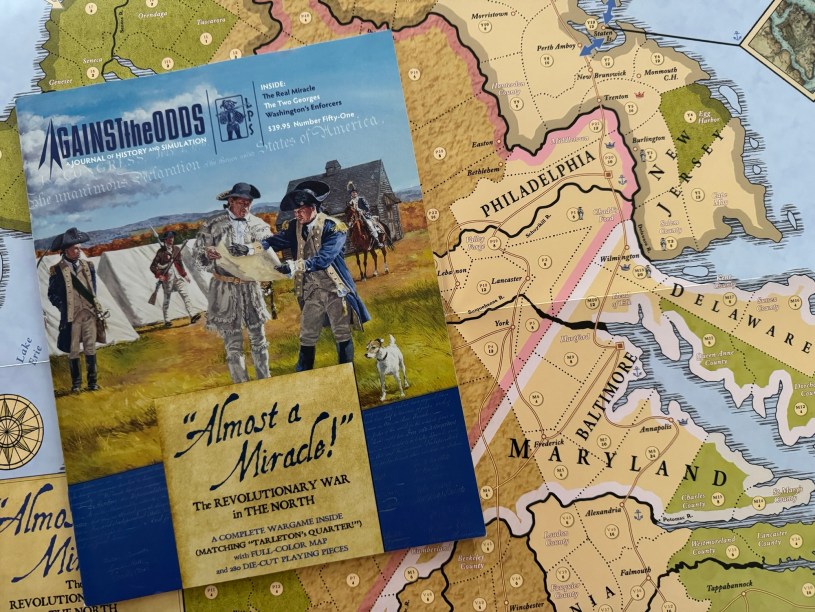
Continuing along in this series devoted to the best looking boards found in the wargaming world where I will highlight the art and layout of a different board in a wargame that we have played to show you the various talents of the artists and graphic designers involved. In my humble opinion, a well designed and attractive board can make all the difference in the world to me enjoying a wargame. Don’t get me wrong, the game has to be good, but if it’s also good looking it always is a better experience. A board can draw me in. Can make me feel that I’m there. Can set the stage for the thematic immersion that we all crave. And I have found many of these type of boards and I want to make sure that I share them with you.
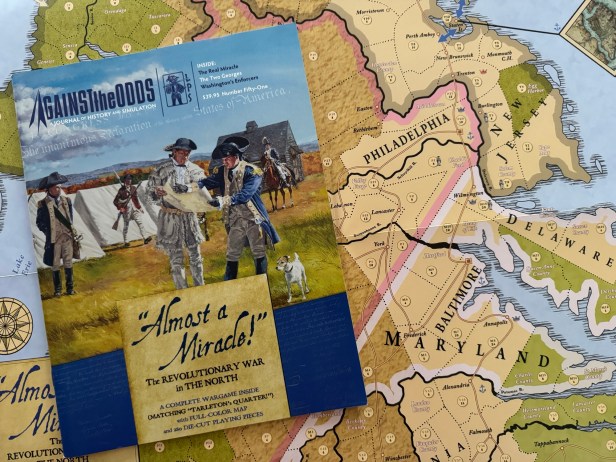
In this entry in the series, we will be taking a look at the fantastic looking board for Almost a Miracle!: The Revolutionary War in the North found in Against the Odds Magazine #51 from LPS, Inc. The board is illustrated by the very talented Mark Mahaffey whose board from Stilicho: Last of the Romans we have already covered in this series. Now typically, Magazine Wargames are nothing special. Both in their game play but also in their component quality and in the area of art and graphic design. But LPS takes great pride in the games found in their flagship magazine Against the Odds. And Almost a Miracle is such a beautiful example of great graphic design and art but also the board is absolutely a piece of art worthy of being framed and hung on a wall.
The board is illustrated by Mark Mahaffey who is a very accomplished full time artist who has done art for nearly 200 games including Celles: The Ardennes, December 23-27, 1944 (2012) from Revolution Games, The Dark Valley (2013) from GMT Games and Stilicho: Last of the Romans (2020) from Hollandspiele to name just a few. I think that Mark has a real talent for making a board coherent, easy to reference upon first glance and pleasing to look at during play, but I would not say that a lot of his boards are over the top beautiful but that is definitely the case with his effort for Almost a Miracle!.
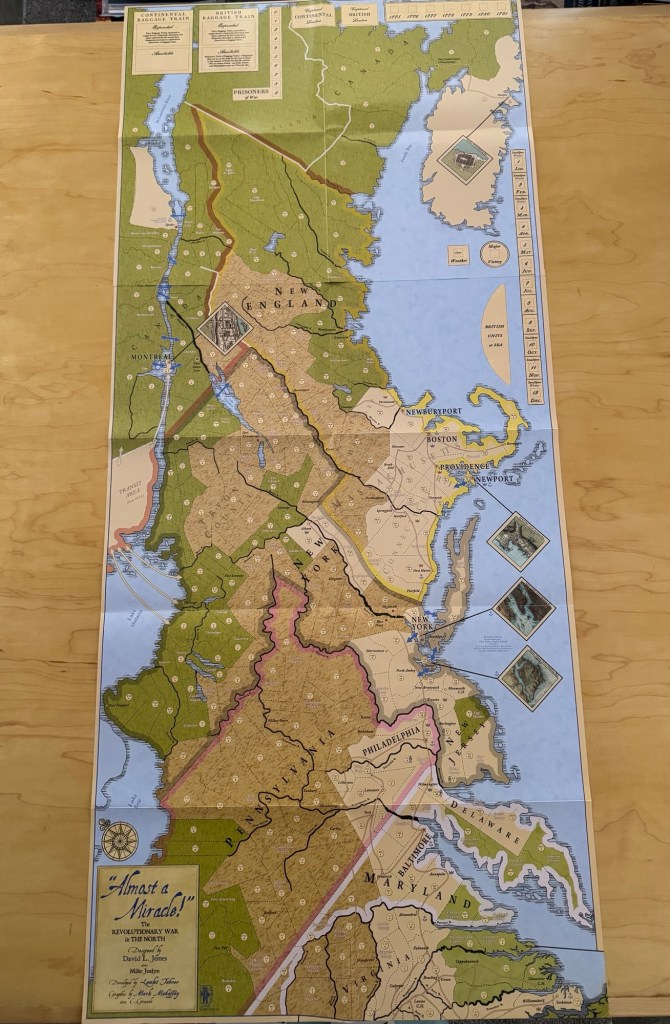
The board represents mostly the Northern Theater of the American Revolutionary War but also includes Virginia and Maryland in addition to Pennsylvania, New Jersey, Delaware, New York and an area identified as New England which encompasses Massachusetts, New Hampshire and Connecticut. Canada is also represented at the top of the board. The map comes in 2 separate parts that join together in New England and that measures 22″ x 51″ total when combined. The interesting thing about these 2 maps is that one is significantly smaller than the other one. I would say about 75% of the playable board is found on the larger of the 2 sections with the northern tier only covering 25%.
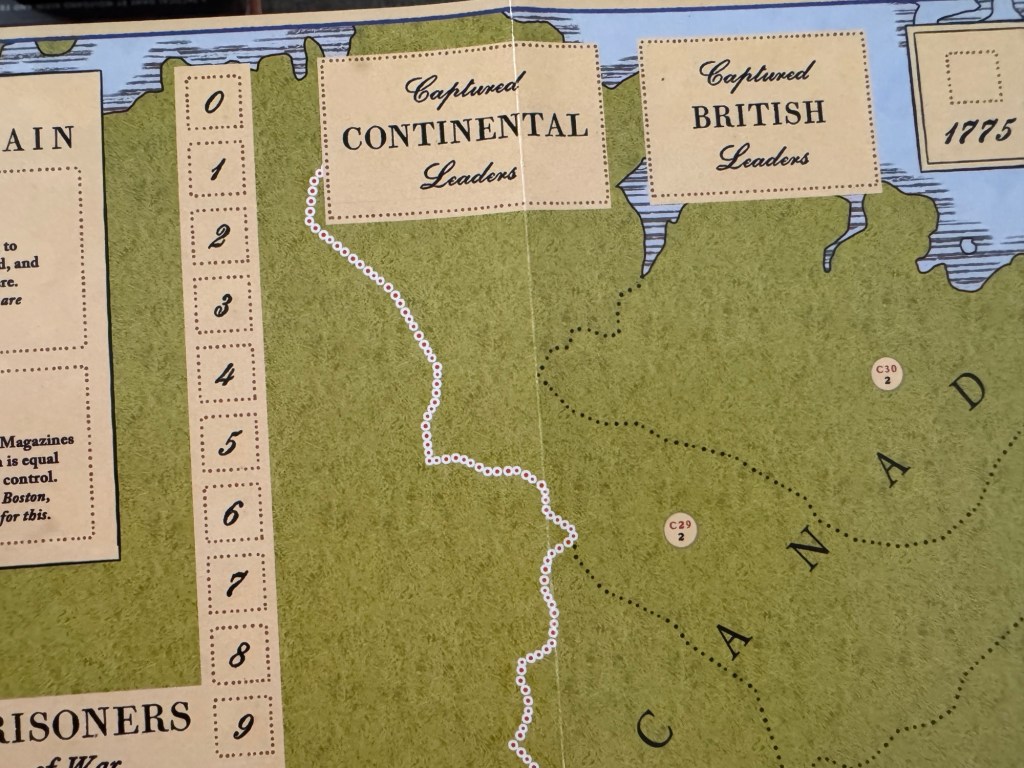
My only real issue with the 2 parts of the board is that they join together fine but the way the map was folded created a really defined white seam in the board that really stands out. You can see it located to the right of the words New England and it runs from Penobscot to the top of the board ending in Canada around the top of Acadia. Not a huge issue but more of a distraction from the beauty that the board offers.
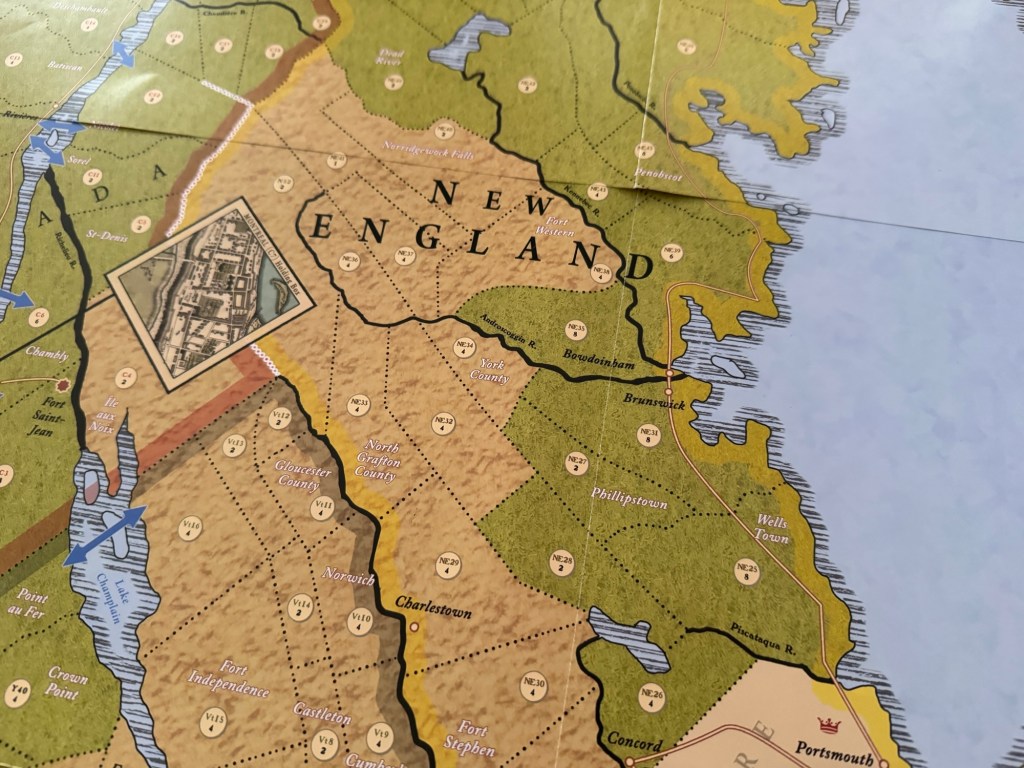
But the board is really quite beautiful and really provides a fantastic backdrop for the game itself. As you can see, the color palette chosen focuses on various shades of green and brown and they really give the game a natural and wild feel to it. With these American Revolutionary War games, I always keep in mind that the majority of the area of each colony, outside of a few larger population centers such as New York City, Baltimore and Philadelphia, are farmland and wilderness timber. Not a lot of development and definitely a land rich in natural resources in the form of wild game, furs, fish, lumber and ore. This “natural” color scheme of greens and browns really sets the tone of the period and provides a ready conduit into the theme and setting of the war.
Let’s focus on the southern portion of the board that includes Virginia, Maryland, Delaware, Pennsylvania and New Jersey. First off, I very much love the inclusion of the title box in the bottom left hand corner of the board with the game title and the various contributors including the designer David Jones and Mike Joslyn (who designed Tarleton’s Quarter which covers the Southern Theater) and the graphic design and art teams. These additions are always nice as they feel period to me and almost as if I am looking at a map of the region created at the time.
One thing that I want to point out is the use of lines to mark the various counties in each of the colonies. These lighter dotted lines are not as prominent as the other more important colony boundaries, roads and rivers. You will also notice that each of the colony boundaries are a different color because they touch and are easier to differentiate with the use of colors. Pennsylvania’s boundary is pink as it comes into contact with New York, New Jersey, Maryland and Virginia. Then the boundary of New Jersey is gray and New York is brown as they both touch Pennsylvania. This was a very nice touch and is important to understand the colony boundaries for recruitment and reinforcement purposes. This visually aids in distinguishing the various locations and to assist in grounding you in the geography.
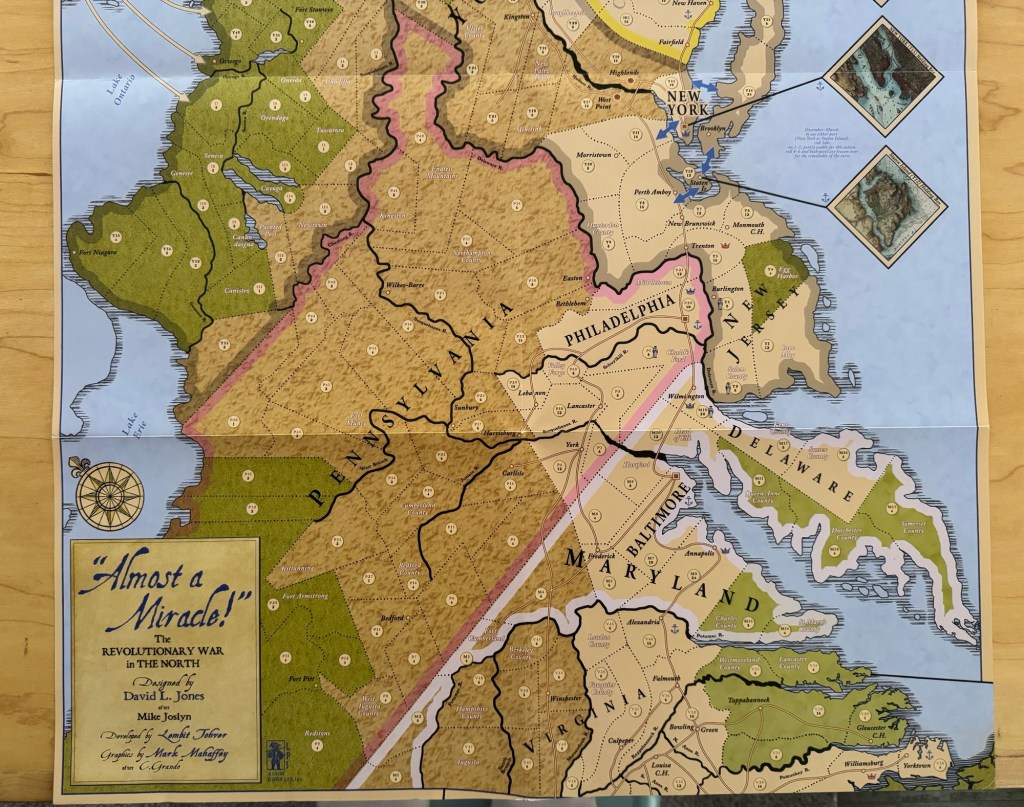
Foraging is also a major part of the game and when troops are out campaigning they rely on baggage trains and supply depots for food and ammunition but also can forage the countryside which is hit or miss. These foraging results are found on a table and are influenced by the terrain type that the troops are located in. So knowing what the terrain in any given area is important and these colors quickly identify the type.
The other very nice feature on the board is the use of lines to mark the shorelines of the various bodies of water including lakes, bays and oceans. In the picture below, we get a look at the shoreline of New Jersey, Delaware, Maryland and Virginia and you can see the deft use of these horizontal dark lines to mark the water as it comes in contact with the shoreline. I also really like the small islands that are sprinkled in the midst of these lines and they add some real depth to the feature. You can also see in this picture the names of each of the counties in each of the colonies. You may also notice the nice use of the silhouettes of soldiers on the boards in some of these counties. These are the starting positions for your forces and I very much like the way they did this.
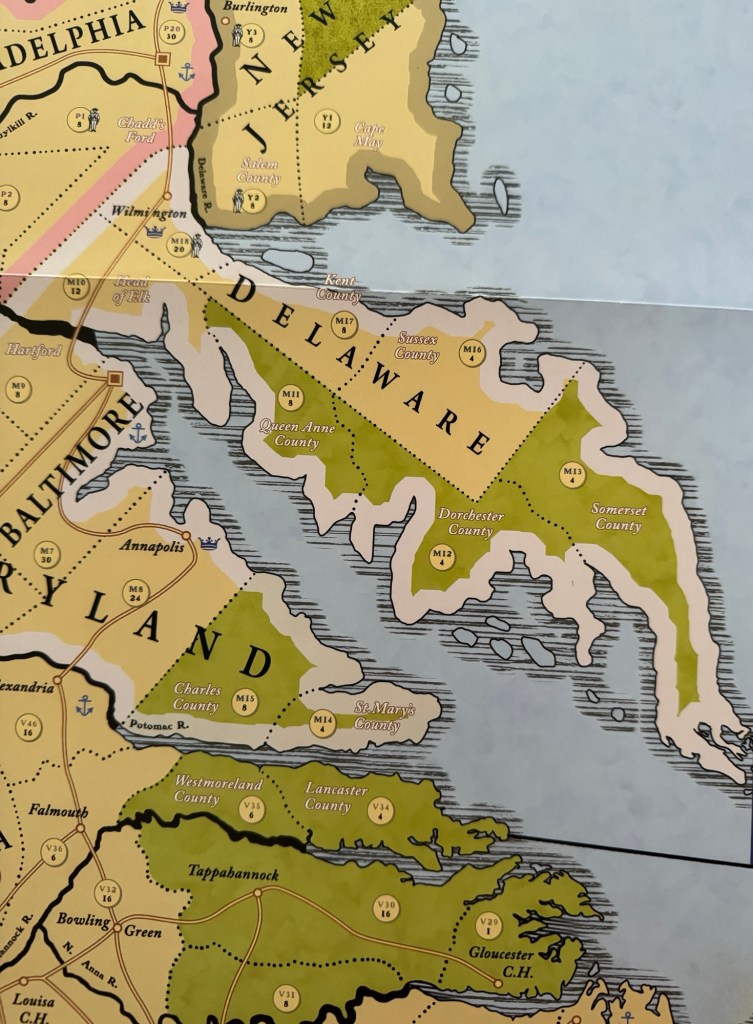
You may also notice the blue crown icons found on the board near major cities. In this picture you can see the blue crown icon at several places including: Wilmington in Delaware and Annapolis in Maryland. These blue crown icons denote the capitals of each of the colonies and some of the larger ones have multiple capitals. This has to do with victory at the end of the game for the British as if they control the colony capitals and there are no Colonial Regulars or Militia present in the colony they can then place the Colonial Governor and declare “the King’s Peace” in at least 2 colonies to end the campaign game.
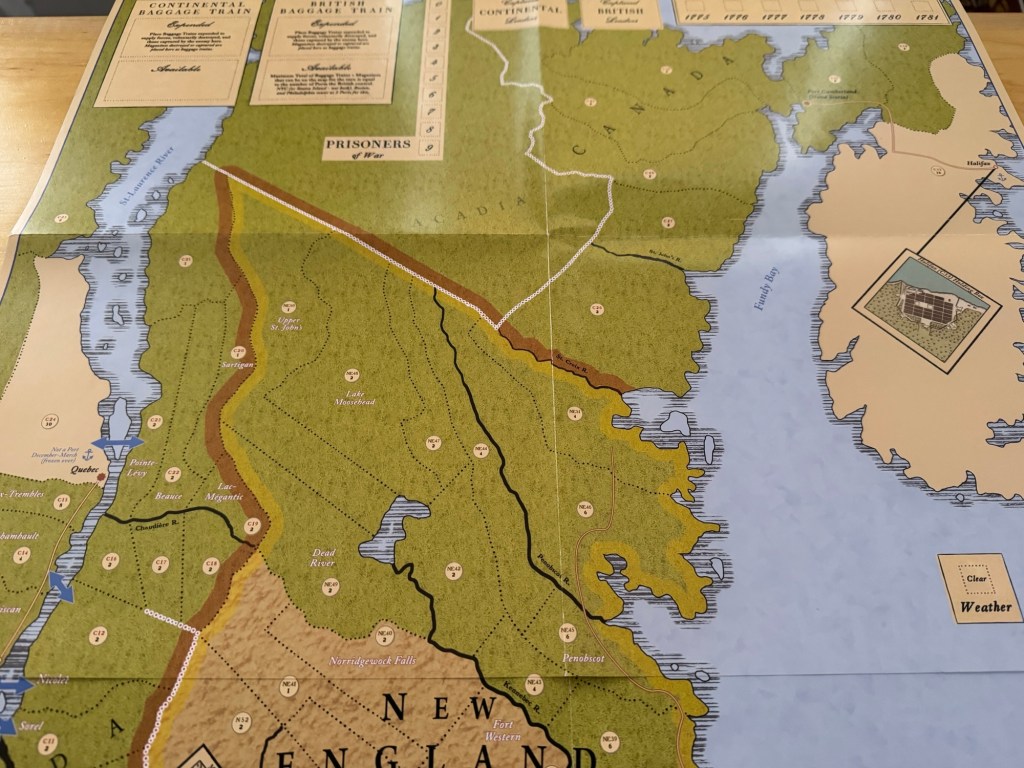
As we move to the north of the map, and enter the less populated and definitely more wild areas of the colonies, including northern Massachusetts and the wilderness of Canada, the board changes quite a lot as there are less roads, less markings and frankly more green on the board. It still looks really good and the use of lines for water features is continued particularly in several of the larger lakes in the area.
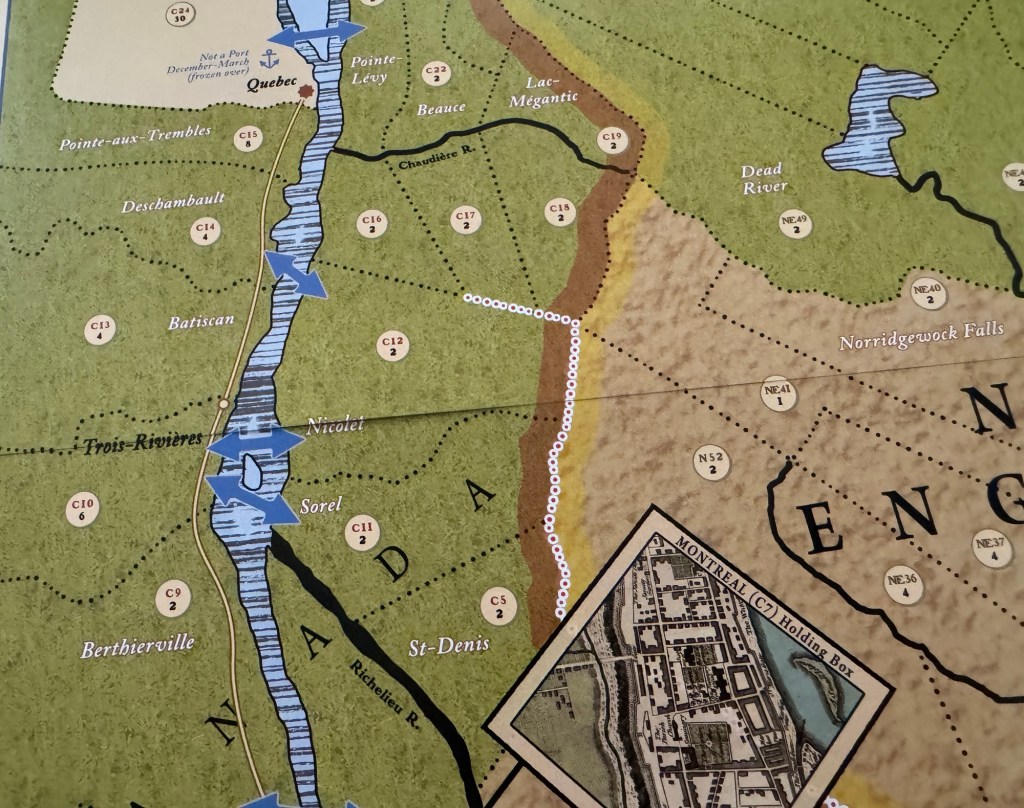
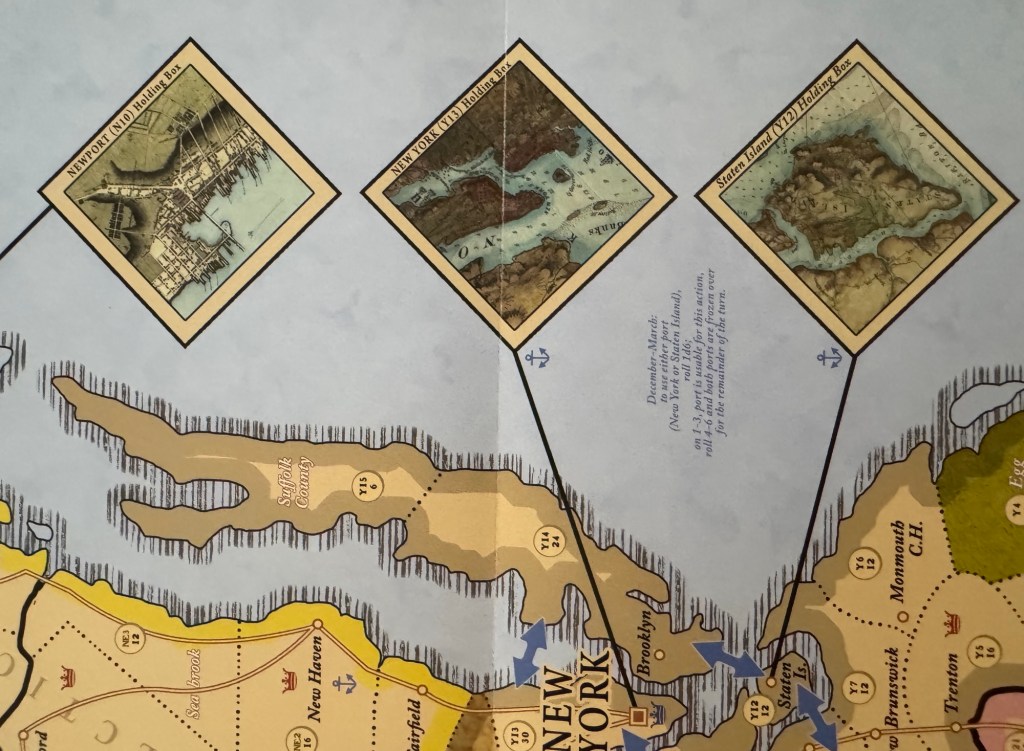
In the picture above, you can see a good example of the Holding Boxes for troops in the larger metropolitan areas. Here we get a look at the Montreal Holding Box and I very much like the way that they have drawn the outline of the city itself with some of the streets, buildings and homes. This is a very nice touch to the board itself and there are several of these Holding Boxes found on the board including those shown in the picture below such as the Newport Holding Box, New York Holding Box and Staten Island Holding Box. These are very nice additions to the board itself and they look really good and add a layer of depth as well as playability to the game.
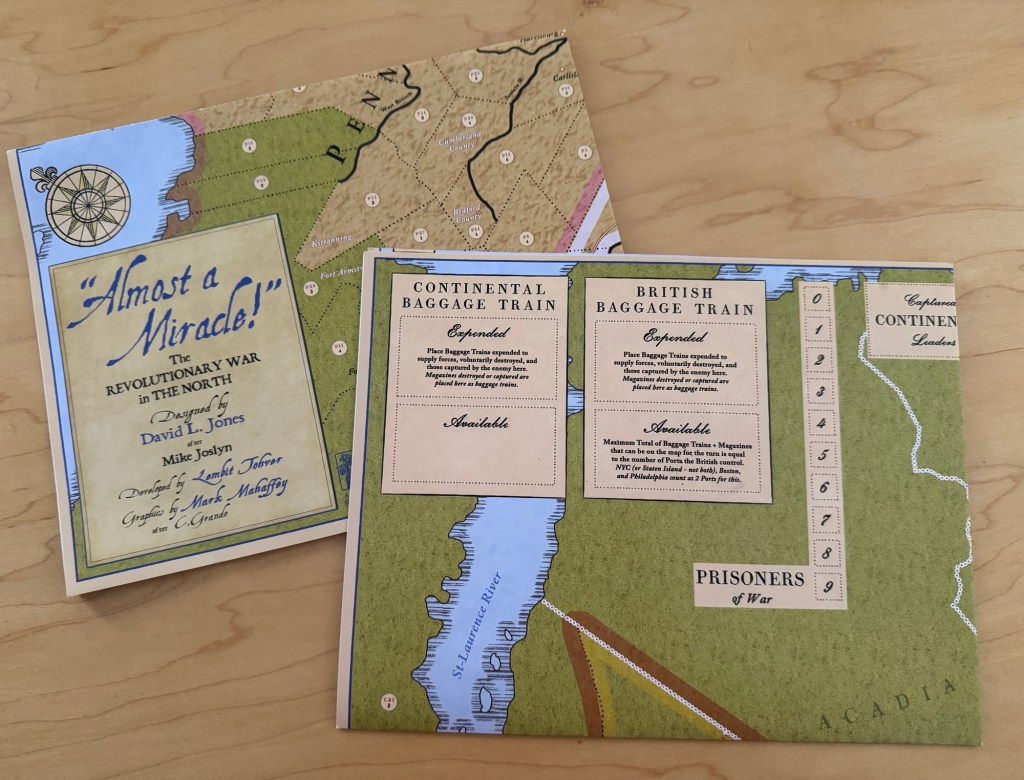
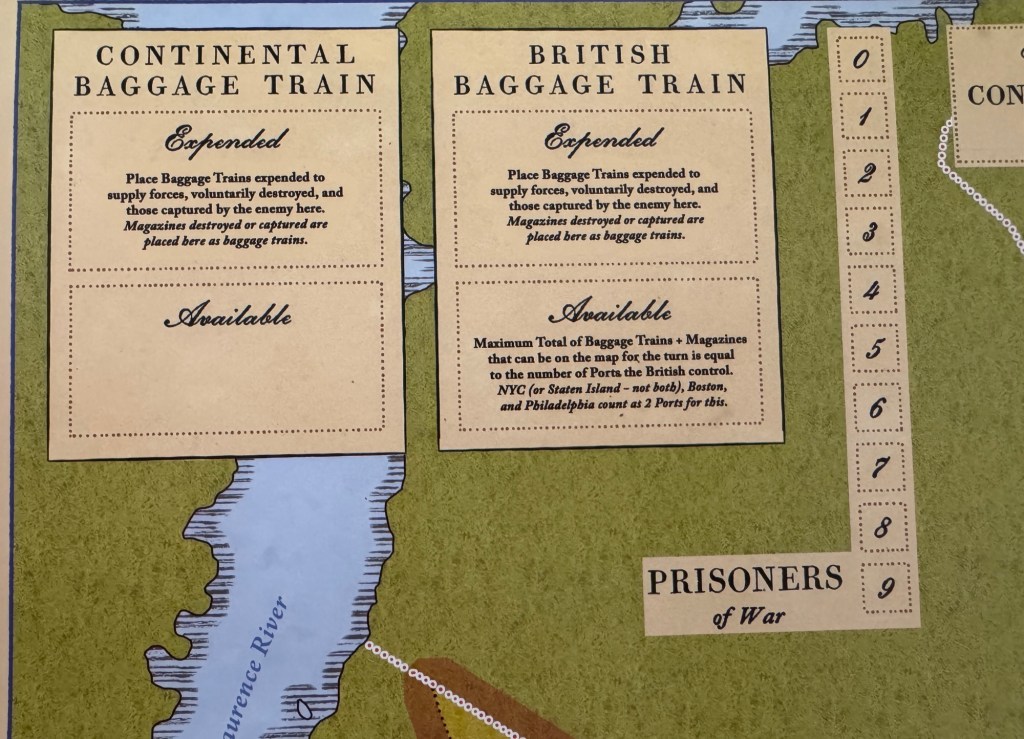
The game aids and tracks that are printed directly onto the board are very useful and well done. These use calligraphy like cursive writing that really feels period and adds to the thematic immersion of the player into the American Revolutionary War period. These boxes include the Continental Baggage Train Box and the British Baggage Train Box and shows the game’s focus on Supply. In these boxes, there is an available and an expended section that are used. There also is a Prisoners of War Track that is very period as well as these pitched battles were never fights to the death but represented the fighting style of the period which lead to many different forms of losses including deaths, injuries and prisoners taken.
Finally, there are Captured Boxes for Continental and British Leaders that aid the players in playing the game. These administrative aids are very well done from a graphics standpoint but I love that this game included them on the very large board as it eases play and cuts down on the need to continually refer back to the rules.
Almost a Miracle! was a game chosen for our Shelf of Shame Dust-Off Event in 2024 and we very much enjoyed the game and the history. The game is focused on the American Revolutionary War in the North and is named Almost a Miracle! because when asked about it years after the war ended, George Washington said that the American victory was “little short of a standing miracle.” Almost a Miracle! uses the Tarleton’s Quarter! System as a game engine starting point to bring the Northern “half” of the American Revolution into play.
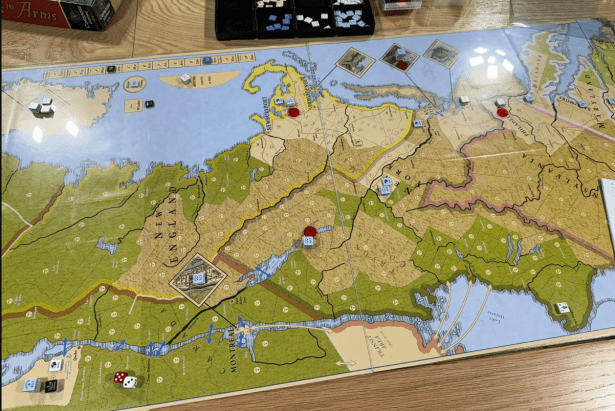
I think that the best part of this game though is the board. It is just gorgeous and is an odd shape to take into account the entire northern colonies. I think that one of the strengths of this game is that it truly shows the difficulty of maneuvering armies around the colonies and the terrain as well as having to search for forage to feed those armies.
If you are interested, here is a link to our video review:
The next board that we will take a look at in the series is Great Campaigns of the American Civil War: Thunder On the Mississippi: Grant’s Vicksburg Campaign, April-July, 1863 from Multi-Man Publishing.
Here are links to the previous entries in the series:
Kekionga!: A Dark and Bloody Battleground, 1790 from High Flying Dice Games
Campaigns of 1777 in Strategy & Tactics Magazine #316 from Decision Games
Battle Hymn Volume 1: Gettysburg and Pea Ridge from Compass Games
From Salerno to Rome: World War II – The Italian Campaign, 1943-1944 from Dissimula Edizioni
This War Without an Enemy: The English Civil War 1642-1646 from Nuts! Publishing
Holland ‘44: Operation Market-Garden, September 1944 from GMT Games
Maori Wars: The New Zealand Land Wars, 1845-1872 from Legion Wargames
Imperial Struggle: The Global Rivalry – Britain & France 1697-1789 from GMT Games
Stilicho: Last of the Romans from Hollandspiele
Nevsky: Teutons and Rus in Collision, 1240-1242 from GMT Games
A Most Fearful Sacrifice: The Three Days of Gettysburg from Flying Pig Games
Donnerschlag: Escape from Stalingrad from VUCA Simulations
Keep Up the Fire!: The Boxer Rebellion Deluxe Edition from Worthington Publishing
Liberty or Death: The American Insurrection from GMT Games
Lanzerath Ridge: Battle of the Bulge from Dan Verssen Games
Salerno ’43: The Allied Invasion of Italy, September 1943 from GMT Games
Bayonets & Tomahawks: The French and Indian War from GMT Games
Undaunted: Normandy from Osprey Games
Traces of War from VUCA Simulations
Standard Combat Series Ardennes II from Multi-Man Publishing
Almoravid: Reconquista and Riposte in Spain, 1085-1086 from GMT Games
Walking a Bloody Path: The Battle of Fallen Timbers, August 20, 1794 from High Flying Dice Games
All Bridges Burning: Red Revolt and White Guard in Finland, 1917-1918 from GMT Games
Storm Over Jerusalem: The Roman Siege from Multi-Man Publishing
Iron, Blood, Snow & Mud from PHALANX
North Africa ’41: The Western Desert, March to December, 1941 from GMT Games
Battles of the American Revolution Volume II: Brandywine from GMT Games
Ardennes ’44: The Battle of the Bulge from GMT Games
Gandhi: The Decolonization of British India, 1917-1947 from GMT Games
Battles of Napoleon: Volume I – Eylau 1807 from Sound of Drums
Tattered Flags No. 01 – Into the Whirlpool from Blue Panther
Alliance: Multiplayer Napoleonic Wargame from Columbia Games
-Grant


Mark did an amazing job with my game!
LikeLiked by 1 person
While I appreciate the kind words, I must say most of the credit for this one should go to Craig Grando, whose style I was emulating here to match his work for the earlier “Tarleton’s Quarter!” (on the southern half of the war).
LikeLiked by 1 person
Well you still did the work so you get credit. Nice job!
LikeLike