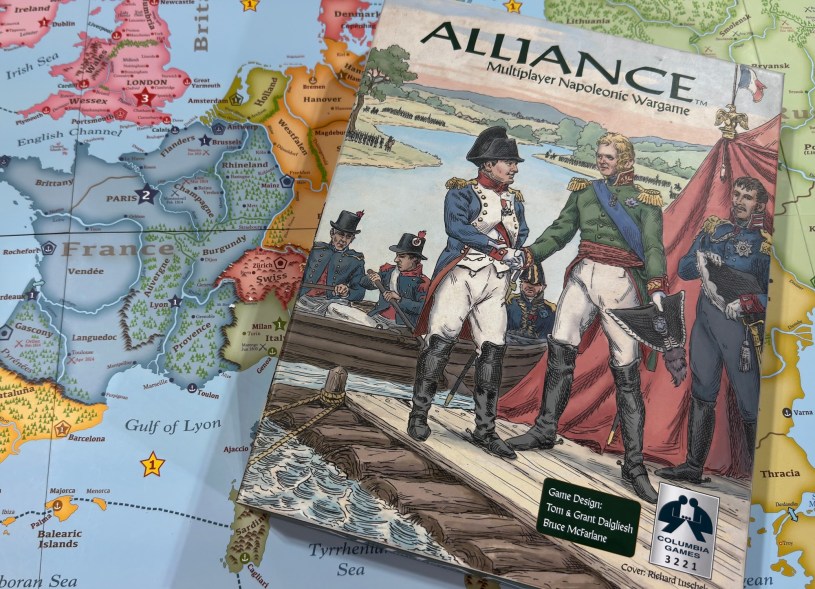
Continuing along in this series devoted to the best looking boards found in the wargaming world where I will highlight the art and layout of a different board in a wargame that we have played to show you the various talents of the artists and graphic designers involved. In my humble opinion, a well designed and attractive board can make all the difference in the world to me enjoying a wargame. Don’t get me wrong, the game has to be good, but if it’s also good looking it always is a better experience. A board can draw me in. Can make me feel that I’m there. Can set the stage for the thematic immersion that we all crave. And I have found many of these type of boards and I want to make sure that I share them with you.
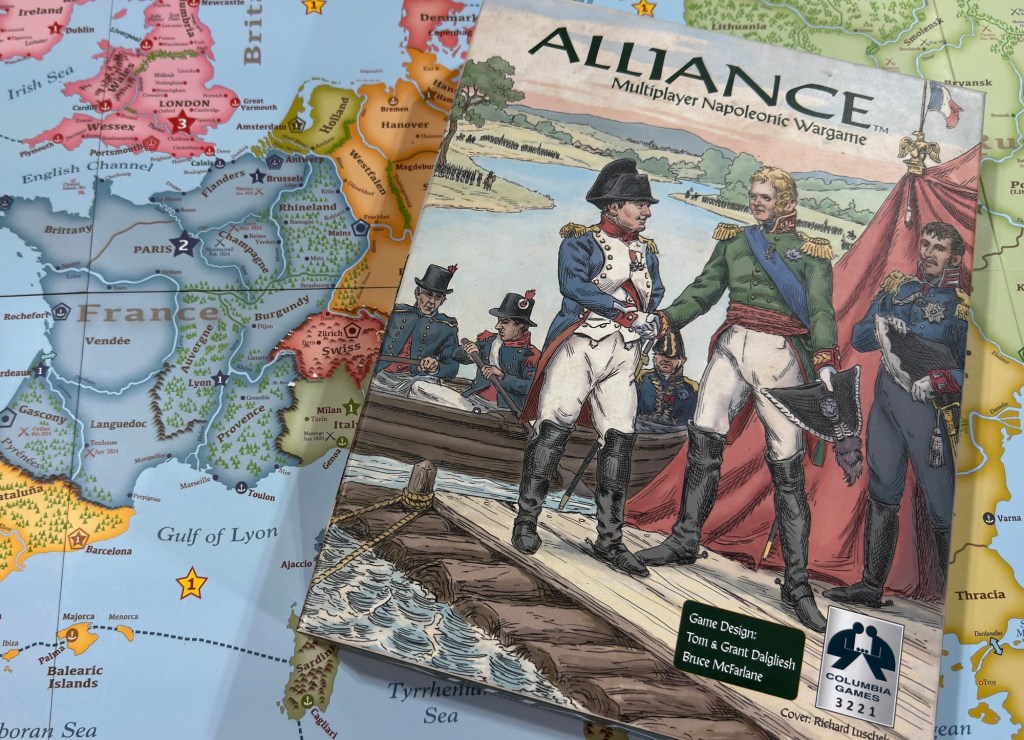
In this entry in the series, we will be taking a look at the fantastic looking board for Alliance: Multiplayer Napoleonic Wargame from Columbia Games. The artist for the game is none other than Tom Dalgliesh, the owner along with his son Grant, who kind of do it all, including game design and art for many of their fantastic block wargames. As I look at the board and the style of the art, I would classify it as very functional and clear but with a real eye toward the aesthetic as the color pallet chosen and the use of imagery for the various landscape and terrain features are really interesting and create a lot of visual appeal for the overall experience of the game. Alliance is billed as a 1-7 player strategic level game of diplomacy and warfare in the Napoleonic Era with a Columbia Block System twist. The game is huge and plays best with more players. The players take on the roles of different nations during the time and you can play as Austria, England, France, Prussia, Russia, Spain, or the Ottomans. While the game is not perfect, and there are some quirks that you must get past, the game is really pretty fun and interesting and could be one of those main staples at gaming conventions where you need a lot of players.
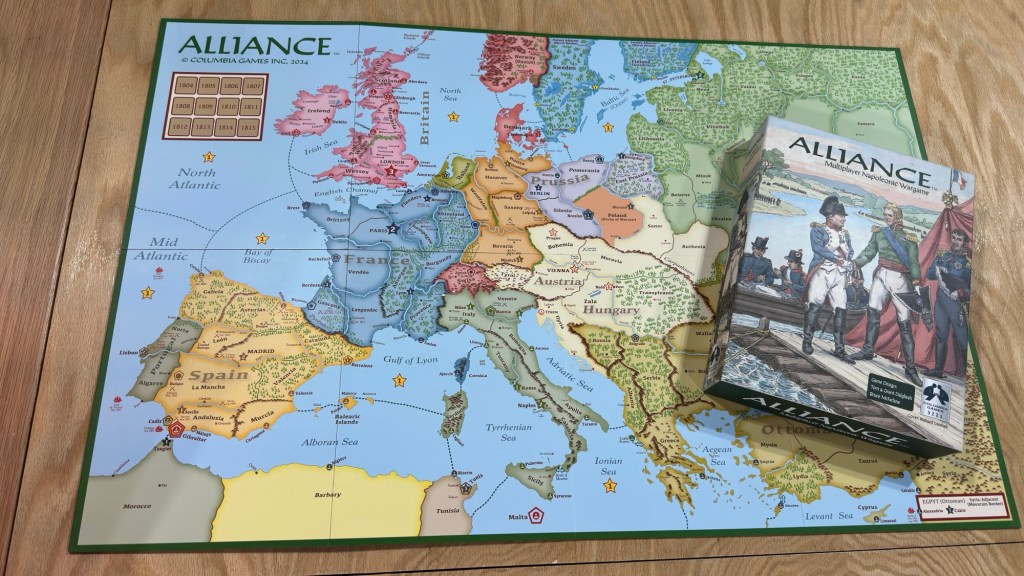
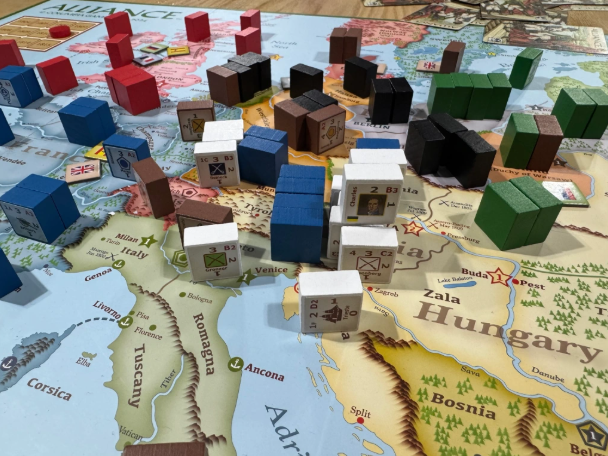
The game includes a 22 x 34″ board that depicts the European continent from Spain in the west, England and Norway/Sweden in the north, the vast steppes of Russia, the Black Sea and the Ottoman Empire in the east and the Balkans and Italy in the Mediterranean in the south. This board is vast in scope and frankly was a bit too small for the game. You see, the game includes blocks as units and those units are supposed to be kept secret from the other players but doing so on this small board is a real challenge. We had to go by the honor system and pledge not to look at nor study the opposing units that were in eye shot. There is good news on this front though as there is an extra option to purchase a huge 44 x 68″ neoprene mat that will replace the smallish sized board. I would recommend this as an option but keep in mind that it is pretty pricey at $149.00.
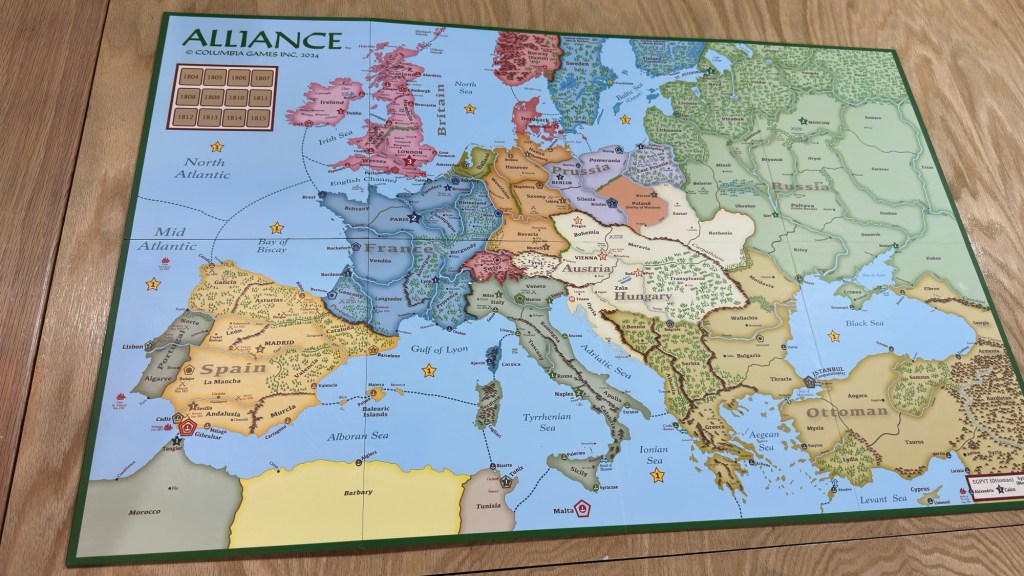
As was mentioned above, the first thing that struck me about the board was the color pallet. I very much love the muted most pastel colors chosen and also the fact that they colors typically represent the historical colors associated with the various nations involved. Green for Russia, Blue for France, Yellow for Spain, Red for England, White or Cream for Austria and Tan for the Ottoman Empire. I would have expected Gray or Black for the Prussians in the center of the board but they went with Purple and Orange. But, that aside, the colors really create a nice and inviting feeling to the game board and will be sure to catch the eye of any passerby or onlookers who are watching the game.
The light blue used for the oceans and seas was also a nice muted choice that fits in with the overall color scheme and I find that it actually accentuates and highlights the other colors bringing out their true look and creating a real depth of texture and permanence.
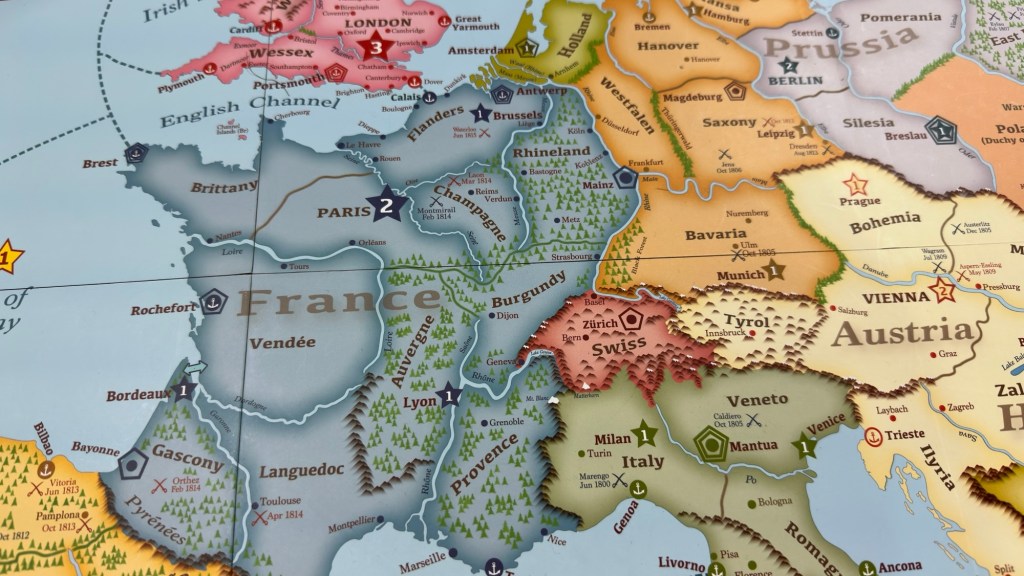
The next part of the graphic design that I wanted to focus on was the lines used to delineate the various areas and countries. As the board is very crowded with dozens of different areas presenting didn’t regions of the major powers, this was a very important part of the design as the game uses an area movement system. Typically, the borders between areas are identified with one of three things: a river, a mountain range or a simple thick grey or green colored line. As you look over the board, you can see all of these identifiers shown and I was initially concerned that this would cause confusion and misunderstanding about where areas were located and how they joined together for adjacency when moving and attacking. But, I think that using the major geographical features such as the mountain ranges and the rivers was a very wise and functional choice. In fact, this board was one of the more clear boards that I have ever played on and it truly aided in playing the game and not worrying about lines but keeping our heads and focus on the strategy.
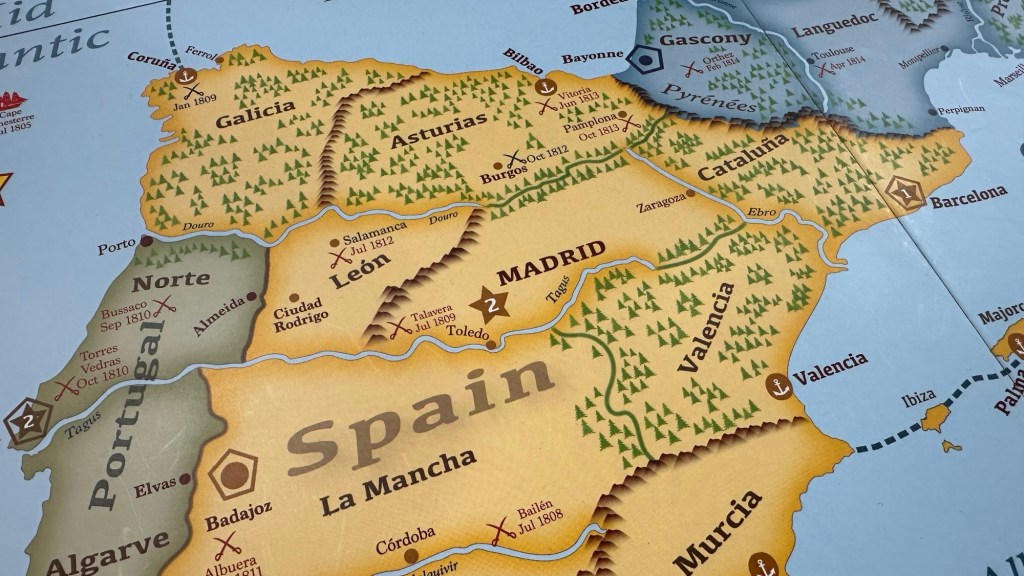
The other aspect of the terrain features that I felt were well done was a “Monet like effect” given to the trees and mountain peaks. If you zoom in and take a look at the individual trees drawn on the board to identify forest, you will frankly be unimpressed. The polygons used are your typical triangular or circular forms used for deciduous and evergreen trees. But, when you zoom out, and take a gander at the board from a 15,000 foot view, these individual shapes really blend in well together to create a feeling of dense trees stretching out over the landscape. Spacing somewhat disappears and you don’t see individual trees but you see groupings of trees that create a real sense of adjacency to form a very thick and dark woodland. I really was unimpressed by the trees upon my first glance but when viewed in this manner really got the sense of large and vast swaths of foliage. This is really well done and truly added some depth to the overall look and feel of the board.
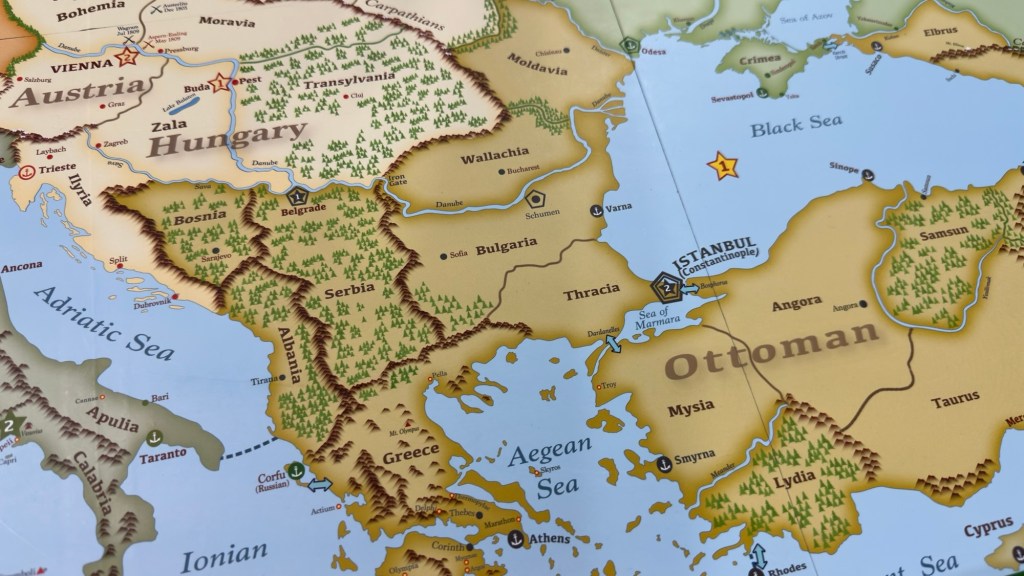
My favorite part of the landscape though is the dark brown mountain ranges that stretch out across the board. The way they are drawn on the board really creates a power struggle between the land and the players as these peaks cause issues with movement and you not only feel that but can see the reasoning behind it. As you look closer, you will see that there are also smaller foothills, such as those shown in the Ottoman Empire in modern day Turkey and southern Greece as well. These are truly different than the more formidable mountain ranges and I really like the contrasts here. The same color but different shape, color darkness and thickness to the shapes used.
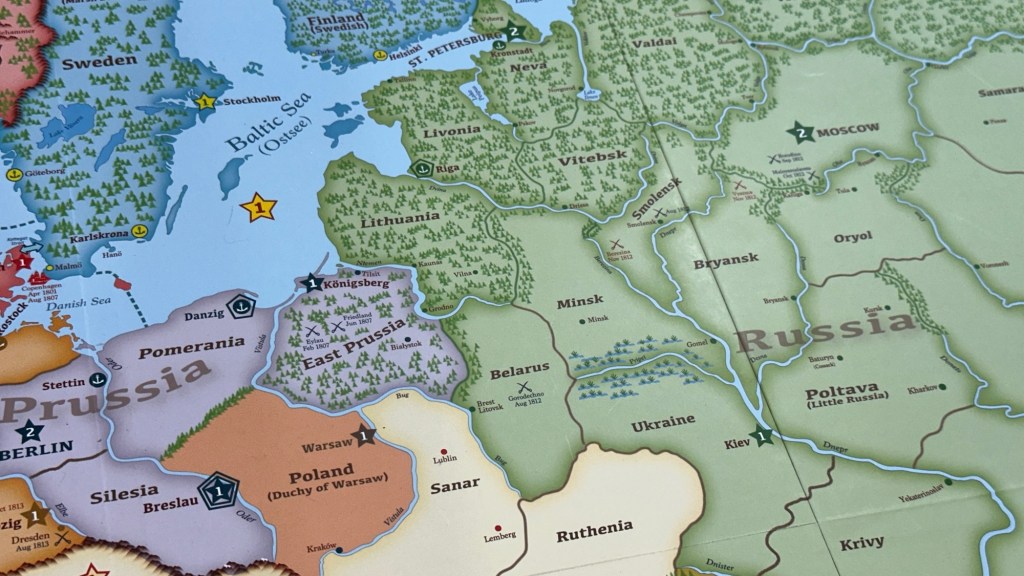
As I looked at the more northern portions of the board, focusing in on Sweden, Finland and Norway, I love the deep color used for their bodies of water. These lakes are cold water lakes formed by the advancing and retreating ice sheets in the north over the millennia and the darker shade of blue really gives off a frigid feeling. Almost as if I had fallen into one of the lakes and was soaked with near freezing temperature water! I love that the color choice and more importantly the shade of that color can create such as feeling by just looking at it. A very well done and easily overlooked aspect of the artistry used in the creation of the board.
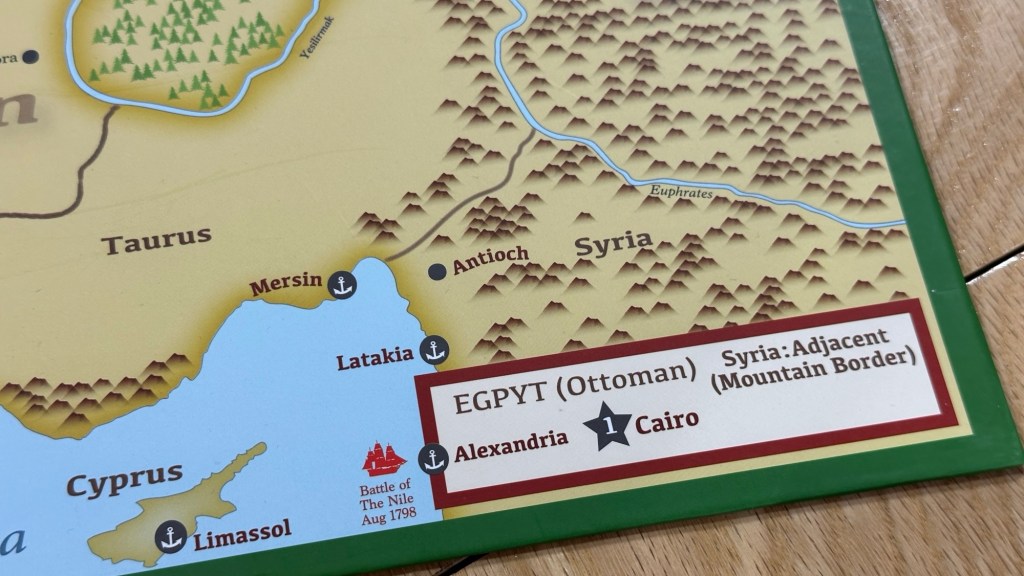
The final aspect we have to take a look at is the playability portions and administrative functions of the board. This typically includes the various tracks, boxes and player aids found incorporated into the playing surface. In this regard, the board isn’t necessarily a star example as there are really only 2 such items on the board including the Turn Track, found in the upper left hand corner of the board, and the Egypt Box in the bottom right hand corner that is a reminder of adjacency for 2 areas not necessarily directly included in the board. These aspects are functional but I was a bit disappointed that the game board didn’t include at least a Sequence of Play on it. Now keep in mind, the game is not an overly complex game, so this omission is not a grievous sin but it would have been nice to keep the game going.
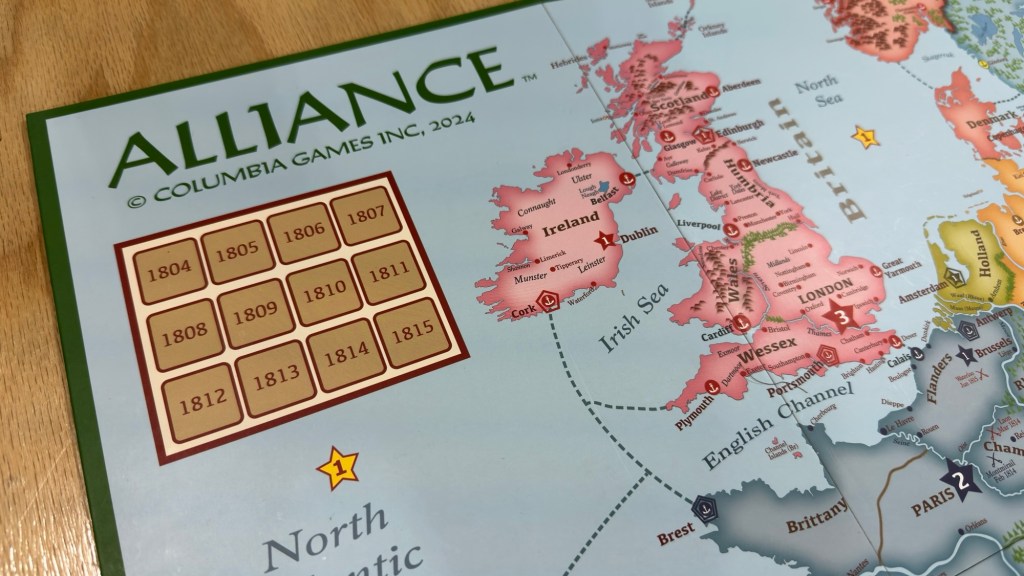
In my humble opinion, the board is absolutely gorgeous and really is a step up from some of Columbia Games other offerings! There is terrain clearly shown including mountains, rivers, hills and forests, the colors are fantastic and eye catching and it just really looks great. The area boundaries are clear and it all just works well together. It is funny, but when we played this earlier this year in January, I immediately that the board would make a welcome addition to the Beautiful Boards of Wargaming! Series….and here we are!
If you are interested, we posted an unboxing video on the You Tube channel:
We also shot a RAW video with the group right after our first play and you can watch that at the following link:
If you are interested in the game, you can order a copy for $99.98 from the Columbia Games website at the following link: https://columbiagames.com/columbiablocksystem/alliance/
The next board that we will take a look at in the series is Phantom Fury: Iraq, November 9, 2004 The Second Battle for Fallujah 2nd Edition from Nuts! Publishing.
Here are links to the previous entries in the series:
Kekionga!: A Dark and Bloody Battleground, 1790 from High Flying Dice Games
Campaigns of 1777 in Strategy & Tactics Magazine #316 from Decision Games
Battle Hymn Volume 1: Gettysburg and Pea Ridge from Compass Games
From Salerno to Rome: World War II – The Italian Campaign, 1943-1944 from Dissimula Edizioni
This War Without an Enemy: The English Civil War 1642-1646 from Nuts! Publishing
Holland ‘44: Operation Market-Garden, September 1944 from GMT Games
Maori Wars: The New Zealand Land Wars, 1845-1872 from Legion Wargames
Imperial Struggle: The Global Rivalry – Britain & France 1697-1789 from GMT Games
Stilicho: Last of the Romans from Hollandspiele
Nevsky: Teutons and Rus in Collision, 1240-1242 from GMT Games
A Most Fearful Sacrifice: The Three Days of Gettysburg from Flying Pig Games
Donnerschlag: Escape from Stalingrad from VUCA Simulations
Keep Up the Fire!: The Boxer Rebellion Deluxe Edition from Worthington Publishing
Liberty or Death: The American Insurrection from GMT Games
Lanzerath Ridge: Battle of the Bulge from Dan Verssen Games
Salerno ’43: The Allied Invasion of Italy, September 1943 from GMT Games
Bayonets & Tomahawks: The French and Indian War from GMT Games
Undaunted: Normandy from Osprey Games
Traces of War from VUCA Simulations
SCS Ardennes II from Multi-Man Publishing
Almoravid: Reconquista and Riposte in Spain, 1085-1086 from GMT Games
Walking a Bloody Path: The Battle of Fallen Timbers, August 20, 1794 from High Flying Dice Games
All Bridges Burning: Red Revolt and White Guard in Finland, 1917-1918 from GMT Games
Storm Over Jerusalem: The Roman Siege from Multi-Man Publishing
Iron, Blood, Snow & Mud from PHALANX
North Africa ’41: The Western Desert, March to December, 1941 from GMT Games
Battles of the American Revolution Volume II: Brandywine from GMT Games
Ardennes ’44: The Battle of the Bulge from GMT Games
Gandhi: The Decolonization of British India, 1917-1947 from GMT Games
Battles of Napoleon: Volume I – Eylau 1807 from Sound of Drums
Tattered Flags No. 01 – Into the Whirlpool from Blue Panther
-Grant
 The Players' Aid
Looks like a “beautiful board”. But, doesn’t sound like the game will work for my situation. And my Shelf of Shame is already full! Great write up!
LikeLiked by 1 person
No shame in that. Large multiplayer games are always hard to table and the main reason that we attend 3-4 conventions per year to get several of them played.
LikeLike