
This is my annual ode to the games of the American Revolution and I typically post this one on the 4th of July. I love this time of year and I love the history behind the holiday, even though most of the country I call home doesn’t really know anything about why we celebrate our independence. But, first off, I want to wish all of my American readers and followers a Happy Independence Day and to those who rooted for the Crown well you lost so Happy Traitor Day to you! As you may know, I really enjoy the history of the American Revolutionary War. I have read dozens of histories on the subject, with my favorite being Robert Leckie’s George Washington’s War: The Saga of the American Revolution, and it never ceases to amaze me how a group of ragtag rebels were able to best an entire global Empire in open rebellion. The reason for that was the patriots resolve and their ability to run away when outmatched to fight another day when they had a better advantage and not necessarily because they were better armed, or drilled or disciplined. I think that their desire to truly be free was the main difference but that is up for speculation.

Several years ago in 2019, we posted the inaugural look at the games we have played dealing with the American Revolution and then again in 2020. While skipping 2021 because we hadn’t really played anything new then came back to the topic in 2022 and in 2024. Since the last post last year, we have been able to play 3 new games to add into the list including Battles of the American Revolution Volume IV: Savanah from GMT Games, Almost a Miracle! The Revolutionary War in the North from Against the Odds Magazine and an unreleased prototype called Common Sense (initially named Absolved from All Allegiance) coming from GMT Games.
And in this post, I will share with you our gaming experience with these wargames focused on the American Revolutionary War. We haven’t played all of the games on the subject, not even close, but we have played enough that we have a good cross section of the different takes on the situation and types of games to give you some insight into what we liked and didn’t like so much. I will be honest, I tend to gravitate more toward the Operational or Strategic level of games on this subject as they tend to deal with more of the issues central to the conflict such as support for the rebellion, supply, sea travel, courting allies, traitorous cabals (looking at you Thomas Conway), and wintering armies.
*In this year’s edition, we will insert the new games we played into the list but mark their titles with RED ink to differentiate and then also state how many slots the other games moved up or moved back.
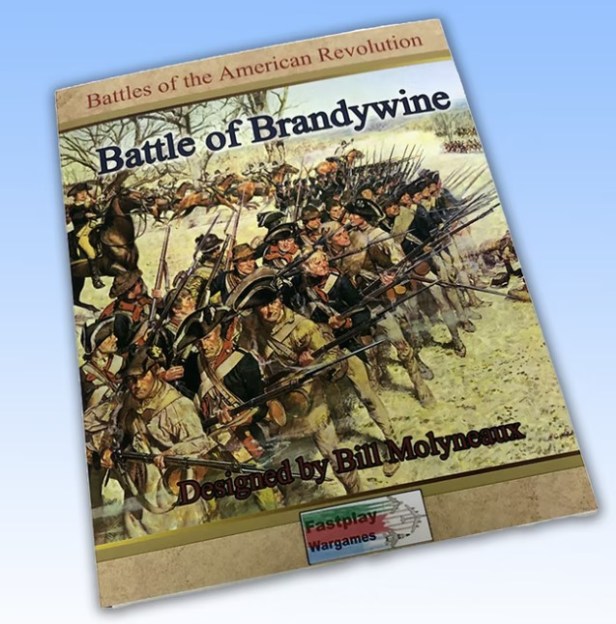
20. Battle of Brandywine from Fastplay Wargames (2022)
*Moved Down Three Spots from (#17 to #20)
The game that brings up the rear in this ranking of Revolutionary War games we have played doesn’t equate to the game not being interesting or a good representation of the American Revolutionary War period. The game deals well with the issues present during this era but is more of a tactical game than a game of the entire sweeping front of the struggle up and down the 13 Colonies.
The Battle of Brandywine is a 2-player tactical level wargame about the American Revolutionary War battle at Brandywine on September 11, 1777 and is specifically designed as a low complexity game but also offers enough optional rules to give the game more complexity for the more seasoned wargamer. The game sets up quickly with both sides commanding roughly 30 units each and several leaders per side and the game can be played in under 2 hours.
The unique aspect of the game is the turn sequence and the ability to resolve combat without a combat results chart. All combat is resolved by rolling a D6 per unit with a target to hit number. The game includes several scenarios and optional rules as well as advanced rules. I did enjoy the different terrain types and how they effected combat with the best element being woods would allow for units to retreat a hex rather than being reduced. Also using your leaders well is important as you want them to be in the mix of the fighting as they provide bonuses but don’t want them to be killed as you don’t really have enough. There is no ranged fire as all attacks are from adjacent hexes.

I played the game solitaire taking the role of the Patriots and really enjoyed my few plays. There is a good assortment of unit types, including Hessians, Highlanders, Artillery, Militia, Scouts and Cavalry and there are good opportunities for some maneuver to get in better position with your lines but also with your cavalry units to outflank the British. The counters are actually pretty well done graphically and are clear. I wish that the board was a bit better and easier to use.
In case you are interested, we also posted an interview with the designer Bill Molyneaux and you can read that at the following link: https://theplayersaid.com/2022/03/14/interview-with-bill-molyneaux-designer-of-battle-of-brandywine-from-fast-play-wargames-currently-on-kickstarter-2/
Here is a look at my solitaire review video:
The game has been picked up by Blue Panther and had a 2nd Edition copy released earlier this year that I have not acquired. If you are interested in Battle of Brandywine 2nd Edition, you can order a copy from the Blue Panther website at the following link: https://www.bluepantherllc.com/products/battle-of-brandywine

19. Saratoga 1777 AD from Turning Point Simulations (2013)
*Moved Down Three Spots (#16 to #19)
Saratoga 1777 AD is a medium weight wargame that is designed to play fairly quickly and provide some very interesting tactical choices. There were two parts of the game that I particularly liked, that felt really appropriate for a game covering the Revolutionary War revolving around Command and Control and Unit Morale.
First off, was the Command-Control aspect of the units. The first thing each player does at the beginning of their Command Phase is to check whether their Formation Commanders are in Command Span of their units. Most commanders have a Command Span of 2, which means that they can control units up to 2 hexes away from their location, not counting their own hex. This element is thematically spot on as communication was limited. If units are caught Out-of-Command, they will have an Out-of-Command marker placed on them and will be unable to activate that turn. Due to problems with terrain, the noise and fury of battle and lack of any formal communications system such as radios, Command Radius is an aspect that must be represented in any pre-modern wargame and Saratoga does a bang up job of accomplishing this thematic element.
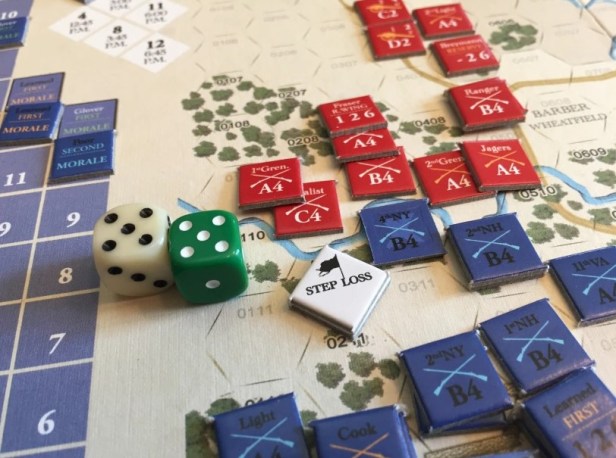
The Commander in Charge units also have an Activation Rating that shows the number of Formation Commanders that the C in C can activate. As an example, the main leader for the British General Burgoyne has a 3, which simply means he can activate 3 different Formation Commanders, who in turn have their own Command Span and can activate units that comprise their formation. This is a great part of the game as the C in C has to be positioned so as to maximize the number of units they can activate and move each round. This is very problematic for the attacking British as they only have 1 C in C unit who has to move from side to side of the board during combat in order to activate units so that they can move into position to attack the Patriots. This slow and plodding movement felt very appropriate, albeit frustrating, especially taking into consideration such aspects as terrain, small one lane country dirt roads, narrow bridges and dense and thick forests.
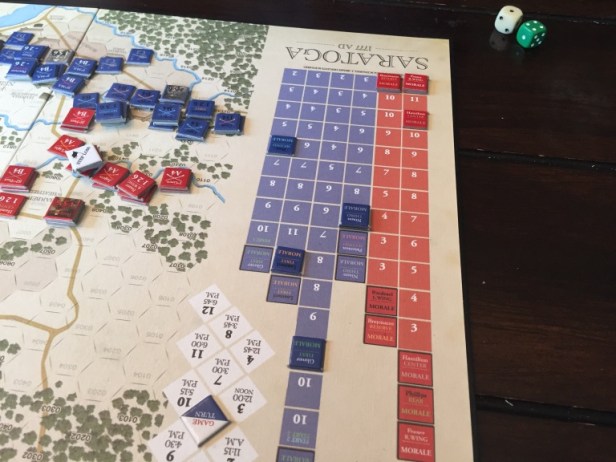
The 2nd element that I thought was very well done was the Morale Table. Anytime a unit is flipped or destroyed (due to the accumulation of 2 Step Loss markers), they must make a morale check by rolling 2d6 and then checking against their current morale on the Morale Table pictured above. If they roll over the current morale, they fail and become a Broken formation and must immediately Retreat one space away from the enemy. This then provides the attacker a free attack on the retreating units with adjacent phasing units, which is devastating.
I really enjoyed the makeup of the Morale Table as it takes into account the quality of the troops making the check. For example, if you look at the above picture, you will notice the British side starts higher and reduces a little more slowly than the Patriot side. This is reflective of the fact that the British troops were seasoned, battle hardened veterans who were professional soldiers as opposed to the relatively poorly trained raw Patriot forces.
Overall, this one is a good tactical entry into your experience with the American Revolutionary War. The game is fairly inexpensive, looks great on the table and plays fairly quickly. The game includes two scenarios; Freeman’s Farm (September 19, 1777) and the Battle of Bemis Heights (October 7, 1777) so you will get two different setups with two very different challenges for both sides.
We wrote a full and in depth review of this game as well as a few Action Points to describe the action (Action Point 1 & Action Point 2). Finally, we also scored an interview with the designer Robert Markham that gave some good insight into the game.
If you are interested in Saratoga 1777 AD, you can order a copy from the Turning Point Simulations website at the following link: https://www.turningpointsimulations.com/Details.cfm?ProdID=13&category=1

18. 1775: Rebellion from Academy Games (2013)
*Moved Down Three Spots (#15 to #18)
I have played all three of the Birth of America Series Games from Academy Games including 1754: Conquest – The French and Indian War, 1812: The Invasion of Canada and 1775: Rebellion and all use a similar system of card play to activate units and perform actions. The game is a “dudes on a map” deal where players are trying to control key areas and cities. I really like this series as you can play it perfectly well with 2 players but it also allows for up to 4 players which involves some table talk and strategizing, which I really enjoy. 1775 is an introductory wargame designed so that families can play together, to learn about the history of the American Revolution, and that Grognards can also enjoy as a light war game.

Each of the factions has their own specific color coded dice and cards that have done a good job of representing their strengths and weakness (those Patriot Militia flee often but come right back during the reinforcement phase). I enjoy these asymmetrical player powers. Their abilities create great decision making opportunities during all rounds of play. Players will have to make decisions on the fly as they decide how best to play their cards, what units to use in combats and where to assign hits. The combat system is simple but really well done to show the historic aspects of the opposing sides and give each side their own flavor.
The card play is also very well done and requires some planning. You wont be able to move all of the troops that you want to or might need in a certain battle so you have to be aware of what is in your hand prior to your turn. The really cool element to the management of your cards is that you will have the one Truce card for each of your factions, which must be used wisely, as it can lead to the end of the game when you don’t necessarily want it to end. You see, once an alliance has played all of their factions’ Truce cards, the game will end at the end of that turn. Remember, you may have to play a Truce card from your hand if it is the only Movement card that you drew so you must be careful.
Overall I have really enjoyed 1775: Rebellion as I have all of the Birth of America Series games, the game play is quick and fun, the components are beautiful and add color to the conflict to bring the game to life, and the game length is just right. The downsides are that there is a certain amount of luck as the dice can be fickle and bad card draws may keep the more strategy minded heavy wargamers away but even they can enjoy the gaming experience.
If you are interested in 1775: Rebellion, you can order a copy from the Academy Games website at the following link: https://www.academygames.com/pages/1775

17. Fort Jefferson Attack from The Historical Game Company (2022)
*Moved Down Three Spots (#14 to #17)
In 2022, I was contacted directly by Blue Panther, which does a lot of print on demand games for wargaming companies such as Hollandspiele, White Dog Games, Paul Koenig Games, Schutze Games, Catastrophe Games and The Historical Game Company. They informed me that they had a total of 10 new games available from The Historical Game Company and I looked into them and several of them were focused on smaller battles of the American Revolution. I was able to get copies of a few of the games including Attack on Cahokia, Battle of Saratoga and this one Fort Jefferson Attack. I was only able to play Fort Jefferson Attack which deals with the Chickasaw Indian attack on Fort Jefferson located in Kentucky in 1780 during the American Revolutionary War.
The game is a low complexity tactical game that has four pages of rules and each side has about 20 counters on the board at any given time. There is nothing really complex or difficult about the rules and the game takes about 90 minutes to play. One player commands the Americans and their allies, and the other player commands the Chickasaws backed by the British. The game is a look at a single small battle that occurred on the banks of the Ohio River in a fort built by George Rogers Clark after his conquest of the Illinois Country.

The game uses cards that are drawn and these cards provide three pieces of key information for that player’s turn; how many units they can activate to move, how many units they can activate to attack and then a special event that might help or hinder those actions. Sometimes the player can move 6-10 units and you feel like you have total control over the battle but with other card draws you may only be able to move 1 or 2 units or even none and this can be very difficult as you are trying to fall back to the fort to use its walls to your advantage. The Special portion of the cards is very interesting and was an attempt to interject portions of the history into the game play and is also very well done. Sometimes you gain a +1 DRM to attacks with units near identified leaders, or sometimes you gain a larger +2 DRM against key targets to help in overcoming their defense values. This card mechanic felt very thematic as there would have been poor communication between the troops of both sides on the battlefield and there would also have been confusion as the Chickasaws move on the block houses and destroyed and burned farm houses and fields as they approached.
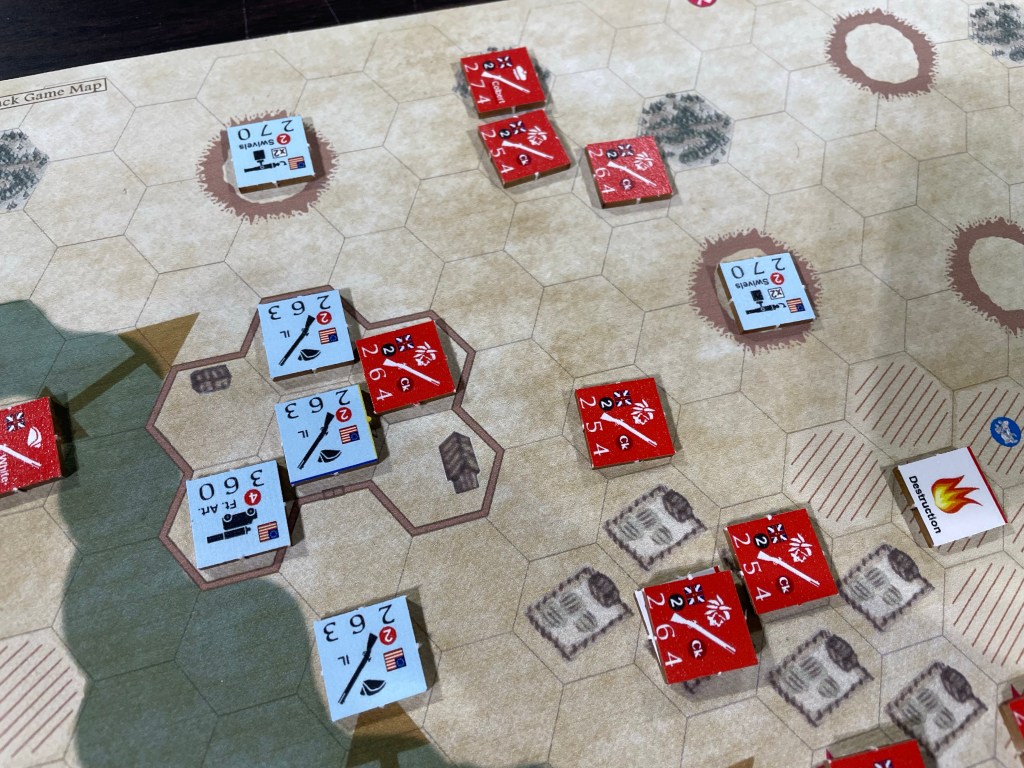
One of the really interesting parts of the design were the fleeing civilian counters that the American player must protect but is also tempted to use in battle as they have a low combat factor that could help in a pinch. These fleeing units if killed are worth VP to the Chickasaw player so there is a real risk in using them. There are 4 of these counters on the board and they are placed in very precarious starting positions and if the Chickasaw gain the advantage and win initiative they can potentially move on them in force and win those VP’s before the American can react to move them to safety.
All in all this was an interesting tactical game on a never before gamed subject (that I am aware of) in the frontier war of the American Revolution. We had a good time with this one but it is a very simple game and may not be interesting enough for more veteran wargames. I would classify this as a game that you would bring out at Thanksgiving to play with your dad. I am interested in the other games in this series and will continue playing them.
Here is a look at our video review of the game:
If you are interested in Fort Jefferson Attack, you can order a copy from the Blue Panther website at the following link: https://www.bluepantherllc.com/products/fort-jefferson-attack?variant=42916402856106
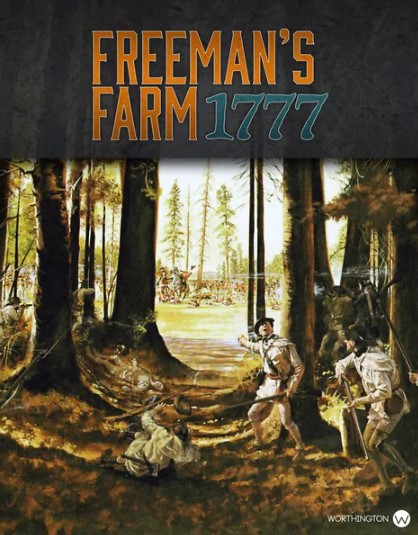
16. Freeman’s Farm 1777 from Worthington Publishing (2019)
*Moved Down Three Spots (#13 to #16)
Freeman’s Farm 1777 is the first in a new Battle Formations Series from Worthington Publishing that are designed for both solitaire and two players.
The focus of this new system is on the individual formations that appeared on the battlefield and places the players in the role of commander to make decisions about which formations to activate and how to use those formations to position themselves to attack the enemy. The key to these decisions is the morale of those formations as each command utilizes one of their levels of morale and if pushed too far, through attacking or being attacked, the formation will be forced to take a morale test to see if it will break.
There are a couple of things that I really liked about this one as I felt it told the story of the style of fighting of the time and incorporated some elements that were very important. This series has centered the focus on formations and how they can interact with each other on the battlefield. It simply looks at how the relative positioning of the formations opens up opportunities for attack or provides advantages or disadvantages to one side or the other. If you are above an enemy formation on high ground or have a superior firing angle on a formation in battle, shouldn’t you gain an advantage? And furthermore, if you are relatively inexperienced green forces and are facing the smoking gun barrels of your enemy’s cannons, don’t you think that your attempts to return fire will be less effective than if firing with hardened troops from cover? This spatial element is a major inclusion in the design and really feels right and makes your choices as commander that much more difficult as you decide how to activate your troops to take advantage of the situation. I really have enjoyed this spatial relationship during my plays of the game and think that the approach is very novel.
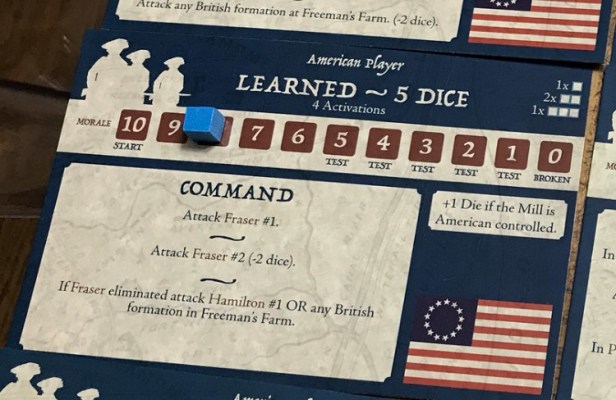
The other element that I really enjoyed was the concept of morale. The design has the player controlling several different Formation Cards that represent their troops on the battlefield and each has their own set of actions they are able to take. The key for these Formation Cards is that each time they are activated through the play of the corresponding Activation Card they have to pay for this activation. The payment comes in the form of paying 1 point of Morale from the Morale Track by moving the cube marker down one space. The formation may also lose Morale as they attack and are attacked throughout the game. The moment that a formation’s morale reaches 5 on the Morale Track they have to conduct a Morale Test to see if they will break and leave the field. This Morale Test is conducted by rolling a single d6 with any modifiers from Tactics Cards that the player controls and then comparing that result to the current Morale of the formation (i.e. where the Morale marker is currently on the Morale Track). If the die roll is higher than the marker location, the formation has failed the test and becomes broken. If the roll is equal to or less than the marker location, the formation passes the test and remains on the battlefield. Each successive reduction in the Morale of that formation will trigger another test which will be harder and harder to pass as the number decreases. Soldiers spend their strength and will to fight in each skirmish and as they are pushed more and more, and in the face of losses and exhaustion, reach a point where their will to fight is gone and they break. I like how the design dealt with this issue and it feels right.
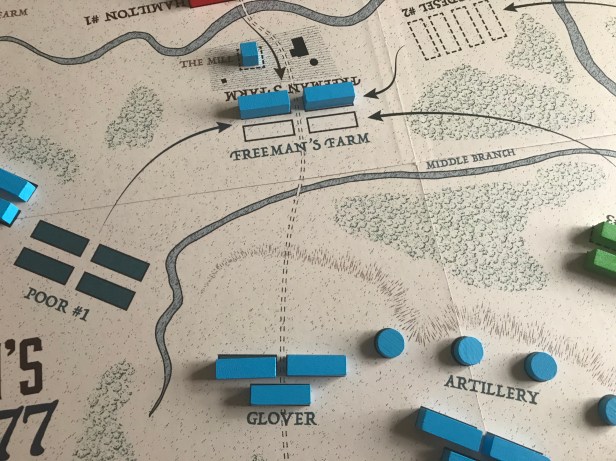
The game uses wooden cubes, disks and sticks to mark formations on the board and it looks like those pictures in text books showing the location of troops during these historical battles. This was a nice thematic touch for me and helped me to get into the mind set of a Revolutionary War battle.
I wrote a series of Action Point posts covering the various aspects of the game. In Action Point 1, we looked at the very interesting board that represents the locations and roles of both sides’ formations as well as their relative positions on the battlefield. In Action Point 2, we examined the Formation Cards and how the Activation Cards are used to command each as well as how Morale Tests work and effect the game. In Action Point 3, we looked at the economy of the Momentum Cubes and how they are used to purchase the all important Tactics Cards. In Action Point 4, which was the final entry in the series, we covered several examples of combat and discussed the way the dice are used.
Here is a look at our video review of the game:
If you are interested in Freeman’s Farm 1777, you can order a copy from the Worthington Publishing website at the following link: https://www.worthingtonpublishing.com/collection/freemans-farm-1777
15. Common Sense (initially named Absolved from All Allegiance) from GMT Games
Last fall, while attending the SDHistCon, we sat down with Sam London to play his upcoming game called Common Sense (it was originally called Absolved from All Allegiance), which will be announced on GMT Games P500 soonish. The game is an American Revolutionary War Strategic Level game that uses trick taking and is a struggle over the Will to Fight Track that measures the level of commitment by both sides to the fight. Keep in mind that the pictures shown here are simply for playtest purposes and are not final components. My guess is that this one would receive the same GMT treatment with beautiful graphics, components and cards. The game uses the Will to Fight System that will see these type of conflicts fought and how the will to continue fighting is a key to the game.
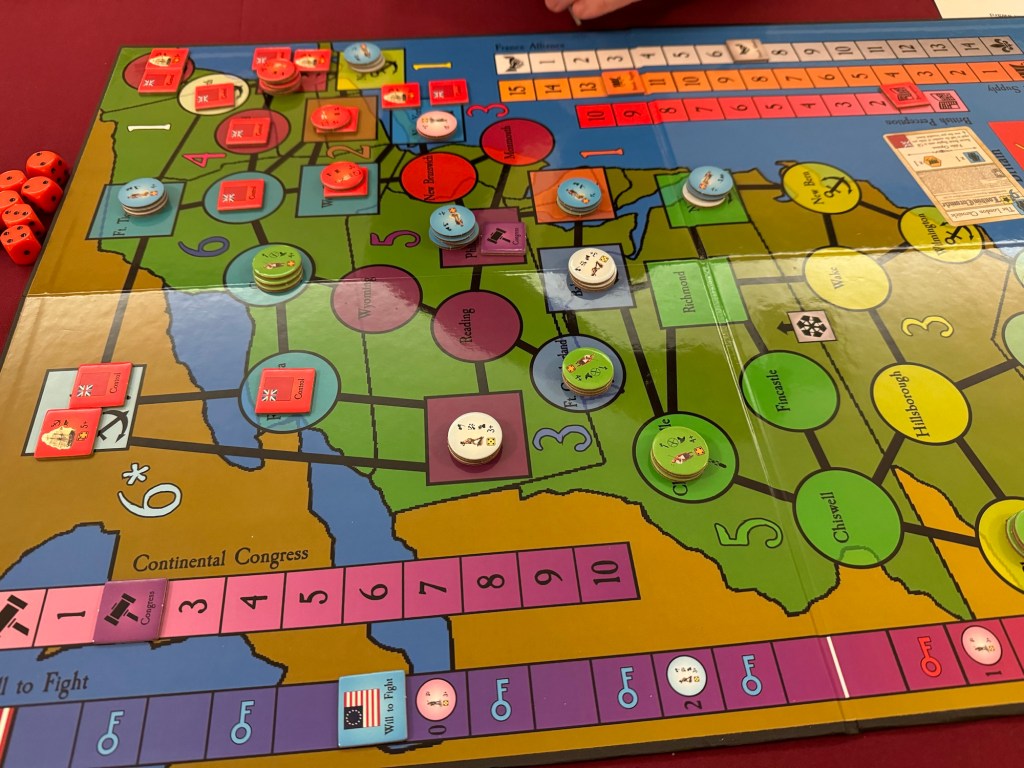
The game sees the players using their cards to take various actions in the game including things like moving troops, mustering new units, battling, making alliances and construction or repair of fortifications. The main focus is that of trick taking where players will play a suited card and the one who plays the higher value will win the initiative and get to go first and take their actions while the loser will have to wait their turn to win a trick. The cards feature several different types of icons that determine how they can be used and when a trick is won, the player can take the actions associated with that suit and also gain a special benefit if they match up properly. Really a very interesting exercise in managing your hand, especially as the Patriots, to win tricks but to win the correct tricks to take the actions you want to take.
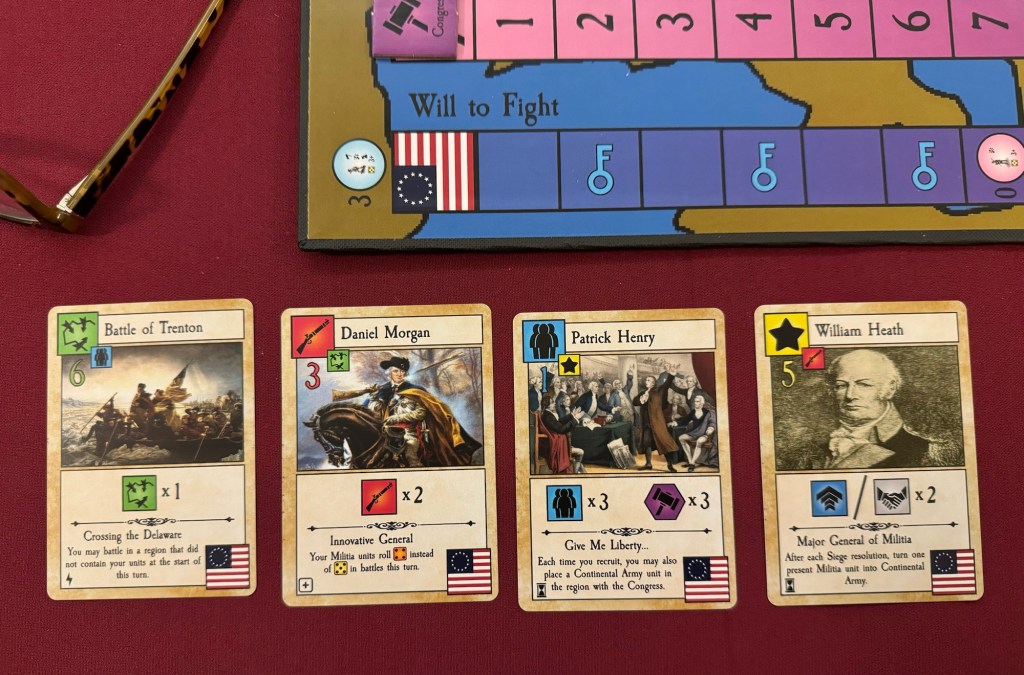
I also very much liked the focus on the various aspects of AmRev war including supply, laborious movement, winter attrition and desertions. Very challenging game that saw me eeking out a win with the Patriots by holding a majority of the major cities while pushing Britain’s will down by winning a few key battles, destroying British Regulars and getting the French to join the rebellion.
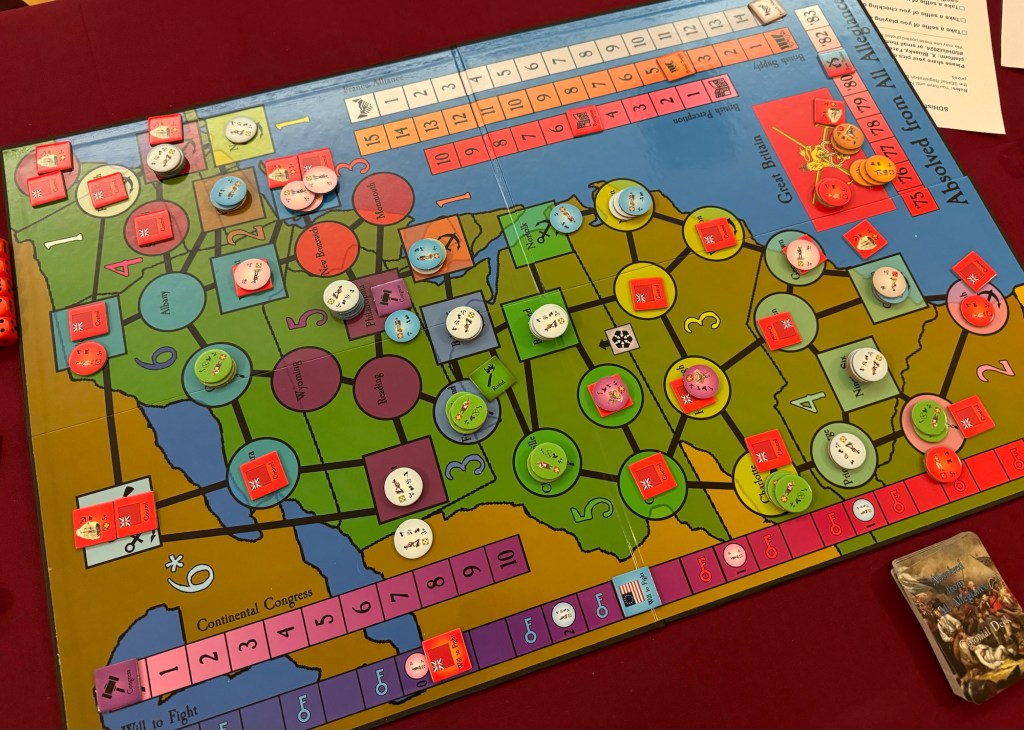
This was a very interesting game and I am very glad we got to try it out and also shoot a 30-minute video with Sam. I look forward to playing this one in its final form in the near future.
Here is a link to our video interview with Sam London after playing the game:
14. Revolution Road from Compass Games (2017)
*Moved Down Two Spots (#12 to #14)
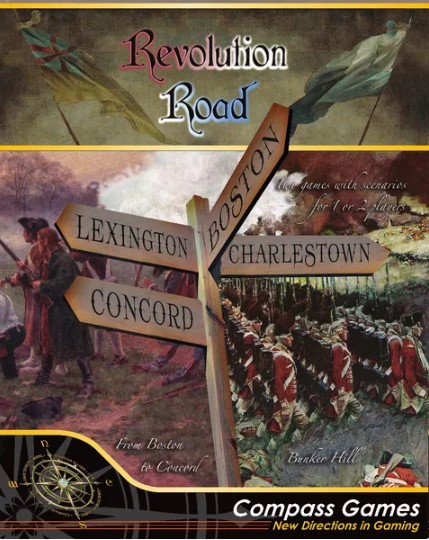
Remember I said that I liked games on the subject that delve into all of the aspects of the campaign…well, this one doesn’t cover all of them but it definitely takes a look at some of the major issues. Revolution Road is actually two games in one including From Boston to Concord and Bunker Hill. I have not had a chance to play Bunker Hill yet but really enjoyed From Boston to Concord.
From Boston to Concord from Compass Games allows players to simulate the events of April 19, 1775 and the events leading up to the famous “shot heard round the world!”. The British player commanding the forces of Lt. Col. Smith are tasked with reaching Concord and finding illegal arms cache spread throughout the countryside while also seeking to capture the prominent rebel leaders Samuel Adams and John Hancock.
The Patriot player must simply hinder the British from reaching Concord and harass them along their trip by using ambush and sniping to take out their forces. The Patriots will also send out Nightriders to raise the alarm ahead of the advancing British calling to arms area minutemen and militia to form and impede the British in their goal.
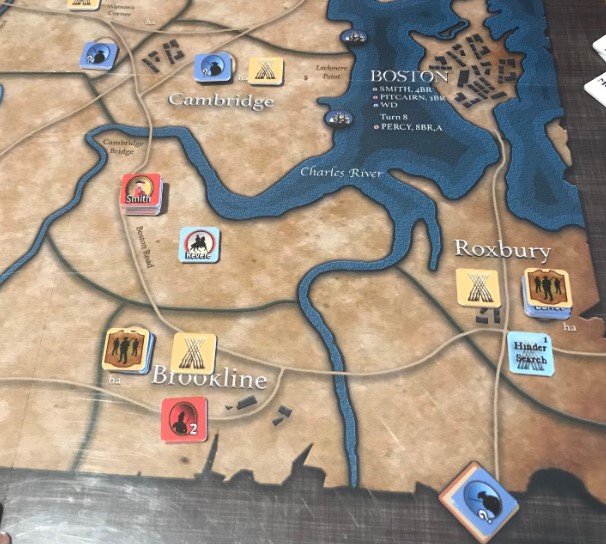
The game is card assisted and is played as players draw one card to determine their number of activation points for each round and then go about spending those points to take various actions designed to help each side meet their victory conditions.
Revolution Road: From Boston to Concord is such a fascinating game and really depicts the two sides very well in this literal David versus Goliath clash. I love how each side is asymmetric and can win in very different ways. I also really like how it focuses on various issues outside of combat such as recruiting, capture of key rebellion leaders, and the differences in both sides’ combat style.

I wrote a series of Action Points covering the various actions that each side can take to accomplish their goals. Action Point 1 takes a look at how the Rebels raise units and escape capture, Action Point 2 looks at the British actions Search and Hinder, Action Point 3 delves into the bushwhacking tactics of the Patriots in Ambush and Snipe and in Action Point 4 we looked at the mechanics of combat, including the Attack, Assault and the very powerful Charge action for the British.
We still haven’t played the Bunker Hill game but it is on our list as it simply looks fantastic.
If you are interested, we posted an interview with the designers John Poniske and Bill Morgal and you can read that at the following link: https://theplayersaid.com/2017/05/15/interview-with-john-poniske-bill-morgal-co-designers-of-revolution-road-from-compass-games/
Here is a look at our video review of the game:
If you are interested in Revolution Road: From Boston to Concord, you can order a copy from the Compass Games website at the following link: https://www.compassgames.com/product/revolution-road/?sfw=pass1719424950
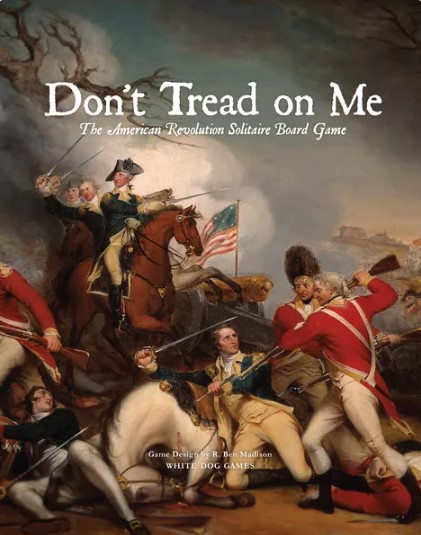
13. Don’t Tread on Me: The American Revolution Solitaire Board Game from White Dog Games (2014)
*Moved Down Two Spots (#11 to #13)
I bought this game a few years ago before the pandemic hit and have had the opportunity to play it twice, once just kind of pushing the counters around to learn, and the second time to a disastrous outcome.
Don’t Tread On Me is a very interesting strategic-level solitaire simulation of the American Revolution from White Dog Games designed by one of my favorite solo game designers R. Ben Madison. You wouldn’t think that this game would have made this list as you as the player are controlling the British side along with American Loyalist forces against the A.I. forces of George Washington and the Continental Congress. But, the game is just that good and encompasses lots of the aspects of the war including smugglers, desertions, special events, etc.
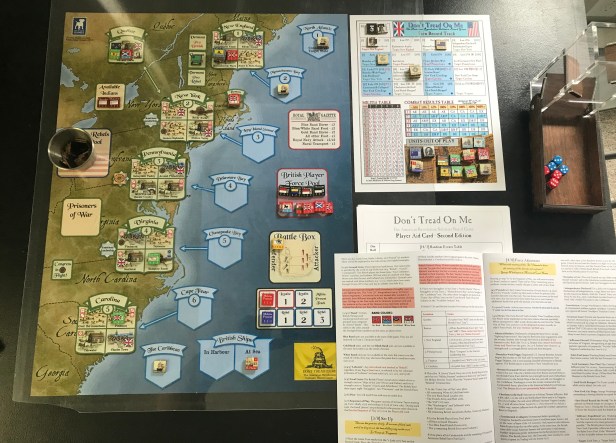
I really like the fact that the game is driven by the individual State Loyalty Levels. This loyalty shows to what degree the colonies feel positively about the crown and their presence. As battles are won and lost, this level will change and if it drops too low will end in a loss for the British. The Loyalty Level also effects several things such as the recruitment of Loyalist and Militia forces during battles. As you know, I feel very strongly about this concept of winning over the hearts and minds of the people and this one does well in this aspect.
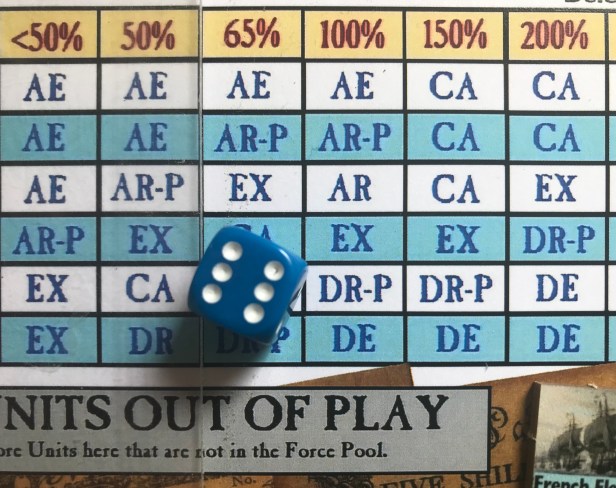
Battles are also very interesting and utilize a CRT where the column used is a percentage of the attacker versus the defender’s numbers. This seems to work very well and forces the player to think about how to get those proper units into the fight that will increase their chances of victory. Terrain also plays a key role in the battles as each County is referenced to a type of terrain, such as Farm, Wilderness or City, and individual units have a different strength value in those types of terrain.
Overall, the game is a really excellent experience and is one of the most interesting strategic level games on the Revolution that I have ever played. The design really does a great job of incorporating elements from history into the game play and I love the various events that can happen and change the game considerably from turn to turn. It keeps you on your toes for sure and combines the military and political parts of the war well. I also really like that it teaches the player events of the war which would otherwise not be known.
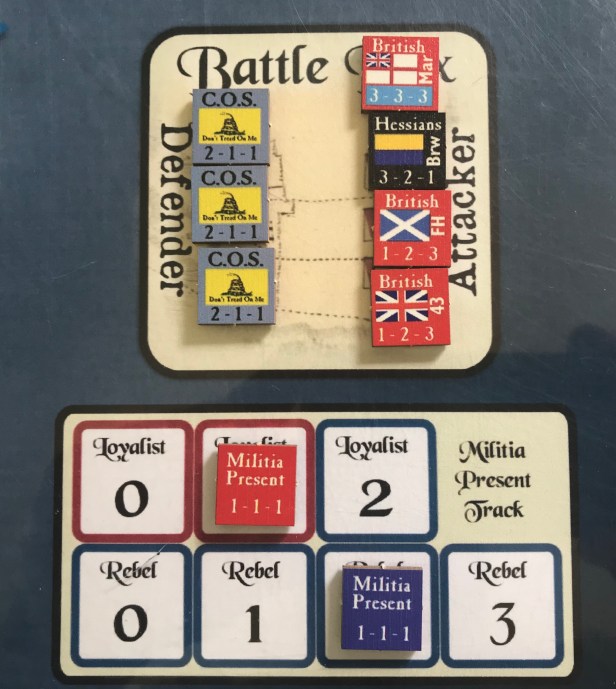
I need to play this one some more and really dive into it as I really have only played a full game once. But it was very interesting. My only complaint is that it is a longer game, taking about 3-4 hours to play as it is very involved and has a lot of steps during each turn. Definitely a game though that you can play a few turns and leave it setup to return when you have time. I think that this one will move up on the list after a few more plays but we shall see.
I wrote a long series of Action Point posts discussing various parts of the design and how they work. In Action Point 1, we covered the map and its various Counties and their terrain types and the Turn Record Track to give perspective to how the action plays out and how the player must meet the demands of Lord North and King George III. In Action Point 2, we looked at the differing units and their abilities as well as the anatomy and meaning of the values on the counters. In Action Point 3, we started taking a deeper look at the various phases of the Sequence of Play beginning with the Smugglers Phase and the Naval Phase. In Action Point 4, we examined the British Ground Phase, which deals with so many different aspects including Winter Attrition, Amnesty, Paroles, British Unit Purchase and Deployment and Moving around the map. In Action Point 5, we moved to the Battle Phase and dove into the procedure used, examined the use of Militia and looked at the interesting Combat Results Table and finally looked at an example. In Action Point 6, we examined the Place Rebels Phase and the Rebel Campaigns Phase and the differences behind Minor and Major Campaigns. In Action Point 7, which is the conclusion to this series, we covered the Logistics and Liberty Phases and also reviewed the various victory conditions.
If you are interested in Don’t Tread on Me, you can order a copy from the White Dog Games website at the following link: http://www.whitedoggames.com/dtom-american-revolution
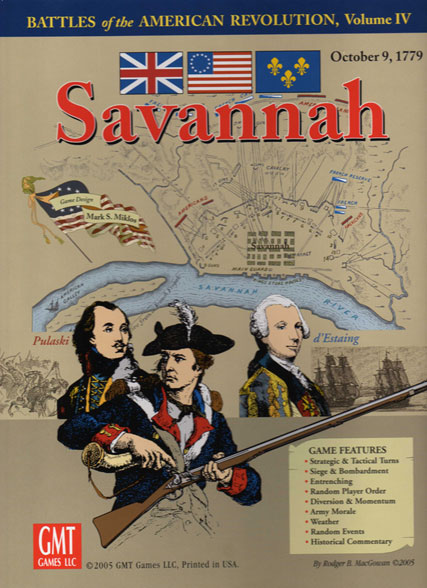
12. Battles of the American Revolution Volume IV: Savanah from GMT Games
This past fall while attending the SDHistCon in beautiful San Diego, California, we met up with Mark Miklos, who is the BoAR Series designer, and played him in a 3-player game of Battles of the American Revolution Savannah from GMT Games. In case you don’t know, Battles of the American Revolution (BoAR) is a tactical level wargame series that portrays various battles of the American Revolutionary War. The series is a hex and counter wargame with Combat Results Tables, and uses tactics cards to determine the stance of both attackers and defenders to gain modifiers to combat rolls. I very much do enjoy this system and feel that it gives some very interesting understanding of the type of fighting that was experienced in the American Revolution.

Savannah was published in 2005 and is volume IV in the series. It covers the events from September 10th to October 9th, 1779, as the Franco-American Allies mount their first significant cooperative effort against the British in North America during the Revolutionary War at Savannah, Georgia.
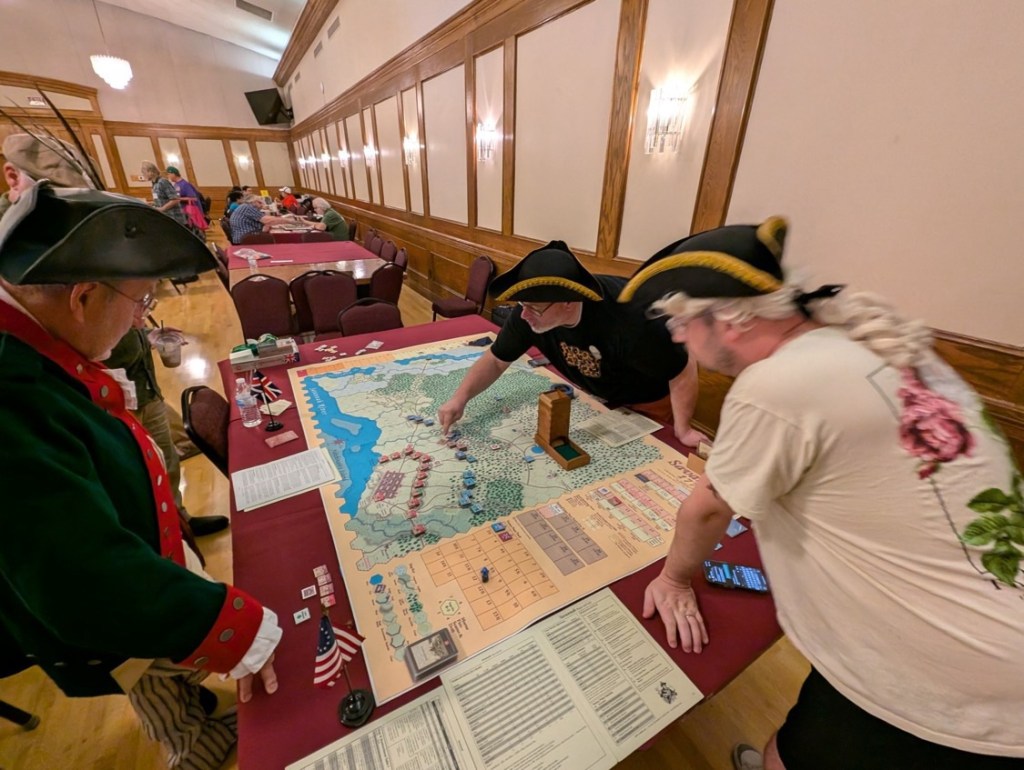
The reason Mark wanted us to play the game is that it is a 3-player game designed to create tension between the 2 Allies the French and Patriots as they must cooperate and draw from the same set of resources in the turn of Event Cards and diversions as well as Momentum Tokens. The cooperation is important but each side will earn their own victory points and only 1 player will be crowned as victor.

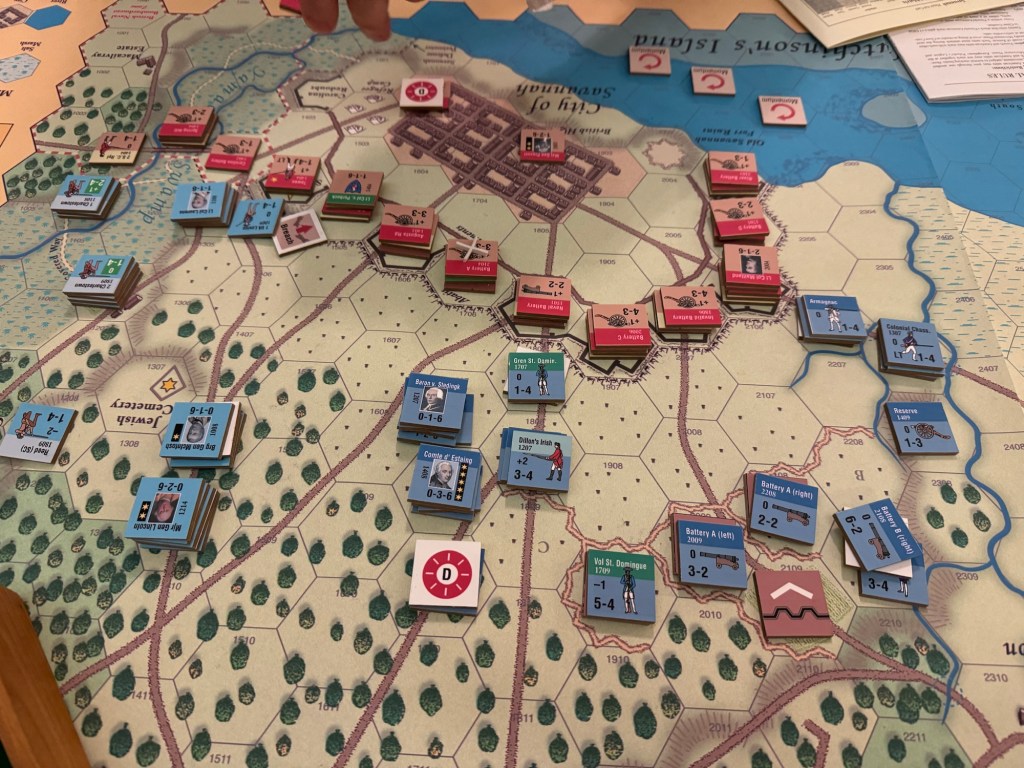
Savannah is a bit of a change of direction in the series as there are several new mechanics including an abstract siege and bombardment table, and the already mentioned random Events Deck. Unlike previous games in the series, initial turns are strategic, reflecting troop movements over 1 and 2-day periods and allowing for the building of defenses by both sides in the form of trenches and redoubts. When the American/French player decides to assault the city, the game switches to the familiar tactical game turns reflecting a single hour of battle. This was a very interesting experience and was quite different from our experience with Brandywine.

We played for about 6 hours and made it to turn 21 of 25 when Alexander and I decided to concede as we just couldn’t muster the needed attack strengths to be effective with our assaults. Mark’s British artillery was very effective and he typically would hit us about 60-70% of the time causing disruptions and retreats which would undermine our combat prowess and made it so we just couldn’t get it done.

My French bombardments were pretty effective though as I hit a few times and rolled well enough to blow 2 breaches in the outer defensive walls of the city of Savannah. This was where I would choose to assault as they would not gain the defensive bonuses from the fortifications.

We had a great time with the game and we are really glad we had the opportunity to play with Mark. He is a great guy and we love his enthusiasm for this history and for the series. I look forward to playing other volumes and he recommended that we need to play Eutaw Springs.
Here is a link to a quick review we game the game with Mark at SDHistCon:
If you are interested in Savannah, you are a bit out of luck as the game is out of stock at GMT Games. You can do a search online to find a copy but most of them are pretty expensive. There are a few copies of the game from our friends over at Noble Knight Games and you can access those at the following link: https://www.nobleknight.com/P/2147354833/Savannah
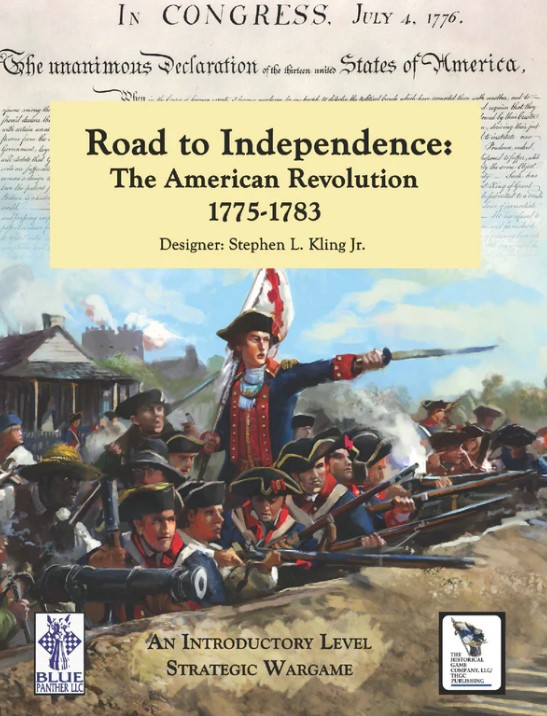
11. Road to Independence: The American Revolution, 1775-1783 from Blue Panther (2023)
*Moved Down One Spot (#10 to #11)
Not every wargame has to be deep. Some of them are light and fast playing and are just fun and interesting to experience. But, with this lightness, that doesn’t mean that the game isn’t a good representation of the history or an interesting play experience. Such is the case with Road to Independence: The American Revolution, 1775-1783 from Blue Panther.
Road to Independence: The American Revolution, 1775-1783 is the second in a planned series of games that will simulate various important conflicts in American history in a casual format. The first game was called French & Indian War from The Historical Game Company and the third game will cover the American Civil War. In this game, two players clash and take the sides of the British or the Americans fighting over the control of the Thirteen Colonies. One of the interesting things about the game is that it not only includes the Eastern seaboard but also the conflict in the far Western territory, a theater not often covered in games on this conflict. Both players will fight for control of important locations using specially made dice that represent British and American regulars, Native American allies, militia units, and (for the Americans) French and Spanish forces. Each player also has their own deck of Event Cards that will allow special events and actions to occur, ensuring that no two games will play the same.
Each player has access to a deck of 15 different Event Cards. At the start of the game, the players will create their Event Card Deck by randomly drawing 10 of the 15 Event Cards. This means that not every card will be used in every game and this provides some different effects and opportunities with each play. At the beginning of each player’s turn each round, they will draw one Event Card from their deck. The Event Cards are the designer’s method of introducing historical events and figures to the narrative and is a really nice choice for the game as it creates some interesting advantages that mimic the fortunes and occasional luck of war.
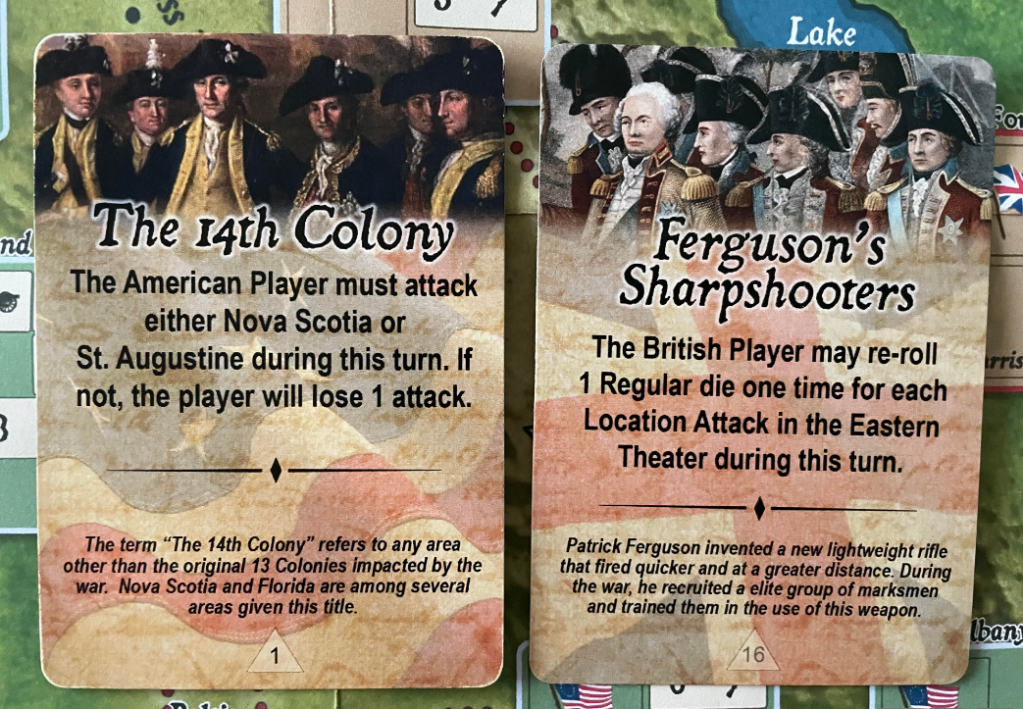
One of the best parts of the game was the custom dice and how combat works. The custom dice actually have the silhouettes of the various units available to each side etched into their surface and each of the dice are different colored to make their affiliation and type clear. The game is strategic in scope and there really are only a few different types of units including Forts, Cavalry, Regulars, Militia/Irregular Troops and Cannon. The game does involve conquest which is determined by die rolls against the strength of various Location’s Defenses found on the game map or also on the Location Cards.

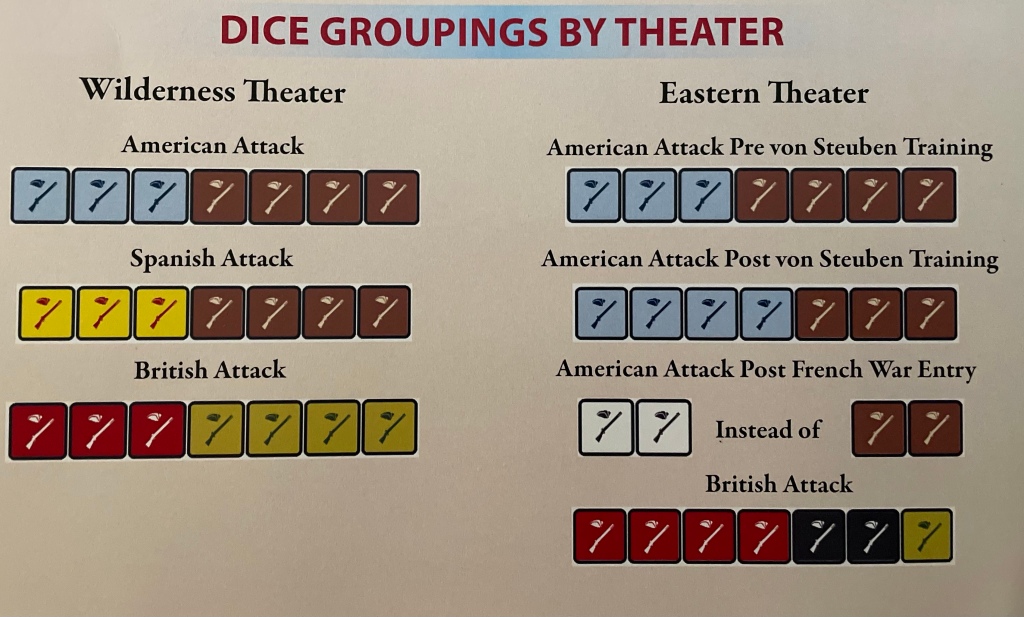
The dice that each player has access is to determined by the Theater in which the combat is taking place as well as what events have gone off at the time of the battle. Below you will see a chart that identifies each side’s dice to be used when attacking in either the Wilderness Theater or the Eastern Theater. Each side has access to 3 Regular Dice and 4 Auxiliary Dice when in the Wilderness. When fighting in the Eastern Theater, the American has the same dice makeup as in the Wilderness unless the Von Steuben Training event has been triggered. After the training happens, the player will then get to use their 4th light blue Regular Troops Die giving them a total of 4 Regular Dice. Remember, in the Eastern Theater there are fewer Indian Allies required as the Location Defenses typically don’t have the requirement. Also while fighting in the Eastern Theater, the British lose 2 of their Auxiliary Dice and gain 2 Hessian Dice making their attacks much more effective and powerful as they can bring to bear a great deal more Infantry power.
The Combat System is really pretty cool and uses a modified version of the dice system found in games like Elder Sign, which is a Euro horror themed game where players have to roll dice to obtain different symbols to defeat Ancient Ones and other challenges.
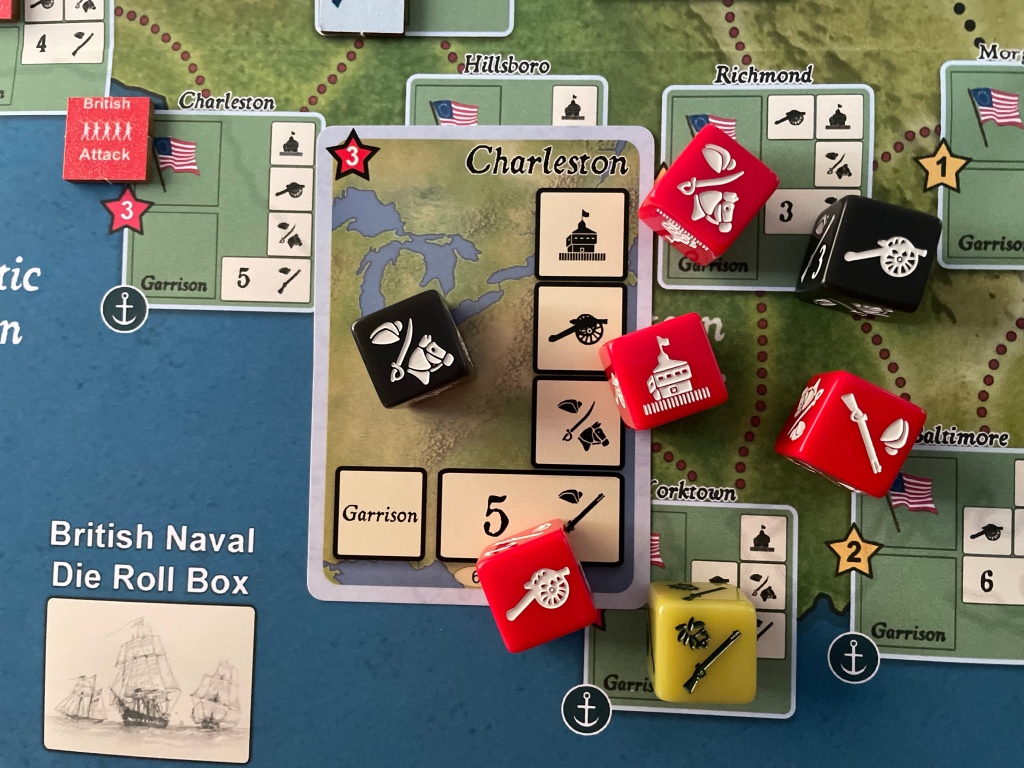
There are a great deal of choices that must be made during the Combat Phase in this game. I really enjoy how the custom dice are used and the decisions that you have to make. There is a good amount of considering how best to use your dice and their relative odds of achieving the results you are needing during that specific roll. But, you have to remember that this is a lite dice chucking game and the best plans can be dashed with bad luck and poor rolls.
We have not played the game a glut of times but in our few plays we have seen a pattern emerge in American victories. In fact, in all 3 of our plays the Americans won. Each of the games was close but it is such a difficult climb for the British. This doesn’t diminish the playability of the game and I suggest that this is a game that you should plan to play each side in a given night and compare the overall score of the British in both to determine the real victor.
In case you are interested, we also posted an interview with the designer Steven Kling and you can read that at the following link: https://theplayersaid.com/2023/09/18/interview-with-stephen-l-kling-jr-designer-of-road-to-independence-the-american-revolution-1775-1783-from-blue-panther/
I also wrote a series of Action Point posts diving into different aspects of the game. In Action Point 1, we looked over the Game Board and discussed the two theaters depicted including the Wilderness Theater and the Eastern Theater and their differences. In Action Point 2, we took a look at the Location Cards and their use. In Action Point 3, we discussed the various different custom dice and what units they represent and how they are used in the game. In Action Point 4, we looked at the Event Cards and their effects. In Action Point 5, which is the conclusion to the series, we discussed the victory conditions and examined which side has the trickier time of achieving theirs.
Here is a look at our video review of the game:
If you are interested in Road to Independence: The American Revolution, 1775-1783, you can order a copy from the Blue Panther website at the following link: https://www.bluepantherllc.com/products/road-to-independence
10. Supply Lines of the American Revolution: The Southern Strategy from Hollandspiele (2018)
*Moved Down One Spot (#9 to #10)
In 2017, we played and really enjoyed Supply Lines of the American Revolution: The Northern Theater, 1775-1777 from Hollandspiele and were impressed with the way the game modeled the importance of supply and logistics during the first three years of the American Revolutionary War. Last year, we finally had an opportunity to play the follow-up game in the series called, you guessed it, Supply Lines of the American Revolution: The Southern Strategy which shifts the scene of the fighting to the Southern colonies of Virginia, Georgia, and North and South Carolina.
This edition of the system has a very different feel and emphasis than its predecessor. In the Southern Theater, both combatants have much smaller armies with fewer resources. Maneuver is more central to each player this time around and there are new Siege and Naval Battle rules that provide new opportunities for attack. The big change though is the addition of Partisans who don’t directly fight against the opposition but provide support in the background with holding spaces to extend supply lines, running raids to disrupt enemy supply and supplementing the armies in the theater with new recruits. Each player also has a set of Militia (Patriot light blue) and Loyalist (Crown pink) counters that represent the partisan war that ensued in the South during the campaign. These forces represent the pro-British colonists who couldn’t imagine life without their tea and crumpets and the pro-freedom loving Patriot forces who never picked up a gun and marched with the regular army but nonetheless fought the occupation the best way they could. Each of the Irregular Units found in the game is identified with a specific colony and will be used to place in the Partisan Boxes to effect battles and operations in those colonies from turn to turn during the Impulse Phase to take certain actions that we will cover in a later post.
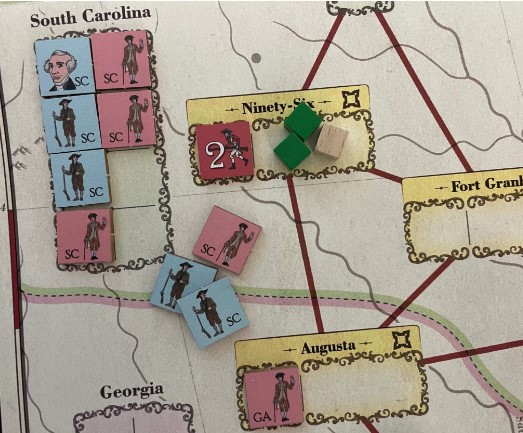
There is a special Partisan counter for the Patriots called The Swamp Fox. This counter represents the famous Irregular leader Francis Marion who rode the swamps of South Carolina to harass and defeat the British with non-conventional warfare. This counter grants some specific benefits to the Patriot player by basically ignoring the disparity of Irregular counters in the South Carolina Partisan Box and granting the ability to take militia actions at any time. The other advantage when he is present is that normally used Irregular counters will be taken out of the Irregular Cup and returned to the supply until they are placed back in the cup later. Not with Francis Marion as rather than being put into the supply used units are placed back into the Irregular Cup.
The really cool part about the Partisan Box is that it is a game within a game and allows for players to aid their forces on the mapsheet by foraging for food, but also by recruiting new Units into the regular Army and also taking the Skirmish or Hold Action that will help each side to deal with the troubles and limitations of supply. After all, this game is more about supply than it is about battle.

The Southern Strategy also added Navies to the mix of units available to the players and this addition was interesting, but not altogether important. Each player has access to just one Navy counter which can be used to control Sea Zones on the mapsheet and provide the Crown player with transport options for men and materiel to get from the south to the north quickly. These Navies cannot be on the mapsheet during Winter Turns, which represents 2 of the 5 Impulse Phases and once removed by being destroyed may not come back as they only appear in a Sea Zone on a roll of 1 or 2 on a d6. Their presence can make or break the game for both sides though as without the Navy the British have to go cross country which can be very slow and arduous and the Patriots don’t have to worry about defending each and every port in the north as the British will only be able to attack via connected Locations.
This is a very good game and we have enjoyed it very much. I placed it here on the list because I still have the love for the original but this one is very much a great game. I think that any student of the American Revolution can learn a thing or two from how these armies moved and fought and also how the Partisans played a major role, whether they were Patriots of Loyalists.
We posted an interview with the designer Tom Russel and you can read that at the following link: https://theplayersaid.com/2018/05/14/interview-with-tom-russell-designer-of-supply-lines-of-the-american-revolution-the-southern-strategy-from-hollandspiele/
I also wrote a few Action Points posts diving into the game. In Action Point 1, we cover the Mapsheet looking at the differences between the various spaces including Cities, Forts and Points while also covering the various Sea Zones and Partisan Boxes and how they function in the game. In Action Point 2, we looked at the different Units including Leaders, Soldiers, Navies and Partisans.
Here is a link to our video review:
If you are interested in Supply Lines of the American Revolution: The Southern Strategy, you can order a copy from the Hollandspiele website at the following link: https://hollandspiele.com/products/supply-lines-of-the-american-revolution-the-souther-strategy
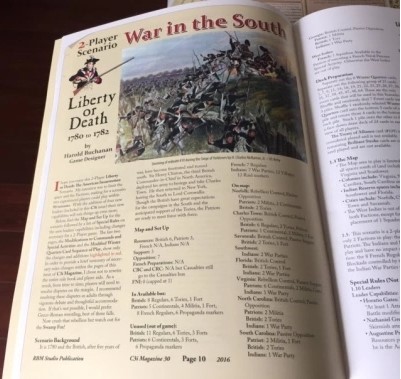
9. War in the South Scenario for Liberty or Death: The American Insurrection in C3i Magazine #30 from RBM Studio (2017)
*Moved Down One Spot (#8 to #9)
You will see my thoughts about Liberty or Death later, but I really like the COIN Series and really have enjoyed my numerous plays of Liberty or Death. In fact, it is the COIN Series game that I have played the most (nearly 25 times) with about 75% of those being solo plays. Suffice it to say, I love it. So when a 2-player scenario was bandied about a few years ago focused on the southern colonies, I became immediately interested.
War in the South focuses on the war in the southern colonies of Virginia, North Carolina, South Carolina and Georgia with Florida in as well although it wasn’t a colony. The game uses the 2-player eligibility track created by Brian Train for his COIN Series game Colonial Twilight and it creates a very interesting and tense mechanic to the game. The game adds in some new leaders who fought in the southern theater including Augustine Prevost and Lord Charles Cornwallis for the British and Horatio Gates and Nathanael Green for the Patriots.
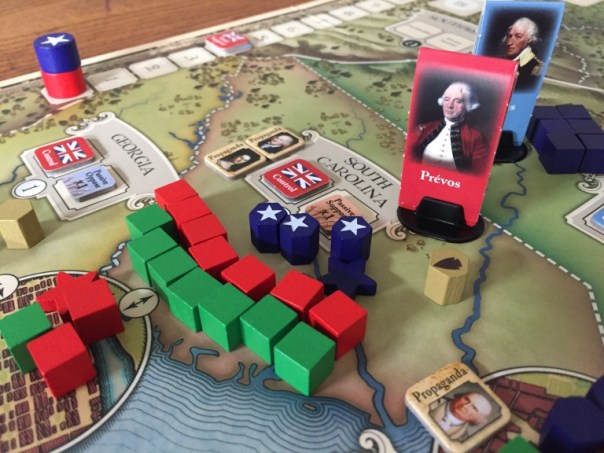
The game focuses only on the British and the Patriots although the French and Indians are used but aren’t eligible factions. I love the 2-player focus and find that this variant forces players to really understand what they are trying to do and to focus on that. The name of the game is Support versus Opposition and both sides will find good use for the rules while using Propaganda markers and the Win the Day rule to change Support or Opposition with a victory where the losing side loses multiple pieces.
I also really can feel the history as the British will find themselves sticking near the major cities of Norfolk, Savannah and Charlestown and the Patriots will try to goad the British into coming out to fight on their terms. The designer also has created a list of cards that focus on this time period in the struggle and really highlights the events involved from history. I find this game is good at replicating the issues of the day including the focus on supply, the attritional style of warfare with rare pitched battles but more skirmishing and ambush.
If you are interested in War in the South you will have to own a copy of the base game for Liberty or Death and obtain a copy of C3i Magazine #30.
Here is a link to our video review:
If you are interested in War in the South Scenario for Liberty or Death: The American Insurrection in C3i Magazine #30 from RBM Studio, you can order a copy from the Noble Knight Games website at the following link (as the magazine is sold out on Amazon and at RBM Studio): https://www.nobleknight.com/P/2147654084/30-w-South-Pacific
8. Table Battles: The Battle of Brooklyn Heights Scenario from Hollandspiele (2017)
*Moved Down One Spot (#7 to #8)
I feel a little sheepish including this one into the mix as it is a not a Revolutionary War game per se. It is a very interesting and unique game that includes a scenario for a Revolutionary War battle, but that is it. But, the game does such a good job of representing some of the elements inherent in the fighting of the time that I felt compelled to put it here. This year this title did move down a spot because I decided I liked Supply Lines of the American Revolution: The Northern Theater (also from Hollandspiele) better.
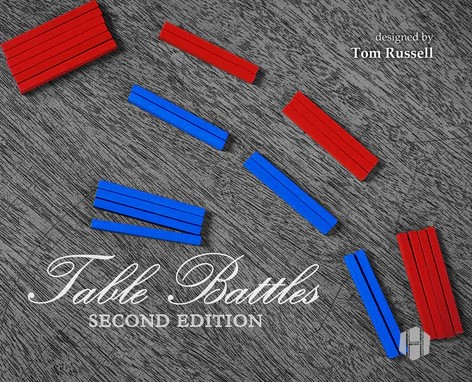
If you don’t know, Table Battles is a snack sized wargame that pits two sides against each other replicating battles from history using cards, dice and these really cool various colored matchstick sized wooden bits. The players control a number of formations within a wing and each of these formations has abilities to attack, maneuver, screen or cancel opposing unit attacks. The player will roll up to 6 dice each turn and then assign these dice based on a cards ability requirement and then can discharge those dice back to the pool to take an action. A card might say you can place 5’s or 6’s on that card to use its ability, or it might require a 4 dice straight of 2, 3, 4 and 5, or any set of doubles, etc. The games go back and forth until a certain number of formations are broken, i.e. their “matchsticks” have all been removed due to damage inflicted from enemy attacks, and the players gain enough morale cubes for the set victory requirement for the scenario. Games take 10-15 minutes to play and are very fulfilling even though the game is fast playing, has a small footprint with only a few cards, dice and wooden bits, and the rules are not overly complicated.
The reason I added this one to the list was because of the scenario we played, The Battle of Brooklyn Heights. The scenario card says the following:
A diversionary attack by Grant disguised Clinton’s advance on the Patriot flank. Outgunned, outmanned, outnumbered and outplanned, they’ve gotta make an all-out stand – at least until the main body of the army can escape. For experienced players.
Not much to go on, I know, but it outlines what historically happened in the battle. When you play this little scenario, you will find that this is exactly what the choice of abilities on the cards force the players to do while trying to accomplish their goal. The Patriots don’t have the all out force necessary to simply attack the British at will but must use stratagem and the nice ability of their cannon to cancel attacks from the British until they can get the right combination of dice to make an all out attack and destroy one of the British formations. On the other hand, the British are trying to simply hold their ground until Clinton can arrive with his very powerful attack and mop up the Colonials and chase them from the field. This holding out is represented by getting a number of dice on each of the two red formations before you can place dice on the pink formation which is Clinton as he is attempting to arrive.
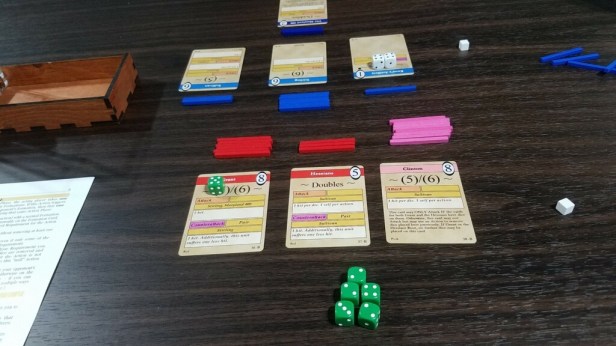
The mechanics combine nicely in this scenario to create a very interesting challenge for both sides to show the fighting styles of both the Patriots and the mighty British. I love this game and the best part about it is you can play in 15 minutes, change sides, set back up and play again. Brilliant and well integrated scenarios with history in mind.
Here is a link to our review video:
If you are interested in Table Battles 2nd Edition, you can order a copy from the Hollandspiele website at the following link: https://hollandspiele.com/products/table-battles?_pos=1&_sid=61f3f67fb&_ss=r
7. Supply Lines of the American Revolution: The Northern Theater, 1775-1777 from Hollandspiele (2017)
*Moved Down One Spot (#6 to #7)
I love an interesting and different game. And I found both when we came into Supply Lines of the American Revolution: The Northern Theater, 1775-1777. Supply Lines is a two-player game focused on the supply and logistics aspect of the Patriots and their struggle for independence during the first three years of the American Revolutionary War. The game is a struggle between the two sides of the war, the Patriots and the mighty Crown forces. The game does a fantastic job of focusing on the logistical side of war and makes it readily apparent to players why this is important as moving and attacking are specifically tied to possessing a certain type of supply.
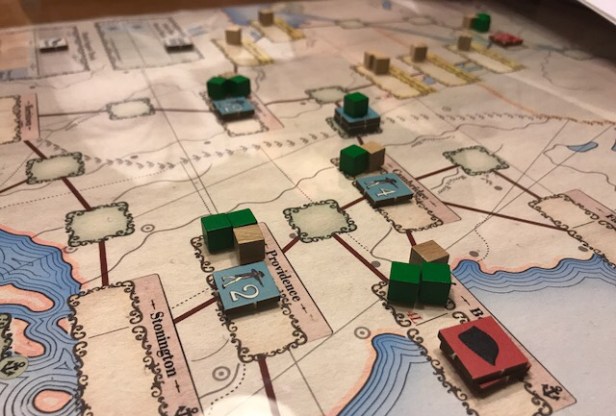
Green cubes, representing Food Supply, are used by each side to move their troops around the board to position them for battle and natural cubes, representing War Supply, such as ammunition and powder, are used to gain battle dice to be rolled in combat. If you don’t have the type of supply required to fund the actions you desire to take, you will find that you are not doing anything and will need to quickly change your tactics to address this problem.
As mentioned, war is a part of the game as well and becomes a logistical challenge and exercise on how to manage your resources to do the most good. During battle, players determine the number of battle dice they roll based on the number of War Supply they spend. That’s what I really like in this one choices. Do I spend all my resources to ensure one massive attack or do I conduct a series of smaller attacks?
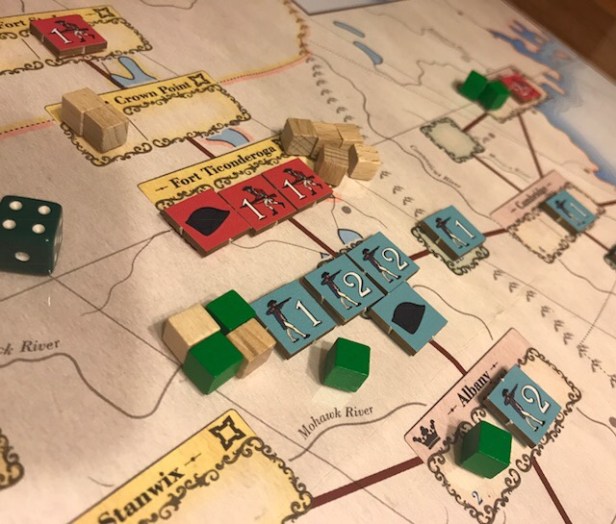
Supply is the name of the game and managing those Supply Lines, while also attempting to ruin and disrupt those of your enemy, will lead to victory. This game becomes a very thinky battle between the two sides and I have found that when a mistake is made it must be jumped on and you must punish the side that makes it. Great fun and a game that focuses on a very different aspect of the war but also is grounded in the basic underlying issue of support versus opposition. I like this one a lot.
Here is a link to our video review:
I also wrote a series of Action Point posts to give you a feel for the mechanics. Action Point 1 focuses on the type of supply and how it is used and Action Point 2 takes you through some examples of combat.
If you are interested in Supply Lines of the American Revolution: The Northern Theater, 1775-1777, you can order a copy from the Hollandspiele website at the following link: https://hollandspiele.com/products/supply-lines-of-the-american-revolution-the-northern-theater-1775-1777?_pos=1&_sid=b10bbacd5&_ss=r

6. Almost a Miracle! The Revolutionary War in the North from Against the Odds Magazine
This game was one of the games chosen for our Shelf of Shame Dust-Off Event last year and we very much enjoyed the game and the history. The game is focused on the American Revolutionary War in the North and is named Almost a Miracle! because when asked about it years after the war ended, George Washington said that the American victory was “little short of a standing miracle.” Almost a Miracle! uses the Tarleton’s Quarter! System as a game engine starting point to bring the Northern “half” of the American Revolution into play.
I think that the best part of this game is the board. It is just gorgeous and is an odd shape to take into account the entire northern colonies. I think that one of the strengths of this game is that it truly shows the difficulty of maneuvering armies around the colonies and the terrain as well as having to search for forage to feed those armies.
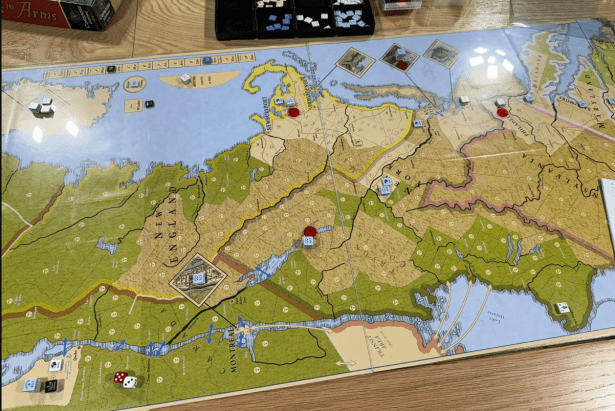
I also think that the game does a great job of showing players why battles took place in key areas due to the terrain and other factors. While the colonies were settled and developed, they were not necessarily developed enough to support such large scale troop movements and battles and armies had to stay close to their sources of supply or risk being cut off. The British consistently failed to live off the land and had to buy or ship food to sustain their armies, while the Continentals struggled with purchasing power and transportation assets. The game also shows the other more interesting and different campaigns such as Halifax, Fort Pitt, and Quebec.
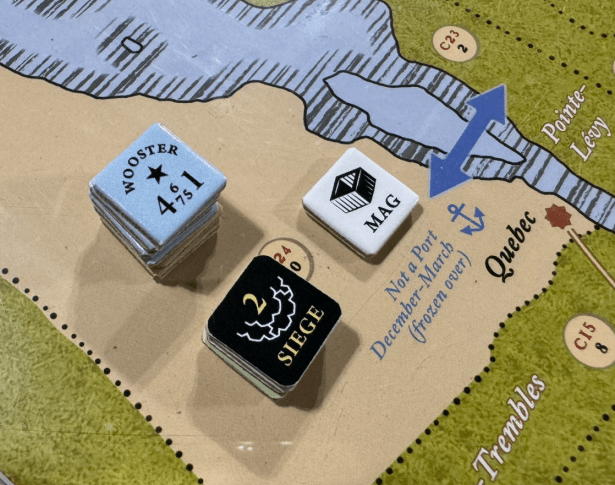
The best part of the game was how it handles battles. These battles are both large and small in scale and the chosen combat mechanic and system models well 18th Century combat and how it differed from later wars. In this system, morale, readiness, leadership and sometime chance are critical factors but the game also does a great job of modeling things like disease and desertion as these can lead to armies dwindling over time due to the harsh terrain and climate.
I very much enjoyed the special rules covering the short enlistments of the Continentals and the uncertainty of French support and entry in the war. These elements are key to the Patriot player and will take time to understand and to develop working tactics. There are also things like prisoner exchanges and the support of Loyalists and Native Americans. These latter troops provide a look at very asymmetric battle and focus on the smaller battles and skirmishes that were common leading up to large engagements.
We somewhat struggled with the rules and grasping their intent and I am not sure that we got it all correct at this point but we had a good time and I am very glad that we played the game.
Here is a link to our video review:
If you are interested in Almost a Miracle! The Revolutionary War in the North, you can order a copy from the Against the Odds website at the following link: https://www.atomagazine.com/Details.cfm?ProdID=157
5. Commands & Colors Tricorne: The American Revolution from Compass Games (2017)
*No Change – Still Holding Down #5 Spot
The Commands & Colors System from Richard Borg is, at it’s heart, a light weight two player wargame. It uses a battlefield divided up into three sections to help reduce overwhelming command decisions for new wargamers and keeps the scenarios simple in their objectives. It’s a great introductory system, and the themes are numerous. Tricorne is the American Revolution title from Compass Games and comes in a 3 inch box chocked full of wooden blocks, stickers, a mounted map, terrain tiles and most importantly cards. From title to title C&C stays mostly the same with only a few changes. One of the major changes in Tricorne is the addition of more cards.
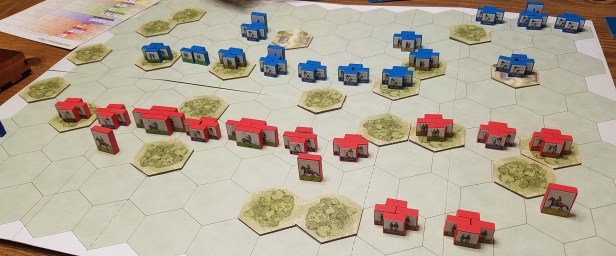
There’s the regular Command Card deck, a common deck that both players draw from. These are the cards that players will play to activate units on the board (two units on the right flank, or one in each of the three sections, etc.). But Tricorne also introduces Combat Card decks. The game comes with two separate decks, one for each faction, and they are both unique. The Combat Cards are a variety of different abilities and events that represent the differences between nations beyond just their unit composition. This is where this game shines and the theme of the American Revolution comes through. For example, the British Combat Card deck includes things like bayonet charges, better drilling, and equipment. The American Combat Card deck includes extra rally bonuses, skirmish style bonuses and other items. Mechanically speaking none of these actions are game breaking or even that major, but thematically they add a richness to the game that differentiates itself from other C&C games. The other great aspect of the Combat Cards is accruing them. Most scenarios will start you with four or five, but to gain more you’ll need to employ certain Command Cards that will give you the option to draw more Combat Cards. I always enjoy, even in a simple form like that, seeing your command structure provide added benefits. You play a card that moves fewer pieces on the board, but allows you to draw extra capabilities for use down the line. Simple choices, but ones that keep the game fresh.
The other element of the design that fits the period and helps the game earns its place on this list is Combat. Combat resolves very typically, using custom dice that show the symbols of all the units in the game. If you’re trying to shoot infantry, then you need to roll infantry symbols, if you’re trying to stop cavalry then hopefully you roll the cavalry symbol. Combat also uses a set amount of dice in Tricorne. For fire combat you roll two dice if you don’t move and one if you do, regardless of how many blocks you have remaining in the formation. That’s different from, say, Napoleonics where a unit of British line infantry will roll one dice per block plus one for fire combat, so up to 5 at full strength without moving. So what does that do to gameplay? Well, generally speaking it means it’s much harder to wipe out entire units in combat with lucky attack rolls. With fewer dice being rolled it means you would be peppering each other in long lines or being forced into melee combat to break any lines. However, Tricorne also introduces some very interesting morale mechanics to keep the game from dragging out.
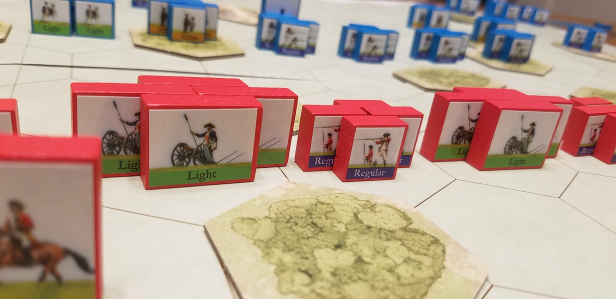
When attacking if you roll flag symbols that typically forces the defending unit to retreat a number of hexes. That’s standard across the entire series. But in Tricorne if a unit is forced to retreat they must make a rally check after conducting that retreat. They will roll a number of dice equal to the amount of blocks left in the unit, modified by present leaders, and unit quality. If they roll any single flag then they will remain on the board in their present state. If they fail to roll any flags then the entire formation routs off the board and gives a victory point to the opposing player. On reading and first implementing the rule we found it to be a little harsh.
We had a couple of occasions where entire full-strength units would rout due to unlucky rolls. With each dice having only two flags (out of six faces) the likely hood of a full strength unit passing that check using four dice is something like 80%. when the dice are that cataclysmic it can feel a little cheap. But luck is a cruel mistress. And it’s a way of keeping the game lite and on pace, which is important because this one is a little longer than most of the other games in the series.
But after we finished and talked it over it became apparent that the rally/rout check is actually very clever, from a historical standpoint at least. It’s designed so that units with 25% casualties are much more likely to stand their ground, which is obviously much more realistic. If I have a singular block retreat, it’s unlikely that they’d run back and charge the enemy in melee like I make them do all the time in Napoleonics! And think about the American Revolution, it was a conflict where mobility was very important, and skirmishes and engagements were often broken off as militia melted into the forests and hills, and British forces would regroup to strengthen numbers once again. So for me I think the rule serves a great gameplay purpose (keeps the games short enough), and a good thematic purpose. It took a little bit to win me over and not feel arbitrary, but I came round to it eventually.
Here is a link to our video review:
If you are interested in Commands & Colors Tricorne: The American Revolution, you can order a copy from the Compass Games website at the following link: https://www.compassgames.com/product/commands-colors-tricorne-the-american-revolution/
There is an expansion for this game that includes the French and we are very interested in adding it to our collection.
4. Battles of the American Revolution Tri-Pack: Guilford, Saratoga and Brandywine from GMT Games (2017)
*No Change – Still Holding Down #4 Spot
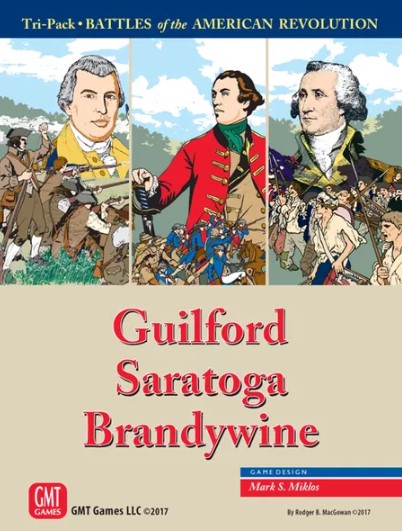
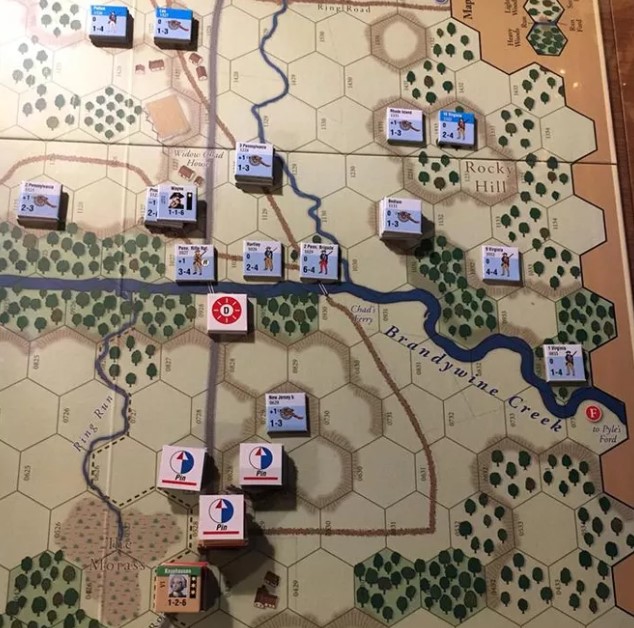
After owning this one for a few years, we finally got it to the table last summer and played the Brandywine game. I really like tactical feeling games and this one is definitely in that genre as you are moving smaller typically regimental unit counters around the board. The Battles of the American Revolution Series are a long standing and well respected series of hex and counter wargames that portray specific American Revolutionary war battles. The series is designed by Mark Miklos and is published by GMT Games and there are a total of 10 Volumes in the series with the upcoming release of the newest volume the Battle of White Plains.
The importance of Leaders was really highlighted in the games and we had an interesting discussion about the difference in leaders between the British and the Patriots as well as their casualty determination in combat. The rules also create a really interesting look at the period and we felt they were very appropriate for the setting and time. Really well done and the system felt very realistic. The combat is very attritional and there are not a lot of losses but rather retreats and disruptions. I really wanted to get into the other volumes in the series but alas we have not had the chance.
The other thing that we really liked was that Brandywine Creek played a major role in the game. The fords across the creek were hard to pass because the Patriots had lined that area with defensive cannons and sharpshooters. Each time the British tried to cross, the Patriots fired and forced them to retreat with some good dice rolling. This caused some real tactical decisions to need to be made by both sides to take advantage of or overcome the terrain. Very well done part of this battle.
The tactics cards are also very interesting. Each side has 8 cards and not all of the cards can be used at all times (for exmaple you have to have a leader present to use certain cards). These cards are then played by both side and you refer to a matrix that identifes various modifiers for the combat. These type of sitautions are always interesting and reward multiple plays of the game and system so you understand better what the other side is going to do and you attempt to anticipate and play an appropriate card.
One of the other things that I really liked about the system and our experience with Brandywine was some of the special units that were depicted. For example, the Hessian units included on the British side had amusettes which gave them some extra firepower and then the Patriots have several rifle units that are better that can really target officers and do some damage. These inclusions are really great as they build the historical narrative and teach the players about the time period.
Here is a link to our video review:
If you are interested in Battles of the American Revolution Tri-Pack: Guilford, Saratoga and Brandywine, you will have to pre-order a 2nd Printing copy from the GMT Games website or from our friends at Noble Knight Games:
GMT Games (this is a pre-order for the 2nd Printing): https://www.gmtgames.com/p-1052-american-revolution-tri-pack-2nd-printing.aspx
Noble Knight Games: https://www.nobleknight.com/P/2147683210/American-Revolution-Tri-Pack-Guilford-Saratoga-and-Brandywine
3. Campaigns of 1777 from Decision Games (found in Strategy & Tactics Magazine Issue #316) (2018)
*No Change – Still Holding Down the #3 Spot
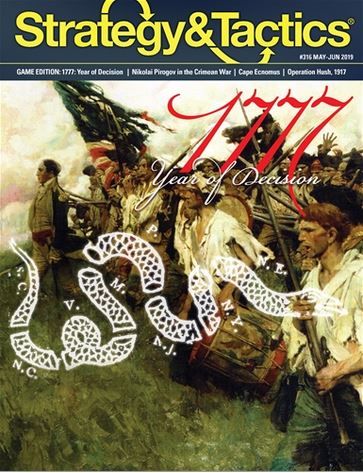
As you know, we really enjoy Harold Buchanan’s approach used in his Am Rev games (Liberty or Death and War in the South from C3i) and he had a new one last year that appeared in a wargaming magazine. Campaigns of 1777 is a two-player, point to point movement wargame in which players control the Patriots or the British in the northern Colonies during 1777, which was a critical year in the American War for Independence. As you know, the Patriots scored their first major victories at Saratoga that year and this was enough to bring in the French on their side.
We really enjoyed the game and found it to be a very interesting look at the battles fought in the northern Colonies including the Sieges of Fort Ticonderoga and Fort Stanwix, the battles of Brandywine, Germantown and Saratoga as well as the surrender of Burgoyne’s army at Saratoga. The game uses point to point movement so there are only a few ways that the British can come down from Canada to attack the Patriot and the Patriot player knows this and must maneuver their forces well to intercept and slow their advance down before they are beaten by the overwhelming British forces. I really liked playing as the Patriots as I had to pick my battles well and try to slow their advance rather than chasing them off the field in an overwhelming victory.
The objective of the game for the British player is to control certain spaces in order to fulfill their Victory Conditions. The Patriot player’s objective is simply to prevent the British Victory and this really makes for some interesting choices on the very well done map. There were two elements that we found very interesting including sea movement and the way that the Patriots could recruit forces.
Each turn, there are 13 chits that can be blindly drawn and include 2 supply chits, 2 event chits, 5 British Primary Leader chits and 4 American Primary Leader chits. The Leaders have a certain amount of Leadership points that can be used to take certain actions like marching, forage and recruiting. The players will have to keenly manage these limited actions in order to make sure that progress is being made.
I also liked that there are several key forts on the British route down the Colonies and the Patriot can put up a pretty staunch defense by planning out moves and thinking about how to force the sieges to take one more turn than the British player expected. Of course, the British can use sea movement to quickly marshal their forces to appear in key locations to put more pressure on the Patriot player and force them to take actions they don’t have to take. Overall, a great game of cat and mouse that felt very thematic and true to history.
I wrote an entry in our Beautiful Boards of Wargaming series covering the board for this done by Terry Leeds and you can read that at the following link: https://theplayersaid.com/2022/09/30/the-beautiful-boards-of-wargaming-campaigns-of-1777-in-strategy-tactics-magazine-316-from-decision-games/
Here is a link to our video review:
If you are interested in Campaigns of 1777 from Decision Games (found in Strategy & Tactics Magazine Issue #316), you will have to order from our friends at Noble Knight Games: https://www.nobleknight.com/P/2147746858/316-w–Campaigns-of-1777
I have head a rumor that this one will be getting a new boxed edition but I don’t have any links to further information.
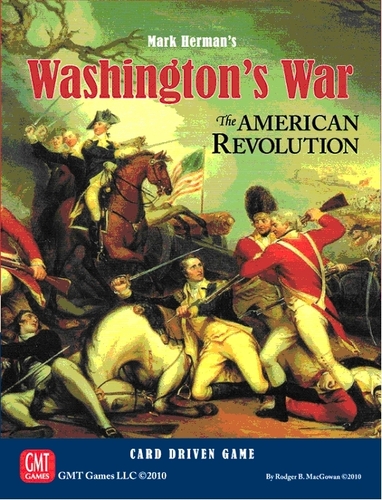
2. Washington’s War from GMT Games
*No Change – Still Holding Down the #2 Slot
Getting near the top of the list and there are not many games better than the one I’m going to talk about now. Washington’s War is a war game, make no mistake about that. But, it is virtually impossible to win the game by focusing only on the field of battle. For that to happen, the Patriots need to completely drive the British forces out of the 13 colonies or the British need to wipe the American forces off the map. Both are extremely difficult and I would be surprised if any more than 1 out of 30 games ended in such a way. Rather, the ultimate goal of the game is to have political control of the colonies. If at the end of the game the Patriots control 7 colonies, while holding the British to control of less than 5, they win. If not, the British win. Simple as that. So, you can see that battle is not the main goal but control is. And more importantly political control.
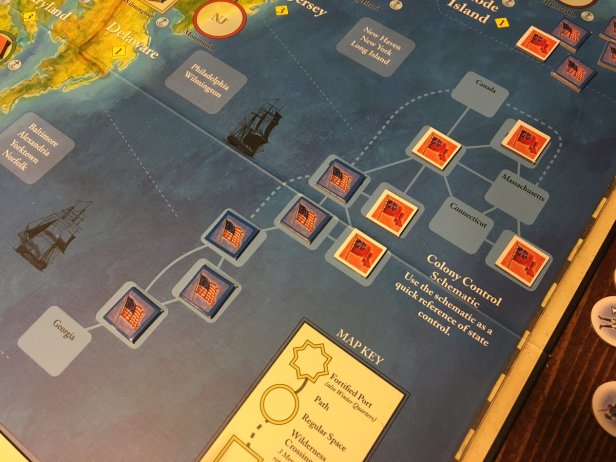
Washington’s War is a Card Driven Game or CDG, and as such, relies on cards to provide to players the actions needed to play the game. The cards contain OPS Points which can be used to drive various actions, including such things are activating leaders, who in turn will then move with forces to attack, and also contain written text in the form of events. These events can be played only by the side they are intended for and if drawn and played by the opposing side, they can only be thrown away while granting a few possible actions, such as placing or removing Political Control markers.
As a self professed lover of the CDG mechanic, I really like this implementation of that system and must now say that Washington’s War is solidly in my Top 5 CDG games. The fact that this game is well designed and implements the CDG mechanic well should come as no surprise though, as it’s designer, Mark Herman, is the Godfather of CDGs. This game is really solid with low complexity and a relatively quick play time, but offers players with deep and meaningful choices about how to wage the war for the “minds and hearts of the people”.
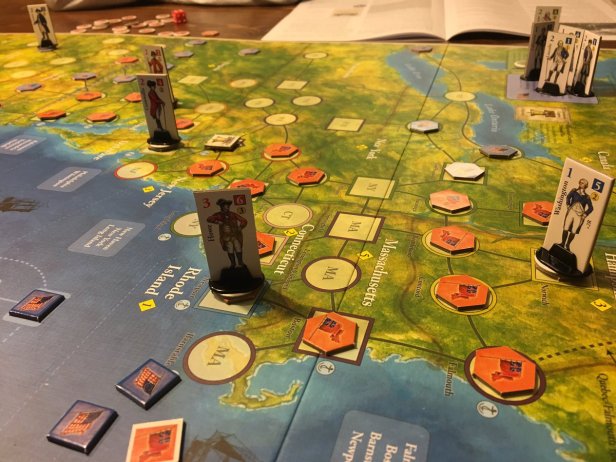
For a whole lot deeper look into this game you can read my written review at the following link: https://theplayersaid.com/2017/08/02/the-revolution-was-effected-before-the-war-commenced-the-revolution-was-in-the-minds-and-hearts-of-the-people-a-review-of-washingtons-war-from-gmt-games/
Here is a link to our video review:
If you are interested in Washington’s War, you can order a brand new 3rd Printing copy from the GMT Games website at the following link: https://www.gmtgames.com/p-735-washingtons-war-3rd-printing.aspx
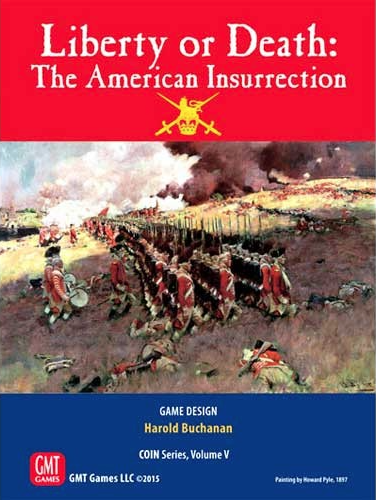
1. Liberty or Death: The American Insurrection from GMT Games
*No Change – Still Holding Down the #1 Slot
I already mentioned this earlier but I love Liberty or Death: The American Insurrection! The fifth volume in GMT’s COIN Series is the series’ first foray into non-modern warfare and takes us to the 18th Century and the days of the Brown Bess musket, the 18 pounder siege cannon and nice and tidy formations better suited for a gentleman’s war. The focus of the game is the struggle of the American Patriots against their mother British government as they have made their intentions clear to become independent with the Declaration of Independence. The game is a multi-faction treatment of the American Revolution, which includes the Patriots and their allies the French against the British and their reluctant allies the Indians.

Liberty or Death is a 1 to 4 player game focused on all aspects of the struggle including financing operations with Rabble Rousing, infiltrating British held cities to Skirmish, blockading major cities with the mighty French fleet, Raiding the frontiers with the Indian nations, the spread of propaganda to build support for the revolution, fort building and small scale battles. So, with this short description you can see that this game is not a “traditional” wargame but does contain some armed conflict. So a game about the American Revolution that isn’t focused on battle you say? How can that be? Well, I will tell you that this game is probably a perfect representation of the multifaceted struggle that wasn’t necessarily decided on the field of combat, but by the little actions of many behind the scenes characters. Yes battle will decide the control of major areas of the board and decide the fate of troops as they must be concerned about being in supply through a network of forts but the game is so much more than just rolling some dice and consulting a CRT!
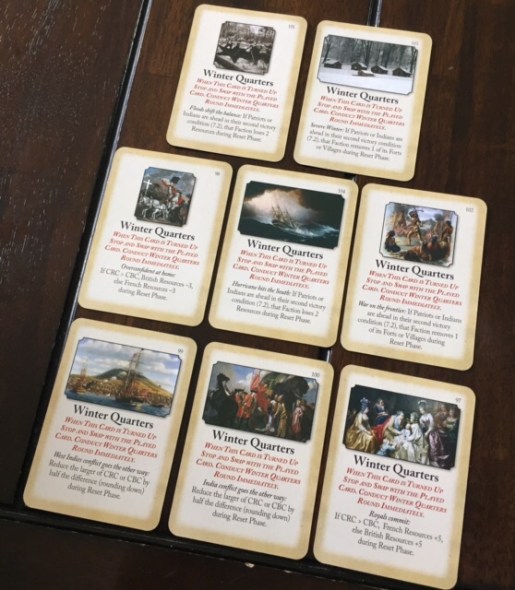
That is why I think LoD is my number 1 game on the American Revolution. It does a fantastic job, very similarly to Washington’s War, of capturing the focus of the real issues and how the war was eventually won by a rag tag band of farmers, merchants, blacksmiths and school teachers.
For a deeper dive into the game you can read my written review at the following link: https://theplayersaid.com/2017/03/01/turning-the-wargaming-world-upside-down-a-review-of-liberty-or-death-the-american-insurrection-by-gmt-games/
I wrote an entry in our Beautiful Boards of Wargaming series covering the board for this done by Terry Leeds and you can read that at the following link: https://theplayersaid.com/2023/10/20/the-beautiful-boards-of-wargaming-liberty-or-death-the-american-insurrection-from-gmt-games/
I also started a new series last year called COIN Workshop and took at a look at the Indian faction and their Commands and Special Activities and you can read that at the following link: https://theplayersaid.com/2023/01/17/coin-workshop-liberty-or-death-the-american-insurrection-from-gmt-games-indians-faction/
If you are interested in Liberty or Death: The American Insurrection, you can order a brand new 3rd Printing copy from the GMT Games website at the following link: https://www.gmtgames.com/p-826-liberty-or-death-the-american-insurrection-3rd-printing.aspx

I hope that you all have a Happy Independence Day! And for those that don’t celebrate this holiday, or maybe call it by another name (Happy Traitor’s Day), I hope that you have enjoyed my look at some of the games about the American Revolutionary War that we have played and really liked. There are other games out there and here is a list of games that I would like to acquire/play:
Liberty: The American Revolution 1775-1783 from Columbia Games
1776 from The Avalon Hill Game Co. (I did get my hands on a copy of this one thanks to a Patron but have yet to dive into it)
Hold the Line from Worthington Games
We the People from The Avalon Hill Game Co.
Tarleton’s Quarter: The Revolutionary War in the South from Against the Odds Magazine #28 (I own this one but haven’t even cracked it open or even punched the counters)
War for America from Compass Games (acquired this game off of Kickstarter a few years ago and have only been able to clip and organize the counters)
Hidden Strike: American Revolution from Worthington Publishing
Battles of the American Revolution Volume X: The Battle of White Plains from GMT Games (own it and have clipped the counters)
Battles of the American Revolution Volume IX: Rhode Island (own it and have clipped the counters)
Please let me know what games you guys have enjoyed on the topic and other games that I need to take a look at.
-Grant
 The Players' Aid
thank you very much
bill
LikeLiked by 1 person
Thanks for this article! Always appreciate your 4th of July ranking – and I see first two spots firmly kept by two great games I love too!
Happy Independence day to you Guys! 🎉🥳🎊🎁
LikeLiked by 1 person
Thanks Michael.
LikeLiked by 1 person
Very interested in you response to War for America. Designer is a deep thinker about the subject. Also, I have an old copy of AH 1776 but only got to play a few times. I also have the optional leader counters published later that I never go to use. The board is beautiful, as many of the later AH games were, and I do have fond memories of it.
LikeLiked by 1 person
I recommend https://waktogel303.jimdofree.com/ for those of you who want to find new insights about online games from a different perspective
LikeLike