Continuing along in this new series devoted to the best looking boards found in the wargaming world where I will highlight the art and layout of a different board in a wargame that we have played to show you the various talents of the artists and graphic designers involved. In my humble opinion, a well designed and attractive board can make all the difference in the world to me enjoying a wargame. Don’t get me wrong, the game has to be good, but if it’s also good looking it always is a better experience. A board can draw me in. Can make me feel that I’m there. Can set the stage for the thematic immersion that we all crave. And I have found many of these type of boards and I want to make sure that I share them with you.
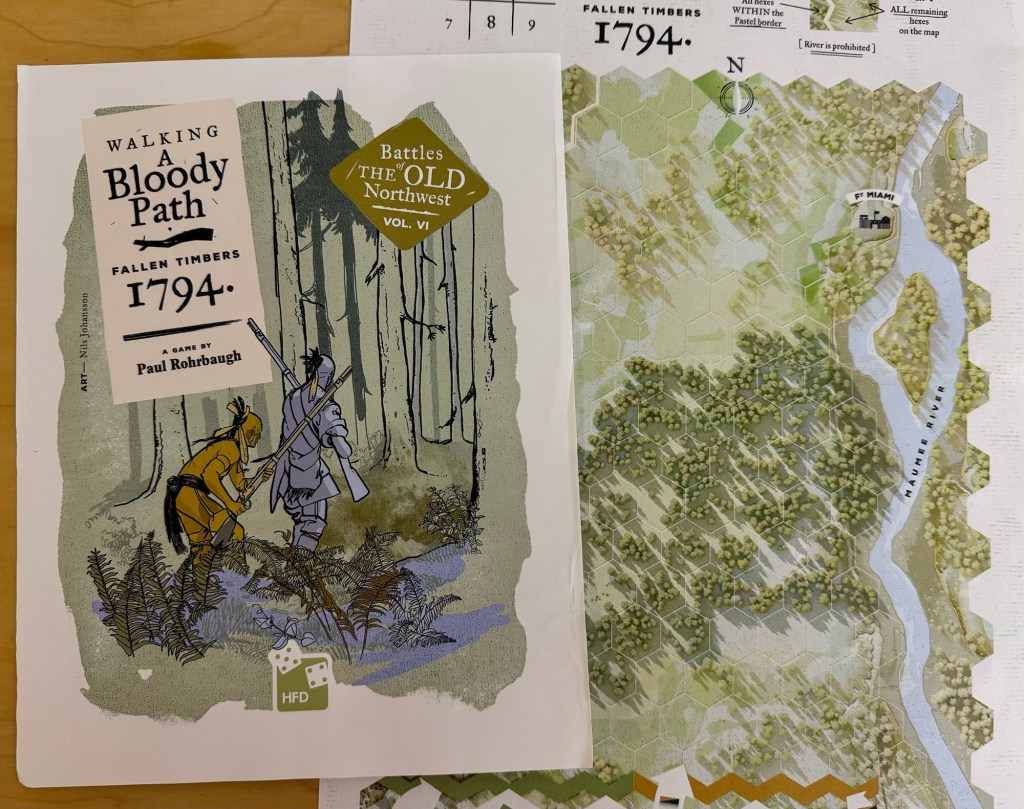
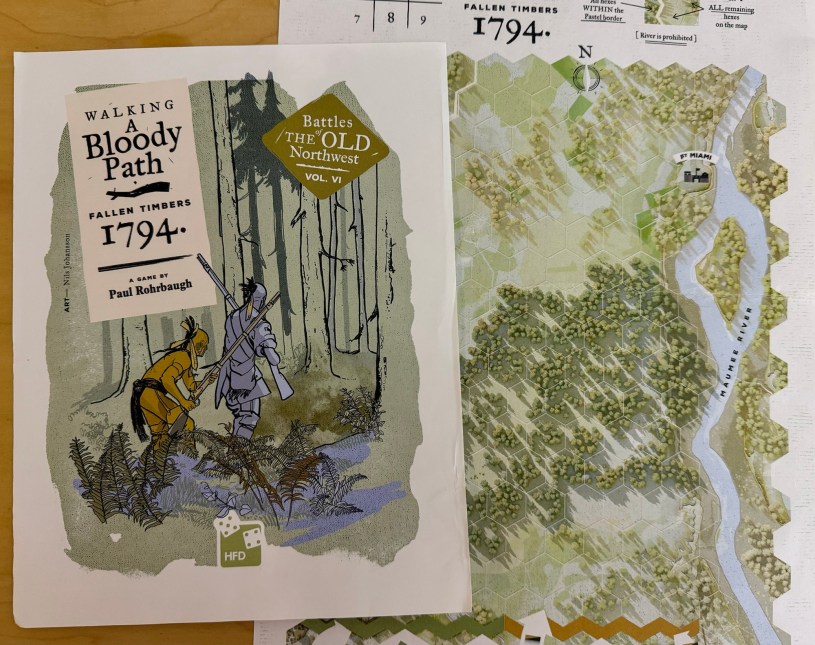
Walking a Bloody Path: The Battle of Fallen Timbers, August 20, 1794 from High Flying Dice Games is a small format wargame that deals with the struggle between the fledgling United States and the several Native Tribes who claimed the Old Northwest Territory which spanned the present day states of Ohio, Michigan, Indiana, Illinois, Wisconsin, and parts of Minnesota. Following defeats in 1790 and 1791, the US Government authorized the creation of a standing army to invade and subdue the area. Appointed in overall command of the force was Revolutionary War hero General “Mad” Anthony Wayne, so nicknamed for his headlong and daring attacks against the British in that war. General Wayne elected for a methodical and remorseless campaign against the Native Americans and dubbed this new US army a “Legion”, which he further divided into four “sub-legions”, each of which was a combined-arms force of regulars as well as militia infantry, dragoons, artillery and engineers. The Battle of Fallen Timbers was the final battle of the Northwest Indian War. The battle took place amid trees toppled by a tornado near the Maumee River in northwestern Ohio at the site of the present-day city of Maumee, Ohio.
The United States was victorious against a combined Native American force of Shawnee under Blue Jacket, Ottawas under Egushawa, and many other tribes. The battle was brief, lasting little more than one hour, but it scattered the confederated Native American forces. The U.S. victory ended major hostilities in the region. The following Treaty of Greenville and Jay Treaty forced Native American displacement from most of modern-day Ohio, opening it to settlement, along with withdrawal of the British presence from the southern Great Lakes region of the United States.
The artist for the game is a very talented and skilled professional named Nils Johansson. This is now the 4th time we have covered one of Nils illustrated boards in this series and it will not be the last. To date, we have covered Kekionga!: A Dark and Bloody Battleground, 1790 from High Flying Dice Games, Maori Wars: The New Zealand Land Wars, 1845-1872 from Legion Wargames and Lanzerath Ridge: Battle of the Bulge from Dan Verssen Games. He has done several other games including Breaking into Valhalla from High Flying Dice Games (2001), City of Confusion: The Battle for Hue, Tet 1968 from High Flying Dice Games (2012), Dueling Eagles: Aerial Combat over Malta from High Flying Dice Games (2013), Ambon: Burning Sand & Little Seagulls (2021) from SNAFU to name just a few.
The board for Walking a Bloody Path: The Battle of Fallen Timbers, August 20, 1794 is spectacular and is focused on Fort Miami located along the banks of the Maumee River. The fort was located at the eastern edge of present-day Maumee, Ohio, southwest of Toledo. In the picture below, the fort is shown in the upper right corner of the board. The trees around the fort have generally been cleared leaving a good site line for the defenders of oncoming troops.
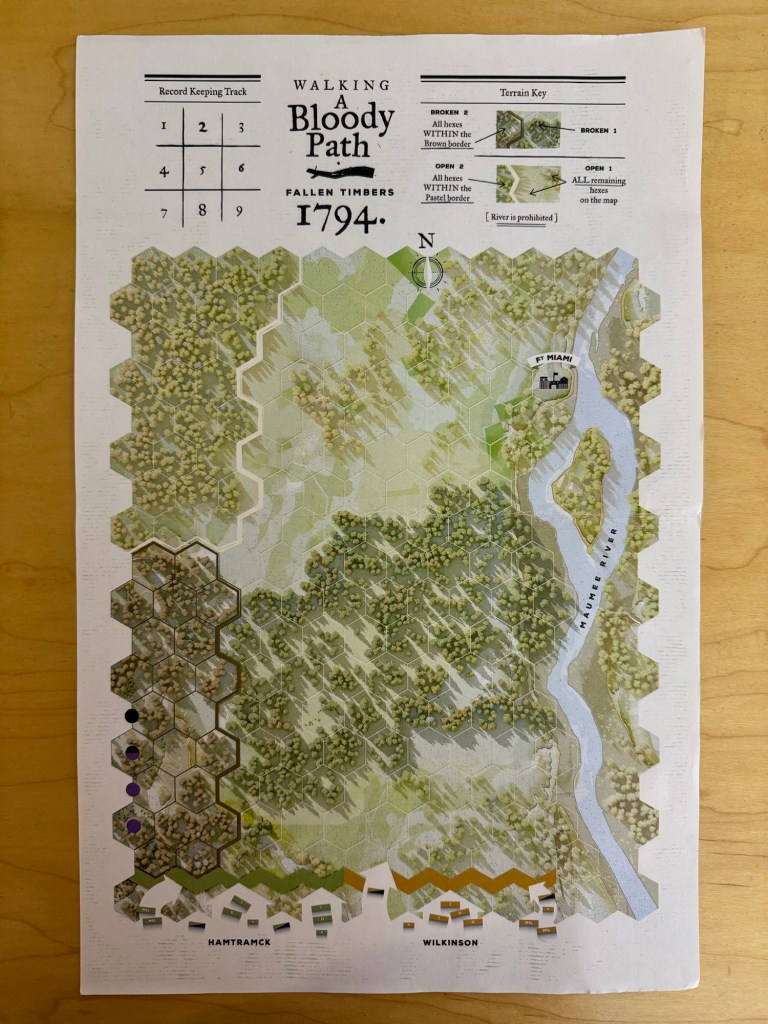
As we zoom in on the fort the first thing that sticks out to me is the shadows being cast by the trees. This effect is a very nice addition to the board to give it some real depth and a feeling of the time of day as the sun is most likely moving past noon and is located to the west of the area and casting those long shadows back to the east. The fighting didn’t really take place at the walls of the fort itself but in the woods where a recent tornado had ripped through the forest creating a grouping of downed trees and twisted roots that created a sort of natural abatis which would protect the confederate warriors from attack.
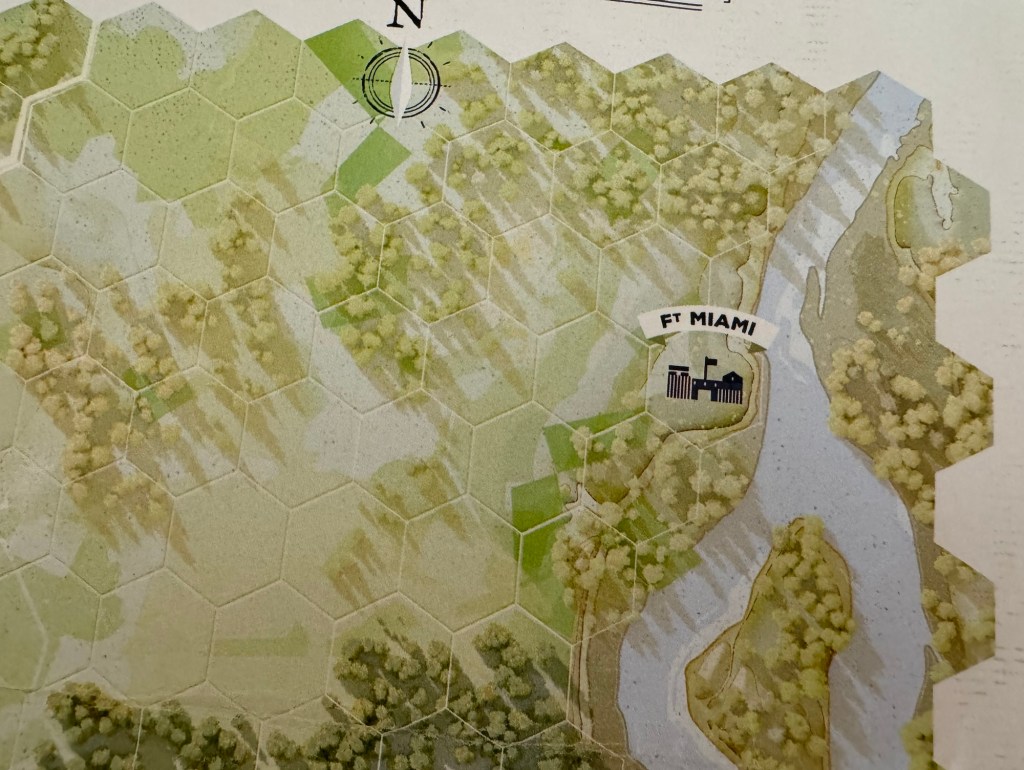
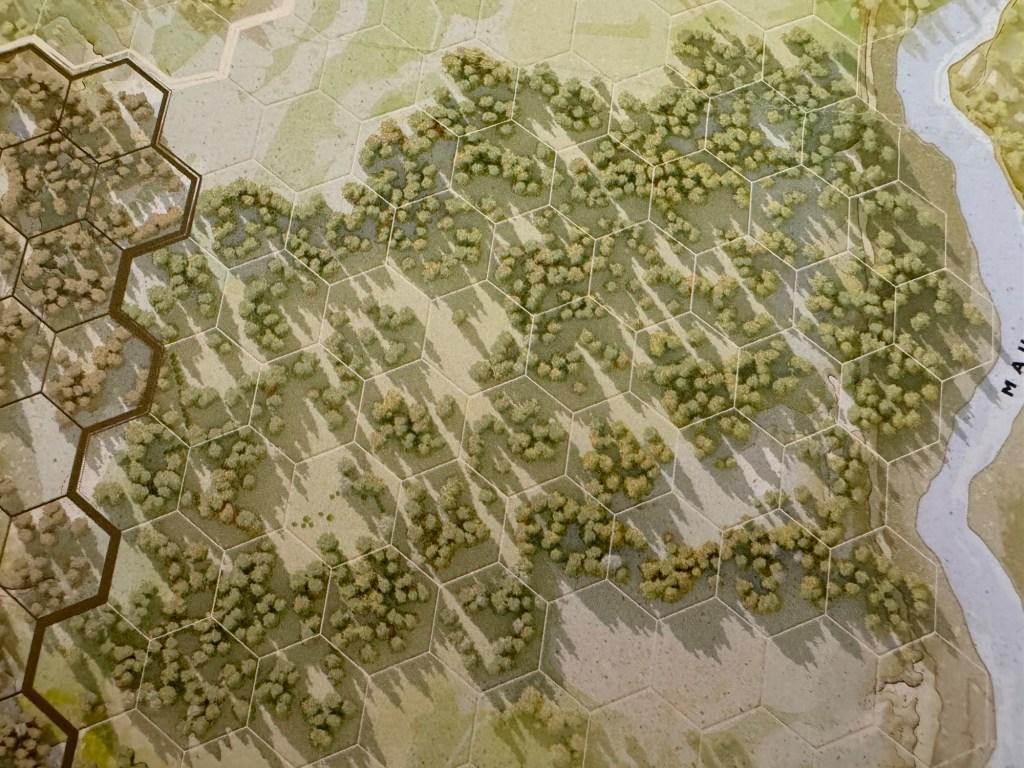
As we move further down the board and into the forested area you will notice the dark brown line that has been drawn on a grouping of hexes to the west. This is the area of the abatis of downed trees and creates a second type of terrain called Broken 2, which provides better protection for the native warriors. The rest of the forested areas are classified as Broken 1. I really like the way Nils used the thick and dark brown lines to mark these areas of different terrain as they were a key part of the battle and needed to stand out to the players. There is no mistaking the location of the havoc wreaked by the high winds.

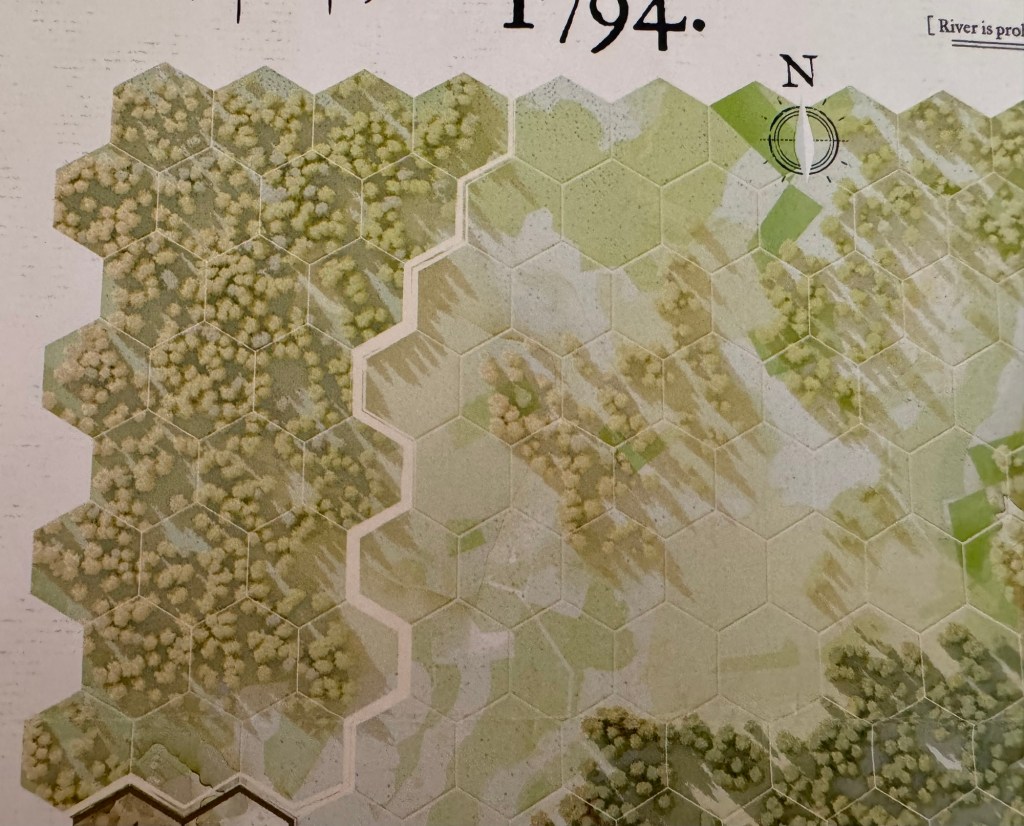
I really like the choices that Nils made with the Open Terrain and how to differentiate it but also how to keep it varied and not repetitive and nice to look at. As you can see, some of the Open Terrain is green, light gray, a stony color or even light brown. These are all classified as Open Terrain but represent different elements such as meadows, rocky flats, rolling flat areas and even grass land. You will also notice that there is a pastel/light tan border drawn around some of the trees to the west of the open areas. This represents Open Terrain 2 which slows movement as compared to Open Terrain 1. There are an abundance of tress shown behind this line but they shouldn’t be confused with the similar looking trees located to the south behind the thick dark brown line as they are different.
Next I want to take a look at the makeup of the Maumee River as it winds through the terrain. I really like the way that it is drawn on the board with somewhat of a 3D type feel to it as Nils used contrasting colors, notice the lighter blue for the water adjacent to the banks, and lines of movement in the water itself to give the banks a more substantial and solid feel to them. The shadows cast by the surrounding trees also aid in this effect to give the players a feel of real depth to the river.

The island area in the middle of the river near Fort Miami is also really well highlighted and truly appears to be 3D as the banks rise up from the edge of the water to represent an area where soil and other runoff has been deposited over the years creating a substantial and solid mass. I also like the thin brown line that seems to outline the island to help in standing out from the fast moving water itself.
Aiding in the play of the game are the areas of entry shown by formation for the American player and for the Native player. At the bottom edge of the board are squiggly thick colored lines drawn to represent the hexes where the American player can setup their forces. On the right is the golden rod colored area where Wilkinson is to line up with his formations of regulars and Kentucky Militia on the right flank. The name Wilkinson is written in thick dark lines with block like letters and are unmistakable as to their purpose on the board. Also included are stylistic lines in the form of an arrow showing the historical formation movement. These suggest to the player the potential best course of action with the units that will be deployed here but is only a suggestion as the player has freedom to line up their units where they will in the confines of the boundary.

To the left of Wilkinson’s formation area is Hamtramck’s area, which is shown with a beautiful shade of olive green. This color really blends into the surrounding tangled forest mass that the Natives will be hiding amongst. You can see the small circles drawn in the hexes to the west at the edge of the board. These are the setup areas for the Native formations and are shown as purple and black with a joint area that can accept either of these units with a split half and half purple/black circle.
I also really like the parchment look to the off-board areas under and nearby these formation areas. You can see those intermittent lines drawn their so lightly that some are not even visible unless you look closely. All of this combines to create a very pleasing look for the board.

And once the units are placed out on the board, as shown in the picture below, the beauty simply continues as the counters themselves are also beautiful representations of the various tribes involved including Shawnee, Ojibwa, Mingo, Wyandotte, Delaware and Pottawattamie to name a few. These Natives were a confederation of tribes led by Little Turtle and Blue Jacket and were fighting together to preserve their way of life.
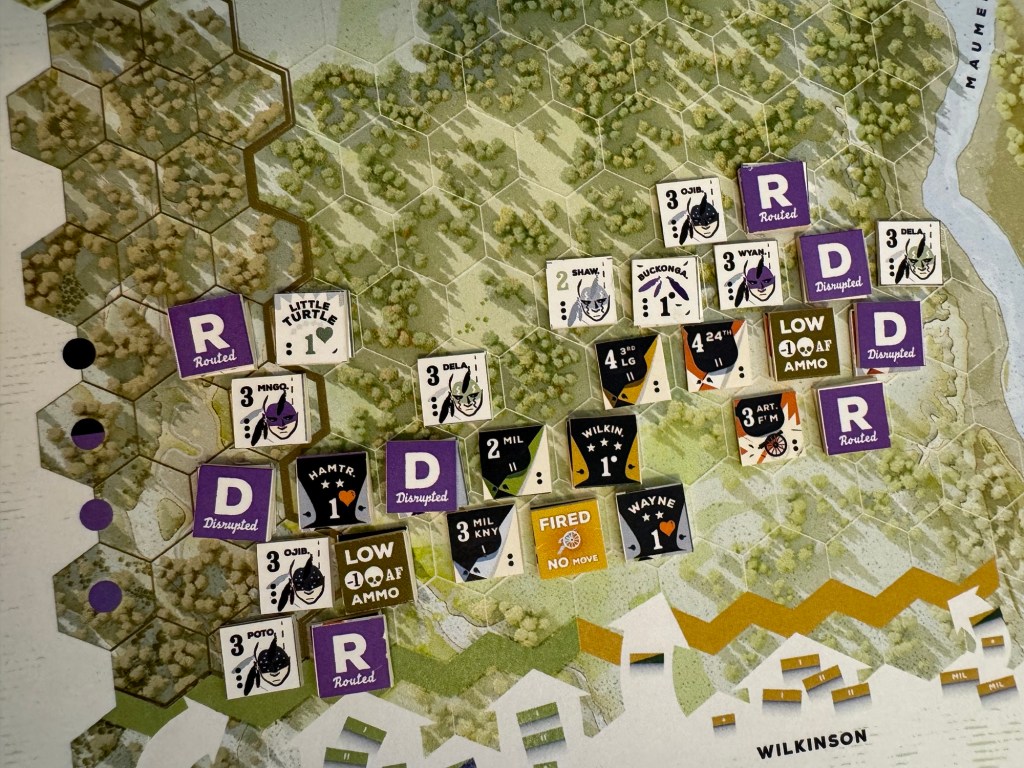
The functionality of the board is also very good as the terrain types are listed at the top of the board and are very clear as to what is considered in that category. The Record Keeping Track is shown at the top left of the board and is a very important part of the game as here are tracked Morale, which determines how effectively the different units fight and how easy they are to Rally after they have been Disrupted in combat and the victory points.
Overall, we really enjoyed our play experience with Walking a Bloody Path: The Battle of Fallen Timbers, August 20, 1794 from High Flying Dice Games. Really easy rules, a good combat system that realistically evokes the bloody hand to hand style combat that would have characterized these vicious battles and the board itself. It is a thing of beauty and is one of the best canvases I have had the opportunity to play on. I really enjoy Nils’ style and his efforts with contours and elevations to give his maps a simple 3D look without showing these layers explicitly.
Here is a look at our unboxing video for Walking a Bloody Path: The Battle of Fallen Timbers, August 20, 1794:
Here also is a link to our interview with the designer Paul Rohrbaugh and you can read that at the following link: https://theplayersaid.com/2019/05/15/interview-with-paul-rohrbaugh-designer-of-walking-a-bloody-path-the-battle-of-fallen-timbers-august-20-1794-from-high-flying-dice-games/
We also did a video review and you can watch that at the following link:
Finally, if you are interested in Walking a Bloody Path: The Battle of Fallen Timbers, August 20, 1794 you can order a copy for $16.95 from the High Flying Dice Games website at the following link: https://www.hfdgames.com/timbers.html
The next board that we will take a look at in the series is All Bridges Burning: Red Revolt and White Guard in Finland, 1917-1918 from GMT Games designed by V.P.J. Arponen and illustrated by Chechu Nieto.
Here are links to the previous entries in the series:
Kekionga!: A Dark and Bloody Battleground, 1790 from High Flying Dice Games
Campaigns of 1777 in Strategy & Tactics Magazine #316 from Decision Games
Battle Hymn Volume 1: Gettysburg and Pea Ridge from Compass Games
From Salerno to Rome: World War II – The Italian Campaign, 1943-1944 from Dissimula Edizioni
This War Without an Enemy: The English Civil War 1642-1646 from Nuts! Publishing
Holland ‘44: Operation Market-Garden, September 1944 from GMT Games
Maori Wars: The New Zealand Land Wars, 1845-1872 from Legion Wargames
Imperial Struggle: The Global Rivalry – Britain & France 1697-1789 from GMT Games
Stilicho: Last of the Romans from Hollandspiele
Nevsky: Teutons and Rus in Collision, 1240-1242 from GMT Games
A Most Fearful Sacrifice: The Three Days of Gettysburg from Flying Pig Games
Donnerschlag: Escape from Stalingrad from VUCA Simulations
Keep Up the Fire!: The Boxer Rebellion Deluxe Edition from Worthington Publishing
Liberty or Death: The American Insurrection from GMT Games
Lanzerath Ridge: Battle of the Bulge from Dan Verssen Games
Salerno ’43: The Allied Invasion of Italy, September 1943 from GMT Games
Bayonets & Tomahawks: The French and Indian War from GMT Games
Undaunted: Normandy from Osprey Games
Traces of War from VUCA Simulations
SCS Ardennes II from Multi-Man Publishing
Almoravid: Reconquista and Riposte in Spain, 1085-1086 from GMT Games
-Grant


The artwork of the map is beautiful. I love the style and what grabs me is it’s not the same thing that is being produced for war games. It reminds me of the art for the game 1812! War on the Great Lakes Frontier by Compass Games. It has style and personality! 🙂
LikeLiked by 1 person
Indeed Grant, the work of Iván Cáceres on the game maps for 1812! War on the Great Lakes Frontier should be on your list to review!
LikeLiked by 1 person
Yes that board is absolutely gorgeous! We have yet to play the game but when we do I am sure that it will find its way into a post in this series!
LikeLike
I agree – this is a beautiful map. On the flip side, their maps for their recently released TYW games are bland, colorless, and without much character. I was looking forward to the TYW games, but the maps have me holding off for now.
LikeLiked by 1 person
Which games?
LikeLike
ECW games “Boldness and Courage Unto Them”, “Three Hoorays for the King”, “A Most Frustrating Fight”, and “The Dawn of Revolution”. I incorrectly recalled them as TYW (which I believe they’ll also be publishing).
LikeLiked by 1 person
Got it. I was going over and over the TYW acronym and was coming up blank. If you’d said ECW I would have got it. Thanks.
LikeLike