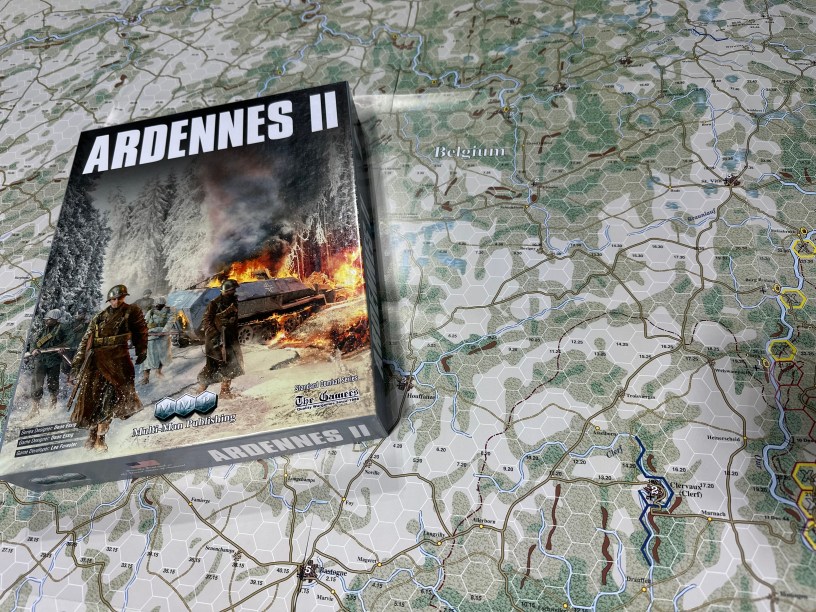
Continuing along in this new series devoted to the best looking boards found in the wargaming world where I will highlight the art and layout of a different board in a wargame that we have played to show you the various talents of the artists and graphic designers involved. In my humble opinion, a well designed and attractive board can make all the difference in the world to me enjoying a wargame. Don’t get me wrong, the game has to be good, but if it’s also good looking it always is a better experience. A board can draw me in. Can make me feel that I’m there. Can set the stage for the thematic immersion that we all crave. And I have found many of these type of boards and I want to make sure that I share them with you.
Not often does a game get a 2nd Edition. And even more rare is a 2nd Edition with new rules, new art and new graphics. But in 2023, SCS Ardennes has done just this with the release of Ardennes II from Multi-Man Publishing. Ardennes II is a part of the Standard Combat Series and is a reissuing of the award-winning game Ardennes from 1994. The new edition uses the additional research available from BCS Last Blitzkrieg, which was published in 2016, and also changes some basic concepts from the SCS system.
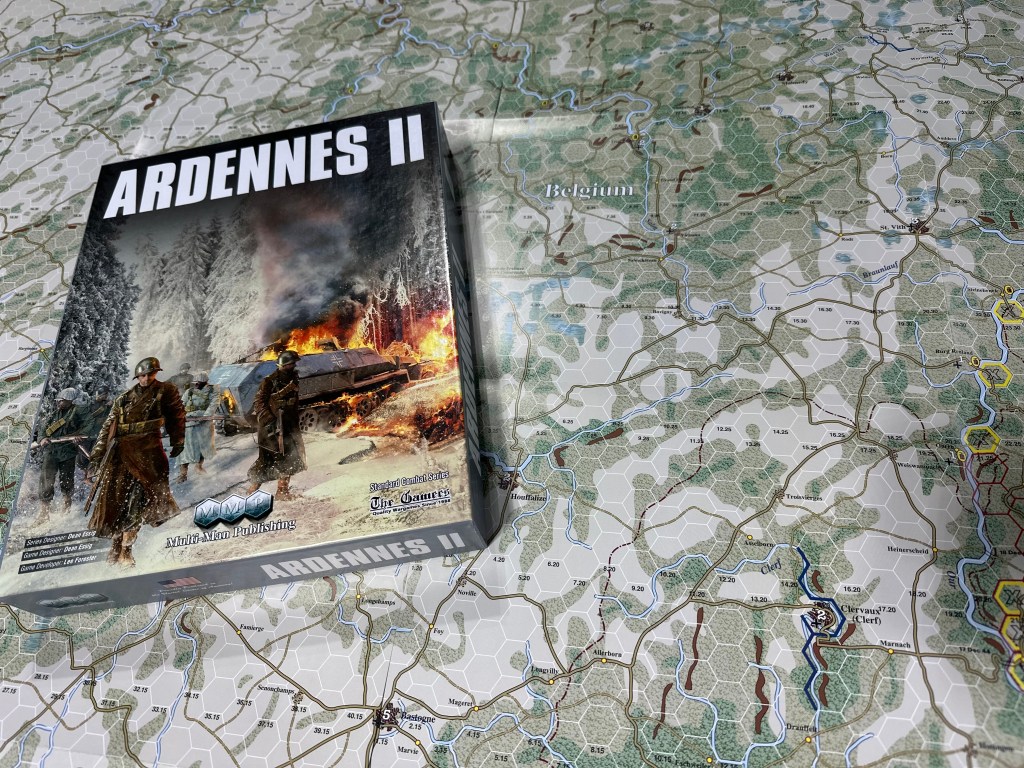
The artist and designer for the game is the late Dean Essig, who also designed not only the Standard Combat Series from The Gamers, but also designed many of the entries in that series. His SCS Series is really a great introductory wargame series that is known for its playability and also for its innovation found in each each entry as Dean tried to tailor the system to fit the campaign or operation being covered. Dean is a fantastic designer and we will miss him greatly but he has established a good solid network of acolytes in his various systems and his work will carry on in the next generation of great designers. With that being said, Dean has many artist credits out there as well including games such as OCS Enemy at the Gates from Multi-Man Publishing (1994), TCS Bloody Ridge (2005) from Multi-Man Publishing, BCS Baptism by Fire: Kasserine Pass (2017) from Multi-Man Publishing and OCS Crimea: Conquest & Liberation (2023) from Multi-Man Publishing. I think that his early work is simple yet effective but as he got better and more skilled and the years passed, he really has improved upon that functionality and playability and increased the aesthetic value of the boards he has illustrated. Such is the case with SCS Ardennes II.
The game features 2 large full-color 22″ x 34″ game maps. They are just gorgeous and when we played this game last year I was just stunned at the quality of the board. The color choices were just fantastic, although when paired with the counters created some difficulty in quickly identifying units. The hexes were clear and well marked and the various terrain features and landmarks were well highlighted. I think that it is important now though to discuss the general differences and improvements of the map as compared to the original edition Ardennes (1994).
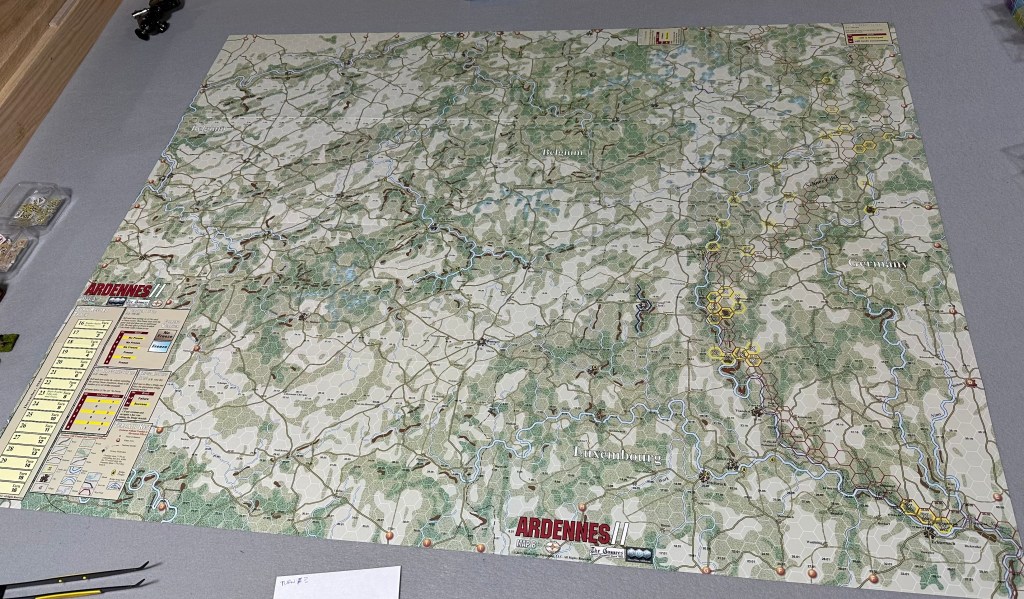
Because this is a new edition of the classic 1994 game, I wanted to first show you a simple comparison of the board from Ardennes to Ardennes II. Below is a picture that I found on Board Game Geek (credit to Philipe Muller aka @phimul). On the left is the original Ardennes board with the Ardennes II board on the right. The first thing that I would say about the main difference is just the vibrancy. On the left the colors are much more muted and hushed and fairly monochromatic in their approach. Yes I see that they have used green and white for the board but the forests in particular are all the same uniform green color. Now compare that to the Ardennes II retouch on the right and you will see that the forests have now been further delineated with several different colors of green representing heavier woods versus light woods. Dean also replaced the off white with more of a creamy color for the clear terrain and I actually really like this contrast better as it seems lighter and makes the green have more of an impact. The one thing that I am not sure is a improvement is that the road brown used is a bit lighter and thinner than what was used with Ardennes. I just don’t feel that the roads stand out as clearly as they did previously. But, overall the aesthetic and color changes to the board have made a big difference and create a more inviting and interesting playing surface.
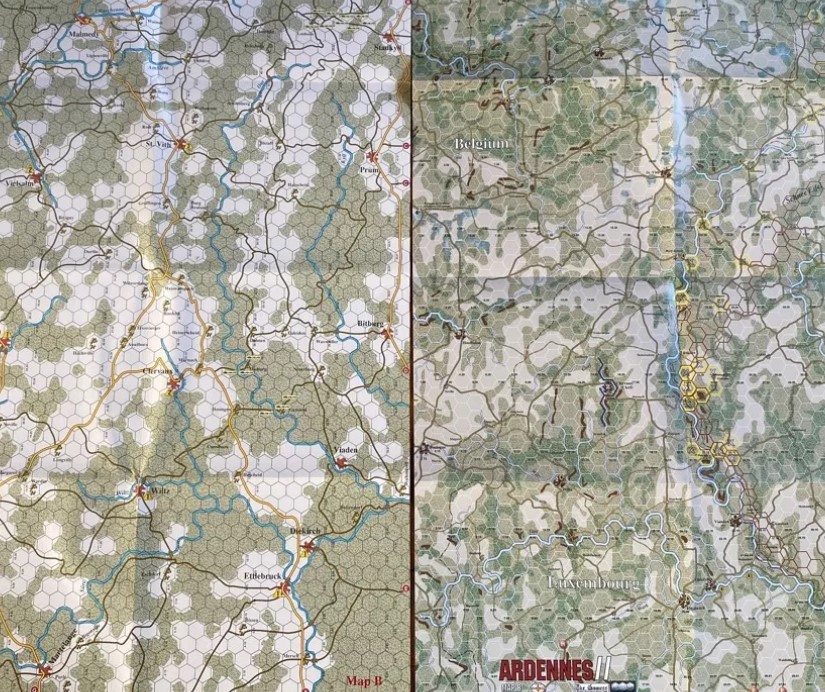
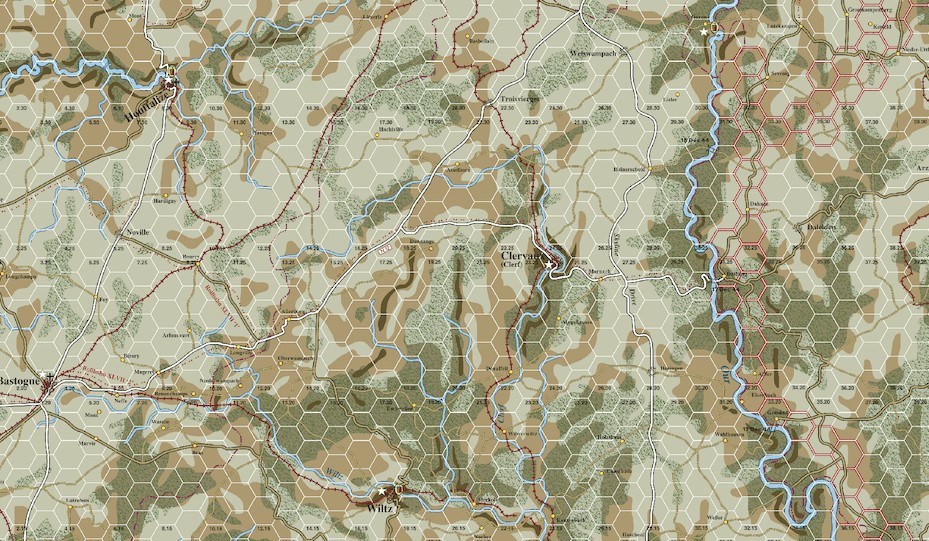
Here is another swath of the board that shows the bottom of the board at the right of the picture and you just barely see Bastogne on the left side of the board. One thing that I want to point out here is the use of the red highlighted hexes on the right side of the board which are the starting hexes for the German setup. I really like when wargames give these type of onboard aids to play that make the game that much easier to get into and get going.
As I look at the totality of this part of the board, it really has a very clean and nice look that draws me in and makes me want to explore the playing surface. I think contrast is always one of the most important parts of graphic design as it gives our eyes something else to focus on and keeps us locked in on the image. Without a solid contrasting background, it is very easy to get lost on the board and feel like everything is simply the same. Dean did a really nice job with this touchup and I applaud his efforts.
One of the historical elements that need to be properly modeled in this situation is the concept of lots of single lane country roads and their capacity to carry heavy tanks, trucks and other vehicles. To this end, the game focuses on an abstract method to do with the addition of Traffic Hexes. Traffic Hexes are shown on the map with a yellow highlight in the hexes with a large X in the center. These hexes will apply a DG Marker to any German units that start movement in or enter these hexes as they simulate the trouble with driving lots of tanks, trucks and other vehicles on the small one lane roads throughout the Ardennes. You can stack in the Traffic Hex, but only if you move the units as a stack into it. If you send one unit into the hex, no others can enter it. Once you move a stack in there, the hex becomes prohibited for all others afterward which is the intent of the designer to stop other units from entering whether just to go there, or to attempt to scoot past the traffic on the road by using the off-road MP costs.
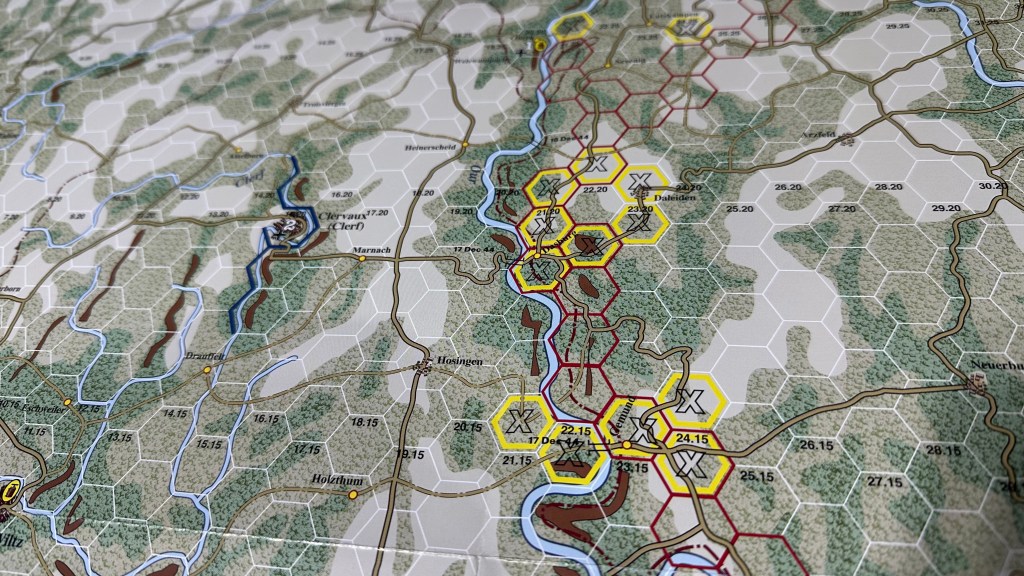
The end result of these hexes is that the Germans have a bear of a time moving their units at the outset and their progress is really slowed as this will turn into a real crawl as units will stack up and become ineffective with those DG Markers. After the Traffic Hexes are cleared, mobile units like tanks must stay on roads. The terrain here is very brutal and the roads have very weird loops and double backs into the same spaces which simulates these issues. Tanks also simply cannot enter the forested hexes and have to do their fighting from the road hexes.
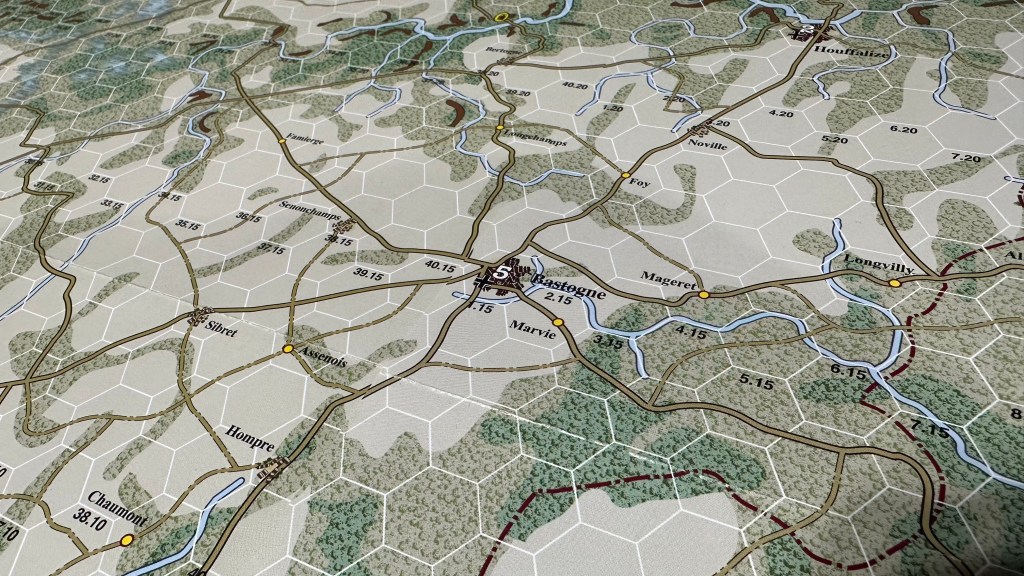
The final point I wish to focus on is the very important role and position of Bastogne. As we all know, Bastogne is where the 101st Airborne made their stand to hold the Germans at bay until the cavalry could arrive. German armored divisions encircled the town and quickly outnumbered as well as outgunned the staunch defenders. Running out of food, ammunition, and medical supplies, the embattled assistant division commander, Brigadier General Anthony McAuliffe, faced an almost now win situation and on December 22nd, the American troops received an ultimatum from the German forces outside of Bastogne demanding “the honorable surrender” of the town within two hours. General McAuliffe’s reply was brief, ballsy and succinct:
“To the German Commander:
N U T S !
–The American Commander”
Having made their position clear, the Americans dug in and waited for the attack. Contrary to German expectations, the 101st held out and reinforcements arrived in the form of the US Army’s 4th Armored Division. The Battle of the Bulge continued for several more weeks, with thousands of casualties on both sides, but by the end of January 1945, the Allies had retaken all the territory lost to the Germans and were headed toward Berlin. Bastogne encompasses just 1 hex on the board but you will notice the large 5 shown. This is the surrender value and the game has the players count this down when various things happen and when it reaches zero it will surrender.
The Standard Combat Series is quickly becoming one of my favorite WWII systems and for good reason as the mechanics make sense but are also very playable. I really love the push your luck nature of playing the Germans here in Ardennes II and the many decisions forced upon players about how to best use their limited artillery and where to fall back and defend. I really like the addition of the retreat before combat rule and the ZOC Bonds as they created a very interesting puzzle for both sides. I would play this one again in a heartbeat and really would like to get this back to the table soon.

I really liked the board for SCS Ardennes II and really feel that this type of improvement will enhance and increase the enjoyment of this great system for new players. I would say keep releasing these 2nd editions so that I can get them all and play them.
Here is a link to our unboxing video so you can get a closer look at the components:
Here also is a link to our video review:
The next board that we will take a look at in the series is Almoravid: Reconquista and Riposte in Spain, 1085-1086 from GMT Games designed by Volko Ruhnke and illustrated by Chechu Nieto.
Here are links to the previous entries in the series:
Kekionga!: A Dark and Bloody Battleground, 1790 from High Flying Dice Games
Campaigns of 1777 in Strategy & Tactics Magazine #316 from Decision Games
Battle Hymn Volume 1: Gettysburg and Pea Ridge from Compass Games
From Salerno to Rome: World War II – The Italian Campaign, 1943-1944 from Dissimula Edizioni
This War Without an Enemy: The English Civil War 1642-1646 from Nuts! Publishing
Holland ‘44: Operation Market-Garden, September 1944 from GMT Games
Maori Wars: The New Zealand Land Wars, 1845-1872 from Legion Wargames
Imperial Struggle: The Global Rivalry – Britain & France 1697-1789 from GMT Games
Stilicho: Last of the Romans from Hollandspiele
Nevsky: Teutons and Rus in Collision, 1240-1242 from GMT Games
A Most Fearful Sacrifice: The Three Days of Gettysburg from Flying Pig Games
Donnerschlag: Escape from Stalingrad from VUCA Simulations
Keep Up the Fire!: The Boxer Rebellion Deluxe Edition from Worthington Publishing
Liberty or Death: The American Insurrection from GMT Games
Lanzerath Ridge: Battle of the Bulge from Dan Verssen Games
Salerno ’43: The Allied Invasion of Italy, September 1943 from GMT Games
Bayonets & Tomahawks: The French and Indian War from GMT Games
Undaunted: Normandy from Osprey Games
Traces of War from VUCA Simulations
-Grant
 The Players' Aid
The MMP map style wasn’t fully appreciated by me at first but it is really starting to grow on me. I am starting to dip my toes into BCS and OCS and am really loving Dean’s maps.
I’ll have to consider SCS as well!
Ben
LikeLiked by 1 person
SCS is just good clean fun. Very good system. We are loving BCS but need to get into an OCS game soon.
LikeLike
Love this game. I own both the original and this one and both are great. The graphics on this one though are a thing of beauty.
LikeLiked by 1 person