Continuing along in this series devoted to the best looking boards found in the wargaming world where I will highlight the art and layout of a different board in a wargame that we have played to show you the various talents of the artists and graphic designers involved. In my humble opinion, a well designed and attractive board can make all the difference in the world to me enjoying a wargame. Don’t get me wrong, the game has to be good, but if it’s also good looking it always is a better experience. A board can draw me in. Can make me feel that I’m there. Can set the stage for the thematic immersion that we all crave. And I have found many of these type of boards and I want to make sure that I share them with you.
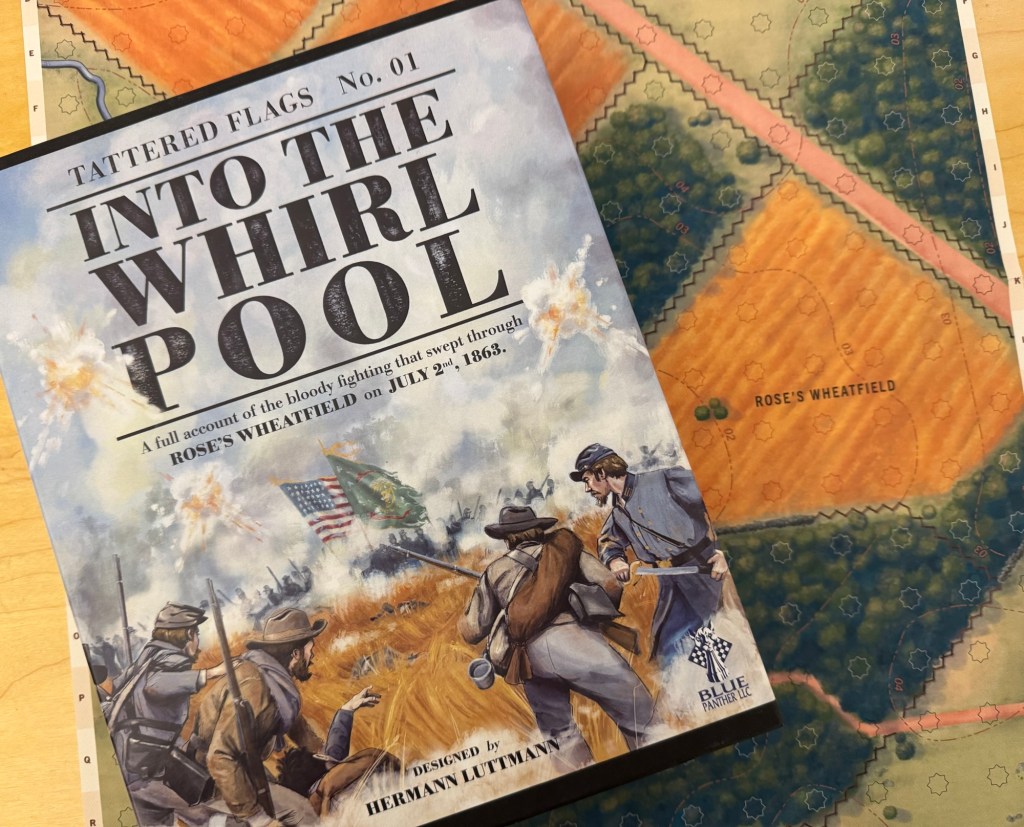
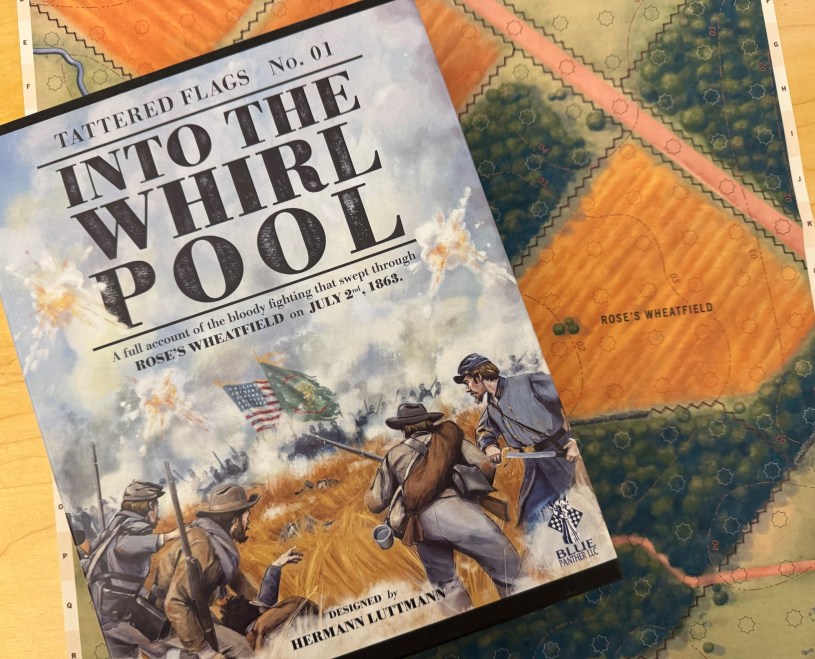
In this entry in the series, we will be taking a look at the fantastic looking board for Tattered Flags No. 01 – Into the Whirlpool from Blue Panther. The artist for the game is the very talented Alex Zatarain who is an experienced Landscape Architect, Graphic Designer and artist but is a newcomer to the world of wargame board design and graphics. But, that hasn’t stopped him from making a huge splash with his first game! At this point, Alex has only done graphics for 2 games including Tattered Flags No. 01 – Into the Whirlpool and The Pursuit of John Wilkes Booth both from Blue Panther. Into the Whirlpool is a tactical American Civil War design that really has the feel of a miniatures game with the way units move and the facing of those units on the battlefield. The game covers the engagement around Rose’s Wheatfield at the Battle of Gettysburg on July 2, 1863. The Wheatfield was a key location of very intense fighting where George Rose’s farm property included the 20-acre field known simply as “The Wheatfield”, which was situated between Devil’s Den and the Peach Orchard. The Wheatfield saw brutal combat and significant casualties during the battle, with Union and Confederate forces battling fiercely for control of the area.
The really interesting part of the game is the way the map is laid out. It doesn’t use traditional hexes but uses star shapes that act as hexes but are called 8-pointed spaces. The rules are really tight and crunchy as to hit rolls are expressed in percentages and players roll 2d10 with one die identified as the lead. I have played the game twice now and very much enjoy its fast pace and action packed sequencing as the game is in your face and up front.
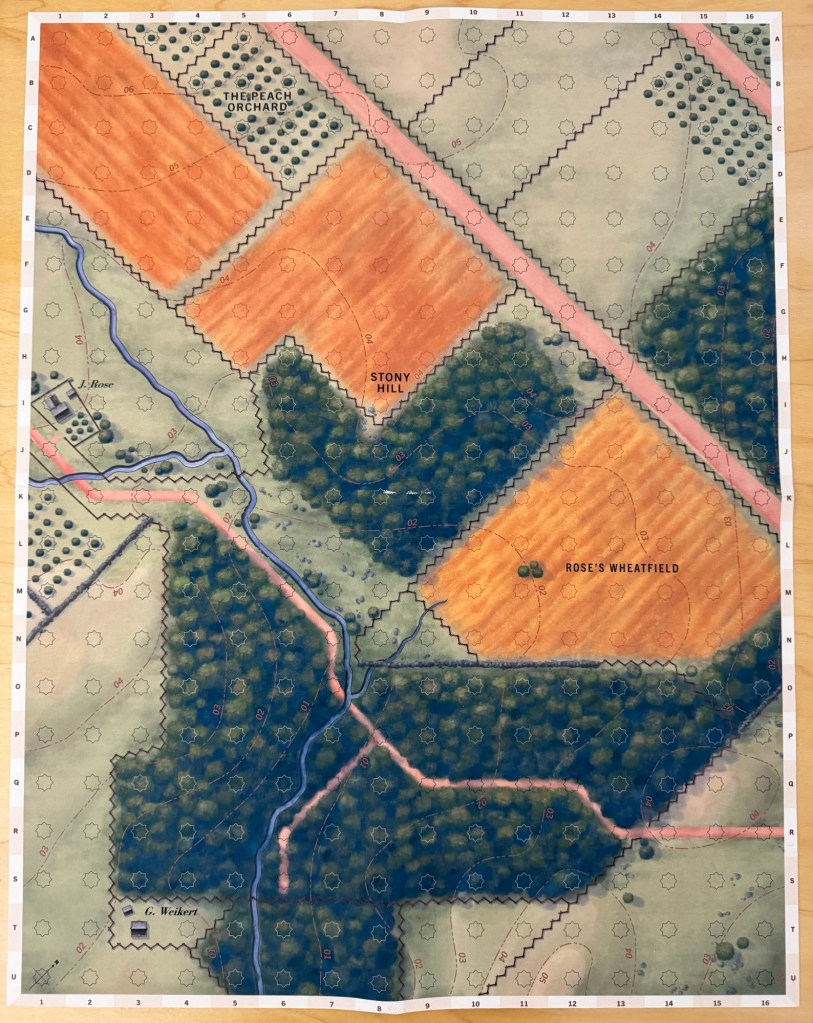
The game includes a 17 x 22″ canvas map that adds a really nice touch to the game and feels a bit more period to me for an American Civil War game. The game occurs in this small area of the battlefield and the small size of the board, which I think was a deliberate choice, really keeps the action hot and heavy and works really well to tell the story of this key tactical small scale battle where roughly 20,000 troops fought on a tract of land about 20 acres in size. As you can see in the picture below, the board is ringed by numbers on the top and bottom ranging from 1-16, and letters along the left and right sides ranging from A-U. These aid in the setup of units on the board at the beginning of each scenario and was very helpful.
The focus of the board is the area of Rose’s Wheatfield and Stony Hill. The key features here are Plum Run, a small stream that runs west of the field, and the remnants of stone walls that were used by soldiers for cover. The area was the site of intense fighting on July 2, 1863, and was known as a “whirlpool of death” because it changed hands multiple times. The Confederate troops come from the bottom of the map to cross over the Plum Run in the center where the Union troops are awaiting their advance hidden amongst the terrain in the woods and the behind the fences and the lone stone wall there.
In the zoomed in picture below, you can see the fantastic lines used by Alex to create the fields in the area, which are colored yellow representing the wheat that would have grown there. Faintly, you can make out the rows of plants and I love the very impressionist style of painting that he did here with great effect. The woods located in the center of the picture are also really well done. You can see the outline of the trees but they are all matted together to create a forest that feels like a very thick and lush tree canopy. The dark green color chosen for the trees really pops against the yellow and lighter greens used for the open fields and really creates a warm and inviting sense. I know that the fighting here was brutal but the backdrop in the board is really has a good aesthetic.
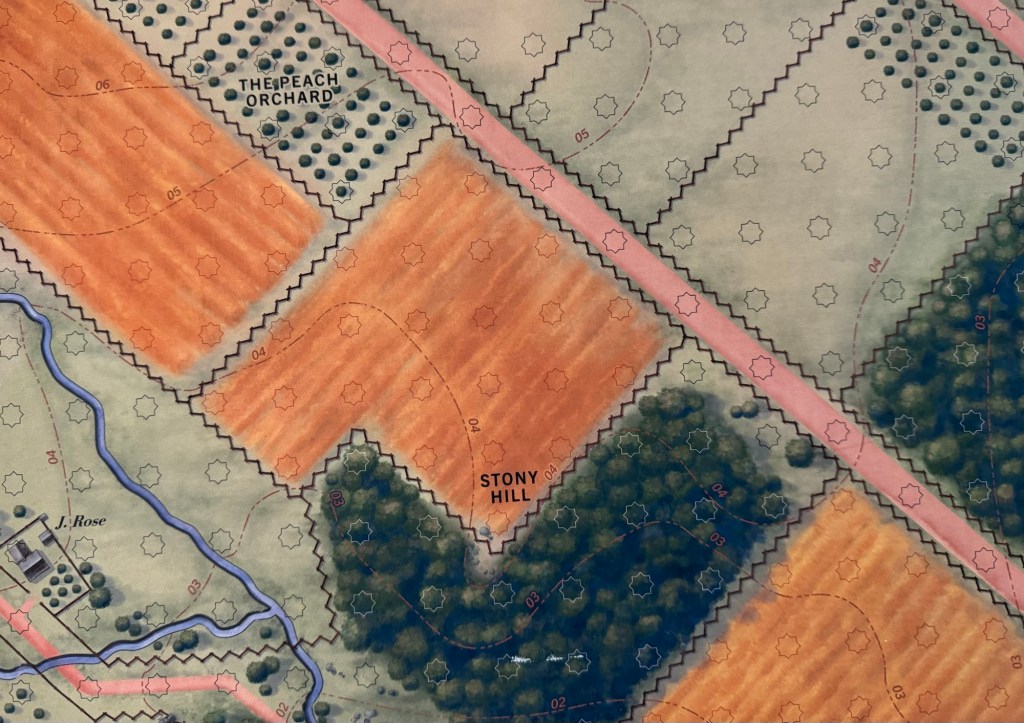
To the north of Stony Hill is located the Peach Orchard, which was a strategically important area of the battlefield, particularly on July 2, 1863, the second day of the battle. Union General Dan Sickles controversially moved his troops forward to the high ground of the orchard without orders, creating a vulnerable “salient” (a protrusion in the battle line) that the Confederates then attacked, leading to intense fighting and heavy casualties for the Union. The fighting in the Peach Orchard was part of a broader Confederate assault aimed at the Union left flank, which also included attacks on Devil’s Den, the Wheatfield, and Little Round Top.
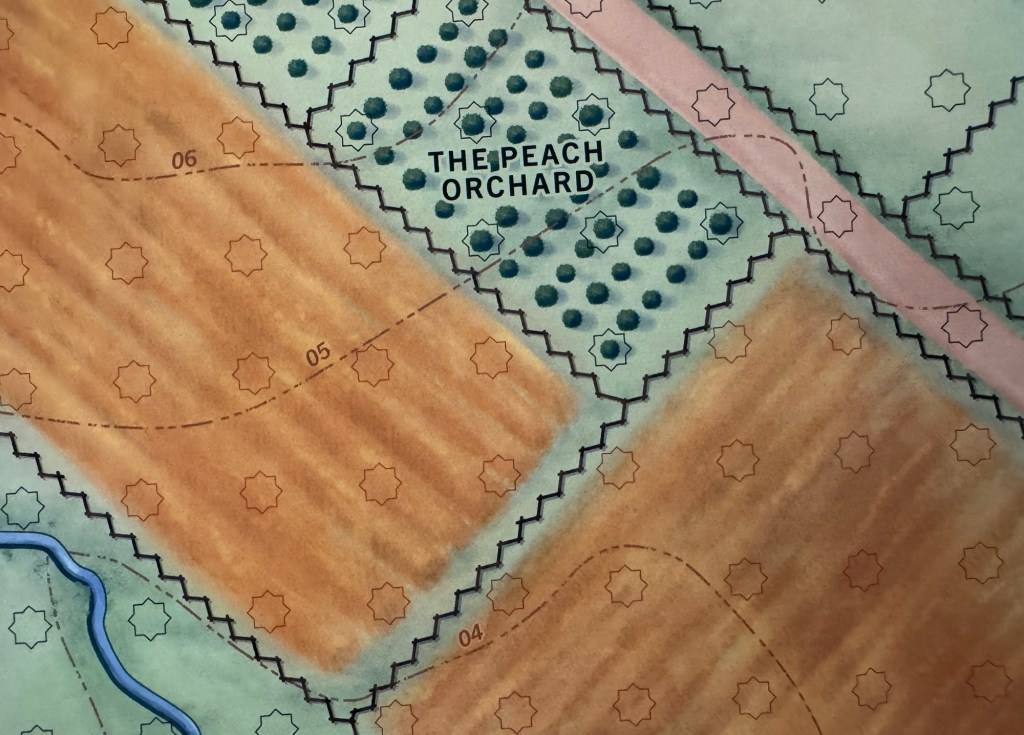
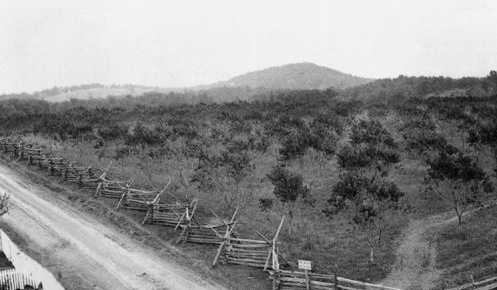
I very much like the way that the peach trees are shown on the board. At first glance, I thought they there were possibly spaced a bit too far apart from one another but as I did a bit more research I found the below picture of the Sherfy Orchard (commonly referred to as the Peach Orchard) that showed the tree spacing and it is a spot on match for what Alex did here. The orchard is also flanked by split-rail style wooden farm fences which also match the look of the original parcel. Just very well done research here on the geography and features of the battlefield that were included into the game on the board for added detail and immersion.
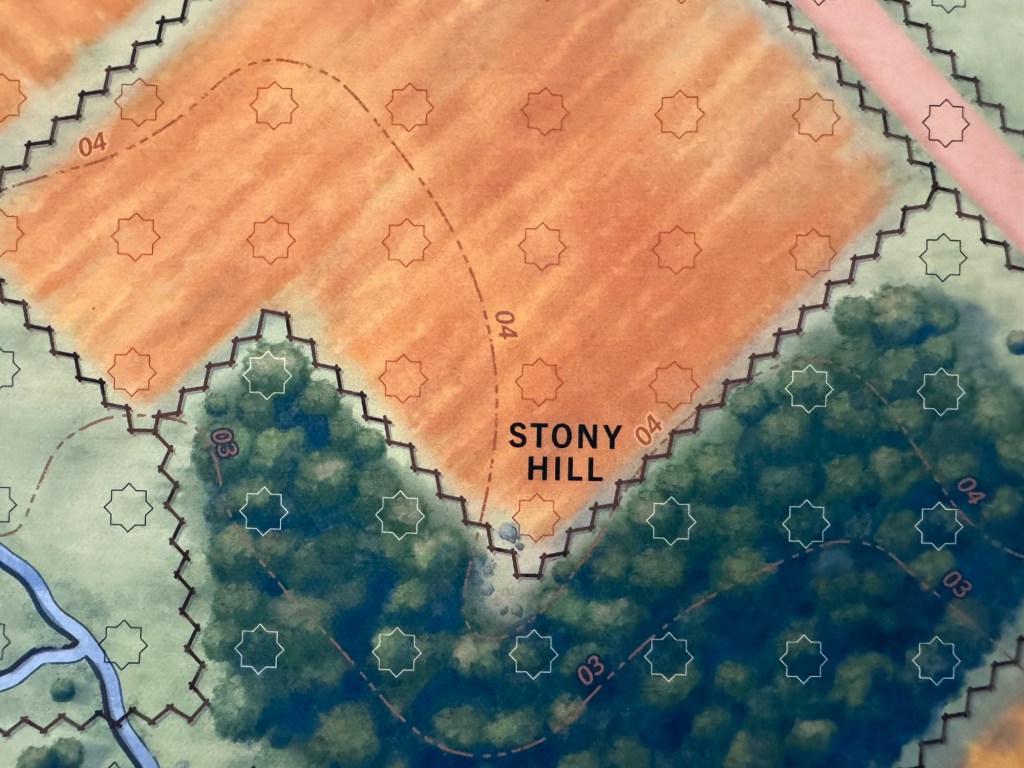
I want to go back to the Stony Hill area of the board for a moment and point out the contour lines that are shown here denoting the change in elevations on the battlefield. Alex did a nice job with the way he drew these contour lines and uses a dashed line approach to faintly outline the elevation without having it dominate the board and obscure the other aesthetic elements These contour lines are key for game play as plunging fire does give some modifiers to your to hit rolls and are something that the players want to be able to readily recognize when calculating the odds of attacks.
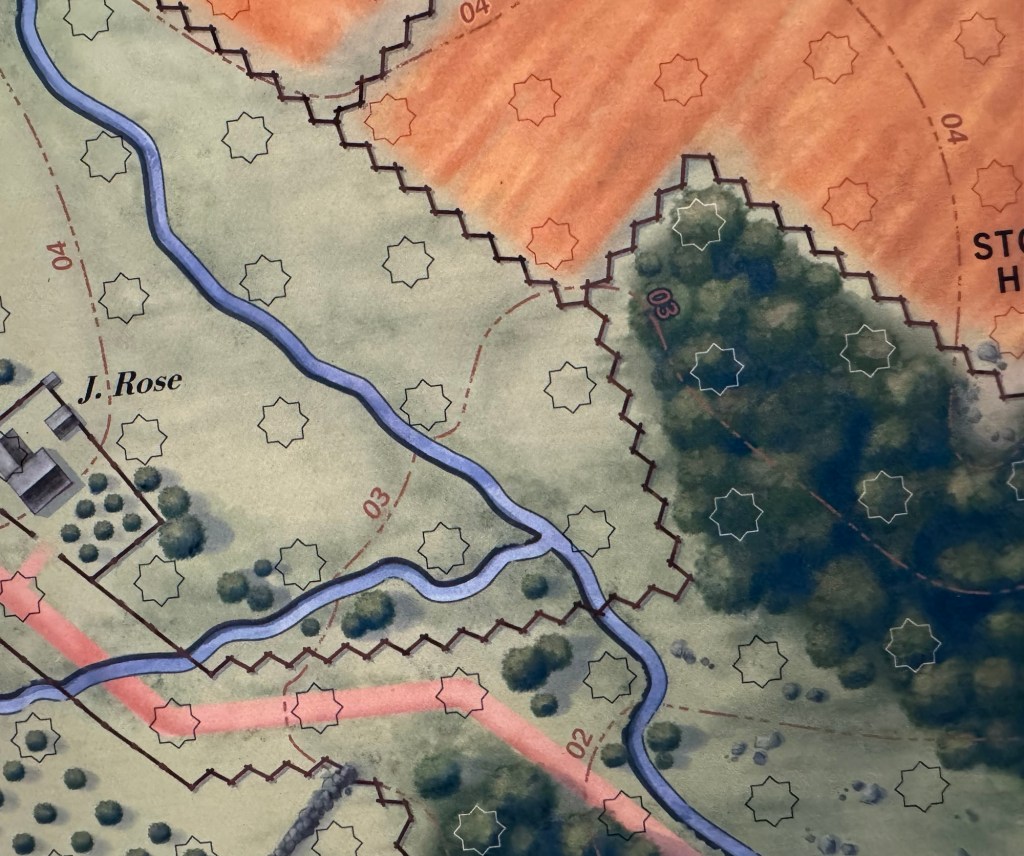
Next, I want to take a bit of a closer look at the way that the Plum Run is drawn on the board. As a waterway, you would imagine that blue is the best choice of color to highlight the creek and the blue used here is somewhat of a lighter color that complements the surrounding color pallet well. But, Alex added a gradient feel to the color that gives the impression of depth of the water as you follow the run of the creek. He also used a thick black line for the south bank of the creek that really shows the height and change in elevation of the area.
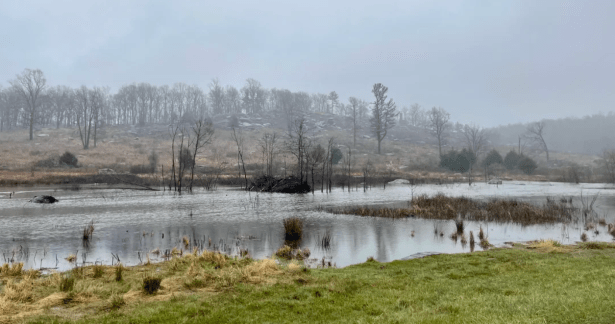
Here is a look at an actual photo of the Plum Run, more near Little Round Top, that shows a flooded creek that was taken in April 2024. At this point, the creek is flowing over its banks but you can still make out the banks and the elevation of them. The creek would have been much lower at the time of the battle on July 2, 1863.
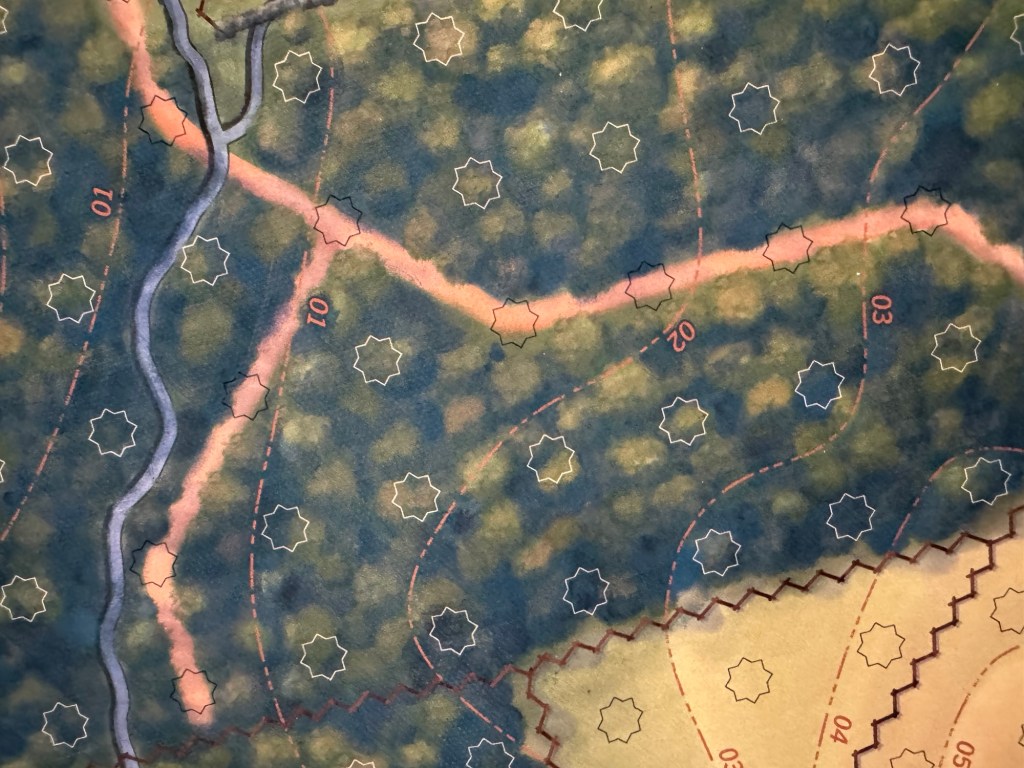
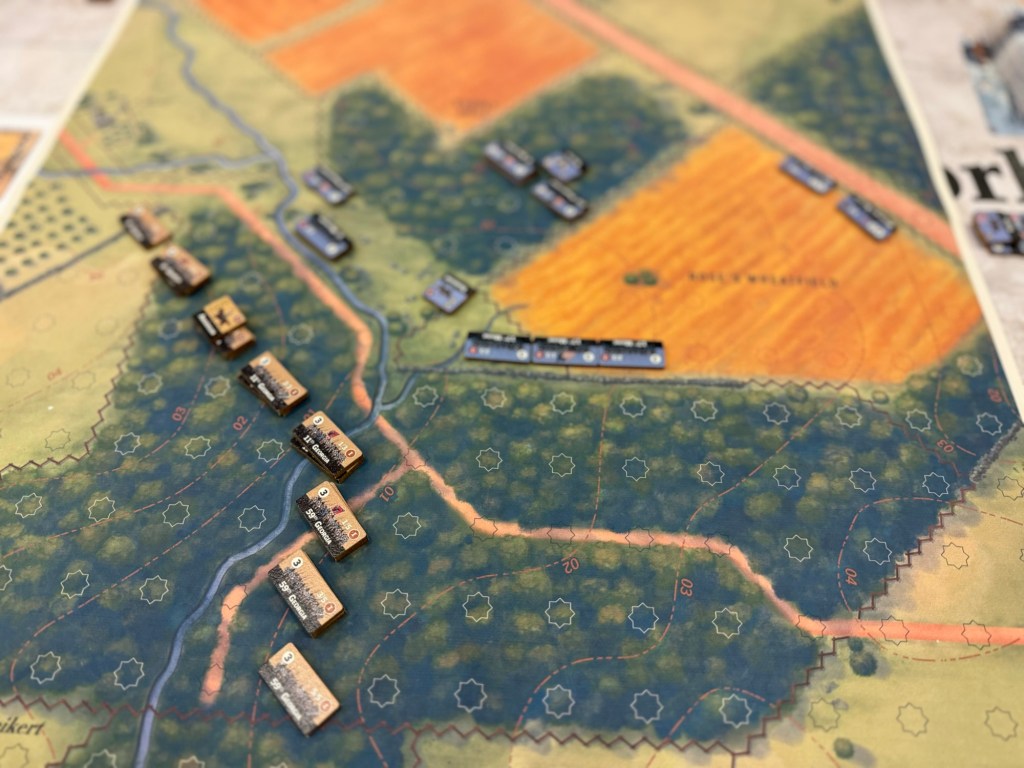
Here is a bit of closer look at the creek as it winds through the woods and I very much like the use of a white outline for the 8-pointed spaces to make these important points stand out amongst the trees. The other aspect I like here is the way the road is shown. First, I like the color chosen, which seems to be a bit of a rosy sand color that would have been a dirt road at the time of the battle. But I also like that you can see the edges of the trees bleeding over into the road itself to create the feel of a wooded area and the confined nature of the small one lane road through the trees. These small graphical touches really create a unique feel to the board and helps me to get into the feeling of the battle.
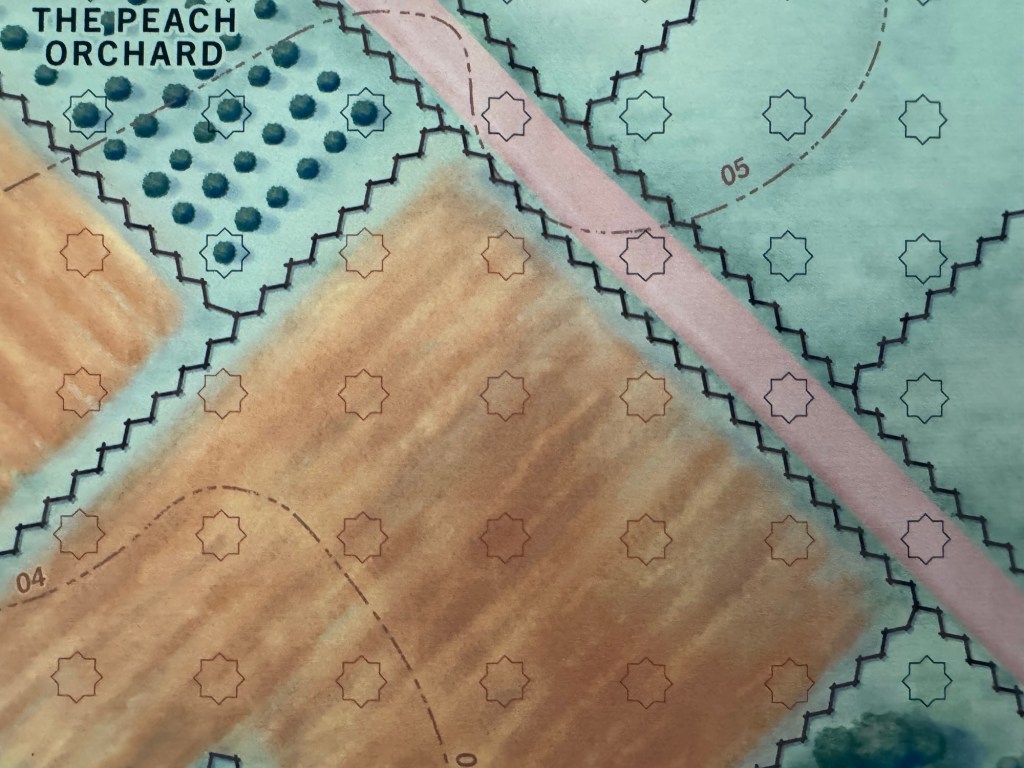
Also here is a closer look at the Peach Orchard and the Emmitsburg Road that runs alongside it on the battlefield. The orchard was located at the intersection of the Emmitsburg Road and the Wheatfield Road. Here is used the same rosy sand color but the Emmitsburg Road is shown as nearly twice the size of the other secondary roads through the woods. I also really like the split-rail fences that flank the road on both sides and that are connected to other fields and the Peach Orchard in the area. These split-rail fences was the most common type on the battlefield and did not require the digging of post holes. Instead, the zig-zag pattern of stacked, split rails provided stability, making them easy to assemble and dismantle. While a prominent feature, they were a less formidable barrier for soldiers than post-and-rail fences and offered a bit of protection from the hail of lead bullets fired on the battlefield.
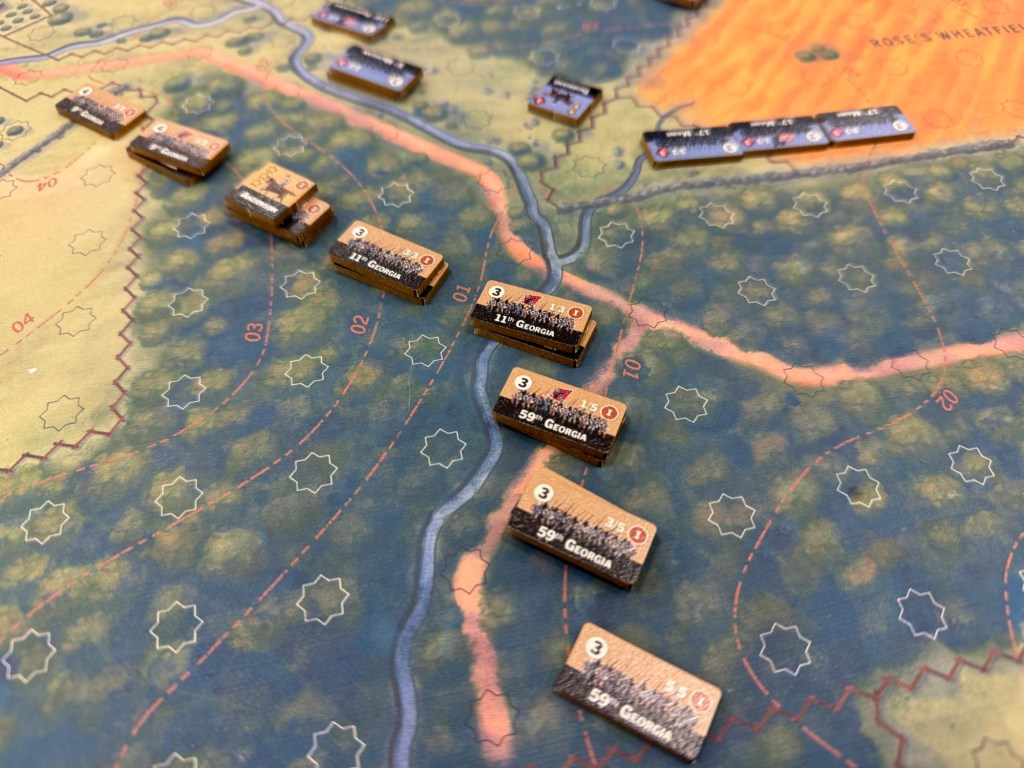
And once the counters are setup on the board, with their rectangular orientation and shape, the game really pops and I really like the visual impression that the game conveys.
I very much like this game and the very innovative 8-sided star-based movement system and the detailed and beautiful battlefield map, which effectively simulates linear combat and unit formations. I was also very impressed by the system’s ability to provide a visceral miniatures-like combat feel using cardboard counters. The tactical depth offered by the order system and the “miniatures game as a board wargame” approach really simplifies setup and play while maintaining strategic complexity and the overall intense feeling of the fighting that occurred at the Wheatfield. Just a great little game with a very fine artistic approach to the board as well by Alex Zatarain.
If you are interested in Tattered Flags No. 01 – Into the Whirlpool, you can order a copy for $70.00 from the Blue Panther website at the following link: https://www.bluepantherllc.com/products/tfwhirlpool
The next board that we will take a look at in the series is Alliance: Multiplayer Napoleonic Wargame from Columbia Games.
Here are links to the previous entries in the series:
Kekionga!: A Dark and Bloody Battleground, 1790 from High Flying Dice Games
Campaigns of 1777 in Strategy & Tactics Magazine #316 from Decision Games
Battle Hymn Volume 1: Gettysburg and Pea Ridge from Compass Games
From Salerno to Rome: World War II – The Italian Campaign, 1943-1944 from Dissimula Edizioni
This War Without an Enemy: The English Civil War 1642-1646 from Nuts! Publishing
Holland ‘44: Operation Market-Garden, September 1944 from GMT Games
Maori Wars: The New Zealand Land Wars, 1845-1872 from Legion Wargames
Imperial Struggle: The Global Rivalry – Britain & France 1697-1789 from GMT Games
Stilicho: Last of the Romans from Hollandspiele
Nevsky: Teutons and Rus in Collision, 1240-1242 from GMT Games
A Most Fearful Sacrifice: The Three Days of Gettysburg from Flying Pig Games
Donnerschlag: Escape from Stalingrad from VUCA Simulations
Keep Up the Fire!: The Boxer Rebellion Deluxe Edition from Worthington Publishing
Liberty or Death: The American Insurrection from GMT Games
Lanzerath Ridge: Battle of the Bulge from Dan Verssen Games
Salerno ’43: The Allied Invasion of Italy, September 1943 from GMT Games
Bayonets & Tomahawks: The French and Indian War from GMT Games
Undaunted: Normandy from Osprey Games
Traces of War from VUCA Simulations
SCS Ardennes II from Multi-Man Publishing
Almoravid: Reconquista and Riposte in Spain, 1085-1086 from GMT Games
Walking a Bloody Path: The Battle of Fallen Timbers, August 20, 1794 from High Flying Dice Games
All Bridges Burning: Red Revolt and White Guard in Finland, 1917-1918 from GMT Games
Storm Over Jerusalem: The Roman Siege from Multi-Man Publishing
Iron, Blood, Snow & Mud from PHALANX
North Africa ’41: The Western Desert, March to December, 1941 from GMT Games
Battles of the American Revolution Volume II: Brandywine from GMT Games
Ardennes ’44: The Battle of the Bulge from GMT Games
Gandhi: The Decolonization of British India, 1917-1947 from GMT Games
Battles of Napoleon: Volume I – Eylau 1807 from Sound of Drums
-Grant
 The Players' Aid
Such a gorgeous map! I’m tempted to use it as a poster.
LikeLiked by 1 person