
Continuing along in this new series devoted to the best looking boards found in the wargaming world where I will highlight the art and layout of a different board in a wargame that we have played to show you the various talents of the artists and graphic designers involved. In my humble opinion, a well designed and attractive board can make all the difference in the world to me enjoying a wargame. Don’t get me wrong, the game has to be good, but if it’s also good looking it always is a better experience. A board can draw me in. Can make me feel that I’m there. Can set the stage for the thematic immersion that we all crave. And I have found many of these type of boards and I want to make sure that I share them with you.
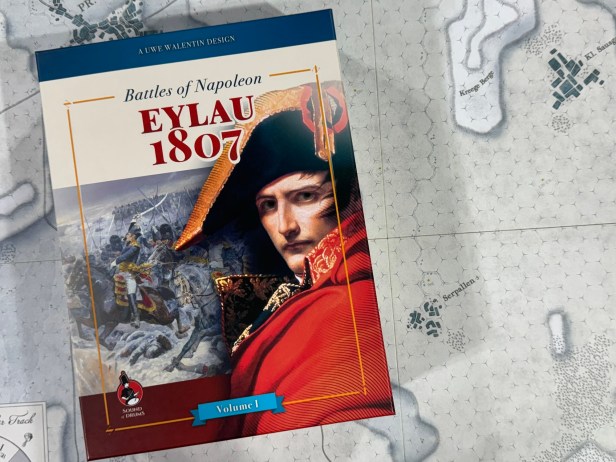
In this entry in the series, we will be taking a look at the fantastic looking board for Battles of Napoleon: Volume I – Eylau 1807 from Sound of Drums. This game is a fantastic example of a deep and interesting simulation of the period but with very approachable rules and mechanics designed to be able to appeal to any level of wargamer. While we didn’t experience the grand campaign game contained in the box, we did play a very approachable and relatively low counter density scenario that taught us the basics of the system and really gave us a taste for more! The artist for the game is the very talented Marc von Martial, who is a professional freelance graphic designer/graphic artist with over two decades experience as a professional in the design and gaming business. He provides services for game artwork for both digital and board games, map artwork, counter and game piece artwork, box and cover artwork and logo design and has worked for various publishers like Lock ‘n Load Publishing, Matrix Games, Slitherine, Hexasim, VUCA Simulations, Flying Pig Games, Collins Epic Wargames, Accurate Designs, Sound of Drums and others. Some games that show his artistic talent include 1793: Patriots and Traitors from Sound of Drums, Great War Commander from Hexasim, 1914: Nach Paris from VUCA Simulations and many other games.
The game includes two 22″ x 34″ mounted boards that when merged together create a full 44″ x 68″ playing surface that is just massive! It was a bit of an ordeal to get a picture with the full board and I had to stand up on a chair next to the table to get the below picture. As you can see, the boards join in the middle just to the north of the village of Preußisch Eylau. The seam works well if you lay out some heavy game boxes on top of the board to flatten it out before playing. While you can see the seam, it doesn’t distract from the play experience and frankly great care was taken to make sure that the boards join up well as the hexes are all impeccably aligned.
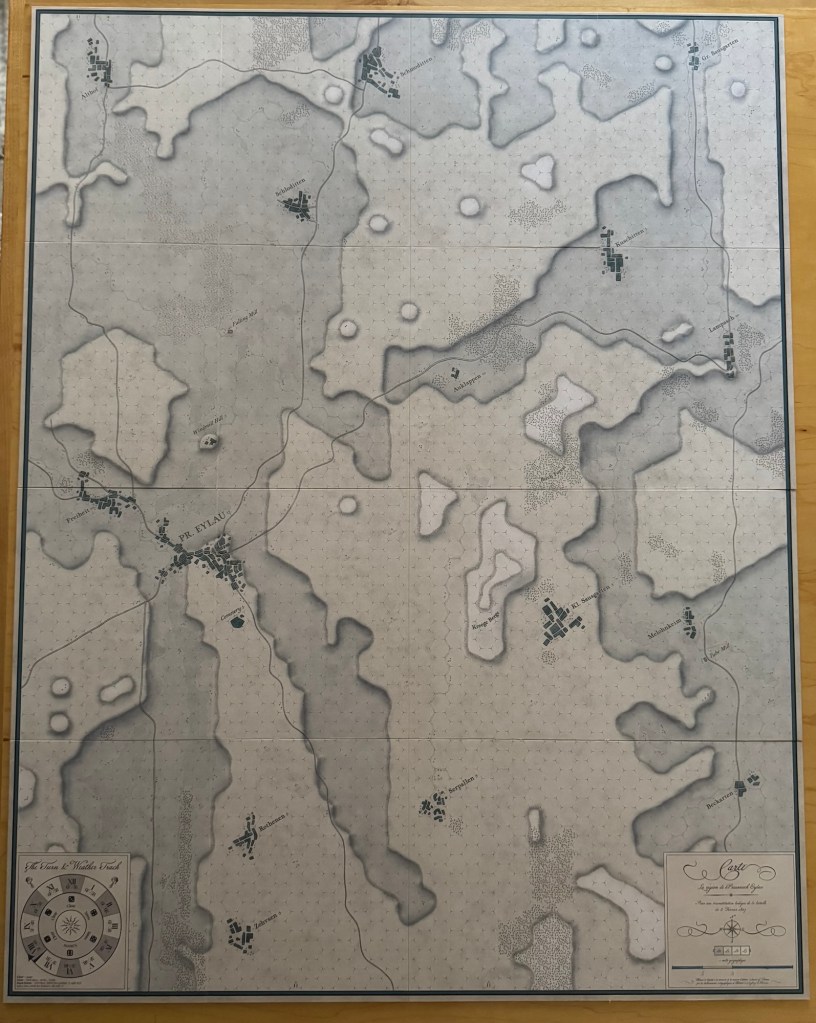
Marc’s work on the board for Eylau 1807 is simply phenomenal. I know that the board is mostly gray, white and black but the color scheme chosen just fits the topic and the circumstances of the battle. Remember, that the Battle of Eylau was fought during February 1807 and took place in East Prussia between the Grande Armée and Russia. The weather was extremely severe at the time, with temperatures as low as -22°F, and the battlefield was covered in snow, with some areas having up to three feet of snow, as well as all of the lakes and streams in the area being frozen solid. The shallow streams and rivers on the board also don’t have any effect on movement due to their frozen condition. The ground was also frozen and was as hard as concrete. The color scheme Marc chose conveys the feeling of the weather in my mind and truly fits with the history.
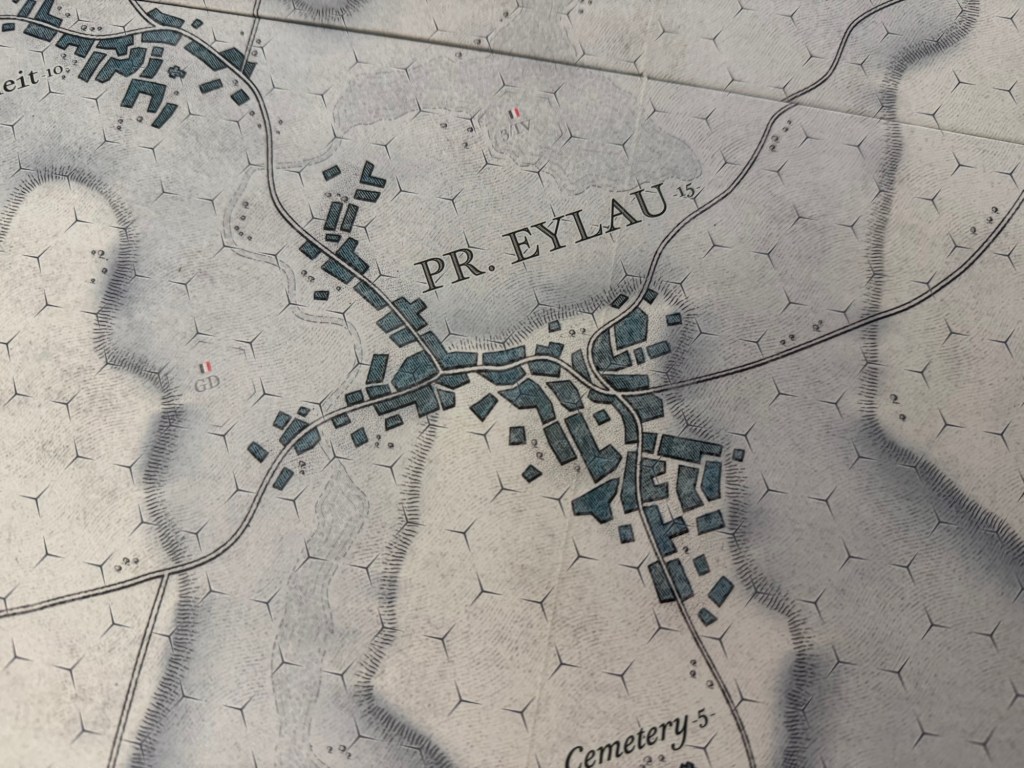
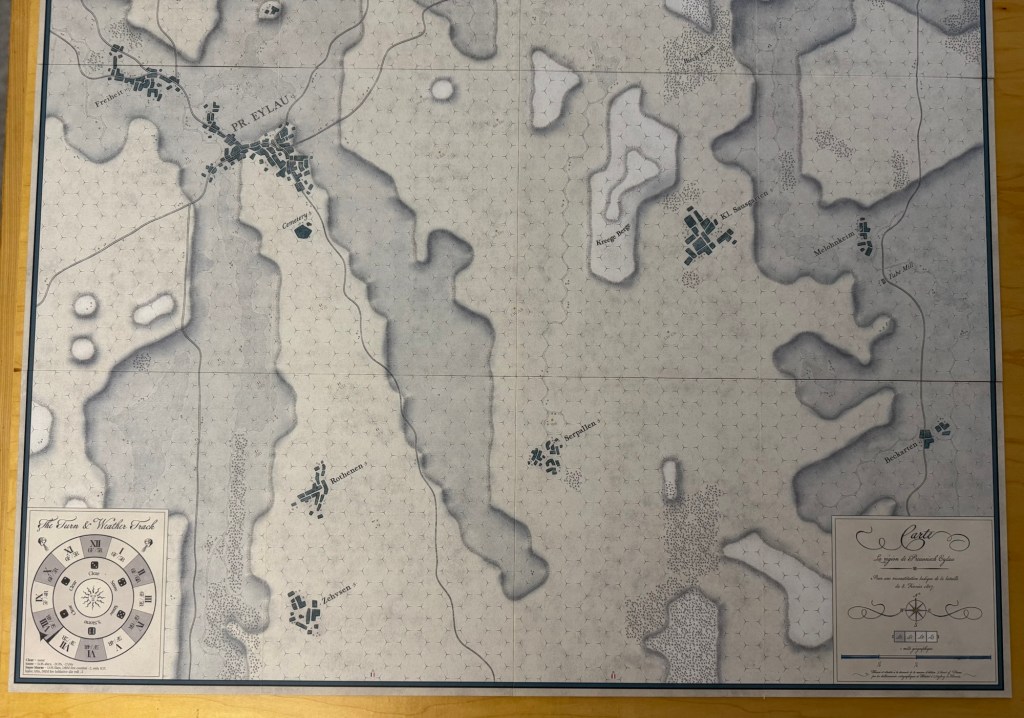
In the picture below, I wanted to take a look at the village of Preußisch Eylau, which was a Prussian village, now called Bagrationovsk in Russia and is located on the road to Königsberg, near two lakes and a small hillock with a church and cemetery. The village had a population of about 1,500 people at the time and was dwarfed by the forces for both sides as the French had 25,000 and the Russian-Prussian coalition had about 30,000. I love how the village is drawn here with polygons representing the homes and businesses of the time all located along the roads that lead to larger areas. The dark building shapes stand out against the backdrop of grey and white and give the players a real feeling of strength in the defense of this village. You can also see the elevations of the ground with the cross hatches that surround the lower half of the village. I also really like how Marc drew the streams and the lakes as they appear the same as the other background around them as they were frozen and in essence are all one hard surface. I just shiver when I look at the board!
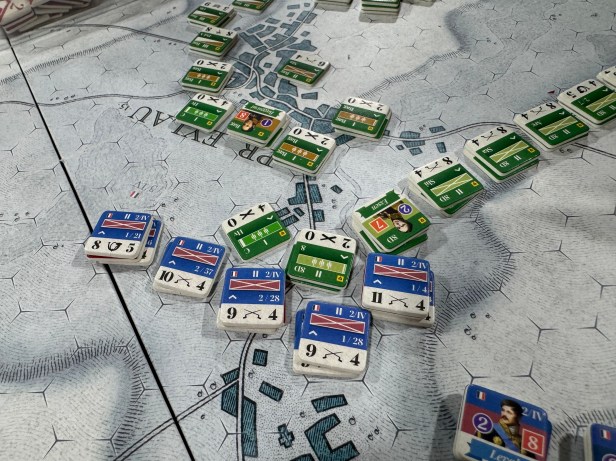
Also with the chosen color scheme as a backdrop, the unit counters really pop off of the board and create a very appealing looking view of the battle. The green of the Russian and Prussian units really stands out and the deep blue for the French units is also a great complement to the base neutral color scheme of the board. I think that when we set the game up that was the first thing that we noticed was how well the counters and the board worked together to create an overall impressive visual experience with the game.

I also very much liked the small details that Marc included in the stark and generally colorless landscape with the addition of trees, smaller outbuildings and even the rough texture of the ground that was used. You can see that texture well in the below picture in the area between the villages of Rothenen and Zehvsen. The use of this technique really added some depth to the otherwise basic backdrop and I really got the feel of the terrain from it. The trees are also very well done and create a very nice contrast to the land and it is unmistakable what that terrain represents.
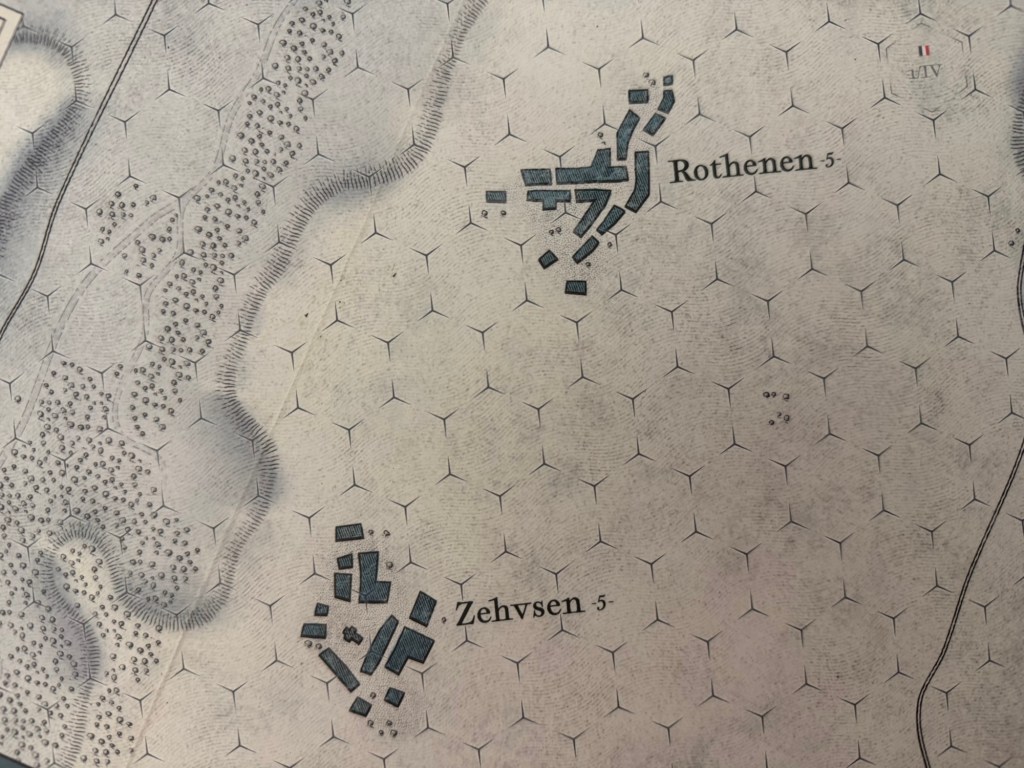
One other interesting element of the gameplay that is shown graphically next to all of the major objectives on the board are the Army Fatigue Point values. If you look closely at the names of the villages above, just to the right of the notation is a number. In this picture, both Rothenen and Zehvsen have values of 5 AFP’s noted. These are a few of the smaller values but some of the major villages and objectives have values of 10 to as high as 15. A player gains AFP’s for taking control of a geographical objective that was previously controlled by the opponent (and gets these AFP’s from his opponent) and gains 1 AFP for each Regroup Order taken. This is important because if you have too many AFP’s you will be unable to take certain Orders like attack. I very much appreciate that the numbers were listed on the board in easy view of the players as this helped us to understand better the impact of those various objectives.
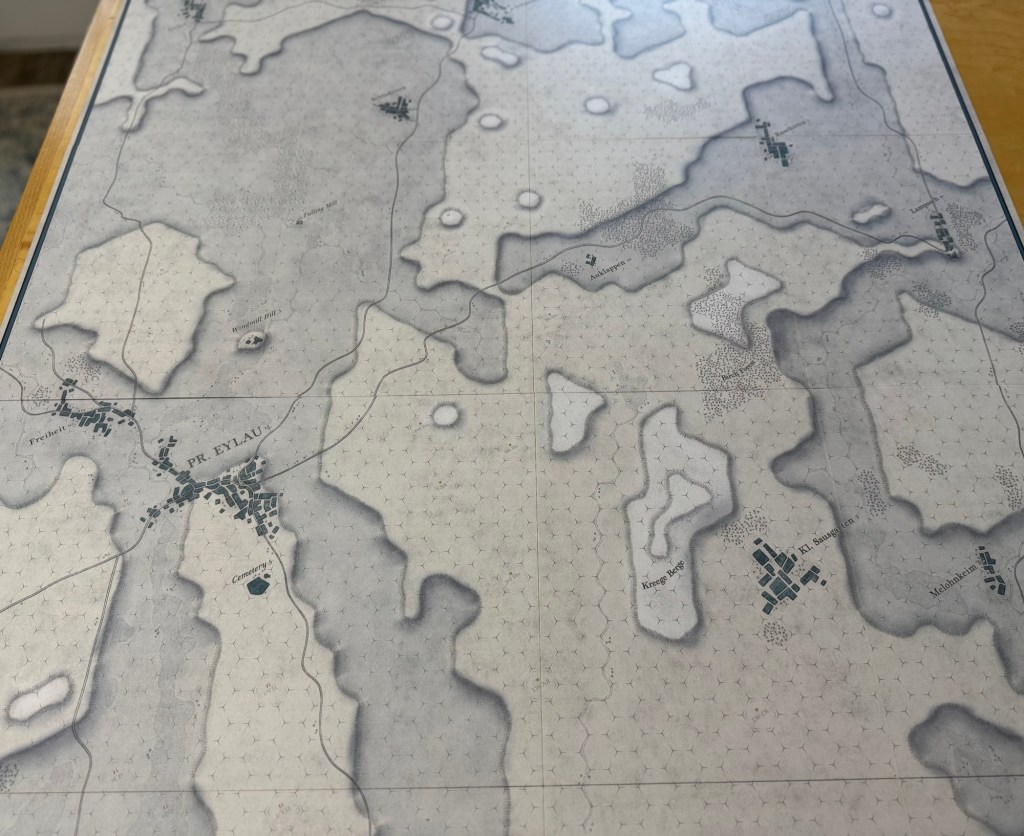
Elevation is also a major part of the game and factors heavily into the combat. Any higher elevation, obstructed terrain and even other combat units block the light of sight of units and their firing arcs if the firing units and the target are on the same level. In the above picture you can see several examples of the various heights of the terrain. The grey colored terrain is the higher elevation and if you look closely at the outline of this area you will see cross hatched lines that represents this elevation change and the start of the higher terrain in the slope. I also really very much like the 3D effect that the terrain also gives to the board. Almost as if they have cut out cardboard pieces laid on top the board that represent the elevation the flat drawn images and the way they are oriented really creates a feeling of height and change in the ground.
Absolutely everything contained in this big and beautiful game is absolutely of the highest quality. The counter design is fantastic, albeit simple, and just works really well and the general aesthetics of the remaining components is superb. My favorite part of the game components though is the beautiful board. You might look at the board and initially think that it is a just a hodgepodge of white, gray and darker gray, and you wouldn’t be totally wrong in that assessment, but the way those colors are used and presented really create a fantastic backdrop for the battle. The board is totally devoid of any other colors but I found myself just staring at it as we were playing. Once the counters are placed on the board, the entire aesthetic changes to one of highlighting the garish colors of the French and Russian units against this background of white, gray and darker gray. This causes a very imposing look to the units in formation as they make their lines of battle and brace to accept the oncoming enemy. Just a really great presentation of the battle and a fine canvas upon which to play out this titanic struggle!
We just really had a great time with Eylau 1807. And even though we played a smaller scenario to break ourselves into the system and get an idea about how it works, this one is going to come back to the table as I believe that the intent of the game is best realized in the play of the campaign. Here is where fatigue will matter more and the attritional style of the combat losses will begin to add up. But this system is top notch and very fun. I was super impressed with the design and really feel like what we were doing and how we were trying to do it. The designer and publisher Uwe Wallentin did a good job with this one.
I wrote a fairly in-depth First Impressions style post on the blog and you can read that at the following link: https://theplayersaid.com/2025/02/05/first-impressions-battles-of-napoleon-volume-i-eylau-1807-from-sound-of-drums/
Here also is a link to our review video:
If you are interested in Battles of Napoleon – Volume I: Eylau 1807, you can order a copy for €89.00 ($97.00 in US Dollars) from the Sound of Drums website at the following link: https://soundofdrumsgames.com/shop/battles-of-napoleon-eylau-1807
The next board that we will take a look at in the series is Tattered Flags No. 01: Into the Whirlpool from Blue Panther illustrated by Alex Zatarain.
Here are links to the previous entries in the series:
Kekionga!: A Dark and Bloody Battleground, 1790 from High Flying Dice Games
Campaigns of 1777 in Strategy & Tactics Magazine #316 from Decision Games
Battle Hymn Volume 1: Gettysburg and Pea Ridge from Compass Games
From Salerno to Rome: World War II – The Italian Campaign, 1943-1944 from Dissimula Edizioni
This War Without an Enemy: The English Civil War 1642-1646 from Nuts! Publishing
Holland ‘44: Operation Market-Garden, September 1944 from GMT Games
Maori Wars: The New Zealand Land Wars, 1845-1872 from Legion Wargames
Imperial Struggle: The Global Rivalry – Britain & France 1697-1789 from GMT Games
Stilicho: Last of the Romans from Hollandspiele
Nevsky: Teutons and Rus in Collision, 1240-1242 from GMT Games
A Most Fearful Sacrifice: The Three Days of Gettysburg from Flying Pig Games
Donnerschlag: Escape from Stalingrad from VUCA Simulations
Keep Up the Fire!: The Boxer Rebellion Deluxe Edition from Worthington Publishing
Liberty or Death: The American Insurrection from GMT Games
Lanzerath Ridge: Battle of the Bulge from Dan Verssen Games
Salerno ’43: The Allied Invasion of Italy, September 1943 from GMT Games
Bayonets & Tomahawks: The French and Indian War from GMT Games
Undaunted: Normandy from Osprey Games
Traces of War from VUCA Simulations
SCS Ardennes II from Multi-Man Publishing
Almoravid: Reconquista and Riposte in Spain, 1085-1086 from GMT Games
Walking a Bloody Path: The Battle of Fallen Timbers, August 20, 1794 from High Flying Dice Games
All Bridges Burning: Red Revolt and White Guard in Finland, 1917-1918 from GMT Games
Storm Over Jerusalem: The Roman Siege from Multi-Man Publishing
Iron, Blood, Snow & Mud from PHALANX
North Africa ’41: The Western Desert, March to December, 1941 from GMT Games
Battles of the American Revolution Volume II: Brandywine from GMT Games
Ardennes ’44: The Battle of the Bulge from GMT Games
Gandhi: The Decolonization of British India, 1917-1947 from GMT Games
-Grant
 The Players' Aid