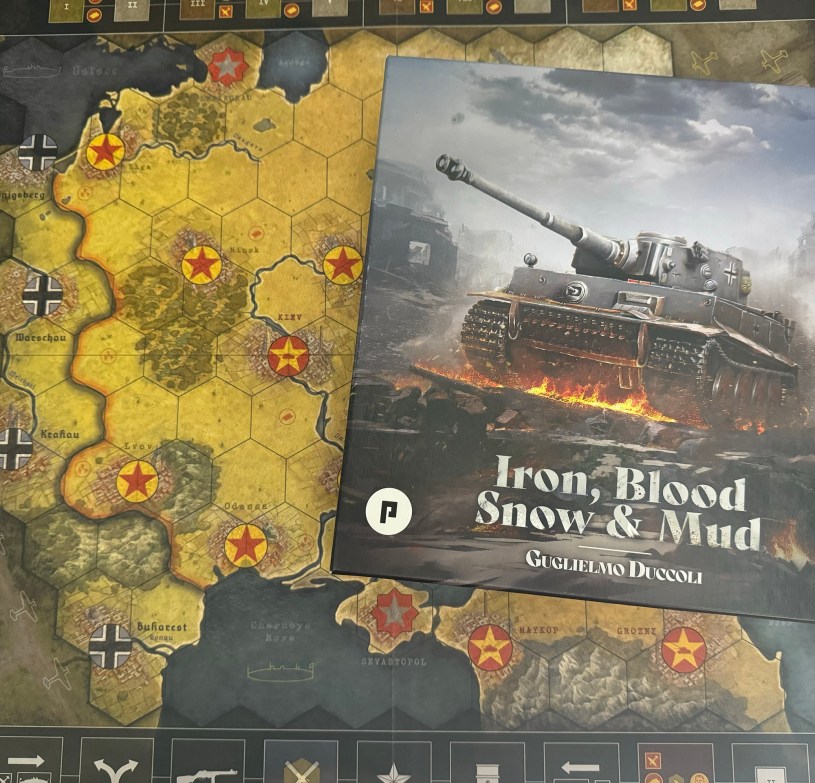
Continuing along in this new series devoted to the best looking boards found in the wargaming world where I will highlight the art and layout of a different board in a wargame that we have played to show you the various talents of the artists and graphic designers involved. In my humble opinion, a well designed and attractive board can make all the difference in the world to me enjoying a wargame. Don’t get me wrong, the game has to be good, but if it’s also good looking it always is a better experience. A board can draw me in. Can make me feel that I’m there. Can set the stage for the thematic immersion that we all crave. And I have found many of these type of boards and I want to make sure that I share them with you.
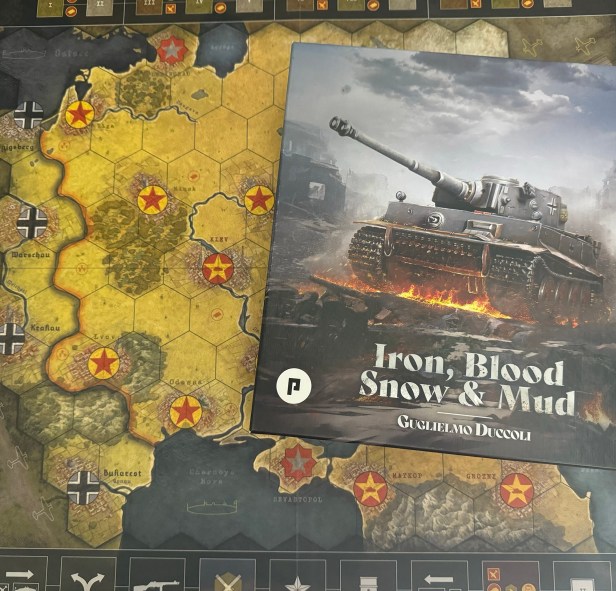
Iron, Blood, Snow & Mud from PHALANX is a fun, light, fast playing strategic level wargame that we found to be extremely interesting and definitely up for grabs as either side seems to be capable of winning. The game also has a puzzle like feeling to it as the German player has to figure out how best to utilize their limited units to encircle and support strong attacks against the enemy in order to capture the Soviet cities along the way to Moscow where you are hoping to capture the city, kill Stalin and end the war on the East Front. The Soviets have lots of tools at their disposal including Partisan Units to harass and block German supply lines and can also use the urban terrain itself to gain an advantage in combat to slow and frustrate the German attacks making their task that much harder.
The artist for the board is Lew Sołowiej a.k.a. Leo Soloviey who is a relative newcomer to the world of wargame boards but has done a few that are really great looking. These include several 1920: Nest of Eagles from PHALANX and Bretwalda from PHALANX. After all that being said, his effort with the board for Iron, Blood, Snow & Mud was just fantastic and really created a beautiful backdrop for the advancing German armies and the defending Soviet armies holed up in their urban centers.
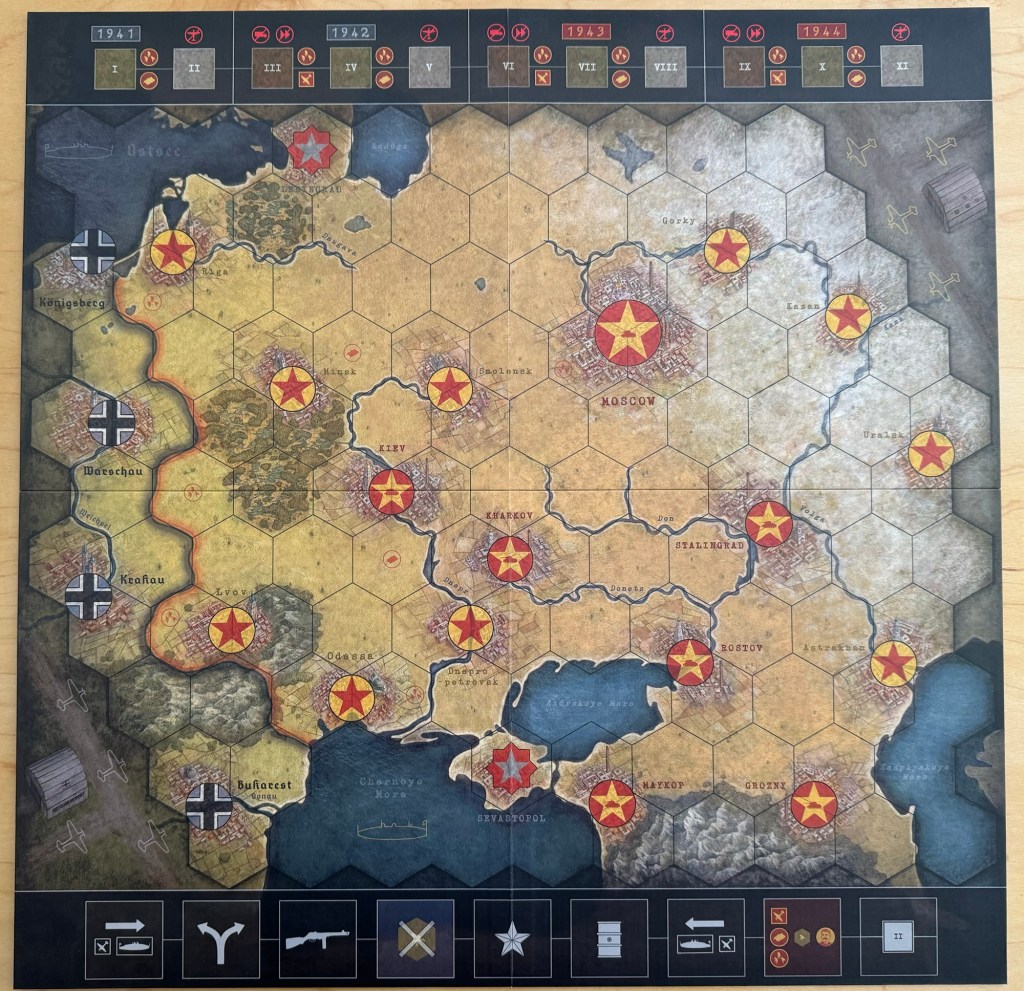
The board is a bit of a non-traditional sized hard mounted mapboard that measures 18 1/2” x 18 1/2” and covers the entirety of the Eastern Front of World War II stretching from Leningrad and Königsberg on the coast of the Baltic Sea in the north to Bucharest, Odessa and Sevastopol on the Black Sea in the south and then out past Moscow to Kazan, Uralst and then Astrakhan on the shores of the Caspian Sea. The board itself is very well done and adds a lot of artistic elements to highlight the terrain and differentiate each from other types.
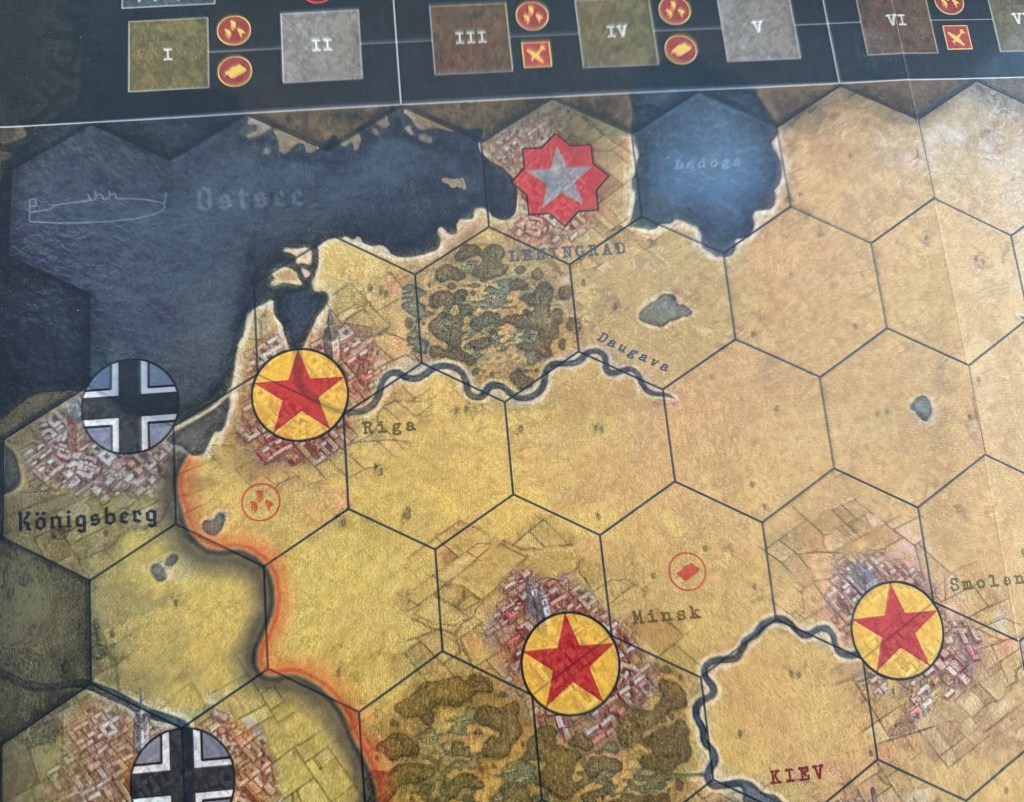
For example, in the picture above you can see several different accents used to highlight the terrain in the forests with their individual copse of trees packed together in various shades of greens and browns, the darker looking boggy swamps which prevent the player from making continuing convoys through these areas and slow the German advance, the thick dark blue rivers stretching like ribbons across the landscape following hex edges, the open steppes in shades of tannish brown dotted by smaller bodies of water and even some hints at farm fields drawn in their background and the imposing mountains in the west along the borders with Hungary. But the crowning jewel in the various terrains are the Urban Locations which surround the various important cities in the game where victory points can be earned and from which the Soviets will spawn if not taken out.
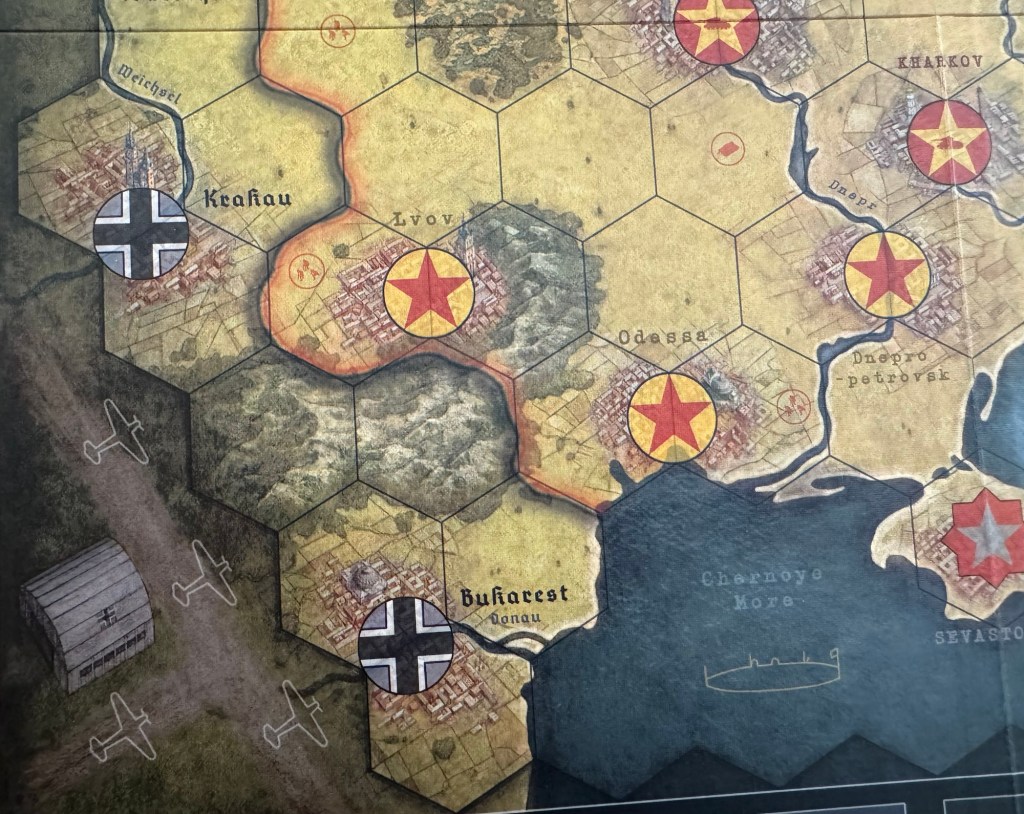
The Urban Centers are truly impressive graphically as each has their own unique look and feel but only when you zoom in a bit closer and take a look at the artist’s attention given to them. From the 30,000 foot view, they look like a massed grouping of various large and small buildings but once you take a closer look you can se specific unique buildings such as churches, government buildings, factories, apartments, offices and other important features. In Kharkov, you can see a large smoke stack on the east side of the Urban Center and it just looks really good there. I truly enjoyed looking at each city and seeing the small and subtle, but sometimes large and standing out, differences given to each. A very nice touch to the graphic feel of the board!
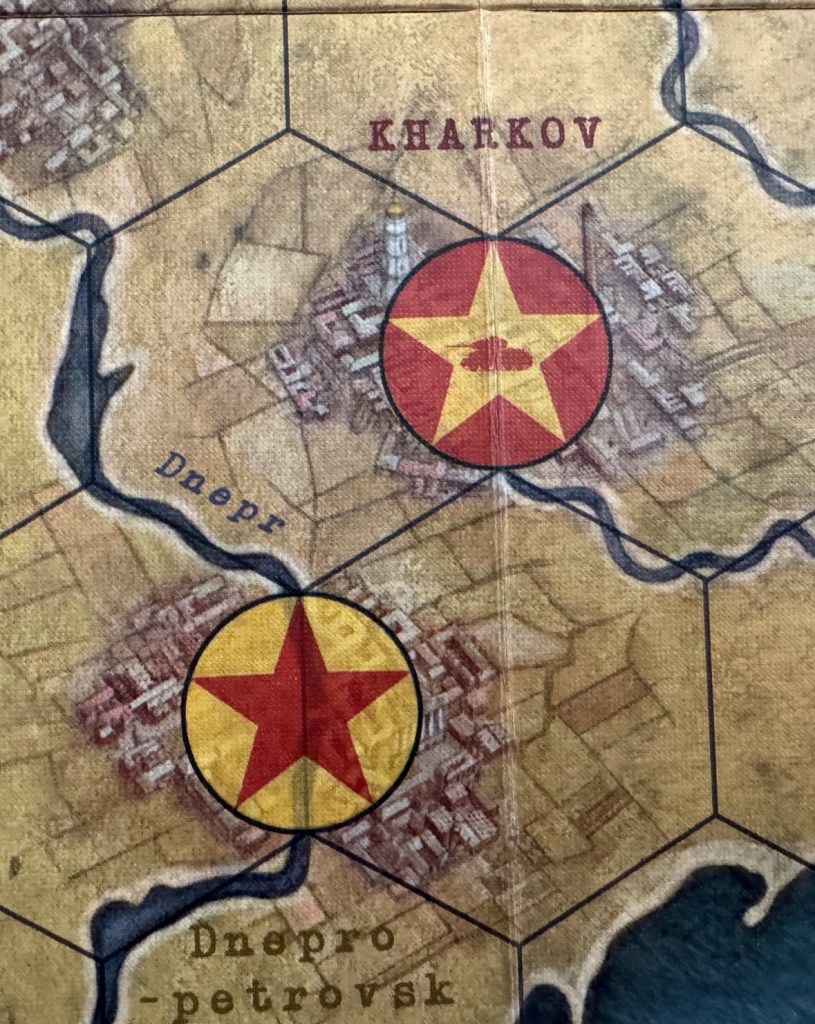
Urban Locations, which represent both cities and industrial centers, are designed to make life difficult for the advancing Germans. The Germans have got to move and keep moving or they will get bogged down and not be able to reach their ultimate objective in time. But they also have to worry about keeping their lines in supply. Controlling Cities is very tough as the German player will have to have units on each hex of the Urban Location before the end of any given turn to place a control marker there. If they do not control the entire Urban Location and all of its hexes, this leaves them open to having a Soviet unit spawn in an industrial center (identified with a red tank in the middle of the star). Below we see the industrial centers of Kiev and Kharkov and the yellow star in the red circle with the image of a T-34 drawn in the center. As you see, the other Urban Centers liked Minsk and Smolensk are red stars continued in a yellow circle, which means they are not industrial centers and will not spawn Soviet units.
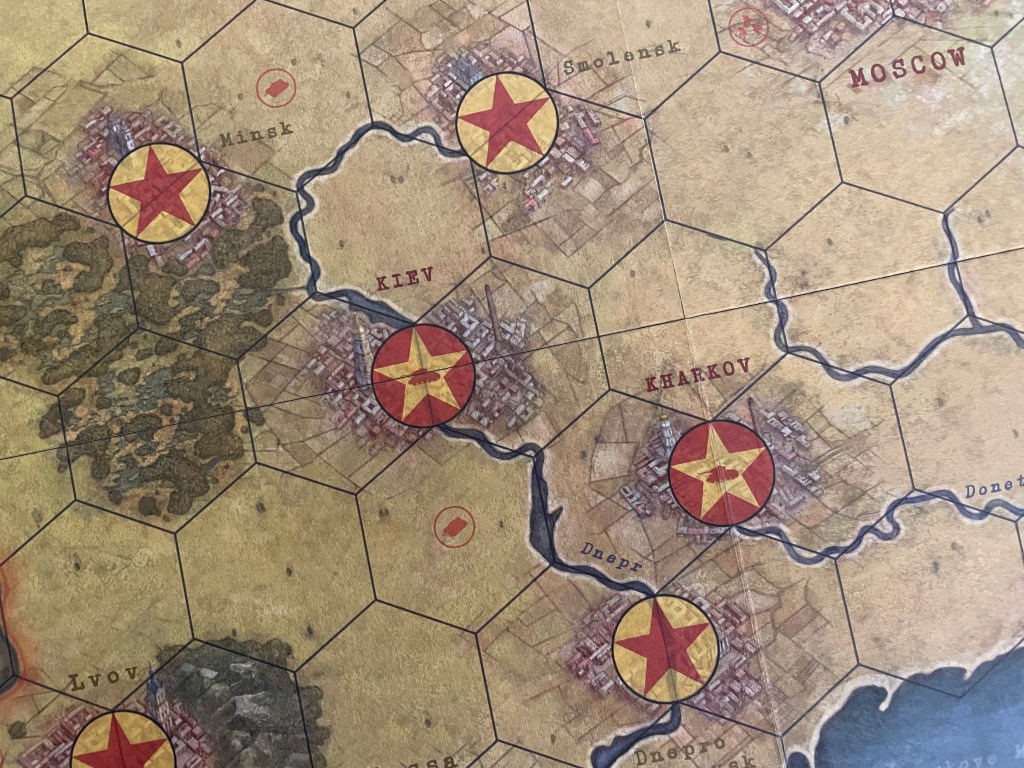
These urban locations also confer defensive bonuses to the player who controls them as they will grant a +1 die bonus in combat, both on offense or defense. The German player will be frustrated by this as they have to move quickly and remove any resistance and that +1 die bonus is massive for the defending Soviets and can make the difference in them holding on or not. I also looked at these Urban Centers graphically and the denseness of the buildings and the narrowness of the streets drawn really represent this close quarter fighting and the advantage the buildings, and even the rubble once fighting had progressed, would have presented and offered to the defending Soviets.
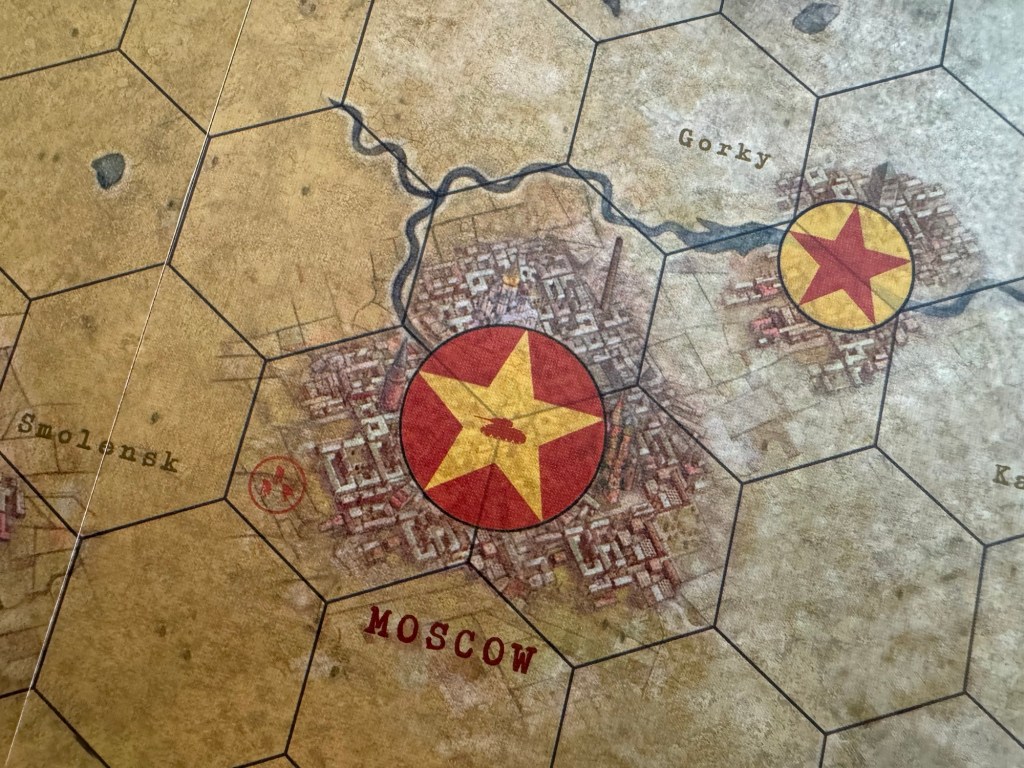
I wanted to next focus on Moscow, which is the goal of the player and to win the game as the Germans it will have to be taken. Notice it has 3 hexes which all must be controlled to claim it. I wanted to point out that the detail of the city is just amazing! You can see Red Square, the large church steeples and other important buildings such as the Kremlin all specifically illustrated and showing in the image. I really appreciate the time to go to this level of detail. It adds nothing to the gameplay, as the hexes are just classified as Urban Centers, but the detail really makes them stand out, creates a lot of interest to the image and helps set the stage for the game. I feel that overall graphic approach to the game was a very wise choice for an abstracted wargame that is lite and simple as it will draw those who are not traditional wargamers into the fold…hopefully!
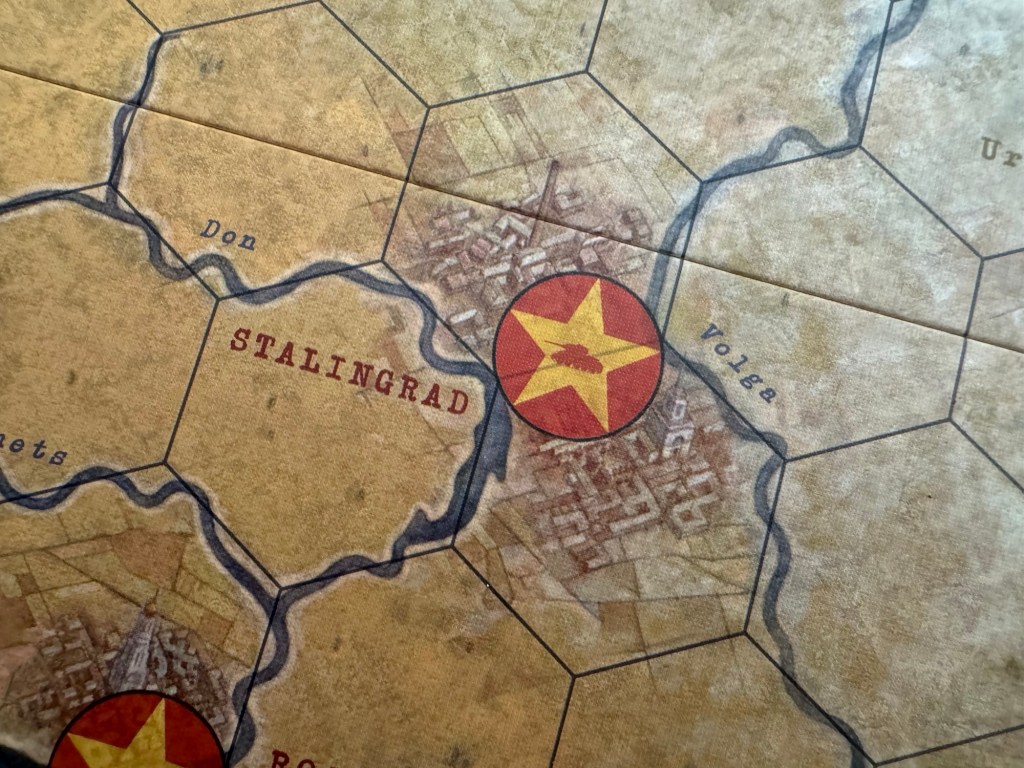
Stalingrad is also spiffy as the buildings here are pronounced and you can see the industrial sectors, containing the Tractor Factory, Red October Steel Factory and Volgograd Tractor Plant represented in the north by a few stacks and groupings of industrial buildings. I also really like how the two major rivers in the area, the Don River and Volga River, are pronounced and really give the impression of constriction on the city itself as the defenders fought for their lives and the future of their country.
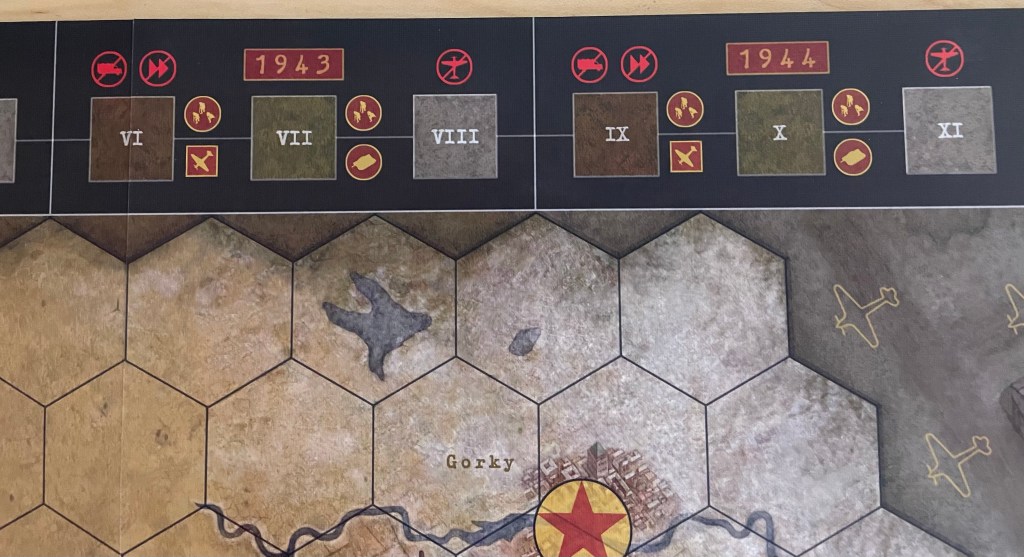
I also really appreciated the Turn Track and how they would include in each year’s box a couple of symbols that had the red circle around them and were then crossed out to let you know that due to the weather that year, these certain actions could not be taken. For example, Convoy Movement is a very important aspect of the game and is shown by a symbol of a 2 1/2 Ton Truck drawn on the board. When you see the symbol on the Turn Track, this means that you can take Convoy Movement because the weather is favorable. A very nice graphical representation of one of the more complex and important parts of the game in movements and the weather’s effect on it. This helped us to pick up the game quickly, not worry over remembering so many rules and just focusing on the game itself, the strategy and having a good time.
Overall, Iron, Blood, Snow & Mud is a great little game that was fun to play and most importantly looked really good on the table. The production quality of the game is very high, as has come to be the norm with PHALANX but this one also is absolutely beautiful! The board is very eye-catching and the components are top notch. It was a joy to play with the game and also to play the game. I would recommend this one to anyone the likes a fast playing, rules lite yet satisfying game that plays in 90 minutes, but really scratches the wargamer’s itch for maneuver, combat, focus on supply and the risks of moving ahead quickly while awaiting your support units to arrive. This is a really great little gem and I am glad that we gave it a chance.
Here is a look at our review video:
The next board that we will take a look at in the series is North Africa ’41: The Western Desert, March to December, 1941 from GMT Games designed and illustrated by Mark Simonitch.
Here are links to the previous entries in the series:
Kekionga!: A Dark and Bloody Battleground, 1790 from High Flying Dice Games
Campaigns of 1777 in Strategy & Tactics Magazine #316 from Decision Games
Battle Hymn Volume 1: Gettysburg and Pea Ridge from Compass Games
From Salerno to Rome: World War II – The Italian Campaign, 1943-1944 from Dissimula Edizioni
This War Without an Enemy: The English Civil War 1642-1646 from Nuts! Publishing
Holland ‘44: Operation Market-Garden, September 1944 from GMT Games
Maori Wars: The New Zealand Land Wars, 1845-1872 from Legion Wargames
Imperial Struggle: The Global Rivalry – Britain & France 1697-1789 from GMT Games
Stilicho: Last of the Romans from Hollandspiele
Nevsky: Teutons and Rus in Collision, 1240-1242 from GMT Games
A Most Fearful Sacrifice: The Three Days of Gettysburg from Flying Pig Games
Donnerschlag: Escape from Stalingrad from VUCA Simulations
Keep Up the Fire!: The Boxer Rebellion Deluxe Edition from Worthington Publishing
Liberty or Death: The American Insurrection from GMT Games
Lanzerath Ridge: Battle of the Bulge from Dan Verssen Games
Salerno ’43: The Allied Invasion of Italy, September 1943 from GMT Games
Bayonets & Tomahawks: The French and Indian War from GMT Games
Undaunted: Normandy from Osprey Games
Traces of War from VUCA Simulations
SCS Ardennes II from Multi-Man Publishing
Almoravid: Reconquista and Riposte in Spain, 1085-1086 from GMT Games
Walking a Bloody Path: The Battle of Fallen Timbers, August 20, 1794 from High Flying Dice Games
All Bridges Burning: Red Revolt and White Guard in Finland, 1917-1918 from GMT Games
Storm Over Jerusalem: The Roman Siege from Multi-Man Publishing
-Grant
 The Players' Aid
Hey, Grant, it’s great to see sove love towards IBSM, and its gorgeous map, but… I’m sorry to say, you mixed up the artists 😉 Miłosz is the author of that lovely Tiger tank cover (and from what I understand, he’s mainly an illustrator for cards and covers), but the author of the map is Lew Sołowiej a.k.a. Leo Soloviey 🙂 He also made the map for 1920: Nest of Eagles and Bretwalda (map and everything else).
LikeLiked by 1 person
Thank you for pointing that out. I have corrected my error.
LikeLike