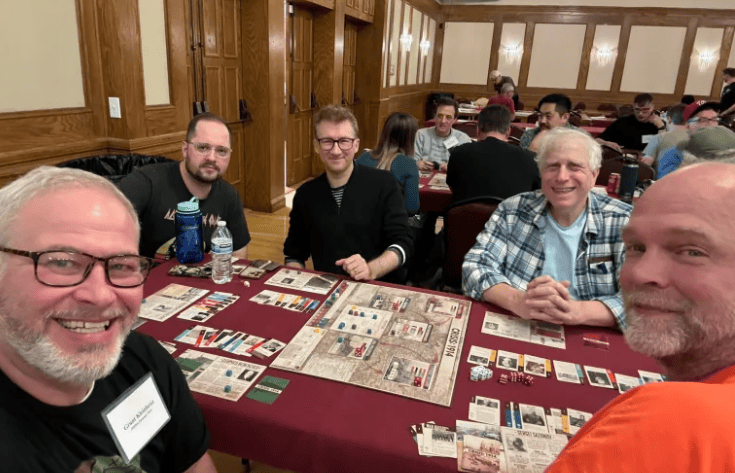
During the summer of 2019, we were introduced to Maurice Suckling and his very interesting design Freeman’s Farm 1777 from Worthington Publishing and really enjoyed the mechanics and how they all came together to create an interactive and interesting look at the Battle of Saratoga during the American Revolution. I was very impressed with Maurice and his appraoch to design and we have followed him every since and played many of his great designs. including Hidden Strike: American Revolution, Chancellorsville 1863 and 1565 Siege of Malta and Crisis: 1914. In this entry in the Best 3 Games with…Series I wanted to highlight the games of Maurice Suckling and share those that I have had the best experience with.
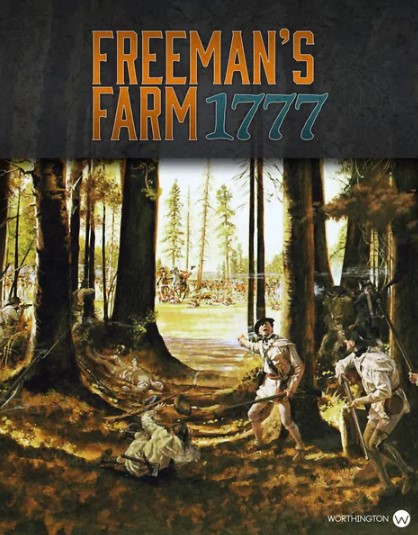
3. Freeman’s Farm 1777 from Worthington Publishing
Freeman’s Farm 1777 is the first in the Battle Formations Series from Worthington Publishing that are designed for both solitaire and two players. The focus of the system is on the individual formations that appeared on the battlefield and places the players in the role of overall commander to make decisions about which formations to activate and how to use those formations to position themselves to attack the enemy. The key to these decisions is the morale of those formations as each command utilizes one of their levels of morale and if pushed too far, through attacking or being attacked, the formation will be forced to take a morale test to see if it will break.
There are a couple of things that I really liked about this one as I felt it told the story of the style of fighting of the time and incorporated some elements that were very important. This series has centered the focus on formations and how they can interact with each other on the battlefield. It simply looks at how the relative positioning of the formations opens up opportunities for attack or provides advantages or disadvantages to one side or the other. If you are above an enemy formation on high ground or have a superior firing angle on a formation in battle, shouldn’t you gain an advantage? And furthermore, if you are relatively inexperienced green forces and are facing the smoking gun barrels of your enemy’s cannons, don’t you think that your attempts to return fire will be less effective than if firing with hardened troops from cover? This spatial element is a major inclusion in the design and really feels right and makes your choices as commander that much more difficult as you decide how to activate your troops to take advantage of the situation. I really have enjoyed this spatial relationship during my plays of the game and think that the approach is very novel.
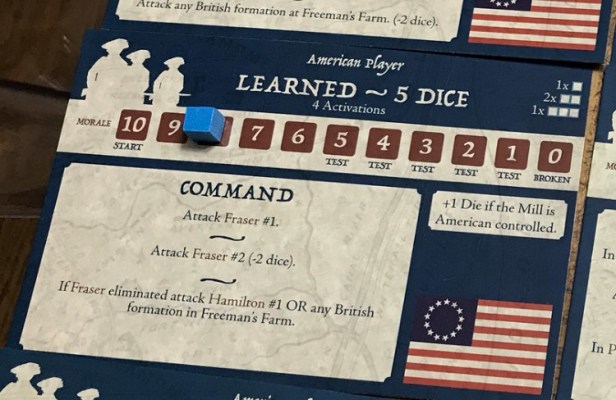
The other element that I really enjoyed was the concept of morale. The design has the player controlling several different Formation Cards that represent their troops on the battlefield and each has their own set of actions they are able to take. The key for these Formation Cards is that each time they are activated through the play of the corresponding Activation Card they have to pay for this activation. The payment comes in the form of paying 1 point of Morale from the Morale Track by moving the cube marker down one space. The formation may also lose Morale as they attack and are attacked throughout the game. The moment that a formation’s morale reaches 5 on the Morale Track they have to conduct a Morale Test to see if they will break and leave the field. This Morale Test is conducted by rolling a single d6 with any modifiers from Tactics Cards that the player controls and then comparing that result to the current Morale of the formation (i.e. where the Morale marker is currently on the Morale Track). If the die roll is higher than the marker location, the formation has failed the test and becomes broken. If the roll is equal to or less than the marker location, the formation passes the test and remains on the battlefield. Each successive reduction in the Morale of that formation will trigger another test which will be harder and harder to pass as the number decreases. Soldiers spend their strength and will to fight in each skirmish and as they are pushed more and more, and in the face of losses and exhaustion, reach a point where their will to fight is gone and they break. I like how the design dealt with this issue and it feels right.
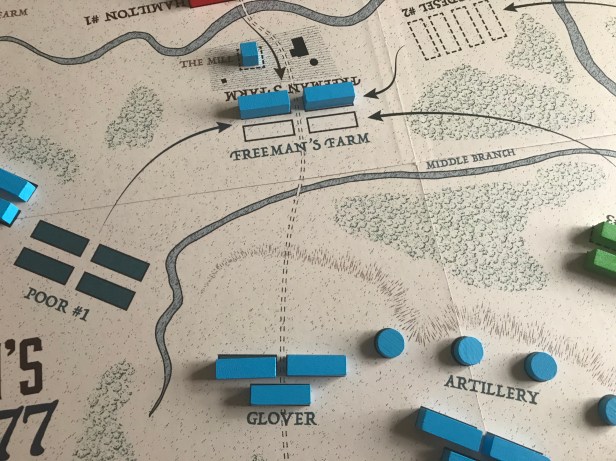
The game uses wooden cubes, disks and sticks to mark formations on the board and it looks like those pictures in text books showing the location of troops during these historical battles. This was a nice thematic touch for me and helped me to get into the mind set of a Revolutionary War battle.
I wrote a series of Action Point posts covering the various aspects of the game. You can read those at the following links:
Action Point 1 – Game board that represents the locations and roles of both sides’ formations as well as their relative positions on the battlefield.
Action Point 2 – Formation Cards and how the Activation Cards are used to command and how Morale Tests work.
Action Point 3 – Momentum Cubes and how they are used to purchase the all important Tactics Cards.
Action Point 4 – Examples of combat and discuss the way the dice are used.
Here is a look at our video review of the game:
2. Chancellorsville 1863 from Worthington Publishing
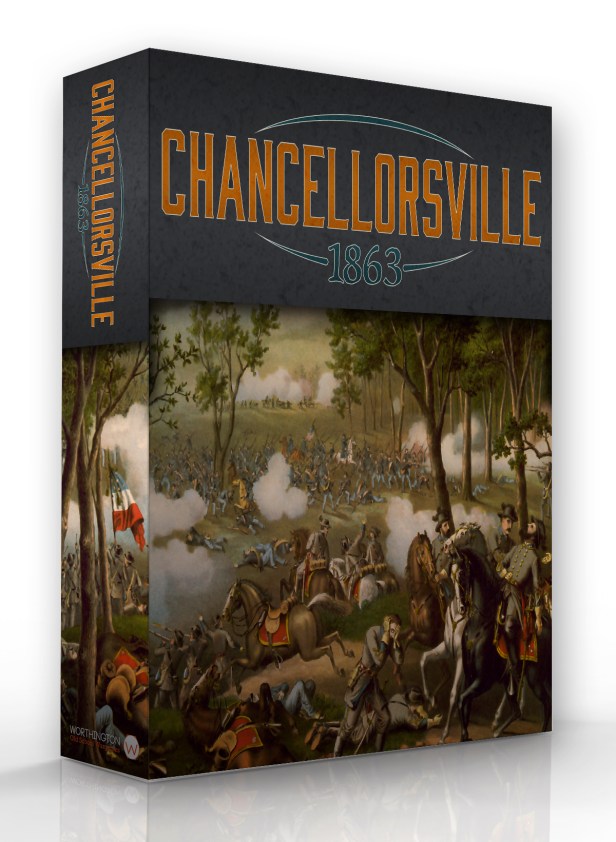
While the next game on this list uses the same system, this entry in the series is definitely improved and matured and I very much liked the blind movement aspect which was added. Chancellorsville 1863 covers the Battle of Chancellorsville during the American Civil War using a similar system to Freeman’s Farm 1777.
At the start of the game some units on each side are visible, which is mostly because they are adjacent (units adjacent to enemy units are always visible on the main map.) Other units are hidden, placed on spaces on their respective mini map hidden behind a screen, in one of a variety of spaces. The mini map is a smaller representation of the main map, with the same movement arrows and nexus points but with the same scale for ‘spaces’ so the same blocks fit on both maps. Each side has their own mini map. If units move into a space on the mini map that is adjacent to a space occupied by a unit on the main map, that unit becomes visible and is transferred to the main map.
There are also some spaces found deep inside the enemy’s lines of communication and moving onto those spaces on the mini map compels an immediate transfer to the main map. In addition, there are some spaces where the lead Union units are visible. This represents Jeb Stuart’s cavalry tracking the Union advance on the Confederate left. This added aspect really makes the game and creates a sense of tension for the players as they simply don’t know where all of the enemy units are located and have to play for those units coming up on their rear even as they are engaged in major battles along the front lines.

Activations are also slightly different from the Freeman’s Farm game as each side only has 15 activations per game but each activation card identifies at least 2 commanders to activate and move. This is very necessary because the Union side has more units to move, and farther to move them to put pressure on objective locations. This has been balanced with the addition of fortifications that allow the defender to set one die per combat at the number desired. This makes for some very interesting decisions about whether to attack or not and how. I have really enjoyed this one as the system is obviously evolving and introducing new elements. I am glad that the designer has decided to take the system to the next level as there are lots of opportunities and applications to various battles for the system.
We published an interview on the blog with Maurice and you can read that at the following link: https://theplayersaid.com/2020/02/04/interview-with-maurice-suckling-designer-of-chancellorsville-1863-from-worthington-publishing-on-kickstarter-now/
Here is a look at our video review of the game:
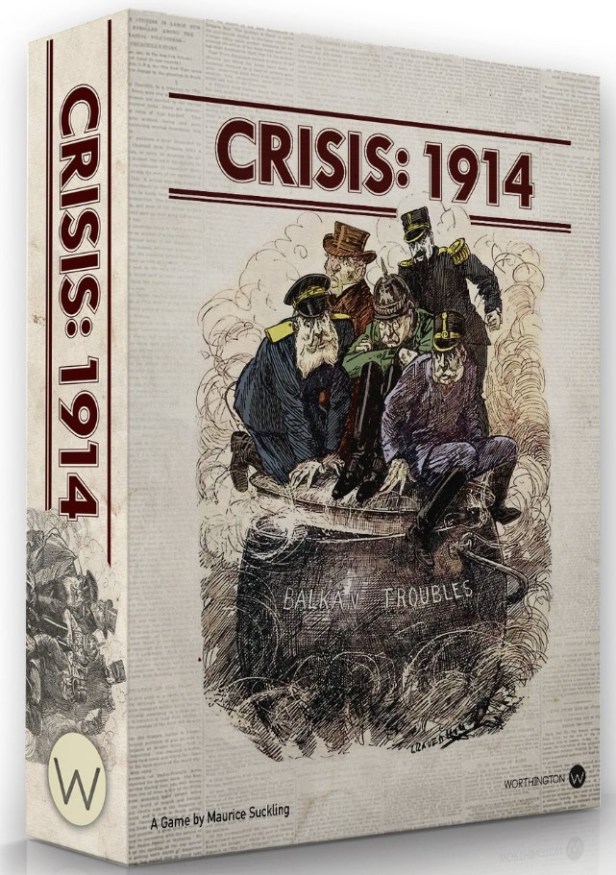
1. Crisis: 1914 from Worthington Publishing
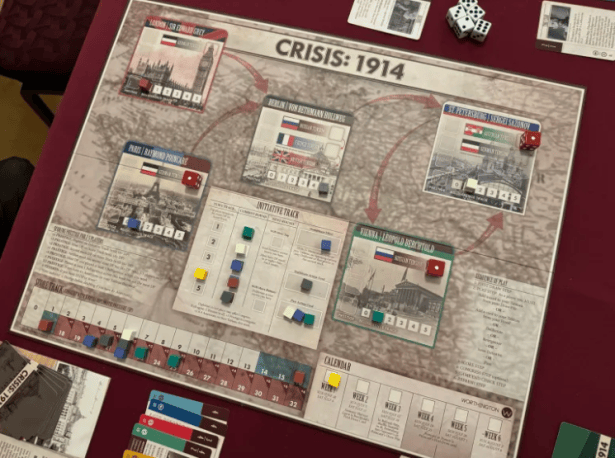
Crisis: 1914 is a game of international brinkmanship meaning if you back down too soon, you lose. If you back down too late you lose. But you have hawks and doves in your cabinet and in your government, and out of these conflicting views you must somehow formulate a coherent response to the crisis to win the day and prevent war. The game is played with players building a tableau of event cards that will score them a certain number of points, some building off of each of the type of cards played, with some of the cards increasing the Tension level of Europe at the time. If the Tension gets too high The Great War will break out and the player causing it by the play of a card will lose with the others winning based on their total Prestige Points. It sounds really simple, and the game is not overly complex, but there is a lot of strategy to how you play your cards, when you play them and how are you are willing to push your luck each round.
There are 3 concepts at the heart of Crisis: 1914 including Prestige, Tension and Diplomatic Pressure. Diplomatic Pressure is how you score Prestige and reflects the skill at which you play your cards to keep your faction moving ahead of the others while simultaneously balancing the level of Tension. Tension is how you lose. Every card has a DP value and you apply DP by playing cards. The player with the most Diplomatic Pressure at the end of a turn earns Prestige points. There are other ways of scoring Prestige points too, but this is the most important one. Prestige is how you win. The player with the most Prestige at the end of the game is the winner.
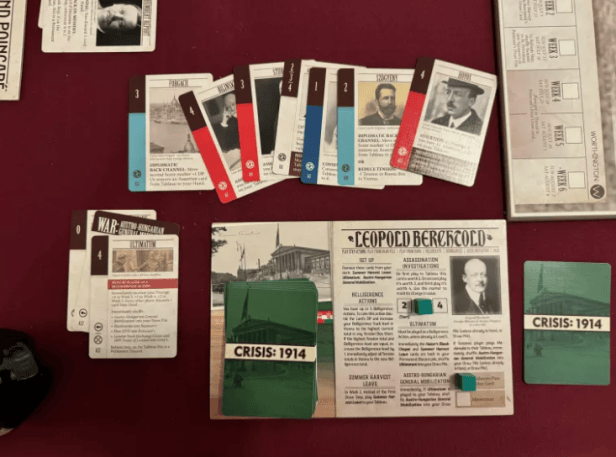
I have played this one 3 times now and and I cannot wait for the next opportunity to play. It is best with 5-players so make sure you get the right group and give yourselves a chance to really learn the game as each faction’s deck is completely asymmetrical and repeated plays will help you understand each faction’s strengths and strategies. While this game is not necessarily a wargame, but more of a war themed Euro game with a bit of negotiation and tension as you build your tableau of cards, we had a great time with it and really feel that the game is a bit under the radar of folks and should be one of those games that is played at conventions as it seats up to 5 players and is really quite good.
We published an interview on the blog with Maurice and you can read that at the following link: https://theplayersaid.com/2023/07/12/interview-with-maurice-suckling-designer-of-crisis-1914-from-worthington-publishing-currently-on-kickstarter/
Also, in a lead up to the game’s release, I worked with the Maurice to do the following Event Card Spoiler posts:
Here is a link to a RAW video we did after our 2nd play while attending Buckeye Game Fest in 2024:
There you have it. My Best 3 Games with…Designer Maurice Suckling! He has done so many good games and the narrative and historical immersion of all of them are top notch. He is definitely a designer to keep an eye on and I know that he has multiple games currently in design including Rebellion: Britannia from GMT Games, Peace 1905 from Fort Circle Games (we played a prototype of this one at SDHistCon a few years ago and it is top notch) and The Emperor’s Choice from Worthington Publishing (I played a short game of this at WBC and it is very good).
What are your favorite games from Maurice Suckling?
-Grant

