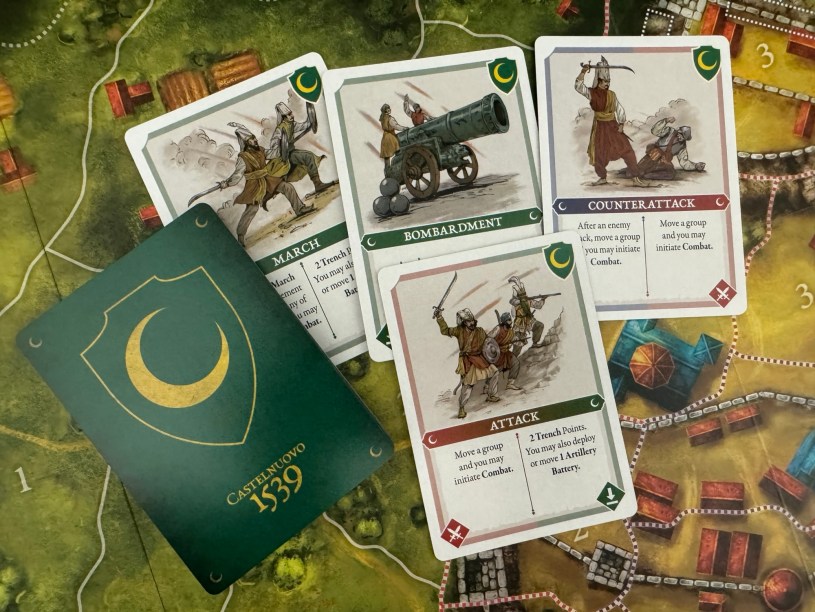
In 1539, a small Spanish garrison of troops numbering 3,500 men held the Albanian village of Castelnuovo for 22 days against the massive Ottoman army consisting of over 54,000 Turk soldiers. This siege took place as a part of the Ottoman-Habsburg struggle for control of the Mediterranean Sea in July 1539 at the walled town of Castelnuovo, which is the location of present-day Herceg Novi, Montenegro. After days of open trench warfare and more than a month of smaller combats, skirmishes, assaults and bombardments from the Turkish navy, the last Spanish defenders fell ending the siege. Castelnuovo 1539 is a wargame that focuses on this siege designed by Francisco Ronco. The defenders are safe behind sturdy walls and battlements but time and continual shelling from the Ottomans will lead to assaults over the walls. The battle is hopeless for the defenders but they can win the game by doing enough damage to the Ottomans to end their campaign and stop them from invading further into the Albania and then onto Spain and the rest of Europe. The game is very well produced using wooden blocks for soldiers, stylized walls, siege trenches and cannon along with ships and the board is also beautifully illustrated. The game is a block wargame where the strength of units are hidden from the opponent and plays pretty quickly in less than 90 minutes and really is a great representation of the battle and its history.
In Action Point 1, we took a look at the beautiful Game Board and its area movement scheme. In Action Point 2, we examined the units available to both sides and compared their relative strengths and weaknesses. In this Action Point, we will take a look at the different types of Command Cards and discuss how they are used.
Command Cards
In Castelnuovo 1539, there are 72 Command Cards with 36 unique cards per player side that are used to drive the tactical asymmetry of the siege. Players will draw hands of 4 cards during Siege Rounds or 7 cards during high-intensity Assault Rounds to be used for maneuvers around the board, bombardments and various special events. The Spanish and Ottoman factions utilize distinct and asymmetrical decks meaning that their available action options differ to reflect historical realities of the forces and their roles. I have already said this in previous posts on this game but the asymmetry is so very well done in this game and each side truly feels different from one another which creates a really interesting tactical challenge as players have to understand not only their own deck and its capabilities but those of their enemy to be able to effectively prosecute or defend against the siege.
There are 5 distinct types of Command Cards in the game, which include Action Cards, Order Cards, Combat Cards, Reaction Cards and Immediate Effect/Event Cards. Each has their own purpose and place in the game and I very much like the way the cards create opportunities for each player. Let’s take a bit of a deeper look into the types of cards, give a bit of a background on their general use and provide some examples.
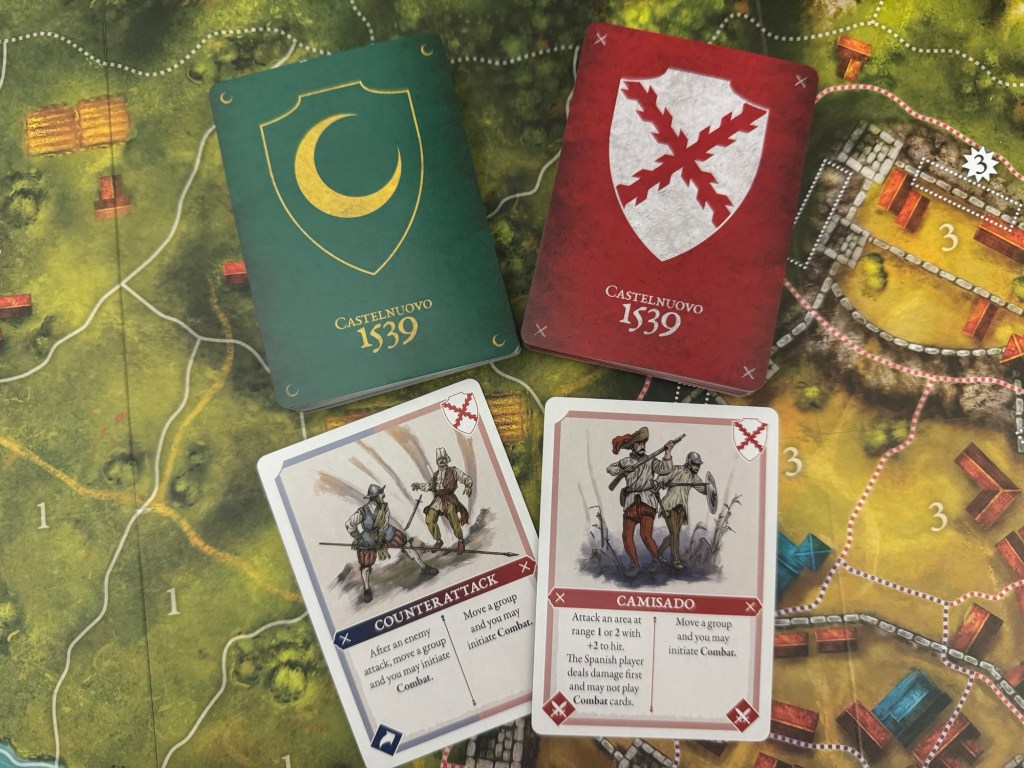
First off are Action Cards, which are used by the players to execute specific actions such as engineering, trench-digging or board-manipulation tasks, such as generating Trench Points to advance through or destroy Spanish bastions. The cards basic purpose is to activate units to take actions on the board.
Order Cards typically dictate the movement, repositioning and coordination of military units, marches, and artillery batteries across the board. These are the most common of the card types and are frankly the most important as you cannot use the other cards to attack until you are in position to do so.
Combat Cards are the force multiplication cards and are played during combat resolution to enhance striking power, modify dice roll or trigger pre-combat attacks like the specialized Ottoman volley actions. These Combat Cards are best used as a hold in your hand to use them when they most benefit the player. This can be challenging as holding too many will mean you are not drawing the Order Cards that you need to advance on the enemy.
Reaction Cards are played out of turn during your opponent’s Action Phase to counter maneuvers or provide mid-combat support for engaged troops. These cards can be lifesavers and are important to any good strategy.
Finally, there are Immediate Effect/Event Cards that are used to inject the historical narrative into the game and to replicate the historical action. These cards can also be focused on environmental factors such as the faith of the defenders/attackers, fire devices or the like that will change the flow and pace of the battle instantly.
Each of the 5 different type of Command Cards have a unique color coded icon to assist the players in understanding the capabilities of the card and the appropriate phase to use the card in. These 5 icons are as follows:
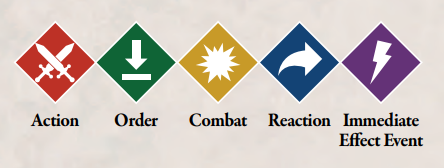
Keep in mind though that several of the Command Cards will have 2 icons listed which means that they belong to either of the types and can be played as either during a play. You cannot play the same card again and use its other icon though. This duality provides the players with a bit more flexibility and creates a more engaging and free flowing game. In my opinion, sometimes games which rely on cards to activate units for moves or attacks can suffer from poor draws. While that can still be an issue in Castelnuovo 1539, the dual icon cards make this a bit less of a problem.
Here is a look at the makeup of the Command Cards by type per faction. Keep in mind that dual icon cards will count double in the categories they represent.
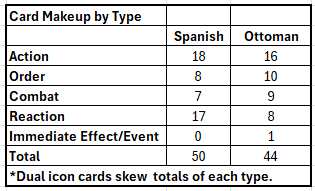
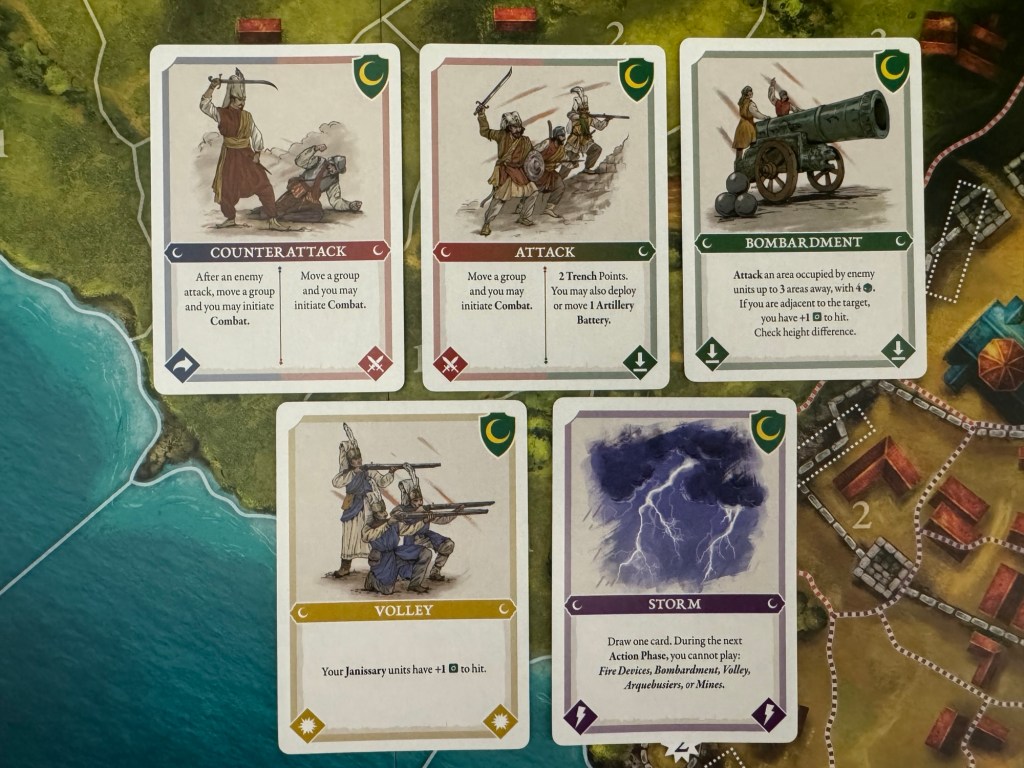
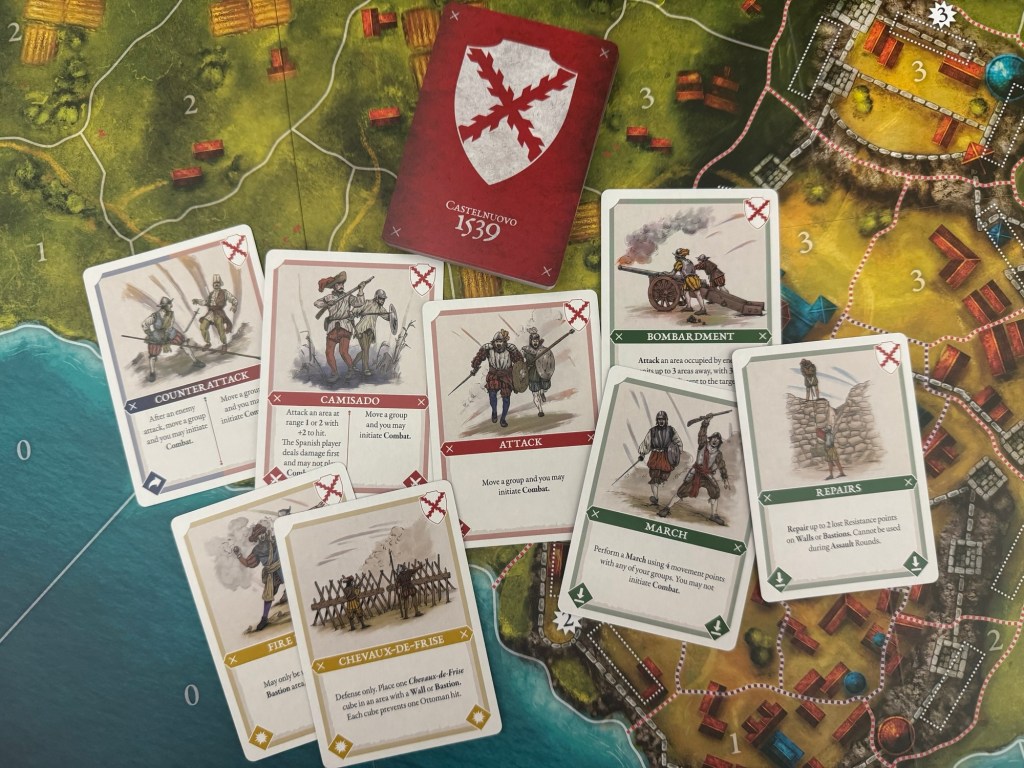
As you can see, the Spanish have more icons represented on their 36 cards than the Ottomans demonstrated by the Total Type of Card icons for the Spanish being 50 (1.39 icons per card) as compared to only 44 (1.22 icons per card) for the Ottomans. This is not a huge difference but does give the Spanish player a bit more flexibility in their cards draws and they will be able to be a bit more nimble than the attacking Ottomans. The Spanish have the advantage in the number of Action icons of 18 to 16. Remember that Action Cards are typically used for specific actions such as engineering, trench-digging or board-manipulation tasks. The Ottomans have the advantage in Order icons which means they have more move and march cards than the Spanish. Keep in mind that the onus to attack lies with the Ottoman player as they will have to move their units on the board to be able to attack the Spanish defenders. Also keep in mind the Bombard is an Order and the Ottoman has more of these type of card icons than the Spanish player 5 vs. 3. One of the most glaring differences is the high number of Reaction icons that the Spanish player has. These type of cards are used in response to your opponent’s card play and include things like Counterattacks, Arquebusiers, which gives a free attack when Ottoman units come adjacent to any Arquebusier unit on the board or Friendly Fire, which allows free rolls against Ottoman units located in between their firing artillery and the Spanish.
Another key card for the Spanish include Cheveaux de Frise, which allows the Spanish player to place a chevaux-de-frise cube in a Wall area or a Bastion. Each cube allows the Spanish player to ignore 1 hit in combat. These cubes are not destroyed by absorbing the hit. In addition, if a combat is tied in an area with these cubes, the Spanish player wins the battle. This card is a huge advantage for the Spanish and these should be played as soon as possible in order to minimize the damage taken from the Ottoman onslaught. If the Ottomans occupy an area with chevaux-de-frise and no enemies, the cubes are automatically destroyed. Another very important card for the Spanish player is Comisado. This Action Card can be used as a normal attack or, during a Siege Round, to make a special attack called the Camisado. The Camisados were night raids carried out by the Tercios troops in reduced numbers, specifically intended to sabotage and attack the Ottoman camps, trying to eliminate the enemies while they slept and to inflict material damage to the camp. The Spanish player selects a group of Spanish units, which may include the Leader Sarmiento, and these units can attack an area that is a maximum of 2 areas away from the selected group. This is a hit and run type of attack that gives the Spanish the powerful opportunity to sally forth from the walls to enact damage and then retreat back to safety.
The Ottomans have their own tricks with special cards including For the Faith. This card can only be played in combat if there is at least 1 Azab unit involved. When used, all dice rolled by Azab units (not Janissaries or Sipahi) in combat have a +1 bonus to hit, but at the end of the battle, the Ottoman player must eliminate 3 points of strength from the Azab units. This card is a tradeoff but the price paid can be very much worth it if the dice are kind.
Both sides have access to cards that perform special attacks or provide bonuses like Fire Devices which is a Combat Card that allows the player to roll 3d6 against enemy units at the start of Combat, when the card is revealed. Any result of 5 or 6 counts as 1 hit, to be assigned by the opponent. It can only be played in areas that contain, or are adjacent to, Walls or Bastions built by the Spanish player. These type of cards are very important to the game and its combat system as the weaker units are the fewer dice they will roll and the chances of hits are lessened.
The Command Cards are very well done and truly create the setting for the asymmetry of the game. These cards serve as a highly effective, dual-purpose engine of the game’s dynamic card driven design and I think that the designer did a fantastic job in creating a very balanced and playable game that provides an opportunity for “victory” for both players. The Command Cards are highly effective because they completely abstract command and logistics into a tight tactical choice with units only moving or initiating combat when activated by a card.
In Action Point 4, we will take a look at the 2 different types of rounds including a Siege Round and an Assault Round and how they differ.
If you are interested, I was able to shoot the following review/overview/summary video with the designer Francisco Ronco after playing the game earlier this year:
-Grant

