Recently, I saw a post on X from one of my favorite designers Mark Herman. If you have to ask who then maybe this post is not for you. But he is one of the best and most prolific designers out there with nearly 100 designs to his credit. Hands down one of the best…and an amazing guy too. In fact, some of his designs are among my favorite wargames including titles like Empire of the Sun, Churchill, Pericles, Fire in the Lake, Washington’s War, Fort Sumter, Rebel Fury and more. Mark knows wargames and he knows how to tell the story of the historical event. Just a master really. The post was Mark highlighting a written review found on Board Game Geek about his newest game in the Civil War Heritage Series called Volume II Army of the Potomac: Campaigns of 1862 & 1864.
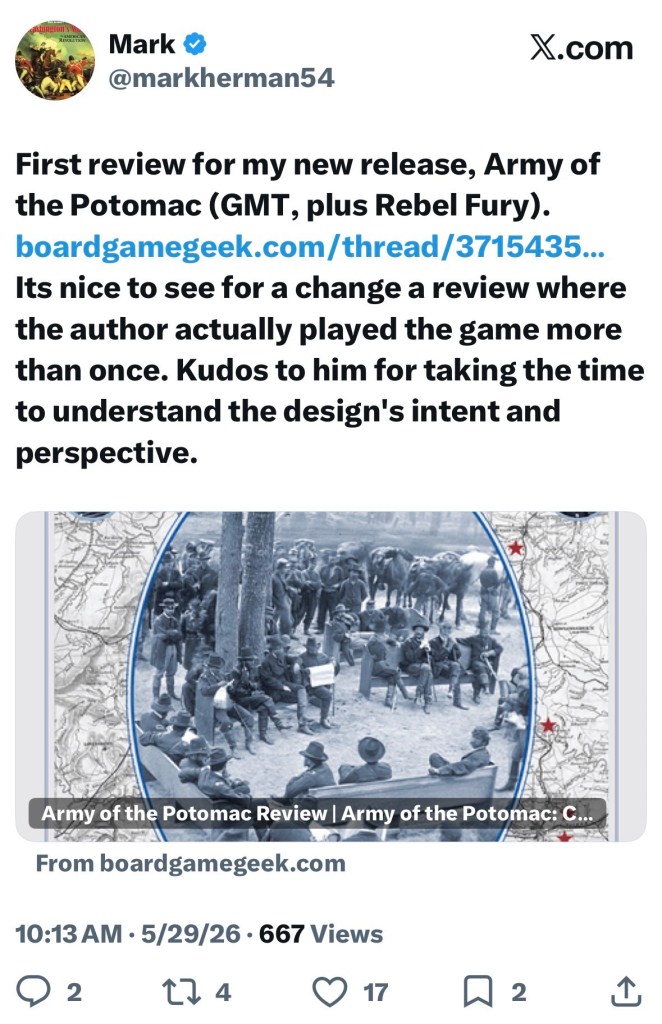
I read the review he mentioned and it is very comprehensive and well done. But this post somewhat triggered me. Why I am not sure but it did. I am not mad about it. Not hurt. Not overly concerned. And when I say triggered a more appropriate word would be caused my thinking juices to be stirred up. But I wanted to share my thoughts and opinion on what a wargame review is but also what it is not because I believe that a lot of gamers have a very different opinion about these things than I do.
When Alexander and I get together to play a game with the intent of doing some sort of review and sharing our thoughts on the design it does take a bit of preparation and time. We have to read the rules, and believe me, this can take hours, to truly get a feel for the game, its processes and the flow. But also to get an understanding of what the designers thesis is about the conflict modeled. I think that designers create games that they agree with and believe in. Not necessarily that are 100% a true modeling of the event. Their bias is inserted into the design and there really is no way around that. And I am fine with it because I know that each story of history has 2 (or more) viewpoints and perspectives. We also have to prepare the counters, which includes clipping them, sorting them and then storing them in counter trays or baggies. We then have to set up the game, and with wargames, this can take an hour or more to make sure you have the correct units, place them in the proper hexes and then check to see if there are any errata with the setup that we will need to change. Sometimes setting up the game wears me out…but then we have to give it a play.
Also keep in mind that the majority of games that we play are big wargames. These games have multiple maps, hundreds if not thousands of counters and a ton of different scenario options to choose from. Typically, a campaign game might take dozens of hours with shorter scenarios taking 6-10 hours. These are not light games that can be played in 45-60 minutes. And because of that, the reality of playing a game multiple times just isn’t feasible. We have never posited ourselves as full and thorough multiple playthrough guys. We just don’t have the time to sink that much time and effort into 1 game. Keep in mind that we only get to play 30-40 new wargames annually, which is a lot but not necessarily a lot for someone that attempts to give a good review of a game. But we always play a game until we are comfortable with the rules, understand the flow and get into a majority of the aspects of the game so we can confidently and accurately discuss them.
So, first let’s take a look at what I think that a review is not necessarily.
What They Are Not!…
Full Exploration
First off, I don’t see a review, or at least our brand of reviews, as a total and full exploration of a game or the system. As I stated above, we play a game until we are comfortable with the rules, the mechanics, the thesis of the game and the general flow. This can mean that we play through an entire scenario or even sometimes the campaign but that is not necessarily the case. In fact, more often than not, that isn’t the case. We also play these wargames to see if we like the system. Liking the system is a very different thing from totally dissecting and examining the system for its flaws, strengths and proving or challenging its thesis. Our focus in reviews is generally pretty simple…sharing the feeling of the game, its accessibility, meaning the clarity of the rules, and then a focus on how the game plays. We don’t always cover every aspect or mechanic but try to give an overall feel for what the game is. This approach stems from our stated goal with the blog and YouTube Channel, which is to give an overall impression of the game and create an environment that makes the viewer or reader feel that they are at the table with us just discussing the game after playing.
Strategy Guide
I also do not believe that our reviews are in any way, shape or form a strategy guide on how to play the game…or rather how to play it well. In fact, I think that we are both not very good at general strategy for a new game. It takes some time to understand the nuances of each game and the capabilities and strengths of units to be able to form a coherent and effective strategy. I do write strategy guides from time to time on games, such as for Labyrinth: The War on Terror, 2001-? from GMT Games, Churchill: Big Three Struggle for Peace from GMT Games, Combat Commander from GMT Games (American, German, Soviets), The Wars of Marcus Aurelius: Rome 170-180CE from Hollandspiele, Stilicho: Last of the Romans from Hollandspiele, Lanzerath Ridge: Battle of the Bulge from Dan Verssen Games, Stalingrad: Advance to the Volga, 1942 from Revolution Games/Take Aim Designs to name just a few. But these guides were written after multiple plays of the games and an intimate understanding of the rules, systems and processes to gain insight into how to go about winning the game. Strategy takes time and multiple plays and that is generally not what we do.
Determinations on Balance
This is a big one that we are asked about a ton with our reviews. Is the game balanced? Does each side have a real chance of winning the game? And other similar questions. The answer to this is that these games, referring to wargames, are generally a look at the history and how it played out. This means that if one side had more and better troops, they are generally going to win the game as they did historically. But a good and skilled designer, will look beyond the numbers and attempt to create some realistic and achievable victory conditions for both sides. Something that if happens, could change the course of future battles and the overall outcome of the war. There is nothing more that I dislike as much as sitting for 4 hours and getting my teeth knocked in because I really have no chance at meeting some objective to say that I won a game.
Skilled designers will attempt to create balanced wargame victory conditions by avoiding certain things, such as simple point-based kill mechanics or even reaching a particular geographically significant spot on a board. Instead, they use scenario-specific objectives and asymmetric victory conditions to ensure that each side has its own unique path to success. These rules force players to focus on historical strategy rather than just duking it out and seeing who can kill more units. But, when we play these wargames, we generally are not necessarily able to devote the time to gain a true understanding of and to uncover whether the victory conditions are balanced. We typically go off a gut feeling and observation of time and distance covered in a historical push to see if the game is reasonable to win by either side. I love Holland ’44 from GMT Games. It is one of my favorite wargames of all time and is a titanic struggle between the Allies trying to run up Hell’s Highway to reach and capture 3 bridges along the way and the German defenders who are trying to do just enough to stop their advance and hold at least 1 of the 3 bridges. I have played this game a few times and found that I have a real tough time as the Allies making the appropriate level of progress over historical results to even get to the final bridge located at Arnhem. But that doesn’t mean that the game is broken or that it is imbalanced, it means that the history is well represented here as historically the Allies failed to reach the “Bridge too Far” and had to turn back.

Expositions on Historicity
Finally, I don’t feel that reviews are about expositions of historicity. I am not a true historian. I know enough to understand the basic events of major wars such as World War I, World War II, etc. but not necessarily the full details of the battles, the maneuvers used and the outcomes. One thing that I know we are asked a lot is about the Orders of Battle (OOB’s) for these wargames. An OOB is simply the makeup of each sides troops, including their historical units, numbers of troops, type of troops and their quality generally represented with movement values, combat factors and defense factors as well as morale values. And my answer typically is that I don’t know. I ask these designers these type of questions in our Designer Interview Series but am not able to verify or check their math because I don’t have the experience or knowledge to do so. And with just a single play will be unable to comment on this aspect of the design. Remember, that wargames somewhat function as interactive experiments intended to bring history to life for key battles. History is interpretive and sometimes facts about the makeup of troops, the terrain involved or even the weather at the time of the battle is sketchy and tough to piece together. But most of these games are attempts at telling the story as accurately as possible. But, keep in mind, that a good historical simulation wargame, will attempt to challenge players with the real limits, rules, and stresses that those commanders faced. Wargames test historical ideas by turning narratives into active problems and allowing users to explore “what if” scenarios. But I cannot necessarily always comment on the plausibility of a design because I usually lack the expertise or intimate knowledge to do so.
I do not think that reviews are what other people believe they are. I see them as insight into a game and how it plays, what can be expected and how it feels to experience the game. Not a full and insight filled thesis paper on the historical plausibility and outcome. But I do believe that our brand of reviews is useful…at least in my humble opinion. But it sometimes does worry me that our review may be the only content out there on a particular game and I have a real fear of misrepresenting something and causing others to turn away from that game. That definitely worries me and I do make sure that I understand what it is that I am going to say about a game before I say it. But keep in mind that our reviews are our opinions and you may have a totally different take on the game. And that is fine as well because in the end your opinion is the one that matters and that will be used to make a purchase decision. Your wallet is yours to protect and I respect that.
What They Are!…
Sharings on Perspective

In the end, any review is an opinion and is something that the creator has taken the time to write down (or video) to share with others. It is about attempting to describe the experience of the game and how it plays. This does mean that each reviewer may see things differently. May focus on different aspects that spoke to them. May decide not to share each and every aspect of the game. But will focus on the experience! And then share that with us. I for one love that there are people out there that are willing and able to do these reviews. It is work and takes time. But in the end, the real treat for us as consumers of these reviews is that we get a bit of insight into the game and an understanding of what it is. This perspective is the most valuable element of a review and is worth its weight in gold. A lot of times, people consume reviews because they have already played a game, made their mind up about that game and what it is and are simply looking for someone to corroborate their feeling. They don’t really care what the person has to think and whether their stance is well reasoned and supported by evidence form the game itself. They are simply reading or watching to validate their own opinion. They want to hear their thoughts come out of someone else’s mouth.
Recently, during one of our Monthly Debrief videos, we discussed games that we disagree on. There are not many games that Alexander and I disagree on…but there are some. As a part of that discussion, we dove into our conflicting thoughts about the venerable tactical level wargame series Advanced Squad Leader. We disagree on this game. I like parts of it, and the overall experience, but Alexander does not. And that is fine. But one of our viewers told us to “put the game back on the shelf” and that listening to us was “cringe”. Well, I do agree that we are cringe but this comment proves my point. We didn’t agree with him and so we are not correct. And that is fine.
Windows into Mechanics
I think that one of the most important parts of any review though is a window into the mechanics. Does this mean a full and detailed description of each and every mechanic, how they work, why they were chosen by the designer and how they reflect history? No…absolutely not. But understanding the base mechanics of a game is critical to understanding whether the game is for you or not. If you happen to really like block wargames and are watching a review on a block wargame such as An Impossible War from Bellica 3rd Generation you would like to know how the block wargame mechanic works. If you like Chit-Pull Activation and you are consuming a review about a Chit-Pull Activation game such as with Blind Swords: Gettysburg: The First Day from Revolution Games, you want there to be some discussion about how the Chit-Pull works. A review should have at least a mention about the mechanics and what is good about their implementation.
Gauges on Complexity
Wargames are generally complex affairs. They have a lot of rules, exceptions to those rules, rules variants or optional rules and sometimes have ambiguity in their explanation of these rules. This last part is really a problem with a lot of games, wargames and other types, but a designer sometimes gets “nose blind” to their own game and takes into account a lot of assumptions about how their description and instructions for the game will be received. I like to make sure that those consuming our reviews understand how complex or difficult to learn the game rules are. I also like to focus on player aids and how they affect the learning process and play so that those who may purchase the game and attempt to give it a play can get an idea of what their learning commitment will be with the rules. And remember, complexity and rules depth doesn’t equate to a good game. If you ultimately cannot get the game played because of the learning curve or the poorly written rules, then a review will do you no good.
A Look at the Fun Factor
In the end, while I play games for many reasons, I am mainly playing a game because I want to enjoy myself. I want to have a good time with the game and its efforts to tell the story of the event and enjoy my time with my opponent. I want to be able to focus on the game and get into the strategy and not have to worry about the rules, the mechanics or the production. And a good review will provide an insight into this aspect of the game. It doesn’t take multiple plays to understand whether a game is right for you or whether it matches your tastes. You can typically see that in just a single play and that is the way we approach things. We have played a lot of games and know when a game is not for us. But, that is not always the case for others and their experience with wargames. And that is fine. But that is a key part of what a review should be.
There you have it…my thought’s on what a review is and what it is not. I know that many will not agree with these points and that is fine. These are my opinions and I have developed them over the past 40+ years of playing games and 10+ years of covering games as The Players’ Aid. What are your thoughts on what a review is? How do you think they best serve the wargaming community? What would you change about our reviews? I look forward to hearing your thoughts and opinions on this matter. Thank you.
-Grant


Mark’s not wrong. And neither are you…true wargame and, more broadly, board game reviews are few and far between for the main reason you bring up – time. When the fictional future where there’s real money available for professional reviews then perhaps that will change.
LikeLiked by 2 people
Mark is never wrong. That guy is truly next level smart and knows his stuff.
LikeLiked by 2 people
Well done. Good analysis of the approach you guys take. I don’t always agree of course but your reviews have been of immense help over the years and are usually an excellent insight into what the game is all about. Cheers.
LikeLiked by 1 person
Thanks. I would hope that most people disagree with us on things from time to time. I know we’ve been doing this for a while but we still miss things, don’t catch the underlying issues and our opinions are affected by our limited experience. But thanks for sticking with us.
LikeLike
Well, I’m going to disagree with you. You were “triggered” based on the very comprehensive nature of your article. I would argue that you shouldn’t have been triggered. You guys don’t pitch your reviews as some sort of Consumer Reports for board games with exhaustive break downs of everything about a game and I appreciate it. I think your process is very transparent and clear to anyone that watches a few of your videos. You give me an idea of what a game is about and how it works along with your opinion of the game. I get it. I think most people get it. I personally think the person that was triggered here was Mr. Herman being triggered by some reviews of his games. Please keep doing what you’re doing.
LikeLiked by 1 person
Very good points. I think that with anything we care about, work on and pour our hearts into, when criticism comes we get “triggered” or at least feel something. I know that Mr. Herman has had his share of negative comments on his games over the years and probably feels that he wished people would give more time to his games and an understanding of his design intent. But thank you for your comments. Appreciate that you read our stuff.
LikeLiked by 1 person
A worthwhile review of wargame explains what the writer likes and dislikes about the game.
LikeLiked by 1 person
Simple and to the point. I like it.
LikeLike
Well, from a reader’s point of view (well, mine, specifically), there’s only one thing I really care about getting from a review, and that’s the answer to the question: is this game for me? (Well, entertainment is also nice, so I guess that’s why I watch and enjoy some review videos when it’s obvious the game isn’t for me, but in practical terms for “serious” reviews, well, here we are.)
On that dimension, almost anything that’s more than an unboxing is valuable (and I’ll skim an unboxing sometimes to get a shallow idea of what a game might be like — see the counters, look at the map, you know). But in particular, your reviews of games where you discuss and explain the mechanics decidedly counts as useful in my book, and is why I keep watching and have no complaints — to me it’s a valuable part of the ecosystem ranging from however you set the (sometimes arbitrary) dividing lines between unboxings and reviews and teach-and-plays and playthroughs and strategy guides.
LikeLiked by 1 person
Grant,
I disagree on one point.
I value historical accuracy in wargames more than “how fun and pretty the game is”.
Many wargames have pretty components but are not good at showing what happened other than in a superficial way. I will not play the new Wilderness game by Worthington because it doesn’t have an orders system. Its yet another “fun” game that misses the mark.
Balance is heavily dependent on player skill. And many situations aren’t balanced. Joe Johnston is not saving Atlanta in 1864
I do watch your videos to understand the mechanics of the game. Thats valuable to me. And if there were things you disliked.
LikeLiked by 1 person
Great post, Grant.
There are many different kinds of “reviews”. There’s nothing wrong with the way you do yours, just like there’s nothing wrong with the way others do theirs.
I don’t feel comfortable doing “one and done” posts (unless I call them first impressions), but then I don’t habitually review 4-8 hour games either.
I’d probably feel differently if I did.
It’s obvious what your reviews are when you watch them.
It’s up to the viewer to decide whether that meets their needs or not.
LikeLiked by 1 person
Thanks for your thoughts on the matter!
As you say: The most important part is transparency. Reviewer owe it to their audience to be clear if they have tried out a game a little bit or have played it to exhaustion. Both (and everything on between) can produce valid insights, but you need to know what you are getting from a review!
Also, as you point out, the time required to play a game differs a lot. A quick game like Red Flag Over Paris can be played a few times in a single evening, and I can understand if a reader/viewer expects that from a review. However, nobody reasonably expects that a monster game like Unconditional Surrender! is played to the conclusion of its 50-100 hour campaign even once for a review, let alone multiple times!
LikeLiked by 2 people
I appreciate the news that you provide about upcoming game releases, which allows me to focus my attention on forthcoming games that are of interest to me. I like reviews which cover the competing victory conditions “baked into” the game, because it allows me to make my own judgements regarding the degree of balance I’m likely to encounter when playing. Warsaw will fall in ’39, but game outcomes can be based on when something happens, as well as what happens. My only complaint is that you are not critical enough about game flaws. A game with 16 pages of rules and 4 pages of errata is a problem product and no ooowing and ohhhing about the component quality is going to make up for that. When you see a pig wearing lipstick, please identify it…as a pig.
LikeLiked by 1 person
Your article is just another example of why The Players Aid is in the vanguard representing our war game hobby. Kudos to you and Alexander for all you do.
LikeLiked by 1 person
Well that was an unexpected and very nice complement. I like being considered the vanguard in any respect but very much so in the wargaming hobby/blogosphere/YouTube world. Thanks for reading.
LikeLike
Great post Grant. At first I read this thinking the intended audience is gamers who read reviews simply to get a better understanding of a particular game. And it’s all valid. But then I got to thinking more deeply on it and I want to say that the audience also includes the reviewer community. A lot of reviews get written without respecting the tenets you’ve laid out here. In a way, irresponsible.
LikeLiked by 1 person