With this My Favorite Wargame Cards Series, I hope to take a look at a specific card from the various wargames that I have played and share how it is used in the game. I am not a strategist and frankly I am not that good at games but I do understand how things should work and be used in games. With that being said, here is the next entry in this series.
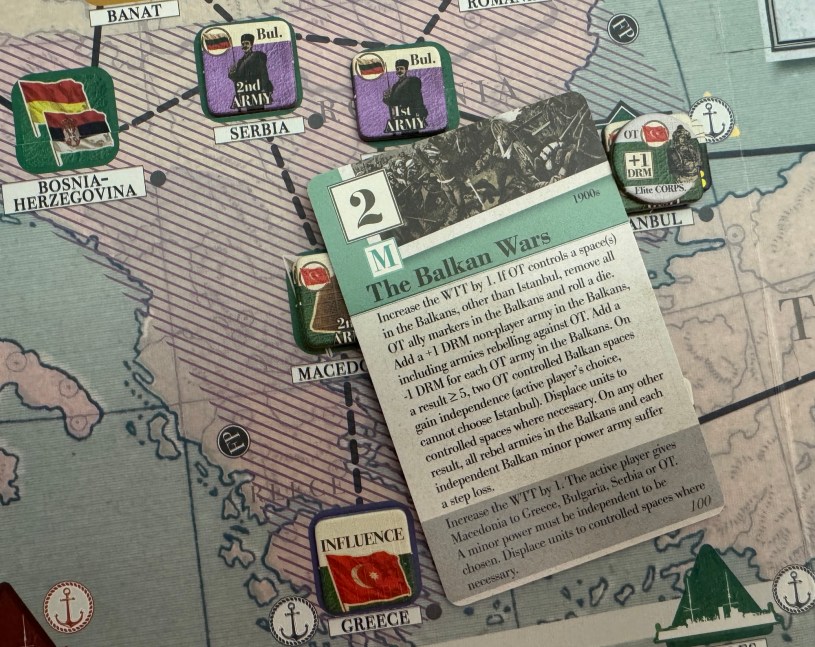
#98: The Balkan Wars from Imperial Elegy: The Road to the Great War 1850-1920 from VUCA Simulations
Imperial Elegy: The Road to the Great War 1850-1920 is a massive card driven game that blends diplomacy, warfare, and statecraft and feels a bit akin to games like Here I Stand and Virgin Queen from GMT Games, which are both grand scale sweeping epics that play multiplayers and take a day to play. Players play as 1 of 6 major powers in the game including Germany/Prussia, the United Kingdom, France, Austria-Hungary, Russia and the Ottoman Empire. The game is quite grand and ambitious as it covers 70 years near the end of the Victorian Era and the Progressive Ear and sees quite a lot of global change and competition between the great powers of the time. The game is a Card Driven Game and uses Action Cards as a type of currency to spend for their Command Points or the printed event to take actions such as recruiting armies and navies, industrialize, moving fleets and armies around the globe, influencing minor powers and establish colonies in Africa, India and the Pacific Ocean. The cards are all tied to the history of the period but the game can be played very much as a sandbox allowing players to explore strategies by trailblazing new horizons or following history.
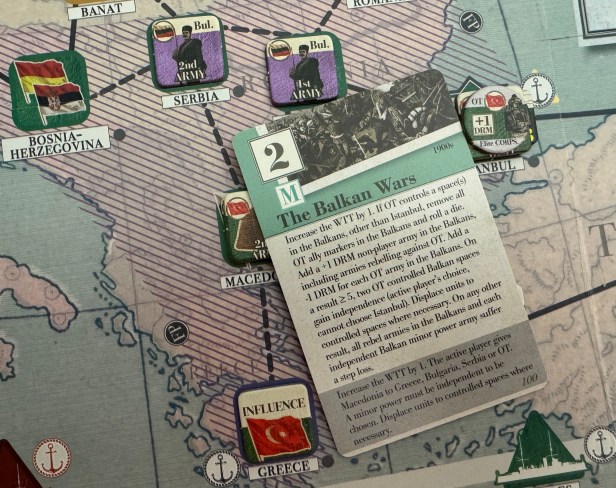
Before we dive into today’s chosen card The Balkan Wars, I want to first make sure you know about Mandatory Event Cards in the game and how they work as they work slightly differently from normal Action Cards. Mandatory Event Cards are all lime green colored and bear a large block “M” just under the CP Value listed in the upper left hand corner. Mandatory Events, as the name suggests, must be played for their events. However, when playing a Mandatory Event Card, players trigger the event and also receive the CP to spend on various actions. The events on Mandatory Event Cards are always resolved first before the CP are utilized. If a Mandatory Event Card is discarded, the event will immediately trigger. There is no way around these cards and they are included in the game to drive the action historically and interject the various special circumstances that drove the rise and decline of these Victorian Age empires. The player that discarded the card resolves the event as if they were the active player. If two such Mandatory Event Cards are discarded in the same impulse the events are resolved in turn order.
Some of the events that occurred historically prior to 1914 were ultimately precursors to The Great War in many ways. The Balkan Wars were two conflicts fought in 1912 and 1913 that stripped the Ottoman Empire of almost all its remaining European territory and directly set the stage for World War I. The Balkan Wars saw similar levels of carnage as machine guns and artillery equipped with hydraulic recoil mechanisms were used in large numbers. Politically, they highlight the volatile nature of international politics in the Balkan Peninsula and are included as a Mandatory Event to ultimately drive up the World Tension Track on a path toward the outbreak of World War I. When played, the World Tension Track will increase by +1 and if the Ottoman player controls any territory in the Balkans other than Istanbul, or has Diplomatic Influence with countries, they will have a chance to lose their control there as a result of the chaos of the First and Second Balkan Wars. If these checks fail, and they will incur a -1 DRM for each Ottoman Army that is located anywhere in the Balkans, non-player armies will be placed in those locations and will increase the difficulty for the Ottomans to gain a foothold in this area. According to the designer Michael Lorino, mechanically this event causes all kinds of trouble in the Balkans, as intended. Similar to the Mandatory Event Card Empire of the Sun, the original event was a bit more involved and had players fight an actual war. In an effort to keep the game in the playable zone, he decided to abstract these wars through a die roll.
I very much enjoy the concept of a Mandatory Event, although they are never convenient for someone at the table as they typically have negative effects for at least 1 faction. But I very much like the approach taken here with The Balkan Wars with the -1 DRM for control of a territory and its thematic connection with the Ottoman Empire’s presence in the region generating tension and setting off these Balkan Wars.
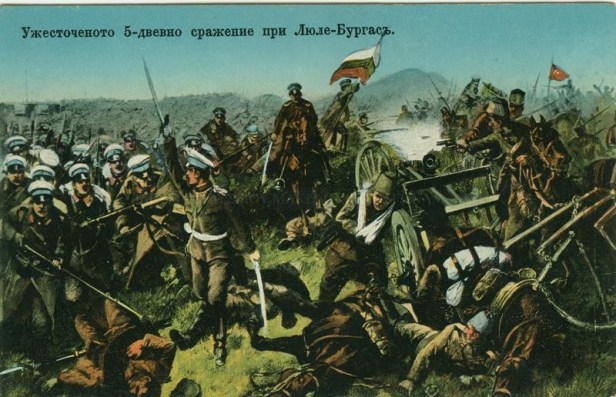
The Balkan Wars were two conflicts that took place in the Balkan states in 1912 and 1913. In the First Balkan War, the four Balkan states of Greece, Serbia, Montenegro and Bulgaria declared war upon the Ottoman Empire and defeated it, in the process stripping the Ottomans of their European provinces, leaving only Eastern Thrace under Ottoman control. In the Second Balkan War, Bulgaria fought against the other four combatants of the first war. It also faced an attack from Romania from the north. As a result of these wars, the Ottoman Empire lost the bulk of its territory in Europe. Although not involved as a combatant, Austria-Hungary became relatively weaker as a much enlarged Serbia pushed for union of the South Slavic peoples. The Balkan Wars set the stage for the July Crisis of 1914 and was a prelude to the First World War.
We have put out several pieces of content covering Imperial Elegy and find it to be a fantastic game. These include written posts and videos. You can visit those by following the links below:
Unboxing Video:
Video Review:
Summary of Solitaire Bots presented by our friend James:
Written First Impressions Post on the blog: https://theplayersaid.com/2026/05/06/first-impressions-imperial-elegy-the-road-to-the-great-war-1850-1920-from-vuca-simulations/
In the next entry in this series, we will take a look at Truman Doctrine from Twilight Struggle: The Cold War, 1945-1989 from GMT Games.
-Grant

