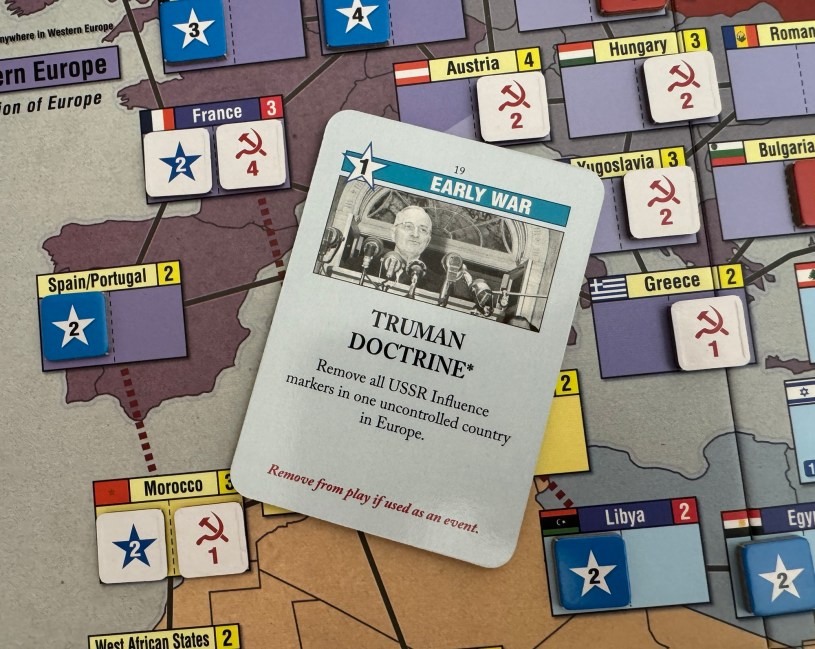
With this My Favorite Wargame Cards Series, I hope to take a look at a specific card from the various wargames that I have played and share how it is used in the game. I am not a strategist and frankly I am not that good at games but I do understand how things should work and be used in games. With that being said, here is the next entry in this series.
#99: Truman Doctrine from Twilight Struggle: The Cold War, 1945-1989 from GMT Games
Twilight Struggle is a 2-player game simulating the forty-five year ideological struggle known as the Cold War between the Soviet Union and the United States which can be played in 2-3 hours. The entire world is the stage on which these two countries “fight” to make the world safe for their own ideologies and way of life. The game starts right after the end of World War II in the midst of the ruins of Europe as the two new “superpowers” of the world squabble over what is left and ends in 1989, when only the United States remained standing.
The map is a world map of the period, where players abstractly move units and exert influence through the placing of Influence Markers in an attempt to build local support and gain allies and control for their superpower. The beauty of the CDG system used here is that each decision of whether to use a card for the event or the operations value is a struggle as if it is the other side’s event, it might go off hurting you very badly. There are mechanics to allow for the ignoring or cancelling of some of the best cards for your opponent in a side game within the game called The Space Race as well as nuclear tensions, with the possibility of game-ending global thermonuclear war (Shall we play a game, anyone?). I have played TS about 30 times and love it more and more with each sitting. The game makes me sweat, cringe, jump with joy and bite my fingernails. To me, a game that can do all of that in one sitting is worth the price.
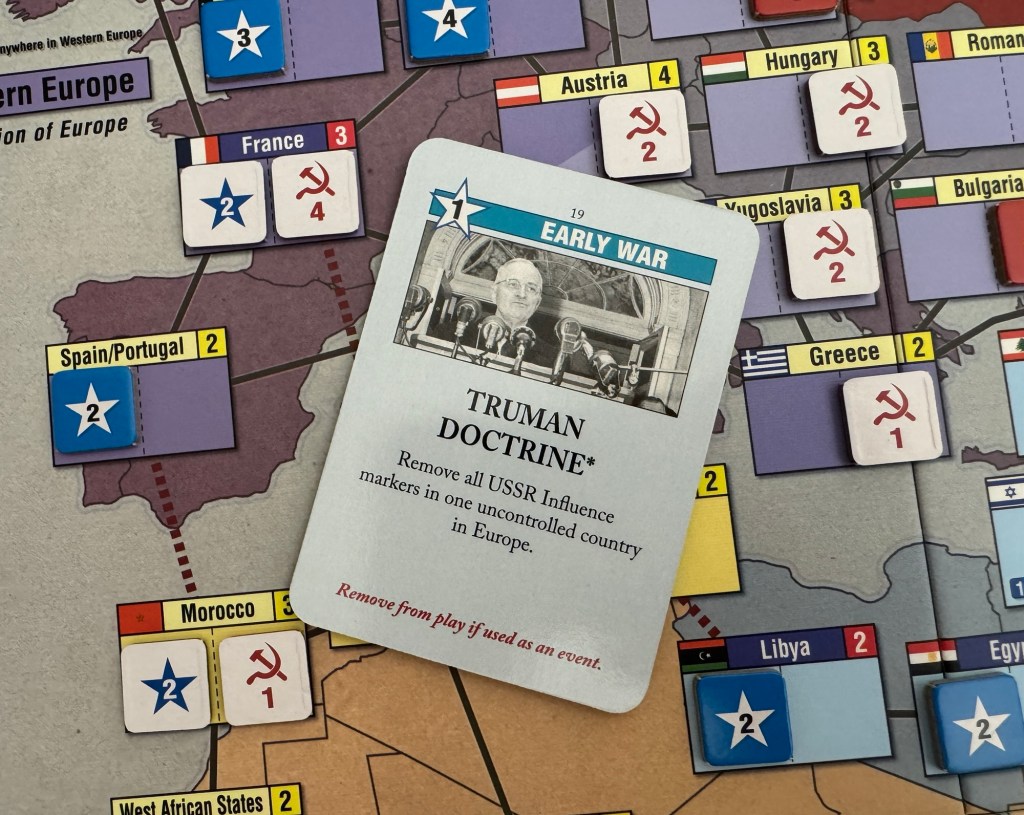
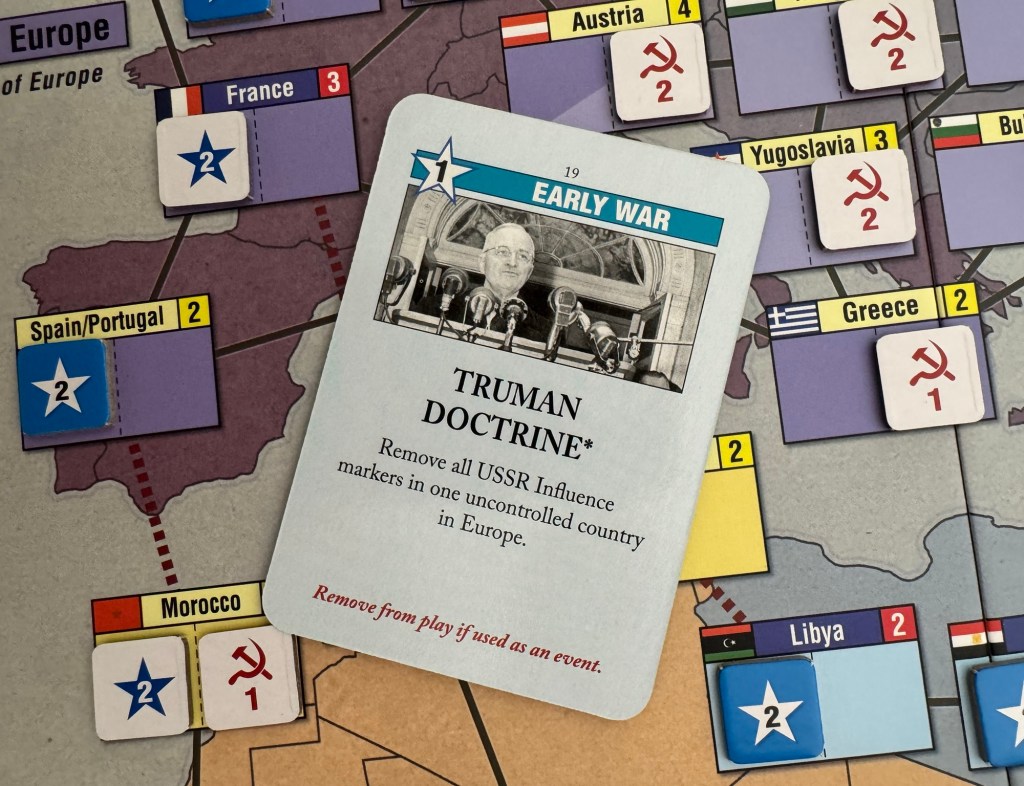
The Truman Doctrine is an Early War U.S. 1 Op Event Card that removes all Soviet Influence from a single country in Europe where the U.S. has presence. This means that the U.S. at least has 1 Influence in a space and the space must be uncontrolled. I think that players should be judicious and patient with this card and do not rush to play early in the game on Turn 1 or Turn 2 if Europe is stable and the USSR has minimal presence there. The best way to use the card is to wait for a window where you can do the most damage in a key Battleground space where each side has been fighting for control by placing Influence there such as in France or West Germany on the last action round of a turn or playing the card during the Headline Phase to wipe out stacked Soviet Influence as a precursor to bumping up your own Influence there for control. The Truman Doctrine card is such a nice booby trap in many ways and the proper use of it can be very efficient and give you a leg up in Europe.
The Truman Doctrine was a United States foreign policy established by President Harry S. Truman on March 12, 1947, which pledged that the U.S. would provide political, military, and economic assistance to democratic nations threatened by external or internal authoritarian forces. President Harry S. Truman asked for $400 million in military and economic assistance for Greece and Turkey. “It must be the policy of the United States to support free peoples who are resisting attempted subjugation by armed minorities or by outside pressures,” Truman declared. “If we falter in our leadership, we may endanger the peace of the world — and we shall surely endanger the welfare of our own nation.”
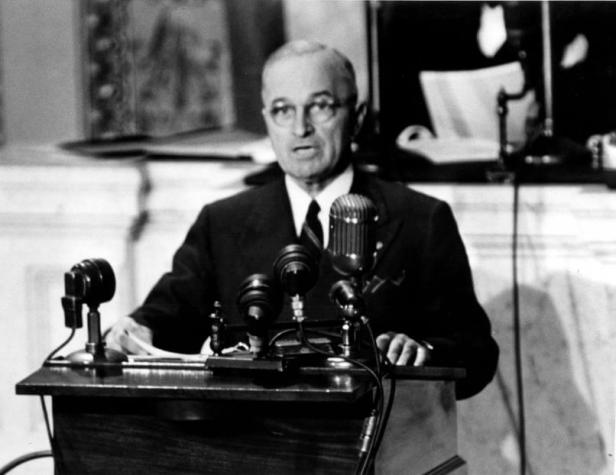
In asserting that the U.S. would intervene in faraway conflicts, President Truman dramatically reoriented U.S. foreign policy. The writing of this ground-breaking message went through multiple stages. In his memoir, Truman noted that the State Department’s first draft of the speech “was not at all to my liking.” Rather than asserting a new foreign policy doctrine, the State Department writers had “made the whole thing sound like an investment prospectus.” Truman returned the draft to Secretary of State Dean Acheson “with a note asking for more emphasis on a declaration of general policy.”
The State Department complied, and included a general policy statement in the next draft. But Truman was not satisfied. “It seemed to me half-hearted,” he recalled. President Truman “scratched out” what he deemed equivocations. For example, Truman replaced “should” with “must” in a key sentence that read “I believe that it should be the policy of the United States…” According to Truman, “I wanted no hedging in this speech.” Because this speech “was America’s answer to the surge of expansion of Communist tyranny,” it “had to be clear and free of hesitation or double talk.” A total of eight drafts of Truman’s speech to Congress are featured on the Truman Library’s website. Many include handwritten comments and corrections. Combined, they give readers a sense of the tremendous effort that went into drafting the Truman Doctrine as well as the importance a single word can make when crafting foreign policy.
Truman delivered his address on March 12, 1947. Over the next several weeks, Congress debated the merits of Truman’s proposed foreign policy. On April 22nd, the Senate approved the legislation to provide assistance to Greece and Turkey. The House followed suit, approving the bill on May 9th. On May 22, 1947, Truman signed the bill into law. According to President Truman, the enactment of his bill “served notice that the march of Communists would not be allowed to succeed by default.”
In the next entry in this series, we will take a look at KSM from Labyrinth: The War on Terror, 2001-? from GMT Games.
-Grant

