Recently, while attending Buckeye Game Fest in Columbus, Ohio, we were able to coordinate a 6-player game of Imperial Elegy: The Road to the Great War 1850-1920 from VUCA Simulations. Imperial Elegy is a card driven game that blends diplomacy, warfare, and statecraft and feels a bit akin to games like Here I Stand and Virgin Queen from GMT Games. Grand scale sweeping epics that play multiplayers and take a day to play. Players play as 1 of 6 unique major powers in the game including Germany/Prussia, the United Kingdom, France, Austria-Hungary, Russia and the Ottoman Empire. In this First Impressions post, I want to share a very brief overview of the game and the experience that we had with it.
Imperial Elegy is a fantastically themed game that takes place over 7 turns, with each of the turns representing approximately a decade. If the Great War breaks out due to the World Tension Track reaching a certain level, the game can be extended by an additional 6 shorter turns. A turn in the game consists of player impulses that is driven by the play of action cards for their Command Points or for the printed events. Players will use CP and events to take actions like colonize, conduct diplomacy with minor nations, fight wars, as well as hinder their opponents by playing events that take away their actions or resources. A turn will end once all players have consecutively passed or when all players run out of cards.
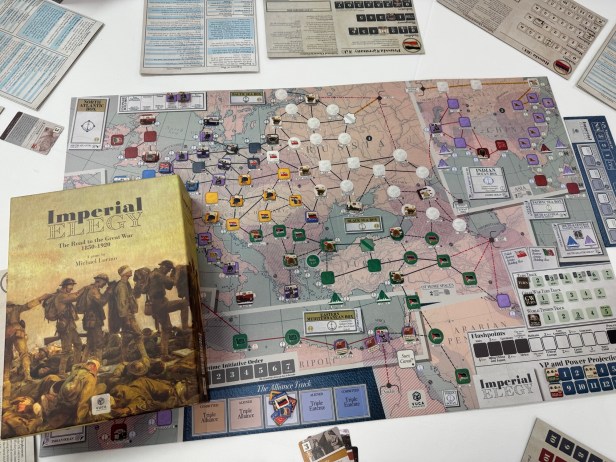
The game is somewhat of a sandbox style game as you have so many options and choices about what to do during the course of the game. Obviously, your faction has some direction about what you should be doing but really it is up the player to spend their resources how they will to accomplish their ultimate goals and score Victory Points. I truly love that aspect about this game and as we played we saw that sandbox and the asymmetry between the various factions. Particularly at the start, each country has some specific goals that they have drawn from the National Goals Deck that are a source of Victory Points, in fact a major source of Victory Points, and players will need to prioritize these cards and decide which ones to attempt to go after from the start. With only 7 turns, they will have to make progress on these National Goals if they have any hope of actually achieving them.
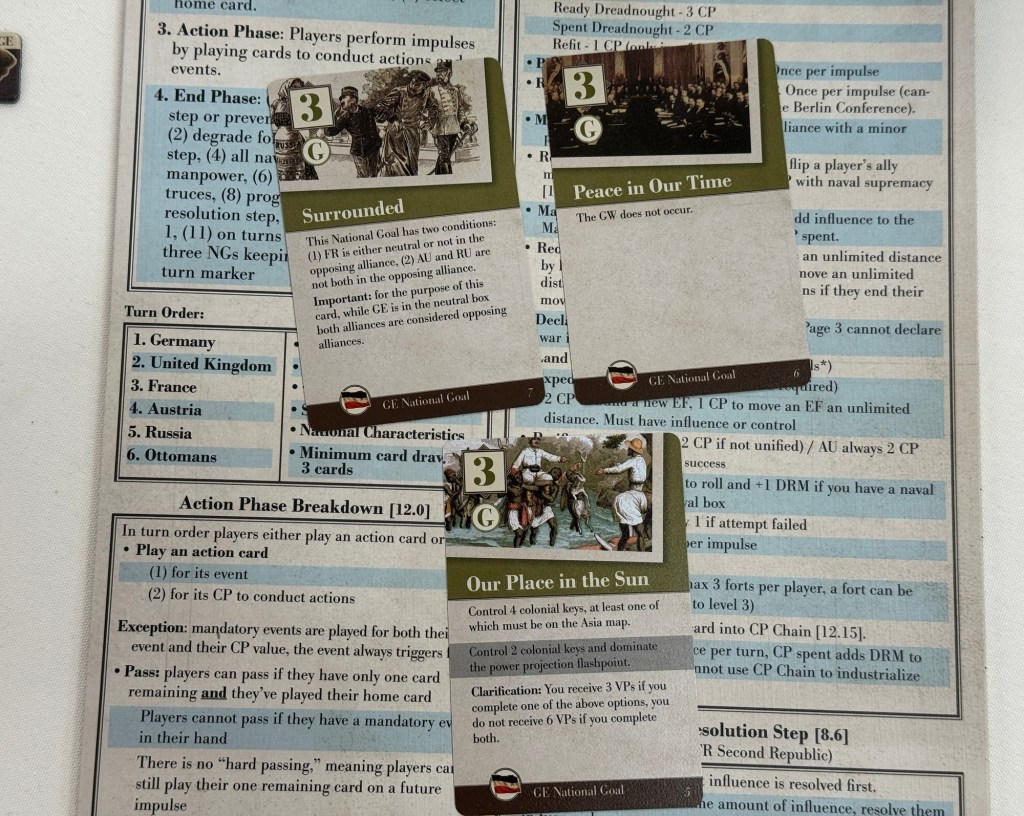
I actually thought that the National Goals was a really great part of the design and really sets it apart from the other games that have been used for inspiration such as Here I Stand and Virgin Queen. I partly feel this because of the options for replayability but also it forces players to change and adjust their strategy throughout the game keeping things fresh and interesting. It also causes players to have to think outside of the box and sometimes do things that their nation might not have prioritized but has been given an opportunity that they must capitalize on in order to earn their victory. Every 2 turns the players will draw 3 of these secret National Goal Cards and decide to keep just 1 of them, so their strategy must change and evolve with the board state and conditions found in the game at that time. This very key element of the design seems truly simple but it really has the benefit of rewarding those players who are extremely flexible and who can adjust on the fly, take some chances, change the course of their general overall strategy and adapt. I say this because I do feel that sometimes in games like Here I Stand or Virgin Queen, the same strategies and series of actions will generally be taken by each of the factions with just a modicum of variation. As you can see in the picture below, these National Goals are pretty variable and include things like preventing the outbreak of The Great War, gaining colonies in various parts or regions of the board and a focus on various alliances and diplomatic conditions.
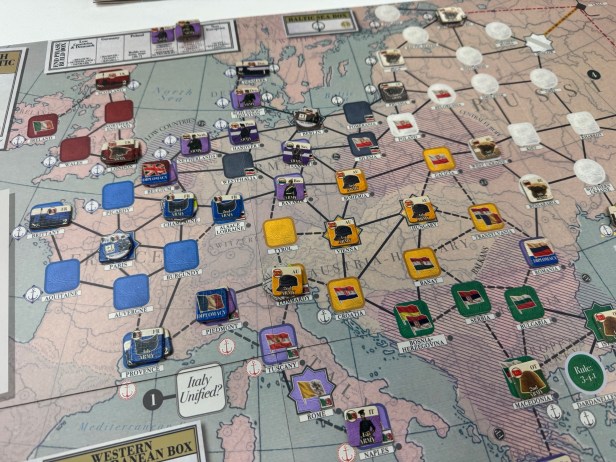
The other aspect that I very much enjoyed was the Flashpoints, which represent key regions of competition amongst the great powers of the period including Italy, the Suez Canal, the Balkans, Qing China and more. Dominating flashpoints is sometimes one of the conditions to achieve and complete some of the National Goals but also provide players with certain benefits, including gaining additional cards each turn or even DRM’s. The specific Flashpoint that I thought was very interesting was the Power Projection Flashpoint which is a projection of the total naval supremacy across the globe through control of ports and naval bases in the various seas and oceans. The only downside here though is that this is an added part of record keeping that players will need to keep a handle on. Not overly burdensome but something that maybe should have been better represented on the player boards or the board itself.
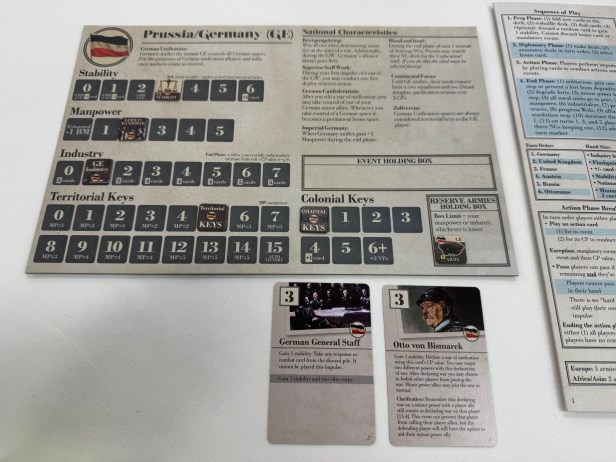
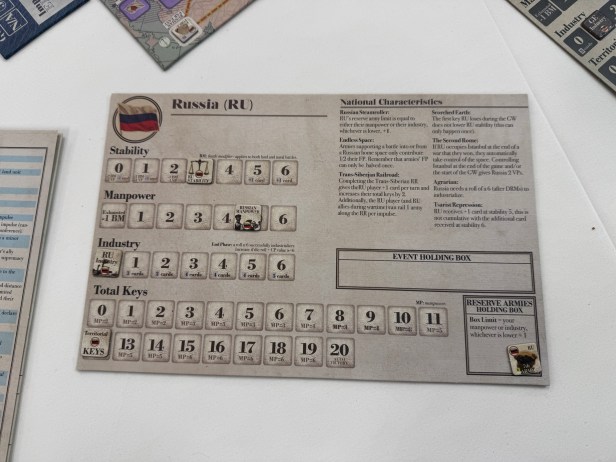
Each of the represented nations in the game have their own special player board that contains various tracks that keep various information readily available to the players. Here is a look at the German player board. I very much enjoyed that they have gone to a great deal of effort to make these player boards and also that they gave each of the nation’s Stability, which decides whether various actions like war can be taken or if there are various positive or negative modifiers, the available Manpower that will determine how many armies can be built, Industry that tells how many action pointed you will have to spend during war to maneuver units, attack and replace losses. The focus of the game is about the control of territories both in Europe as well as colonies abroad and there is an automatic victory if a certain target number is met, in the case of Germany 15.
Here is a quick look at the Russia player board for comparison’s sake as each faction is unique and has various starting levels and abilities. These are very well laid out and assist tremendously in playing the game.
As we played, I started to realize that the key focus of the overall world stability and things like the Domestic Stability Tracks, which are focused of both the internal and external pressures faced by the powers. I really very much liked this thematic inclusion as no one wants to start a major global conflagration and there are steps that players have to take to skirt the inevitable troubles that result in their own actions and how they are seen by the other players in the game. But in our limited play, I never really felt threatened by this concept. Either our group was super skilled at avoiding the inevitable increase in tension or due to our short play we didn’t really experience some of the events that would have tipped this over the edge. I think that we say small increases in our full turn play but nothing that seemed unmanageable and we actually had an event that lowered it so it never became an issue. The game is about spending your resources wisely, in the form of your cards and your aspects like Stability, and to use your cards to do the events that could increase tension didn’t seem to be in our best interest, at least not in the 1st decade of the game. But maybe that will come later.
Keep in mind here that we only played the first full turn and it took us about 90 minutes including an hour of setup and rules overview and discussion as only one of us at the table had player previously (John Lapham). But we very much enjoyed the experience and found lots to like. We have scheduled a full count play of the game in mid June and I will have more to report on at that time but suffice it to stay everyone at the table was impressed with the design and everyone had a good time with it.
Thank you so much for following along and I hope that I was able to show off Imperial Elegy a bit and give it the justice it deserves because it really is something and I look forward to playing more in the future.
-Grant

