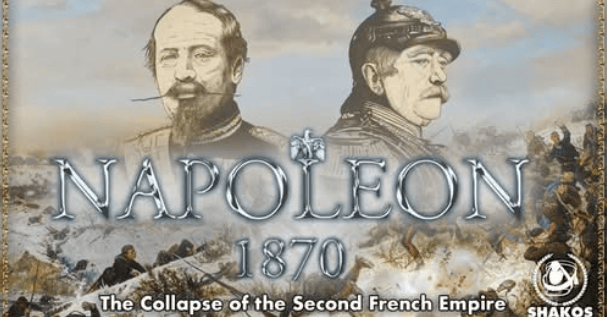
I do love a good Napoleonics wargame and The Conquerors Series from Shakos is really very good as we have played a few games over the years. They have a new volume in that series on Kickstarter that is designed by a tandem of great designers in Brian Asklev (Baltic Empires from GMT Games and 1812: Napoleon’s Fateful March from VUCA Simulations) and Fred Serval (A Gest of Robin Hood and Red Flag Over Paris from GMT Games as well as A Very Civil Whist from PHALANX) called Napoléon 1870: The Collapse of the Second French Empire from Shakos. This game is set in a different period but uses the same system to tell the story of the collapse of the Second French Empire during the Franco-Prussian War of the 1870’s. We reached out to Brian to get some answers to our questions and he was more than interested in working with us.
If you are interested in Napoléon 1870: The Collapse of the Second French Empire, you can back the project on the Kickstarter page at the following link: https://www.kickstarter.com/projects/shakos/napoleon-1870-the-collapse-of-the-second-french-empire?
Grant: Brian welcome back to the blog. What is your new upcoming game Napoléon 1870 about?
Brian: Thanks – Its nice to be back 😊As the title hints at its about the Franco-Prussian War of 1870-71, and covers the opening weeks of that war.
Grant: Why was this a game that you wanted to design?
Brian: As a Frenchman and a Dane, Fred Serval (my co-designer) and I talked about how the wars of German unification (vs. Denmark in 1864, Austria in 1866 and France in 1870) are massively overlooked in our hobby, and we decided to go about to fix this.
I am a sucker for conflicts which had a decisive impact on history as well as wars where the belligerents have very asymmetric strengths and weaknesses at both the tactical and operational levels so 1870 fits this bill perfectly. The 2nd Schleswig War in 1864 would also fit this bill but is a far less interesting topic for a game due to its static nature. This leaves out 1866 and I might just return and do that campaign in this series 😊
Grant: What does the subtitle “The Collapse of the Second French Empire” mean?
Brian: The opening battles in August 1870, which led to most of the French army being trapped and besieged at Metz, was a crippling blow to the French Second Empire under Napoleon III (nephew to the way more famous Emperor of the First Empire, Napoléon Bonaparte). His attempts to salvage the situation led to the remaining part of the army and the emperor himself being trapped at Sedan and France becoming a republic again on September 4th.
Grant: Why does The Conquerors Series work for this battle in the Franco-Prussian War of the 1870’s?
Brian: It’s a very flexible system so it can easily be adapted to different periods. Its fatigue system and uncertain movement system is perfectly suited to show some of the difference between the French and Prussian armies in this campaign
Grant: What unique challenges to this well-tried and highly acclaimed campaign system are explored here?
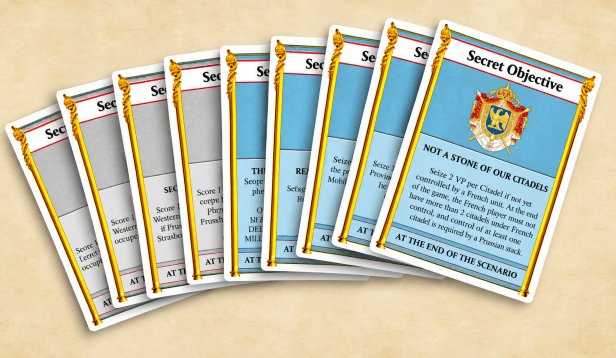
Brian: We have added Objective Cards which allow each player to secretly draw one of their sides 5 Objective Cards before play begins. This card then lists some additional ways of earning VP’s for your side and thus you will play differently in each game depending on what you are trying to achieve besides the usual VP’s for losses and controlling specific locations.
In addition, Event Cards allowed us to add some aspects, such as logistics, which we felt was underrepresented in previous games in the series. As the Event Card use in the system is so flexible we could add this without any additional rules to the series as such.
Grant: Who is your co-designer on this effort? What has their experience brought to the table?
Brian: Fred Serval of Red Flag over Paris and A Gest of Robin Hood fame. We work very well together and find it easy to build upon the ideas of the other as well as stop those ideas that only worked well in our heads 😊
In addition, he has a lot of knowledge about the period as well as being able to read and understand French sources.
Grant: What was the division of labor between the 2 of you?
Brian: The design started when we lived in the same town and saw each other regularly, so it was easy for us to have brainstorming sessions and test ideas so we only divided the labor between us for the design of the various scenarios once we were sure the main scenario and the decks worked as we wanted them to. Besides this we decided it would be best if Fred did the translation into French 😊
Grant: How does designing a game in an established system work? Any constraints on your thoughts for the battle?
Brian: I love designing in established series as I have a solid framework from the start and can do all my reading and thinking from the perspective of the series ruleset. This was also how I started as a designer (with GMT´s Musket & Pike Series). In many ways I am probably more of a tinkerer than a designer as I always start with one or more established systems as my basic framework and then expand, merge and tweak those gradually until I end up with something that is very different from my starting point.
If a suitable system is chosen for the conflict the designer seeks to model there should be few constraints apart from the basic parameters of the series in terms of what it does, and what it does not, focus on. One of my only critiques of The Conquerors Series is the lack of logistics and supply rules as I really like such rules both as a player and as a designer (as anyone who has played 1812: Napoleon´s Fateful March will know). Luckily, The Conquerors Series is very flexible and as noted above, we could easily represent the logistic challenges of the war by the inclusion of Event Cards.
Grant: What did you need to make sure to model from the Franco-Prussian War?
Brian: We needed to include and highlight the asymmetry of both of the armies involved: The French had a massively superior rifle called the Chassepot that in and of itself could have won them the war, while the Prussians had far superior artillery. In addition, the French command was very chaotic and disorganized while the Prussians were remarkably well organized and planned considering they were technically the defending side in the war.
Grant: What sources did you consult to get the historical details correct? What one must-read source would you recommend?
Brian: Fred and I consulted several sources, with Fred having the major advantage here of being French speaking.
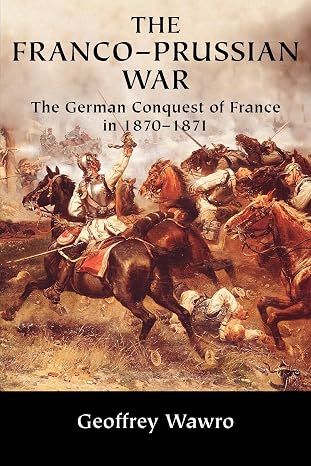
We actually made our own draft versions of the decks and then compared to see where we agreed and where we differed in our choice of focus. To me this was my favorite part of the design process as its very enlightening to see how another person interprets the same source info into card effects and special rules. I would recommend Geoffrey Wawro´s The Franco-Prussian War as a good one-volume book on the conflict.
Grant: What is your overall design goal and thesis with the game?
Brian: My main design goal is always to produce a game that is a solid model of the historical conflict, show players their historical counterpart´s objectives as well as the restrictions they operated under, while being capable of producing plausible alternative outcomes.
When designing in an existing series I naturally adopt that series’ focus and design philosophy, so here we have a system that excels at showing a lot of the friction of war that commanders have little control over and must continually adapt their plans to. Movement rates and combat performance are never certain and both sides have plenty of events that interfere in the operations and capabilities of the other side as well as Must-Play events that can upset the plans of both sides. Historically everything went badly for the French as they were horribly unprepared for the war they started. Within a few days it was obvious that they had to change their overall plan from one of advancing into Germany to one of saving their army from destruction.
I wanted the game to represent this and give the French a chance of winning a sudden death victory by advancing into Germany and repelling their advance forces (and thus shaking up the internal cohesion of the Prussian alliance with the other German states), so the Prussian player is forced to act with some caution in the early phase.
Poor French planning & coordination (represented by initial fatigue levels, pesky Prussian Event Cards and low movement values on their cards) will then often create a situation where the French are in danger of being outmaneuvered and encircled and this next phase in the game will often see the French army trying to fall back in good order and utilize its defensive advantages.
Grant: How does combat work in the design?
Brian: Combat in this series is simple, smooth and elegant. Each side draws a number of cards from their deck and checks the symbols in the bottom corner to see how many losses and fatigue points they cause to the opponent. The number of cards you draw depend on the number of units you have present, their strength and their Fatigue levels. Good defensive terrain as well as unit specific bonuses (clearly shown with icons on the units) may increase the number of cards you draw as well. The two decks are intentionally different. The French deck causes more losses to represent the effect of their Chassepot rifle while the Prussian deck causes more fatigue to represent their superior breechloading artillery.
Grant: What is the area covered by the board? What strategic challenges does it present?
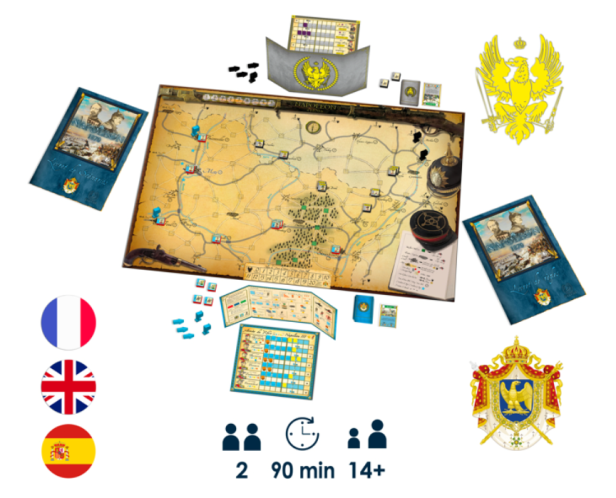
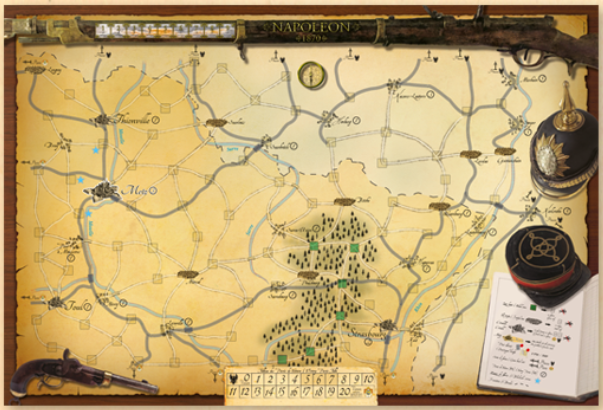
Brian: The game covers only the first phase of the war and thus covers the area of France from (and a bit beyond) the border to Prussia in the east to the area just west of Metz. The fortress of Metz is a key terrain feature on the map and a lot of the late game revolves around it. In game terms it is impassable for the Prussians who have to go around it and control the areas behind it to besiege it. But Metz is not the only VP area on the map and the Prussians have to advance along several axis as well as prevent the French from advancing into their rear and capturing the VP areas inside Prussia. Depending on the Objective Cards drawn for each side some areas may have their VP value further increased, which will make them more important.
Grant: What role does Fatigue play in the design? How do you track this aspect?
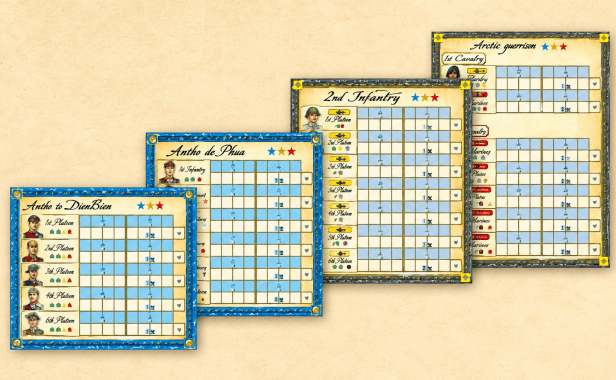
Brian: Fatigue is a critical aspect of the system and each unit´s Fatigue Level is tracked on an off-map display which also serves to track its current strength. The Fatigue Track goes from 1 to 8. If a unit´s Fatigue Level goes beyond 4 you draw one less card for the unit in battle, and at the end of the turn if will lose a strength point.
If Fatigue reaches 8, the Cohesion of the unit collapses completely and it is eliminated. Players can discard cards at the end of the turn to recover 1 or 2 Fatigue Levels on a unit and units that do nothing for a full turn get to remove all their Fatigue at the end of the turn.
Grant: How does the game use cards? Can you share a few examples with us and explain how they work?
Brian: The series uses cards for movement, combat, Fatigue recovery and for events during your own and the opponents turn, so it is very much a card driven system 😊
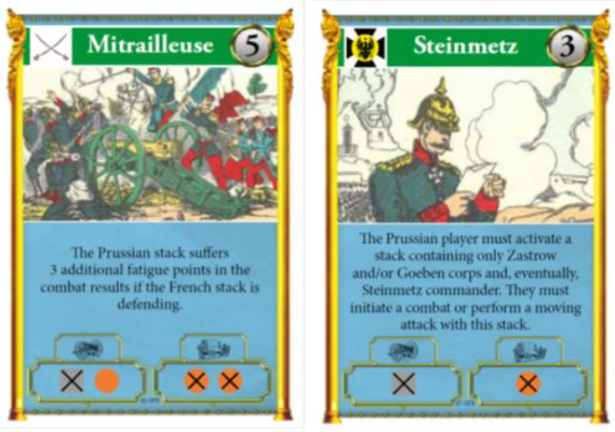
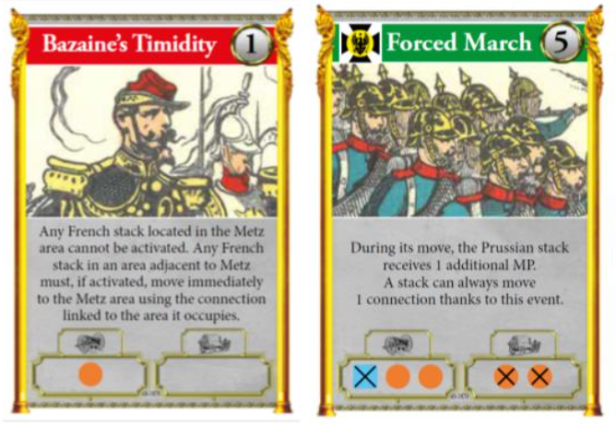
Whenever you wish to move a stack you declare who is moving and then draw a card – the number in the upper-right corner is the stacks movement points (with some modifiers from leader presence and the size of the stack)
The icon in the upper left corner show when a card´s event (the text in the middle) is playable:
- Cards with a sabre icon are battle events that are (as the name implies) playable during battles.
- Cards with your side´s flag are playable when its your turn to move units while cards with the opposing side´s flag are playable in their turn.
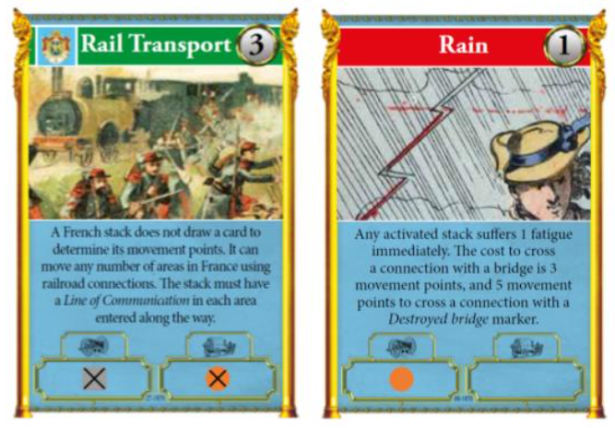
- Cards with their title in a blue box are played at the start of the turn and generally add reinforcements or effects that last throughout the turn.
- Cards with their title in a red box are played immediately and usually represent bad stuff, outside the control of the historical commanders, happening. This could be bad weather but also logistical problems.
- The icons in the lower right section show how many fatigue points you get to remove from a unit if you discard this card at the end of the turn while the icons in the lower left section shows how many losses and fatigue points you cause if this card is drawn to resolving a battle.
Disclaimer: The cards below are low-resolution images from the pre-proofreading so they contain small errors that have already been corrected. Blue background cards are from the French Deck while grey background cards are from the Prussian Deck.
Grant: How is victory obtained?
Brian: Victory is obtained by capturing VP cities and causing losses as in the other games in the series.
In addition to that we, as mentioned above, added Objective Cards that give players options for scoring additional VP’s by fulfilling the conditions on them.
Grant: What are some general strategies for each of the sides?
Brian: The French are definitely the weaker side in this campaign and will be fighting to prevent their army from being destroyed and the Prussians from placing Metz under siege. But on a unit-on-unit basis the French are usually superior, especially when defending, and in the early game have a chance to inflict enough losses on the Prussians to win a sudden death victory. So the Prussians are on a tight schedule and have a lot to do – but also have to be careful in how they to it.
Grant: What different scenarios are included?
Brian: The main scenario covers the period from the start of the war up to encirclement of Metz and then we have a short scenario covering the battles on the border in the opening days of the war and a short scenario covering the battle of Mars-la-Tour and Gravelotte.
Assuming we reach all the stretchgoals, there will also be a hypothetical scenario covering the same period as the main scenario but assuming the French command and logistics were better planned and organized.
All the scenarios come in a fixed setup version and a free setup version.
Grant: What do you feel the design excels at?
Brian: I think we achieved our goal of showing the different strengths and weaknesses of the two armies.
The French, with their accurate and long-ranged Chassepot rifles, will usually cause more losses than they suffer but be forced to fall back to prevent their units’ cohesion from collapsing under the weight of the effective artillery and superior numbers of the Prussians.
Grant: What other designs are you currently working on?
Brian: WAY too many!
I am working on a new Operational level game series with Fred Serval which will include little gamed topics on a vide variety of conflicts in the 1900-1990 time frame. Once we launch this series, we will likely be able to put out titles quickly as we already have several games that are ready to go now.
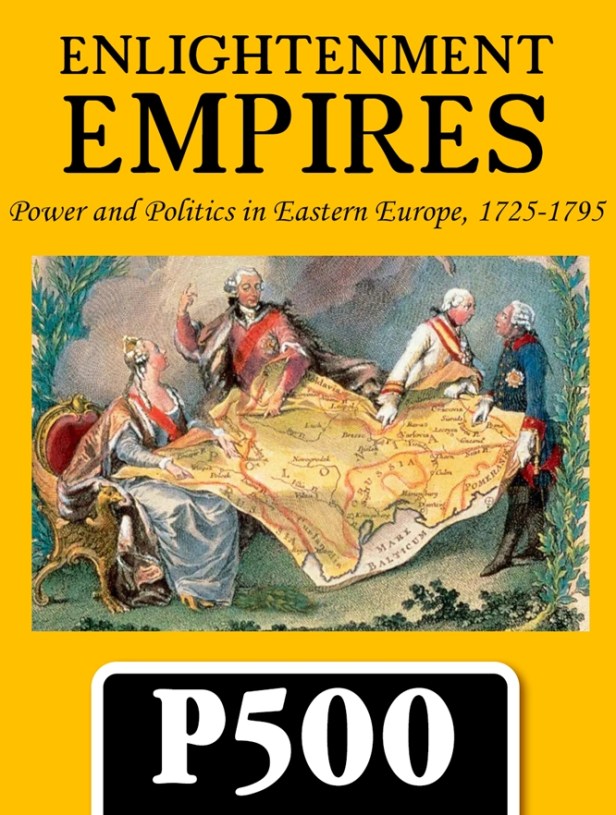
I am co-designing Enlightenment Empires: Power and Politics in Eastern Europe, 1725-1795 from GMT Games (the sequel to Baltic Empires) with Roman Rogov.
I am both designer and developer on 3 new games in VUCA Simulation’s Marshals & Quartermasters Series, which currently only consists of 1812: Napoleon´s Fateful March but will soon include games on the 1813 German campaign (by me), 1814 invasion of France (by Pete Manning), 1796 in Italy (by Antonello Salvatucci) and 1812 in Iberia (by me).
For Academy Games I am (hopefully) finalizing games in the Birth of Series on the Vietnam War and the 2nd Punic Wars. The latter is a co-design with Jose Rivero.
I am also working on new games in VUCA Simulation’s War Chronicles Series I started with Thirty Years of Misery that is just coming out now. One of these will also be a co-design with Jose Rivero on Al-Andalus (medieval Spain).
Lastly, I am also doing final testing on The 38th Parallel in Bellica 3rd Generation’s criminally overlooked Campaign Commander Series 😊
If you want to learn more about the game, you can watch this preview video put together by co-designer Fred Serval for the Kickstarter page:
If you are interested in Napoléon 1870: The Collapse of the Second French Empire, you can back the project on the Kickstarter page at the following link: https://www.kickstarter.com/projects/shakos/napoleon-1870-the-collapse-of-the-second-french-empire?
-Grant

