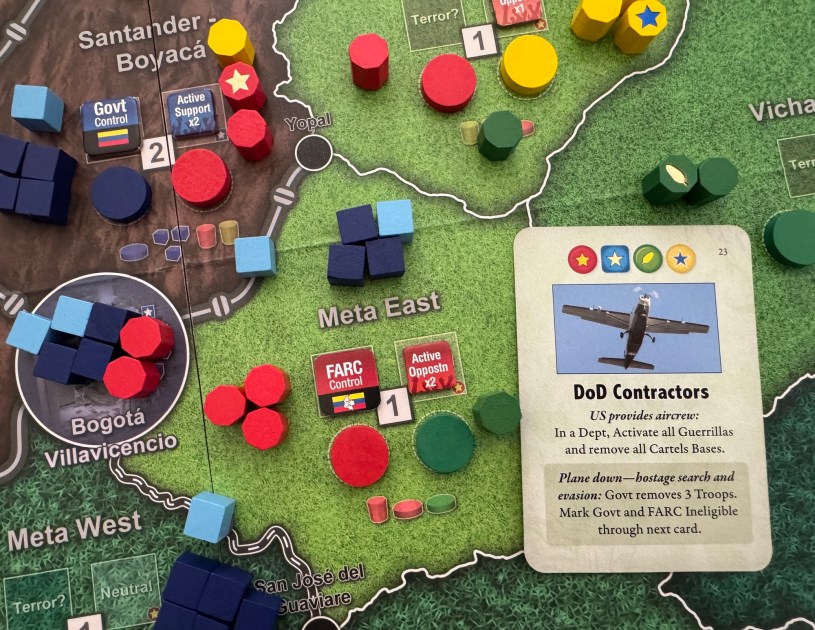
With this My Favorite Wargame Cards Series, I hope to take a look at a specific card from the various wargames that I have played and share how it is used in the game. I am not a strategist and frankly I am not that good at games but I do understand how things should work and be used in games. With that being said, here is the next entry in this series.
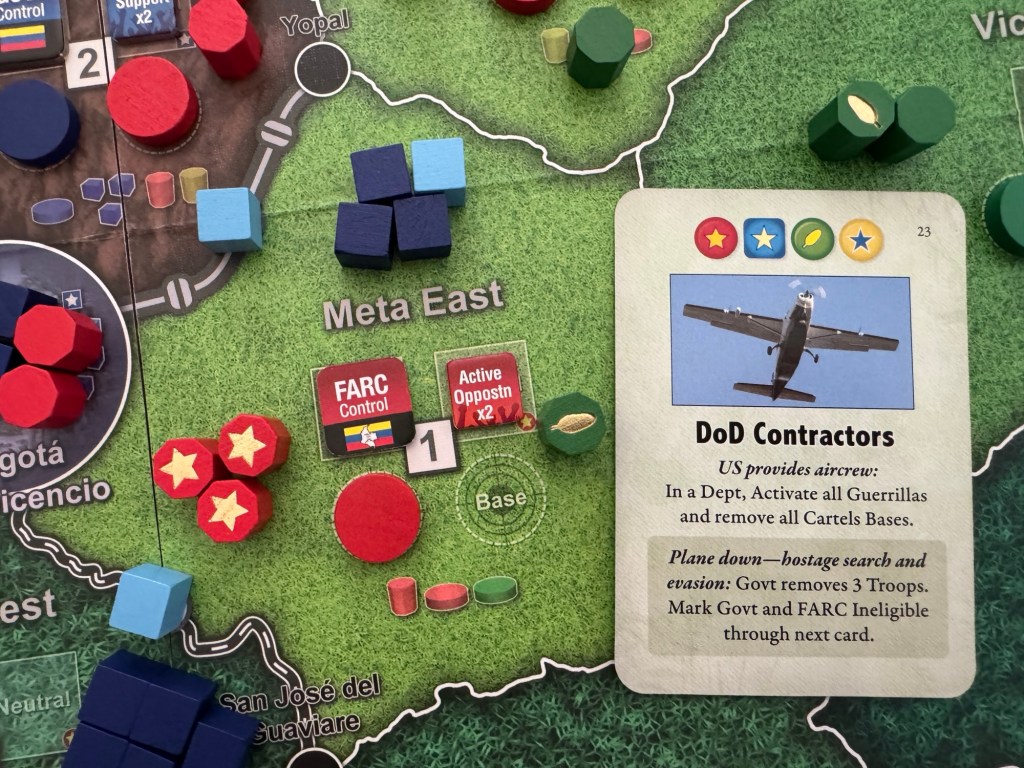
#91: DoD Contractors from Andean Abyss: Insurgency and Counterinsurgency in Colombia from GMT Games
The first game in the COIN Series called Andean Abyss is a 1-4 player multifaction treatment of the campaign for control of Colombia with different factions such as the the Government, FARC (Fuerzas Armadas Revolucionarias de Colombia), AUC (Autodefensas Unidas de Colombia) and the Cartels. The game focuses on all of the facets of the conflict including guerrillas and police, kidnapping and the drug war, military sweeps and terror. The factions deploy distinct capabilities and tactics to influence Colombian affairs and achieve differing goals. Andean Abyss creates an opportunity to get a feel for this model of insurgency and counterinsurgency in Colombia.
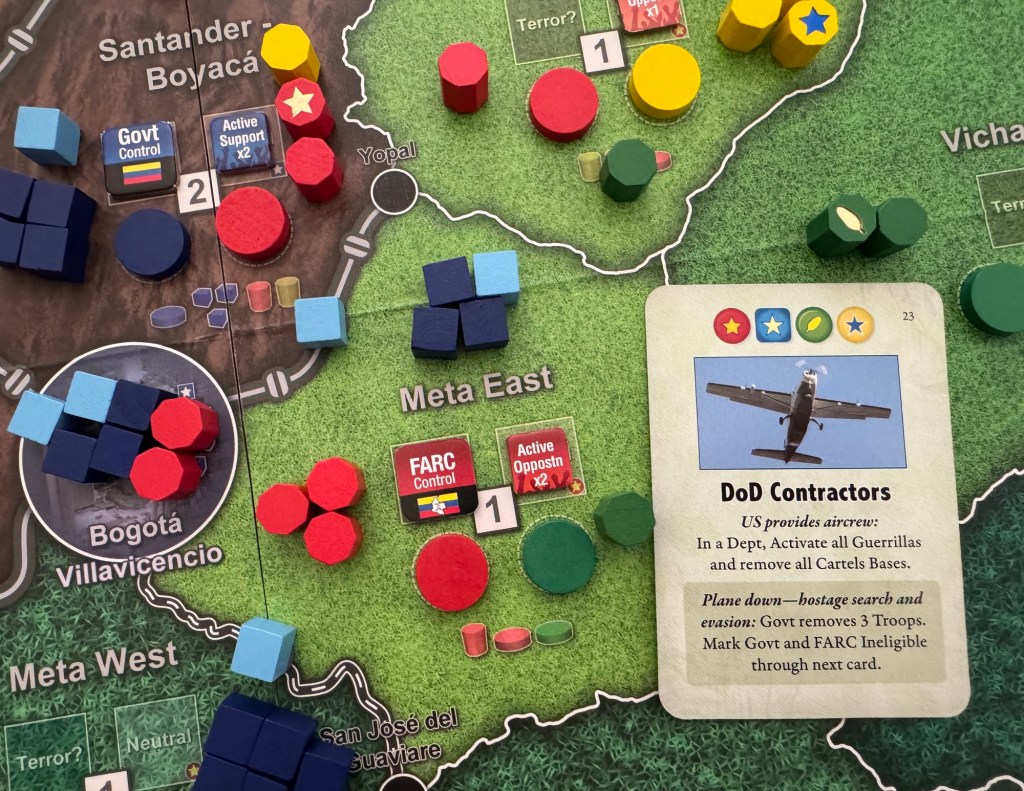
In this entry, we will take a look at the interesting and fairly powerful DoD Contractors. The card pays homage to the efforts by the Department of Defense to pay independent contractors to provide pilots for crop spraying over FARC-held territory and for reconnaissance flights to pinpoint the locations of guerrillas and their bases of operation. Patrolling FARC guerrillas in 2003 shot down one such flight along the western slopes of Caquetá and took three US personnel hostage, setting off a Colombian Army manhunt. The event gives the Government player the opportunity in a single Department to Activate all underground Guerillas and also to remove all Cartels Bases. Typically, to perform this type of action is a multi-turn investment with the Government having to mobilize and move Troops and Police into a Department and then perform a Sweep operation to uncover them. Then on a following turn, they can Assault and do things likes Air Strikes to attempt to eliminate these units. But this is very hard to do as the FARC and Cartel player can just use their next action to send their units back Underground or to Rally additional units in the space to safeguard their assets and Bases. On the other side, the Insurgents can use the event to remove up to 3 Government Troop Cubes and also mark both the Government and FARC ineligible through the next turn which means they will lose a turn. This effect is tied to the manhunt by the Government looking for the downed hostages as their resources and efforts are tied up preventing them from taking their normal actions. This can be really powerful and allow the insurgents to recover and get their units on the move or bring in more. Depending upon the time of the game that this is played, and around whatever circumstances are going on, this can really be a powerful card either way and I love how it reflects the US efforts to smoke out these drug lords in their war on drugs.
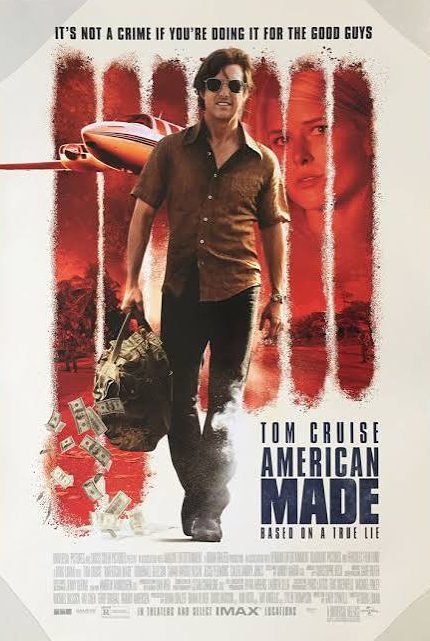
In 1978, Baton Rouge pilot Barry Seal, who flew commercial jets for TWA, is recruited by CIA case officer Monty Schafer. He asks Seal, who has been smuggling Cuban cigars into the country to make a little money, to fly reconnaissance missions over Central America using an Aerostar 600, outfitted with aerial surveillance cameras. Seal accepts the job, but hides it from his wife, Lucy.
In the 1980’s, Schafer asks Seal to act as a courier between the CIA and General Noriega in Panama. During a mission, the Medellín Cartel picks Seal up and asks him to fly cocaine on his return flights to the US. Seal accepts and flies the cartel’s cocaine to Louisiana, airdropping the drug in the countryside.
The CIA turns a blind eye to the drug smuggling, but the DEA tracks Seal down. To avoid the authorities, Seal and his family relocate to Mena, Arkansas and his wife comes to accept the wealth generated by his side job. The small town becomes wealthy as the hub of US cocaine trafficking.
Later, Schafer asks Seal to run guns to the Nicaraguan Contras in Honduras. Realizing the Contras are not serious about the war and just want to get rich, Seal starts trading the guns to the cartel. The CIA sets up a Contra training base in Mena and Seal flies the Contras in, but many of them escape as soon as they arrive.
Seal makes so much money he buries it in suitcases in the backyard. The FBI catches wind of the sudden exuberance on the streets of Mena. Eventually, the CIA shuts down the program and abandons Seal, who is arrested by the FBI, DEA, ATF and Arkansas State Police simultaneously.
Seal escapes prosecution by making a deal with the White House, which wants evidence of the Sandinistas being drug traffickers. They ask him to get photos that tie the Medellín Cartel to the Nicaraguan Sandinistas. Seal manages to get them, but the White House releases them as propaganda against the Sandinistas. Seal is prominently shown in the pictures, which leads to his indictment by the crusading state attorney general and the cartel plotting revenge.
Seal is convicted but sentenced to only 1,000 hours of community service. Moving from motel to motel making video recordings detailing his experiences, Seal expects an explosion any time he starts his car. As his community service is performed at the same Salvation Army building every night, Seal cannot hide from the cartel and is shot dead by an assassin. The CIA destroys all evidence connecting them to Seal and continues smuggling, instead using Iran to get guns to the Contras, as proposed by Schafer.
While this example is a bit more than crop dusting, the operation is part of the same deal and shows the US Government’s reliance on private commercial aircraft pilots during the war on drugs.
In the next entry in this series, we will take a look at Castelnau and Voie Sacrée from Verdun 1916: Steel Inferno from Fellowship of Simulations.
-Grant


Somehow I inadvertently misspelled Colombia in the title of the post (Columbia like the game company). I have corrected it but it may still show up on the links that I have shared. Unfortunate mistake that makes me mad. Sorry.
LikeLike