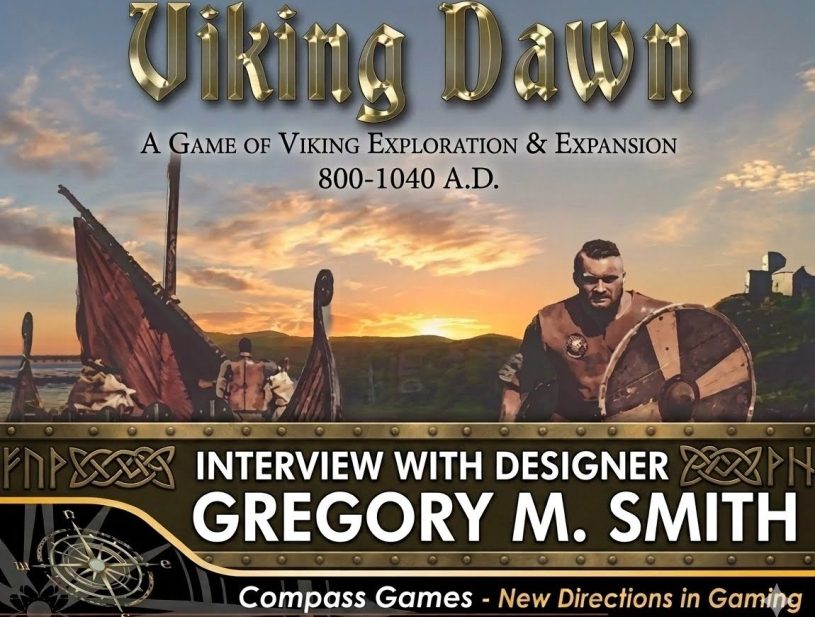
Our friend Gregory M. Smith is a solitaire game designing genius and has done many of these solo, narrative driven style wargames that we have all enjoyed for hours on end while we have been unable to find an opponent or just because we want to play a game on our timeline. We have interviewed him many times for his games such as Zeppelin Raider, Interceptor Ace, The Hunted, Western Front Ace, Amerika Bomber, Defending America, American Tank Ace, British Tank Ace, Rebel Tide, Sinking Yamato and most recently for a magazine wargame called B-52D Linebacker II. But Greg is a versatile designer and also has done many great 2-player games as well. He always has something cooking in his game design kitchen and recently we spoke with him about his new design with Kevin McPartland called Viking Dawn: A Game of Viking Exploration & Expansion 800-1040 A.D. from Compass Games. I was able to play this 1-4 player game while at the World Boardgaming Championships last month and you can read about my experience at the following link: https://theplayersaid.com/2026/07/27/world-boardgaming-championships-2026-daily-debrief-series-day-3/
I reached out to Greg recently to get a bit more information about the design to share with you and he was more than willing to talk with me about this new game.
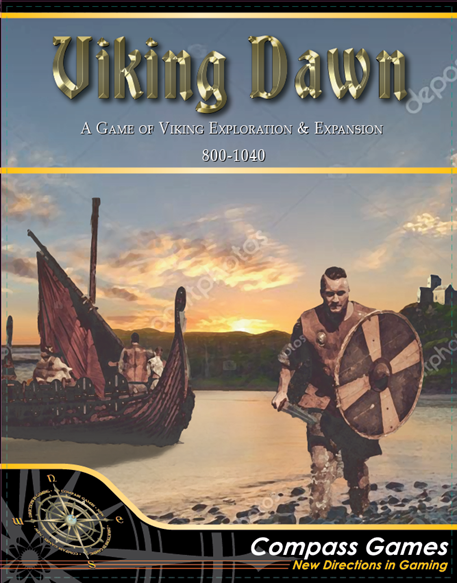
Grant: Greg welcome back to the blog. What is your new upcoming game Viking Dawn about?
Greg: Hey Grant, a pleasure as always. I still think back to the first few of these interviews we did many years ago and laugh. Good times! [Editor’s note: When I reach out to Greg about doing one of these interviews, he is always willing to respond but often adds “don’t get medieval on my ass!” meaning he hopes that my questions are reasonable in number. He has a separate life to game design evidently.]
But, to business – Viking Dawn is an operational/strategic level look at the Viking raids and explorations in Europe, the New World and even into the Mediterranean and North Africa from roughly 800 to 1,000 A.D. 1-4 players will attempt to build a legacy for their faction, including the Swedes, Danes, Norwegians or Geats, by amassing Victory Points through wealth acquisition, exploration, area control, founding and growth of colonies and elaborate Leader burials. The game is playable in 4-5 hours with each of its 8 turns spanning a period of 20-40 years.
Grant: Why did you feel inspired to make this game?
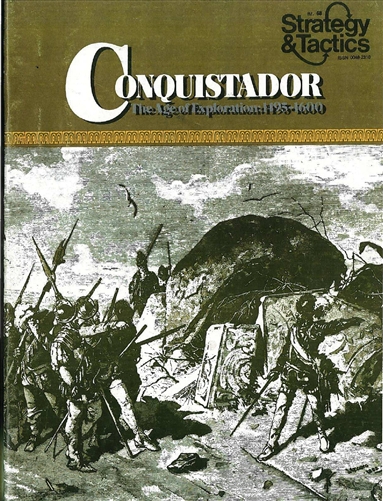
Greg: One of my favorite games in college was Conquistador: The Age of Exploration 1425-1600 from Strategy & Tactics Press and one evening I was watching Vikings (the recent series from the History Channel) and I thought, hey, I should make a Viking version of Conquistador. There’s nothing quite as dramatic as a game that covers 200+ years.
Grant: What sources did you consult to get the historical details correct?
Greg: As you might imagine, there was NO shortage of research materials, which is great on one hand, but on the other, can be daunting. I thought the most scholarly and overall excellent of the bunch was Johannes Brøndsted’s The Vikings. Another great overall look was Robert Ferguson’s The Vikings. Another similar book was Jonathan Clements’ The Vikings. (Nobody hesitates to use that name, you might notice.) The best resource with pictures of artifacts, drawings, and maps included was a book by Richard Hall titled The World of The Vikings.
Grant: I understand you have a design partner in Kevin McPartland. How did this partnership come about?
Greg: It was quite hilarious actually. Kevin is an accomplished designer in his own right, but a couple years back I brought the first prototype of Viking Dawn to the Compass Con and explained how the idea originated. The light bulbs went on in his head, because he ALSO loved Conquistador back in the day and was upset he hadn’t thought of this first! We laughed, then after playing the prototype, he was making nonstop suggestions (and historical corrections and additions). He so improved the prototype I felt I had to have him as co-designer, to which he graciously agreed.
Grant: What was the division of labor between you two?
Greg: Well, I did most of the initial design work, but every time we got together he had some fixes, tweaks, historical corrections, and additions. I’d say he almost acted more as a developer, but he came up with enough mechanics I think co-designer is probably more accurate.
Grant: What other games inspired your design approach?
Greg: As mentioned, Conquistador was the primary inspiration for the overall theme of raiding and exploration, with leaders that last a turn or two before dying (typically of old age, with 20 year turns).
Grant: What is the players goal in the game?
Greg: As with many games, the goal is to amass the most Victory Points, which will determine the winner. Unlike many games, this is achieved through exploration, pillaging, looting, building settlements, and my favorite element through lavish burials for your deceased Leaders. They may have accomplished great deeds in life but if you don’t bury them with gold they aren’t really truly memorable.
Grant: What does a victory look like in the game?
Greg: That is a bit hard to define, as there are many paths to victory, but the most likely path to victory involves settlement income, exploration Victory Points and burial income. If you don’t develop your network of settlements and establish your economy, you will not be able to generate the needed funds to pursue further exploration and settlement and will also not be able to afford to keep your empire going at the end of each turn as you have to pay upkeep on Warbands and Longships.
Grant; What was important to include or model about Vikings in the game?
Greg: Despite the operational/strategic nature of the game, we had to have pillaging and looting or it wouldn’t really be a game about Vikings as this was one of things they are best known for historically and the reason that they were greatly feared in Europe. Just as important (in my mind) was to model the exploration aspects of their seafaring, and this is encouraged by getting Victory Points by being the first to explore various far reaching corners of the map including Russia, Constantinople, Persia and the New World.
Grant: What was your greatest design challenge to overcome?
Greg: The game was too long in its initial versions, and it took some creative editing to chop it down to a more manageable eight turns. It was fun at 12 turns, but just took an inordinate amount of time (6+ hours). I really dislike games that take too long.
Grant: What is the time scale of the game? Why was this important?
Greg: Unlike games about more recent conflicts, the Viking heyday was several hundred years. This was a serious design challenge, but we finally decided on the first two turns being 40 years each <!> and the rest of the turns 20 years each. This sounds crazy, but it actually works, and allowed us to cover the main historical time frame in a playable system.
Grant: What are the different Viking factions in the game?
Greg: You can have 1-4 players, with the Danes, Norse, Swedes and Geats, an offshoot of the Swedes. Think of the Geats as the Portuguese from Conquistador.
Grant: How do factions gain new Leaders? How historical are these Leaders represented?
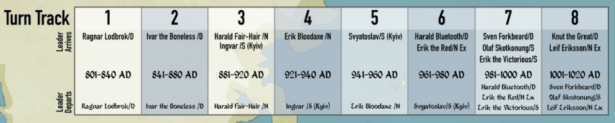
Greg: The Leaders in the game are mainly the more famous/notorious of the Viking faction they represent. They arrive on the Turn Track via their historical arrival dates, and depart via the same (most last only a single turn, some survive for two turns.) However, each player may spend silver and purchase temporary Leaders and Explorers if they don’t have one arriving for awhile. Leaders give a bonus in combat, and Explorers give a bonus in seafaring, so they can be significant. Part of the asymmetrical build of the game is map location, but also Leader arrival times. The Danes have early advantage, but the Swedes and Norse are stronger later in the game.
Grant: Can you share a few examples of these leaders with us?
Greg: For example, these are the Norse Leaders. They have arrival/departure turns (which is sometimes the same turn) and the specialized Explorers have the circular symbol denoting that status.

Grant: What is the general Sequence of Play?
Greg: In general, you receive income, buy units, send out expeditions in turn order, pillage, establish settlements, return home with exploration VP’s, and bury your dead Leaders. There’s more to it than that, but that’s the basic gist of things.
Grant: What different units types are available to each side?
Greg: The basic combat unit is the Warband. The basic transport is the Longship. The basic “civilian” unit is a Settler.
Grant: How does combat and raiding work? How is it Press Your Luck?
Greg: Combat is mainly a combination of how many Warbands you have, modified by Leaders and/or Berserker chits. There isn’t much of a Press Your Luck aspect to combat (exploration, yes, trading, yes, but combat, no.) However, there is a CRT so you have to know your odds. Trying to pillage with only a 50/50 chance of success is risky and should be avoided.
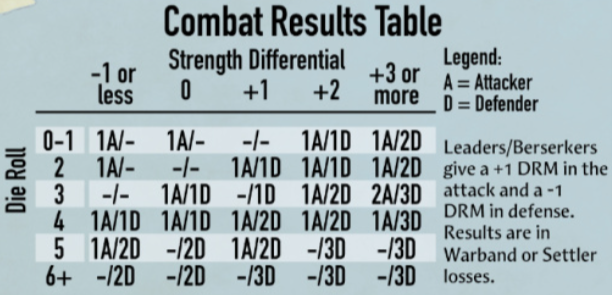
Grant: What actions does each player have access to?
Greg: Players have almost complete freedom in what they want to do – but should obviously focus on doing things that earn Victory Points (making silver, or being the first to explore an area and return home to tell about it). Basically, the actions are external trade, exploration, creating settlements, pillaging, raiding, even demanding ransom. Players can send out multiple expeditions even, with the caveat they have to be able to afford it.
Grant: What is the layout of the board? Who is your artist?
Greg: Here’s the map, being basically most of the places the Vikings went (which was a challenge to show!) Nadir Elfarra, my favorite artist, did the work.
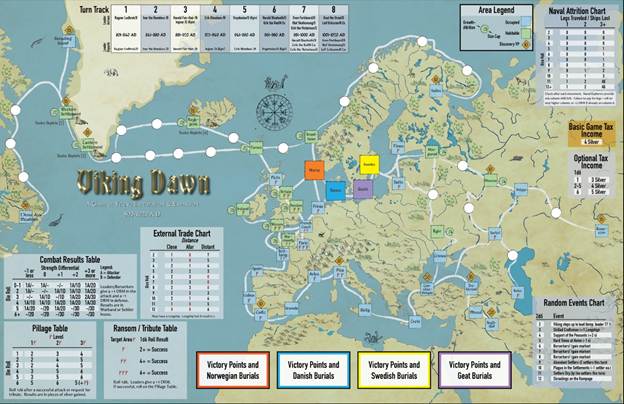
Fun story about the map, I showed an earlier version to my wife, Cindy, and the first thing out of her mouth was “Where are the Sea Monsters???” So we corrected that 😊
Grant: How does trade work?
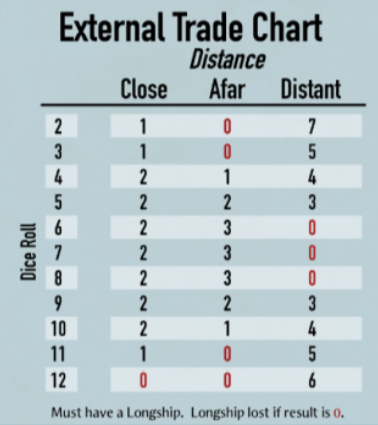
Greg: Internal trade happens automatically with your settlements, assuming you’ve paid for their upkeep. External trade, on the other hand, is a decision the player makes via the External Trade Chart. It requires you to risk a silver and a Longship, and you decide which column to use.
Grant: How are colonies established and how do they grow?
Greg: If you have successfully pillaged a green (habitable area suitable to be settled) you can drop off Settler(s) if you brought any. Each area has a Growth/Attrition number and also a Size Cap. At the end of each turn, you roll to see if the settlement grows (up to the size cap) or suffers attrition. Obviously, England has less attrition and a larger size cap than, say, Greenland. One fun problem is that when areas reach their size cap, they roll to break away and become independent from the homeland.
Grant: How does Longship travel work? What dangers are involved?
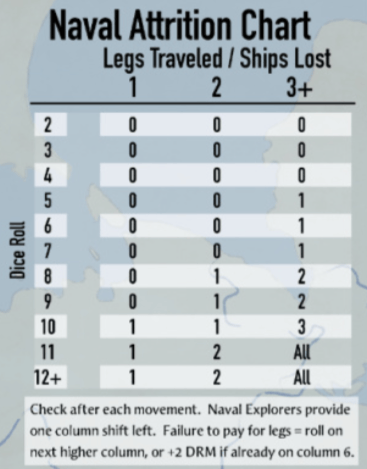
Greg: You may travel a maximum of three legs (each leg being six areas or fraction thereof). This makes the theoretical maximum 18 areas. However, the further you go, the more likely you are to lose Longships and/or your entire expedition. Explorers can mitigate these risks, but there are very few explorers in the game. So there is definitely risk in exploration.
Grant: What type of experience does the game create for players?
Greg; I would like to think of Viking Dawn as a “historical Euro” for lack of a better term. It’s certainly more of a game than an attempt at perfecting simulating all the historical events of the time. Kevin’s fantastic knowledge really helped to make it better historically, and I think it does a really good job of doing a “broad brush” rendering of the Viking age.
Grant: What are you most pleased about with the design?
Greg: I really thought the turn order mechanic made it very tense. Everybody secretly purchases Warbands and Longships, but turn order (a huge advantage to go first early in the game) is determined by who has the most silver remaining after purchases. If you buy a lot, you can do a lot, BUT you’re probably low on silver and going last in the turn. So determining turn order by remaining silver turned out to be a great mechanic.
Grant: What has been the feedback of your playtesters?
Greg: Anybody who knows me knows that I’m my own biggest cheerleader, BUT seriously, we had a great time playing this the last several years at Compass Con. It’s just fun multiplayer, especially when bad things happen. I am very happy with the design, and especially since Kevin McPartland made it ten times better with his involvement.
Grant: When can we expect to see the game released?
Greg: I refuse to answer this question on the grounds I’m never right 😊 but if pressed, I’d have to say early 2027. It’s done and at the printers.
Grant: What other designs are you currently working on?
Greg: I’ve got a few irons in the fire. Solo Banner (Burning Banners dungeon crawler), Western Desert Ace (North Africa WW2 version of Western Front Ace), Soviet Tank Ace, B-52D Linebacker II (magazine game), Gotha Raiders (magazine game), Project Z (Japanese hypothetical heavy bombers 1947), Ground Attack Ace (Stukas and Sturmoviks), Korean Tide (1950-53 Tide Series), Star-Spangled Tide (War of 1812 with Kevin McPartland again), a B-36 game, and a few others. Trust me I’m staying busy!
Thanks as always, enjoyed chatting.
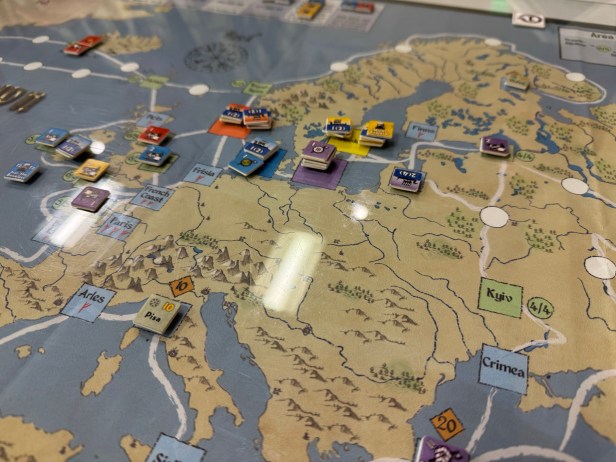
If you are interested in Viking Dawn: A Game of Viking Exploration & Expansion 800-1040 A.D., you can pre-order a copy for $54.00 from the Compass Games website at the following link: https://www.compassgames.com/product/viking-dawn-pay-later/
-Grant


Great interview! Do I need a Viking game? Well, I guess I do. Thanks a lot, Grant! 🤣
LikeLiked by 1 person
I enjoyed playing conquistador over 40 years ago.
I’m glad I read this review because I would never have heard of this game otherwise, and it’s exactly the type of game that I like to play.
I recognize the conquistador mechanics in it
LikeLiked by 1 person