With this My Favorite Wargame Cards Series, I hope to take a look at a specific card from the various wargames that I have played and share how it is used in the game. I am not a strategist and frankly I am not that good at games but I do understand how things should work and be used in games. With that being said, here is the next entry in this series.
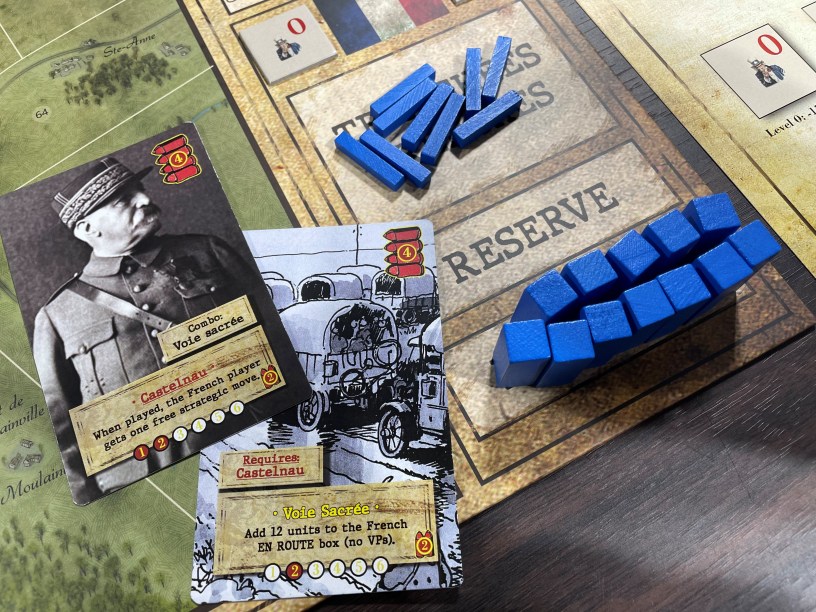
#92: Castelnau and Voie Sacrée from Verdun 1916: Steel Inferno from Fellowship of Simulations
Over the past several years, we have played quite a few World War I games with our focus on the Guns of August events every summer. We have really played some fantastic games including some of the true classics on the genre such as Paths of Glory from GMT Games and The Lamps are Going Out from Compass Games but also some real hidden gems like At All Costs from Hollandspiele, Devil Dogs from Worthington Publishing and Decisive Victory 1918: Soissons from Legion Wargames. A game that we very much liked was Verdun 1916: Steel Inferno from Fellowship of Simulations. The game is a Card Driven Game that uses cards with events and operation points to tell the grim story of the year long fighting around the French city of Verdun. The game uses a bucket of dice approach to the initial bombardments in a battle and then players choose whether to follow that with an infantry assault that doesn’t use any dice to determine hits. The game is very much a wargame but I think the cover highlights a key fact about the game by calling it a “Strategy Game” namely that it is a game as there are wildly powerful events based in history, with lots of dependence on dice not just for bombardments but also for playing certain offensives Event Cards where Victory Points are earned based on the higher numbers rolled. The game is very well done, is truly interesting and surprisingly deep with its tactical choices and decisions.
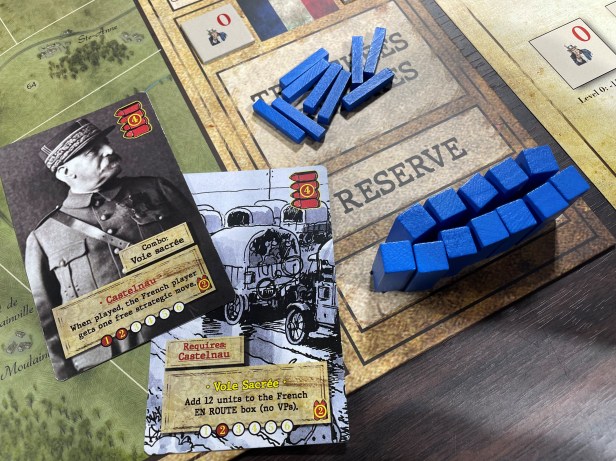
Some cards cannot be played as an Event until a specific named card has been played by the player. This is indicated on the card with a small “requires” box above the title of the card which shows the card that must already be in play as a Permanent Event to allow the new event to be triggered. Also, these Required Cards also have a small “combo” box above the title of the card to remind players which card they will allow to be played as a Permanent Event. Sometimes this concept of Combos must be planned for and may take a few rounds to get lined up to be able to play.
A perfect example of this is the Castelnau/Voie Sacrée Combo. Castelnau is an Event Card that must be played down on the table as a Permanent Event and is available during Turns 1 and 2. Once it is played, then that unlocks the play of Voie Sacrée and allows a very powerful Combo to go into effect by allowing the French player to place 12 units into the En Route Box on the board meaning they will be available for placement during the next Turn. This is so very powerful as in order to get that many units to use, the French player has to sacrifice a total of 12 VP (1 VP per unit added as Reinforcements). With this Combo, you sacrifice no VP’s and get 12 units to place on the board to plug the inevitable holes that will be created by the powerful German Barrages and assaults. There are other Combos as well including several specified Offensives (Russian Offensives and the Somme Offensive) that take several Turns to accomplish with multiple cards to get an opportunity to roll dice to gain VP’s. This was a very novel idea for the CDG mechanic and really worked well to create some portion of the game that required planning and an investment.
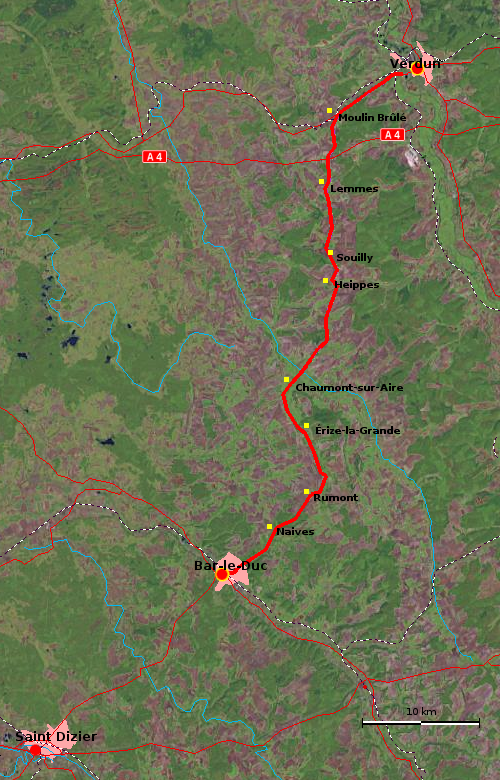
The Voie Sacrée, which is French for Sacred Way or Sacred Road, is a road that connects Bar-le-Duc to Verdun, France. It was given its name because of the vital role it played during the Battle of Verdun in World War I. After March 1916, along the 45 miles of the Voie Sacrée, transport vehicles were on the move day and night, ferrying troops, armaments, and supplies to the Verdun battlefield. During the initial crisis of February 21st through March 22nd, 600 trucks per day had already delivered 48,000 tons of ammunition, 6,400 tons of other materiel and 263,000 men to the battlefield. Beginning on February 21st, all horse-drawn traffic and troop movements on foot had been ordered off the road, leaving it open for truck and motorcar traffic only. After March 1916, one truck passed every 14 seconds, submitting the road to considerable wear and tear. Quarries had to be opened nearby to supply the road with crushed stone. Over the course of ten months, 16 labour battalions worked to keep the road in good shape and order. The road had been recognised since 1915 as the only reliable vehicular road that remained in existence to supply Verdun safely. All the standard-gauge railway lines that could reach Verdun had already been interrupted by German forces in late 1914. To compensate for this precarious situation, the road had been widened to 23 ft during 1915, so it could accommodate the continuous up and down flow of two lines of truck traffic. This preemptive roadway improvement in 1915, plus success in organizing the transport system on the road (a mission supervised by Colonel Maurice de Barescut, the Chief of Staff of the French Second Army), is what ultimately saved Verdun in 1916.
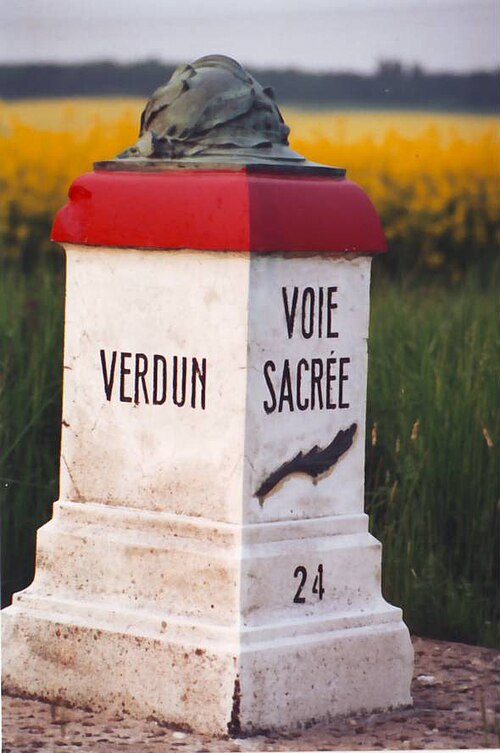
The Voie Sacrée still exists, but it has been paved over and is now an active secondary road. In 2006, the route was renumbered RD1916, a reference to the road’s most critical year. From 1923, the Voie Sacrée was marked by a borne every kilometer along the route. Each borne is topped with a sculpture of an Adrian helmet, the helmet worn by French soldiers during the Battle of Verdun.
The town hall in the village of Souilly, on the Voie Sacrée, served as headquarters to Generals Philippe Pétain and Robert Nivelle during the Battle of Verdun. A large, well-preserved, two-story stone building fronting on the Voie Sacrée, the Souilly town hall is still in official use today. Several plaques on its facade remind the visitor of the historic role it played in 1916 during the Battle of Verdun and, later in 1918, during the Meuse–Argonne offensive.
In the next entry in this series, we will take a look at the German Home Card Otto von Bismarck from Imperial Elegy: The Road to the Great War 1850-1920 from VUCA Simulations.
-Grant


Very cool! This is a great article and really captures one of the main reasons that I enjoy wargames, which is learning the history behind the games. I’ve been exploring Steel Inferno on Rally the Troops and hope to get a game going soon. Your explanation of the mechanics of the game really helps. Thank you!
LikeLiked by 1 person