About a month ago, I started a new feature on the blog called Discussion Thread where I pose a question or a situation and seek your input and comments on the issue to gain greater understanding and to encourage thoughtful feedback. The response to the first post about In-Game Retribution was positive and there were a lot comments and opinions shared. I now wanted to do another post in the series but focus on the subject of Zones of Control and their importance in wargames.
A Zone of Control, typically referred to as ZOC, is the area immediately surrounding a military unit that exerts tactical influence over adjacent spaces, which in turn restricts enemy movement, closes up gaps in a line preventing enemy units from moving through, forces combat or triggers some sort of reactive action such as opportunity fire or engagement without the passive player needing to occupy those hexes or take any actions. They are designed to create some sort of resistance to enemy units as they approach. Mimicking real world combat and adding in this concept of awareness of enemy movement.
I think that everyone has an opinion on the subject of ZOC’s and these opinions are mixed regarding complexity, the type, being rigid or sticky, and their in-game effects, but there is a consensus that they simulate well the concept of military friction and holding frontline positions. Let’s take a quick look at the different types of ZOC’s and I will share my thoughts on each.
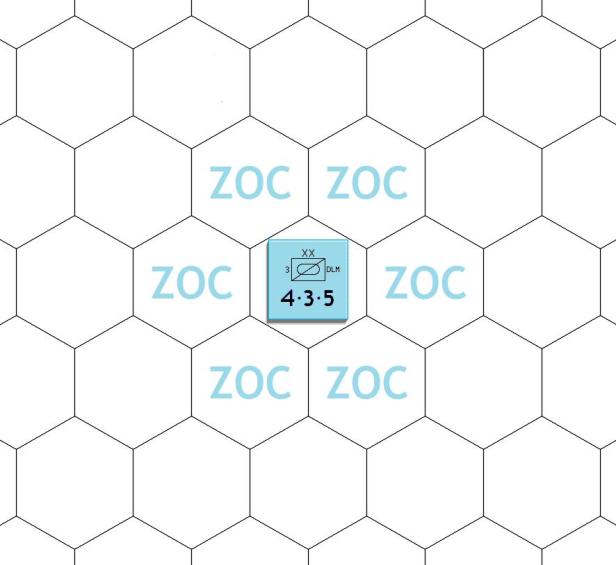
First up, is the rigid/locking ZOC where units must halt their movement the moment they enter a space where an enemy unit is exerting a Zone of Control. The ZOC in this case forces the moving unit to terminate its movement for that turn. I very much prefer these type of ZOC’s as I think that they really simulate the concept of prepared and even sometimes dug-in troops have the advantage and can force advancing units to stop trough interlocking fields of fire or heavy gun projection on the area such as off-board artillery.
Next, we have the soft ZOC where advancing enemy units can move through enemy ZOC influenced spaces, but suffer some sort of movement point penalties, attrition, or extra costs. I also really like this concept as it typically functions similarly to more rigid ZOC’s by costing a +2 or +3 movement cost which typically ends a units movement but not always. I have seen moving units have to take a step loss to take an extra move or more simply extra movement costs such as the placing of a disrupted marker or the like. This type really focuses on the pressures and cost of moving into and through these Zones of Control but are simpler than the more rigid variety.
Finally, I have seen more fluid ZOC’s such as when units can pass adjacent to enemies, but doing so might trigger attacks of opportunity or reactive fire at a disadvantage such as providing the units projecting the ZOC a positive DRM in their attacks or attacking with a column shift on the Combat Results Table. This concept is that moving or advancing units have less cover, less caution and open themselves up to attack more so than those that are forced to stop.
I think that all 3 of these types have their merits and downsides but their use typically depends on the situation represented in the design, the mindset or experience of the designer and the varying historical troop quality and fire power of the units. A line of tanks dug in is much more fearsome and demands a different level of respect in their ZOC projection than say a small arms squad of soldiers who do not have heavy weapons such as LMG’s. And I think that all are viable in design.
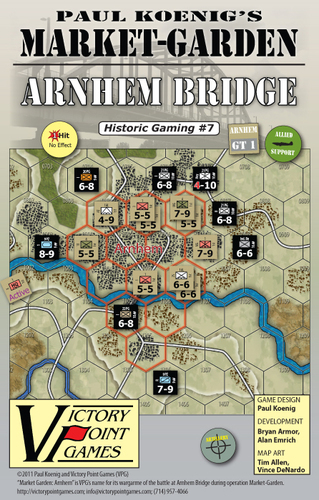
Then there is the lack of Zones of Control. I am not a fan of this concept at all but have found that it is typically used in more introductory wargames that are less complex and focuses on being less of a simulation than a traditional hex and counter affair. Many years ago, and at a time when we were still early in our wargame learning journey, I played a game called Paul Koenig’s Market-Garden: Arnhem Bridge from Victory Point Games. I think that I was attracted to it because of the subject of Market-Garden and the inclusion of Allied airborne units. In looking at the game, the main focus and goal is to move toward the bridge and capture it. The path to move to the bridge is through fairly dense urban hexes with a road leading right to the on-ramps.
Strategically, a German commander would have lined the streets with their best units to prevent the enemy from simply riding right down the middle of the street to the bridge. This commander would have given orders to fire on anything approaching and would have had reserve units located in the buildings to the left and right of the streets to prevent small unit interdiction through the back alleys. These units would have taken up positions to bring heavy fire upon any approach hex and this is typically simulated in other games through the use of a Zone of Control. This ZOC would typically cause advancing units to stop while taking fire from an adjacent unit but in this design, the units just kind of ride on by, waving to the nasty MG-42 nests on the 2nd floor of the buildings and blowing kisses to the Panzers hidden in or behind the piles of rubble!
In reviewing the history of the campaign, one of the major problems the British had in advancing on the bridge was that relatively small German forces had taken up positions in the woods and on the outskirts of the city and effectively pinned down most of the advance of British forces toward Arnhem. This, in my opinion, is a major design flaw and should be house-ruled or cause a redesign of an otherwise fun and good playing game. I have illustrated this point with the pictures below where the British 4-6 Infantry unit simply moves right down the street between 4 better groups of units (an 8-9 Tank, three 6-8 Mobile Infantry and a crack 6-6 SS unit) without taking fire or being stopped! Seems silly doesn’t it?!?


I really tend to prefer the sticky/rigid/locking Zones of Control that seem to be found in most of the hex and counter wargames we play. I am more ok with the less restrictive soft or fluid ZOC’s in a tactical wargame where I can hold actions to then inflict opportunity fire on advancing units. But, as I said before, once you introduce the big guns in the form or tanks or heavy artillery, I really like the sticky/rigid/locking Zones of Control. Is this a taste thing or am I in the minority?
So what are your thoughts on the importance of Zones of Control? Can you enjoy and play a game that doesn’t have them? What is your preference in their stickiness/level of exerted influence in a game? What games do them best? Thanks for reading and for sharing your thoughts. I will come up with a few more of these posts over the next few months to share and I hope to see lots of comments and reaction.
-Grant


I am not used to play without ZOC but recently I played Victory Roads (I was so much looking to play this game!) and they explicitly removed the ZOC concept as each hex is 25km (though it affects lines of supply). I guess in these cases you can live without ZOC.
Then we have Simonitch’s ZOCs :lol
LikeLiked by 1 person
I guess that I never thought of scale being a reason to not have them. That actually makes sense. How does that game play without them?
LikeLike
You need to fight for the roads, rails and hubs. With marshes and forests, even without ZOCs is difficult to sneak in.
LikeLiked by 1 person
it 100% depends on what you’re trying to accomplish.
I don’t think it’s a matter of preference. It’s more a matter of scale and what you’re trying to do.
In a strategic game may not make sense to have his own control.
In an operational game depending on the era in it makes sense to happen control. In the civil War, it could be implemented by costing extra movement points. In world War II, it could be a rigid sign of control.
And a tactical level. It could be range of interdiction or opportunity fire. You could cause enemy units to have to stop and they move adjacent to you.
Zone of control can be used for cavalry screening within an ability to slow down advancing enemy units and the ability to fall back.
it’s a generic mechanic.
it’s it’s up To the designer to implement it in a way that makes sense.
One could just as easily ask the question. How do you feel about combat results tables?
LikeLike
Well sure but people do have preferences aside from considerations outside of scale. I know because I have heard those discussions over the table. Just trying to generate some discussions and see opinions that I have never thought of or considered. And I did mention your concept of the designer’s lien or goal in the game design and what they are attempting to model with the game. Thank you.
LikeLike
The only Wargame item I dislike is the phone decisions in many card driven games. Do X or Y.
I am not fond of the Eurogame infusion in wargames.
hex vs area vs point to point, it depends
ZOC – depends
Chit pull – depends, can also be too random and unrealistic
LikeLiked by 1 person
I for one am a fan of the Typical ZOC in most games I play. But as has been note it depends on the scale of the game being played. I think in your example a rigid ZOC or at least a movement penalty ZOC should apply. Just my 2 cents.
LikeLiked by 1 person
Good discussion! There are also variations in whether units can move from one Enemy ZOC to another – sometimes not all, some yes with a movement penalty, and some depends on whether its an EZOC exerted by a different enemy unit.
I much prefer games that allow movement from one EZOC to another with a penalty – usually 1 hex movement only. Otherwise ‘fronts’ are easily locked up.
Big fan of Simonitch’s ZOC bonds which allows oozing through EZOCs but not through a bond. On the other hand sometimes the ZOC bonds can occasionally look ‘gamey’.
LikeLiked by 1 person
Thanks for raising this interesting topic. Some things in life are real, tangible and possess physical characteristics that regulate the simulation of their capabilities. Tanks are real. Artillery is real. Flamethrowers are real. ZOC’s are NOT real. They are purely theoretical constructs that exist only in the world of wargaming. They are abstractions that serve only to regulate play. Being 100% artificial, they cannot somehow be made more “realistic” by adding layers of complexity to the rules that regulate them. Doing so is akin to claiming that multihued unicorns are somehow more “realistic” than pure orange unicorns. This is relevant in our hobby today because of the rise on ZOC Bond rules in several newly published games. As you might guess, I’m not a fan, but our hobby allows us great choice in picking what games and rule systems we enjoy. If one prefers ZOC Bond rules because one finds that they add more fun to a game, well great. Just don’t attempt to objectively defend them as being more “realistic” when it is purely a measure of preference.
LikeLiked by 1 person
Any zone of control should be related in its effect to what it represents.
It could be that the unit counter actually represents a unit that is spread across the hex it occupies and the surrounding hexes. In this case I would favour a rigid ZOC, either the moving unit stops or conducts an overrun.
If the unit is considered to only occupy the hex containing the counter but to have a field of fire into the surrounding hexes then a flexible ZOC would be better.
Scale and time period are also a consideration.
On a larger scale a ZOC may not be appropriate at all. On a smaller scale there may be situations where the ZOC could extend further than just one hex. In clear terrain an infantry unit may have an effective field of fire into just the adjacent hexes, whereas a tank or artillery unit is able to cover hexes two away.
In earlier time periods facing is going to be an issue. A Greek phalanx, for example, would be able to exert control over hexes to its front but would be unable to affect units passing to its rear.
LikeLiked by 1 person