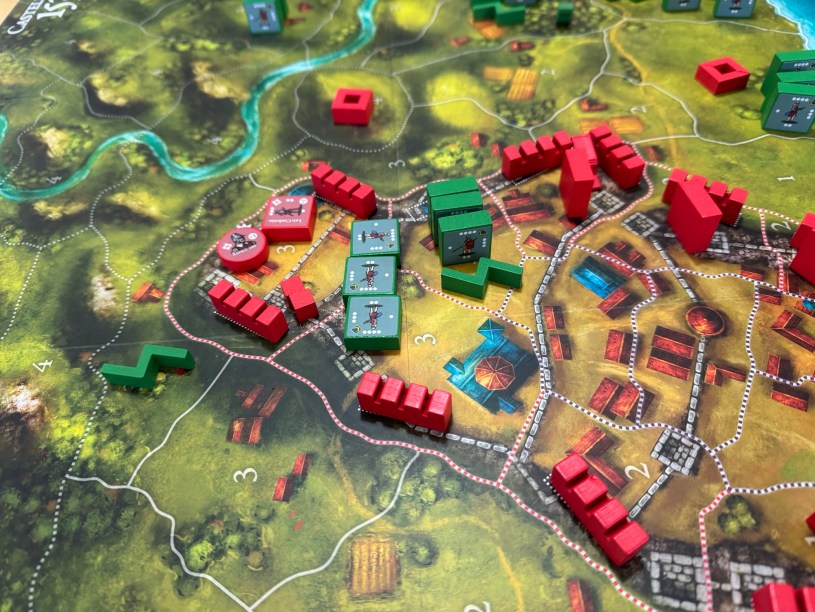
In 1539, a small Spanish garrison of troops numbering 3,500 men held the Albanian village of Castelnuovo for 22 days against the massive Ottoman army consisting of over 54,000 Turk soldiers. This siege took place as a part of the Ottoman-Habsburg struggle for control of the Mediterranean Sea in July 1539 at the walled town of Castelnuovo, which is the location of present-day Herceg Novi, Montenegro. After days of open trench warfare and more than a month of smaller combats, skirmishes, assaults and bombardments from the Turkish navy, the last Spanish defenders fell ending the siege. Castelnuovo 1539 is a wargame that focuses on this siege designed by Francisco Ronco. The defenders are safe behind sturdy walls and battlements but time and continual shelling from the Ottomans will lead to assaults over the walls. The battle is hopeless for the defenders but they can win the game by doing enough damage to the Ottomans to end their campaign and stop them from invading further into the Albania and then onto Spain and the rest of Europe. The game is very well produced using wooden blocks for soldiers, stylized walls, siege trenches and cannon along with ships and the board is also beautifully illustrated. The game is a block wargame where the strength of units are hidden from the opponent and plays pretty quickly in less than 90 minutes and really is a great representation of the battle and its history.
In Action Point 1, we took a look at the beautiful Game Board and its area movement scheme. In Action Point 2, we examined the units available to both sides and compared their relative strengths and weaknesses. In Action Point 3, we took a look at the different types of Command Cards and discussed how they are used. In this Action Point, we will take a look at the 2 different types of rounds including a Siege Round and an Assault Round and how they differ.
In Castelnuovo 1539 there are 2 different types of rounds within the structure of the game including Siege Rounds and Assault Rounds. This 2 type approach is designed to reflect the different preparations and phases of a sustained siege on a fortified location. The Ottoman player is allowed to choose the type of round for the upcoming turn during the Reinforcement Phase, which is the last phase in any round. In this structure, the Ottoman player has the chance to review the previous round, consider their losses and gains on the battlefield, identify their goals and set themselves up for success in the coming round.
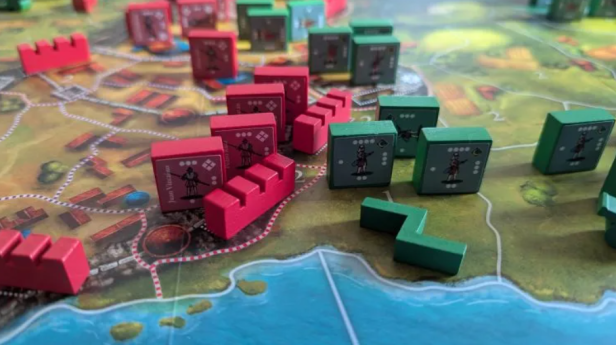
Siege Rounds reflect the necessary preparations, concentration of resources of both men and materiel, the progress of mine works and siege trenches and represent 3 or 4 days of the siege. During this time there are small combats and skirmishes, probing of the enemy lines and reconnoitering but no major frontal assaults. In this type of round, each player draws only 4 cards reflecting the slower and more deliberate planning phases of a siege. The first round of the game is always a Siege Round in the main scenario. There also is another mechanic that is added to the Siege Rounds as the Ottoman player can choose to rest during only a Siege Round and no cards are played and the player also places all of their Azab and Sipahi Blocks on the board at full Strength. This reflects the buildup and preparation for the upcoming assault and is a key decision for the Ottoman player who is pushing against time and must complete the siege in their favor before time expires.
Assault Rounds represent moments of decisive assault, with a great amount of movement and activity on both sides. The action is fast and furious and each turn represents only 1 days worth of combat. In this type of round, the hand of both players increases to 7 cards in order to provide the fuel needed to sustain a planned attack. There is a price to pay for the prosecution of an Assault Round though as each time the Ottoman player declares their intention to assault, the Ottoman Casualty Track will be advanced 1 space.
The decision opportunity for an Assault Round versus a Siege Round comes at the end of the Spanish Action Phase. Before drawing any cards, the Ottoman player chooses which type of round to play next. If an Assault Round is chosen and the player has more than 4 cards in their hand, no new cards will be drawn and the player will discard down to 4 cards. One of the key decision points at this time is the makeup of the Ottoman player’s hand. If they have good cards, such as the necessary Order Cards to initiate attacks as well as a Combat Card or 2 to supplement those attacks and make them more effective, the choice is pretty simple. If their hand of cards is not necessarily setup and beneficial for a siege, they may want to move to an Assault Round where they will draw the maximum 7 cards and can continue their preparations for the next round while still engaging in smaller attacks and bombardments to weaken the defenses and demoralize and reduce the defending Spanish Tercios.
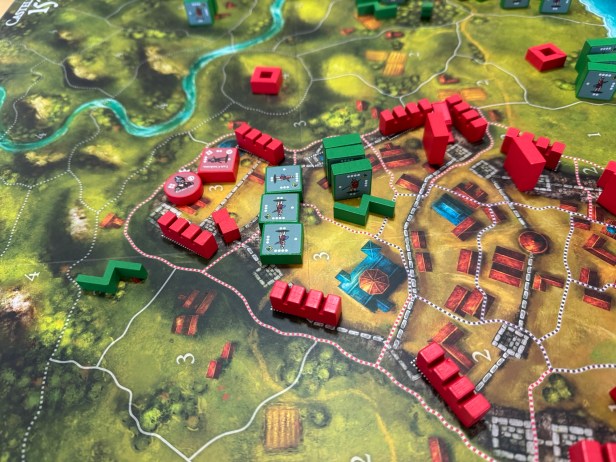
I was very impressed by this distinction in the 2 types of rounds in the design but at first had difficulty making the connection to the history and the design choice. But a siege is a very different and particular case in warfare and has some very interesting nuances that must be taken into consideration. As the game is basically decided by the mounting casualties of both sides, the presence of artillery batteries, the obsolete medieval fortifications of the city and the modern earthen fortifications built by the Spanish to reinforce them, casualties are a reality and the Ottoman player needs to be cognizant of this and take it seriously. There has to be a deliberate and planned attack on the city with the proper and measured construction of siege trenches by the Ottomans to realize the benefit of their usefulness in reducing the casualties of the besiegers.
A good Ottoman commander will play a well balanced game with a consistent pattern of incremental movement upon the city, all the while building their siege lines to form a tightening encirclement of the walls like the coils of an anaconda, inching closer and closer to the walls, using their artillery to weaken and break the defenses and create breaches where close-range assaults can be launched that will ultimately decide the outcome. Digging trenches should be one of the Ottomans first tasks, as they must protect their blocks as they are in the open field, an easy target for attack. Once the blocks are protected with trenches, there is a need to plan the advance and bring these trenches and batteries closer to the Spanish fortifications so that they can breached. Once there are open breaches, it is necessary to throw caution to the wind and take the city by assault as the Spanish attempts to repair the walls and build internal fortifications will continue to hinder the Ottoman’s progress. But, the Spanish player must keep in mind their advantages, including the well known Spanish ‘camisado’ attacks (encamisadas in Spanish) to sally forth and inflict damage upon the besieging forces to weaken their strength. The Spanish leaders are better and will provide great benefits to these attacks that should inflict maximum damage and break the will of the Ottoman as they continue the slow and arduous advance on the city. But the understanding of how to use this Siege/Assault process will take a few plays to understand but once you master the rules, you will see that these fortresses were not defended passively, but rather are in the pattern of an active defense that makes calculated sorties to hinder the work of the attackers by destroying artillery batteries and not giving the Ottomans any rest or respite from the action a vital part of the process.
In Action Point 5, we will delve into an example of combat and bombardment.
If you are interested, I was able to shoot the following review/overview/summary video with the designer Francisco Ronco after playing the game earlier this year:
-Grant


Glad to see this game covered. I’ve been working on a solitaire version of the battle. Thanks for posting. – Joe
LikeLiked by 1 person