A few months ago, I started a new feature on the blog called Discussion Thread where I plan to pose a question or a share a situation and seek your input and comments on the issue to gain greater understanding and to encourage thoughtful feedback. The response to the first post about In-Game Retribution was positive and there were a lot comments and opinions shared followed by a not so successful post on Zones of Control. I now wanted to do another post in the series and focus on the all too common problem that non-wargamers have with the word Wargame and misinterpreting or misunderstanding what it actually is.
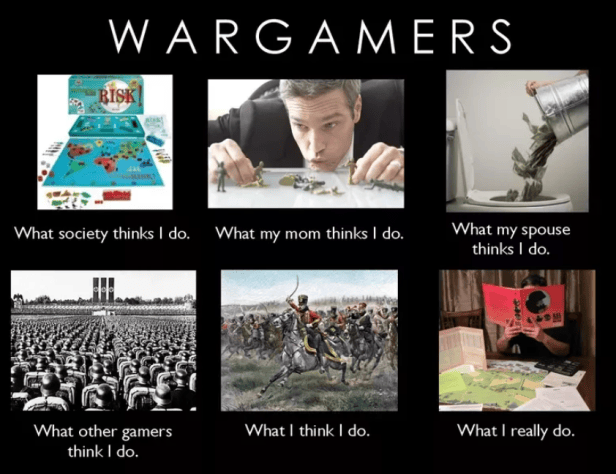
The most common misconception about a board wargame is that it is simply a casual, luck-based mainstream game such as the likes of Risk or Monopoly, that cheapens or treats lightly the historical period covered and those who participated in the event and who fought and gave their lives. Conversely, some people hold that wargames are an inaccessible, dry academic simulation meant only for hardcore military personnel or history professors. Many non-wargamers assume that “wargame” simply means moving plastic armies around a world map and rolling dice to conquer territories. But in reality, traditional board wargames, such as hex and counter games, prioritize historical operational mechanics, logistics, supply lines and terrain modeling over casual social dice-rolling. They also do a credible job at attempting to recreate the outcomes of these battles by ensuring that various elements are accurate including terrain features, weather, commanders and the make-up and skill of troops involved. Finally wargames are a serious matter. No one who plays them takes them lightly nor do they not consider the history covered.
So the reason for me writing this post came from something that I experienced last weekend while attending the Gaming the American Revolution Camden 250 Event in Camden, South Carolina. At this event, which was sponsored by GMT Games, about 100 gamers showed up to play games on the American Revolutionary War from GMT Games including titles such as Washington’s War, Liberty or Death, the upcoming announced Common Sense and the various games from the Battles of the American Revolution Series. As a part of the convention, which was held at the Revolutionary War Visitor Center at Camden, there was a 4-hour tour set up that took participants to see the Camden battlefield, located about 8 miles out of the city limits, and the Hobkirk’s Hill battlefield located in Camden. This tour was expertly lead by the South Carolina Battlefield Preservation Trust Executive Director Rick Wise who was very knowledgeable and entertaining to listen to. You could really feel his passion for the American Revolution as well as the role that these battles in South Carolina and the Southern Theater held in the wider war and the eventual surrender of Lord Charles Cornwallis and his army at Yorktown, Virginia.

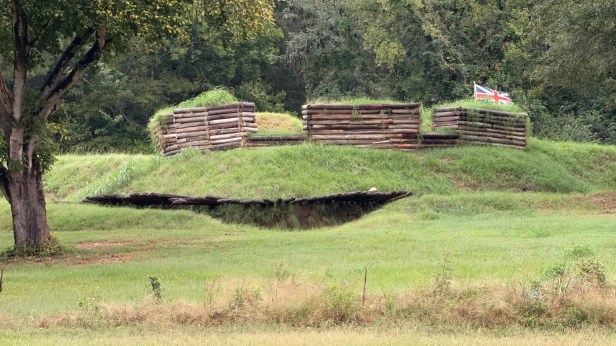
But, when he spoke on a few different occasions he brought up the fact that we were wargamers and that we were gathered to “play” games. This statement is not incorrect as we are all wargamers and were there to play games together. He also said that we needed to understand and keep in mind that there were soldiers who fought, bled and died to win independence and establish the great American nation. I felt like he was really preaching to the choir here with this group as everyone was there for the gaming and the recognition of the history tied to that gaming. Also many attendees were former military and had also served. Finally, I think almost every one in attendance participated not only in his 4-hour guided tour, but also walked the grounds of the Camden Visitors Center to take a look at the redoubt there as well as the Kershaw-Cornwallis House that was used by Lord Charles Cornwallis and Lord Francis Rawdon as an active HQ during the occupation of Camden from 1780-1781. In addition, many attendees came to South Carolina early to visit other battlefields in the area such as Cowpens, King’s Mountain, Waxhaws and Eutaw Springs. I bring this up because of Rick’s tone, and I am not sure that it was valid or necessary in speaking to this crowd, was assuming that as wargamers we were trivializing or taking lightly the gravity of the history involved in the games we were playing. I know that he was not trying to offend or belittle us and our focus but simply wanted to drive home his point of the sacrifices that were made and that we were playing out in a game with dice.
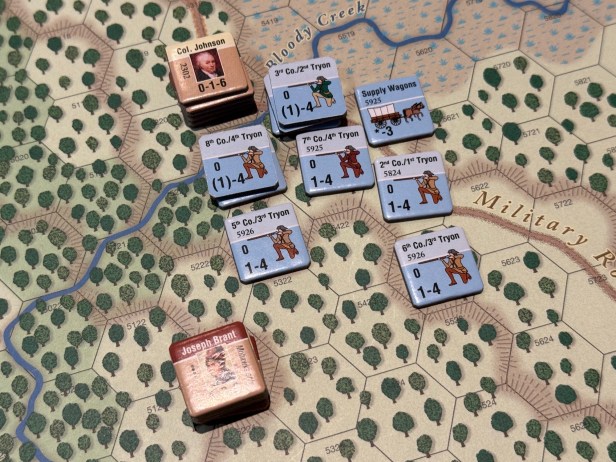
Well, I want to point out a few things about these wargames. They are not trivial but are focused on the actual historical details of the period and the battles involved. Wargames are built upon a few stalwart truths…the people who participated and the terrain upon which they fought and died. These are both hallmarks of every single wargame that I have ever played. The designers take these battles seriously and do hours upon hours of research and investigation to make sure that they have the details correct. For example, with the Orders of Battle or OOB’s, they find the names of each formation, typically named after their commanding officer, and in smaller scale games the names of actual soldiers who were there. These details are listed on the counters and have an impact in the game play itself. But, sometimes the names don’t have an impact and are just added to bring the battle to the view of the players and to hammer home the human element. The designers want players to understand who was involved, how they fit into the larger battle, who their leaders were and even adding in small historical details to make the game grounded in the history. The Battles of the American Revolution Series does this exceptionally well.
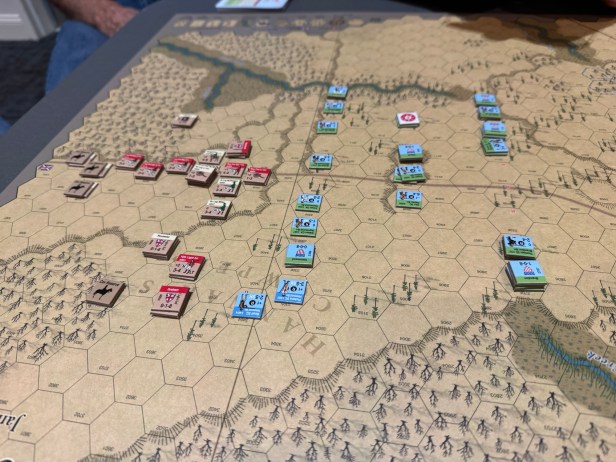
The detail about the makeup of the soldiers involved, as well as their relative strengths and weaknesses, are on full display and are central to us as wargamers gaining insight into the conditions under which they fought, the issues that they would have experienced and the challenges that their commanders would have dealt with in directing their efforts. I like that one of the more interesting parts that is included in this makeup typically is a unit’s morale or their willingness to continue fighting in the face of mounting casualties and fatigue. Numbers are typically assigned for things like morale by designers after reading the histories and taking into account the performance and standing of these troops. More veteran troops typically have higher morale than green or relatively less experienced troops. These factors and attributes are all based on the history and are typically designed as a simulation of the event, or at least as the most realistic and plausible recreation of the event that can be made. And that is the appeal. Understanding the situation from the participants point of view and seeing how it turned out and why. I have played dozens upon dozens of wargames and have always thought about the soldiers and their sacrifice. How did they do what was done? Where did their bravery come from in the face of overwhelming odds? How could they have possibly held up to the better trained and better equipped professional armies of the British? For me, the soldiers are the reason that I play these games. And I assume the same for many of you.
I understand why the average person doesn’t understand wargaming and I get that the word “game” is found in what we do. To the average person, the word game is associated with lighter fare such as Risk, Trouble or Sorry, which are games where you can laugh and joke about things and focus on having a good time and experience with your family and friends. But wargames are more than that…they are a look into the past. A look that includes the gory details, the challenges and the difficulties….and they are made as an homage to the past. Just as books are written to commemorate and outline the details of these battles, wargames are made to serve a similar purpose. To teach, to instruct, to challenge and to test the meddle of players to see if they can meet or exceed historical outcomes or even flip the script and turn history upside down with a totally different outcome. And they are made to be enjoyable but in a different way to the games I mentioned earlier. I love playing games with friends, being with them for hours upon hours, getting to know them, better understanding them and better understanding the history. I would deign to say that I even enjoy playing wargames and do have a good time with them. But I always do keep in mind the history and the soldiers and their sacrifice.
What are your thoughts on this topic? Did I miss the mark in my response? Am I being too sensitive? Thanks for reading and for sharing your thoughts. I will come up with a few more of these posts to share and I hope to see lots of comments and reaction.
-Grant


I’m going to be a bit of a jerk and say this is a pointless/ useless discussion.
its an arbitrary human made subjective definition.
Is Pluto a planet or a dwarf planet?
Is a hotdog a sandwich ?
Is ketchup on hotdogs or pineapple on pizza or eating pizza with a fork a jailable offense?
is Root a wargame (by God I wish I could block it from showing up on a BGG feed)
I did not read your article , I have zero interest in an arbitrary definition.
Is Diplomacy (AH) a wargame? Republic of Rome? Wtfcares
LikeLike
Thanks for the comment but the article is not about what a wargame is but more about the impression or understanding of non-wargamers and what they think. Ketchup on hot dogs is an abomination, pineapple does not belong on pizza and Root is a wargame. I personally have a more broad definition of what a wargame is and include lots of games in the category that others would turn their noses up at.
LikeLike
2 out 3 is acceptable . 😀
Non-wargamers carry diseases, I try to stay away from them🤣
LikeLiked by 1 person
It’s one of the deep paradoxes of wargaming and I don’t think your guide was at fault for pointing out the obvious facts about the underlying reality of war itself that wargamers simulate with their dice and chits. The simulation is not the real thing reflecting the horror of life being taken away, or the screams and bodily stench of a real engagement – or the permanency of death of human beings en masse during war. The closest we can come to simulating that part of the war experience would be war films like “Saving Private Ryan” and those first 20 or so minutes depicted on Omaha Beach – but even then, the film is not the actual events themselves.
I think it is part of our human nature to enjoy drama & conflict, and every good story requires some kind of tension, protagonists and antagonists – dragons and knights etc. And war may be the ultimate drama of all when lives are at stake and the outcome depends on multiple factors: ingenuity, luck and planning. Wargamers simulate the ultimate conflict with chits/dice and cards and get enjoyment out of the drama of the ultimate conflict – but without the actual blood and horror. Which I would like to think, many of us would want to avoid – particularly because we know just how bloody and expensive to human lives actual wars have been because of the many simulations we have played.
But it’s still quite a paradox. We all love watching action flicks, reading books where there are all sorts of conflicts. And the love of conflict/drama has never been absent from human theater or whatever art you express in.
LikeLiked by 1 person
Two things from me:
a) Whenever you search “wargame” the most probable results are miniatures and quite easily WarHammer. So I usually end up, when looking for a war game, writing different variations of “strategy war game”, “strategy board game”, “war board game”… b) About the seriousness of the hobby, I always wonder why no one brings it up when talking about movies, books, chess (yes, chess is about two armies fighting!). I have even been accused of not thinking that when I retire a counter, I am actually killing 20,000 human beings It’s a game, it’s fun and it teaches me a lot, specially to care about every single human being and to hate war which should only exist on a table.
LikeLiked by 1 person
Grognards know well the real cost of war – just how easy it is to have human lives thrown away, especially with incompetent leadership. I would like to wargamers know better than most people do – just how foolish and unwise it is to go to war. That fools jump in where wise men (and grognards) would fear to tread.
There is an old saying that is one of my favorites. If you are a leader of a country and are forced to go to war and must pick a general to lead your army – pick the general who is reluctant to go to war, because he is the one who knows what war is all about – and will be the one who can win it.
LikeLiked by 1 person
Just realised John Amenta has said almost the same as I have.
LikeLiked by 1 person
You said it well too.
LikeLiked by 1 person
one general comment – when I play a wargame I spend some time researching the battle.
I don’t enjoy playing a game on X without knowing about X.
That includes knowing about the human cost .
To anyone who tells me that playing a game on the civil war as the south is morally wrong because it supports slavery can go suck an egg 🥚
LikeLiked by 2 people
Agreed ! For the South the Civil War was not about supporting slavery, but self determination ! They had a right to secede , exercised it and were forced to defend that decision at Ft Sumter, when Union forces refused to leave Confederate land ! Lincoln was at fault for all the lives lost in that war, as he started it !!
LikeLike
I think it is worth interrogating why hobby wargaming so often elicits a response about the dangers of trivializing or taking too lightly the events depicted. There are a number of recreational or hobby activities that center on military history. These include reading books and magazines about historical wars, watching war movies, visiting battlefields and museums, building models, and reenacting. Presumably people enjoy doing these things or they would not do them. That is to say, they are fun. So people are having fun in connection with real conflicts that killed people.
Yet it would be positively bizarre to tell someone who is (let us say) reading a book about the Battle of Gettysburg (which presumably they are doing for pleasure) that they ought to keep in mind real people died in the battle. The reader could respond, “No kidding! That’s what the book’s about!” But that never happens because someone who reads such a book is presumed to be especially mindful of the fact real people died in the battle. Likewise, if someone is planning a visit to Gettysburg to see the battlefield and museums, nobody pipes up to say that they should remember the actual battle was horrible. Again, confronting that is the point of the trip! (You’d almost think somebody was strange for visiting Gettysburg and avoiding the battlefield and museums, though obviously people sometimes have business at the county courthouse or are shopping for antiques or whatever.)
You get at this somewhat in the post by pointing out that most people have no conception of what wargames actually are and may be imagining the classical canon of American boardgames but with a light war theme. But I still think it’s interesting we don’t encounter the same kind of reaction to books, tourism, etc. When someone says in response to wargaming that war was a serious thing and people died, I want to say, “No kidding! That’s what the games are about!”
LikeLiked by 3 people
Fully agree !!
LikeLike
Yep.
Our society trivializes the word “game”, and by extension anything that looks or sounds like a game (unless it’s played with a leather ball in teams, in which case it is closer to a religion).
I’ve never been sure exactly where this notion comes from; it’s some kind of conflation of:
– childhood being a rigidly defined and separate phase of human development during which playing games is permitted
Certainly there is more but I think this covers a lot of it.
LikeLike
A comment on the WP system : I can no longer add a like until I have posted a reply !! Weird !!
LikeLike
It’s one way to get people talking….
LikeLike