I am going to start this new feature on the blog called Discussion Thread where I pose a question or a situation and seek your input and comments on the issue to gain greater understanding and to encourage thoughtful feedback. I think this will only be successful if we get lots of opinions and queries so please speak up and let me know your thoughts. Big or little. Nothing is out of bounds. I also feel that this series will be a bit therapeutic for me and my mental health. I am not sure how often I will post these type of things but wanted to see how it goes and also to share something that happened to me recently in a game that got my gears a grinding.
*All names have been changed or omitted to protect the privacy and identity of those involved.
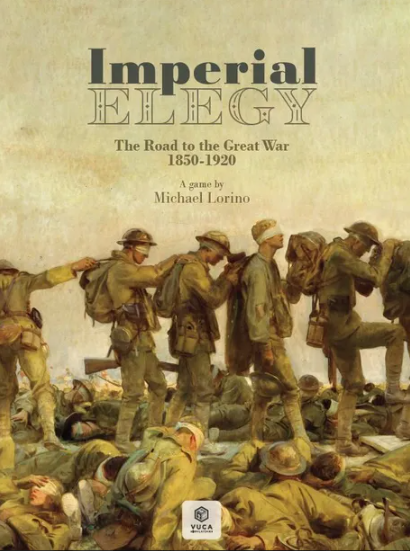
But first, I am going to have to set the scene for you. As you know, we really enjoy attending conventions and playing large multi-player wargames such as Here I Stand, Virgin Queen, War Room, Alliance and many other titles. Over the years, we have absolutely had a blast at these conventions and they are the best places to play these large 5+ player wargames. Recently, while attending the World Boardgaming Championships in Seven Springs, Pennsylvania. This year I attended alone, as Alexander was on vacation in the south of France with family, and I was able to coordinate a full 6-player game of the amazing Imperial Elegy: The Road to the Great War 1850-1920 from VUCA Simulations. This game was released in late 2025 and we have since played it 3 times, including this play at WBC. Imperial Elegy is a is a card driven game that blends diplomacy, warfare and statecraft and feels a bit akin to games like Here I Stand and Virgin Queen from GMT Games. Like those games, IE is a grand scale sweeping epic that play multiplayers and take a day to play (literally 12-14 hours to see the game through to the bitter end). The game covers the dying throes of the colonial and imperial powers of the 17th and 18th century as they deal with local colonial uprisings, attempts to unify fractured countries, build alliances for protection and to aid in their own expansion and economic concerns of population growth and industrialization. Players will take on the roles of 1 of 6 unique major powers in the game including Germany/Prussia, the United Kingdom, France, Austria-Hungary, Russia and the Ottoman Empire. This is a really deep and involved game and frankly after 3 plays I am finally grasping what it is that I should be focused on, how to go about building alliances and the benefits that I must get from those to have a chance at survival. But I am still learning and have only played as the German/Prussian Empire and France, so there is a lot yet to learn and explore.
While playing a 6-player game at WBC recently, I was the French. Previously I had played as the German/Prussian Empire and this was going to be a new experience where I could see what another faction was about and begin to understand their motivations, goals and objectives. A fellow player, who was playing as the UK, which is a natural ally of the French, saw my taking of some actions that didn’t sit well with him and he was actively trying to find ways to punish me for doing what he didn’t agree with. Keep in mind he never said anything about his reasoning at the time of taking the action, because it made zero sense at the time in the state of the game, nor did it make any sense in the game for the UK’s long term strategy. It was simply odd and I was searching for understanding as to why he would choose to do what he did.
In the game, I had just agreed with Germany to voluntarily give up Alsace Lorraine because I had no way to prevent him from coming in and destroying my 1 army there. He had 2 full armies, one of which had an Elite Corps. as well as an adjacent army supporting it on the board. So I decided I would sue for peace and try to avoid a prolonged battle that would waste my resources and that would ultimately, at least in my opinion, lead to me losing the location. The German/Prussian Empire is trying to unify their country and must control a certain number of countries on the board marked with a German flag, of which Alsace Lorraine is one. As a concession with the German player, I was able to convince him to give me 2 cards from the deal, which were randomly drawn as you cannot simply give over a specific card, and they were both 1’s. Bummer. But, I now had 2 extra cards to perform a few more actions that turn and that was a good trade off for me.
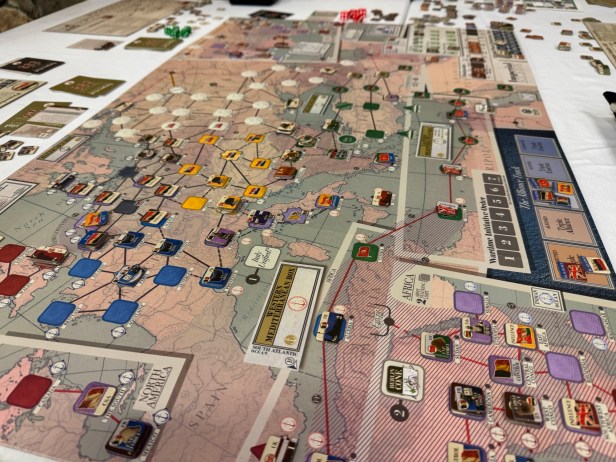
I was planning to go hard into colonies in Africa, Asia and even into North America to get to 6 Colonial Keys to accomplish one of my National Goals and to gain an extra +1 Card and +1 Manpower. I had already made good progress by taking Algeria and gaining traction in Morocco in North Africa and controlled 1 of the spaces on the Africa sub map.
That’s when he played a 3 Ops Card called Folie de Grandeur for the event which allowed him to place a revolt in a French controlled colony in Africa, Asia or North America and he went behind me to take out Algeria which meant I would have to go back and move an Expeditionary Force there and spend 3-4 impulses to Pacify it and get it back under my control. It sucked. The event also forced me to lose a Stability and take a -1 Card marker. This was a devastating and mean card to play at that time.

I asked him why he would play this card, as we were moving toward becoming allies and had discussions about how things should and could go, and I had done nothing to him but had been simply trying to do what France should do by going into City of Light points, intervening in Italy and their unification and building colonies. I was admittedly a bit upset and kept pestering him about his reasoning through the whole game. He said at the time he played that card, he had a good hand with several large Ops cards and didn’t need the extra 3 from this card (I call BS as you can always use more Ops). Plus I actually watched his final card plays that round and he didn’t have good cards but had a middling hand with several 2 OPs cards. I was taking notes.
So we played out the game and he actually screwed me over later with another stupid event (man there are a ton of those Mandatory little events that make taking colonies very dicey) and he was absolutely not in the game at all. He had only scored 2 VP from his National Goals and had only a few colonies with just 2 in South Africa. Later that evening over dinner, I asked him again why and told him his reasons used at the table were BS. He said to me straight faced that I had pissed him off with my move with Germany and he was punishing me. Punishing me? In a game that I am still exploring to learn and understand the buttons to push and levers to pull. As mentioned, I have only played 3 times with Germany/Prussia and France. He was PUNISHING me! Are you kidding me?!? Geeze. This has still bothered me to this day and I wanted to share to have you either talk me down off the ledge or give me some reasoning to make it all make sense.
I want to clarify that this person is a good friend. We have played games together for years and we are always mixing it up. I plan to continue playing games with him and I am sure will have many other experiences to share over the years.
So what are your thoughts? Was I misguided in my angst? Did I take it too personally? Was he justified in his actions? What do you do when you have a situation like this in a game? Thanks for reading and for sharing your thoughts. I will come up with a few more of these posts over the next few months to share and I hope to see lots of comments and reaction.
In the meantime, we have put out several pieces of content, including written posts and videos. You can visit those by following the links below:
Unboxing Video:
Video Review:
Summary on Solitaire Bots presented by our friend James:
Written First Impressions Post on the blog: https://theplayersaid.com/2026/05/06/first-impressions-imperial-elegy-the-road-to-the-great-war-1850-1920-from-vuca-simulations/
My Favorite Wargame Cards – A Look at Individual Cards from My Favorite Games – Card #85: Hydraulic Recoil: https://theplayersaid.com/2026/07/07/my-favorite-wargame-cards-a-look-at-individual-cards-from-my-favorite-games-card-85-hydraulic-recoil-from-imperial-elegy-the-road-to-the-great-war-1850-1920-from-vuca/
-Grant


Well, your story Grant is (unfortunately) not uncommon but fortunately does not happen in my group too often. Destroying somebody’s game and experience and foregoing your actual goals seems to me completely counter-productive and not why we play games. It happens usually when you play with people you do not know, on conventions, as it is much easier to behave like this towards strangers. Thus it is interesting what you said this was your long-term friend.
In the end, you did exactly what I would do: asked politely what is the fuss about, called-out the BS standing behind explanations and hopefully cleared the atmosphere a bit. I just hope your friend will come to senses and will understand how stupidly he destroyed that game experience – not only for you, but I am sure for himself too.
LikeLiked by 1 person
I agree.
in diplomatic centric games ASK your neighbors about actions. Especially in complex games.
LikeLiked by 2 people
I’m afraid the politeness was not all that polite. Stern is the word I’d used with some threats of my own with gusto. Not overly hostile until later but I could have handled it differently.
LikeLiked by 1 person
when playing a multi player game, that involves diplomacy, the Golden rule is to talk with other players.
You simply can’t play a game like that in a vacuum.
A English player should have discussed it with you if he was worried.
When I used to play diplomacy , we would always discuss things we were concerned about. Sometimes you were lied to, which is part of the game.
It sounds like the British player was immature and unfamiliar with how games like that work.
i once played Republic of Rome with a few dipsticks. They ruined the game and Rome fell
LikeLiked by 2 people
I agree that these type of games require continuous discussion. I think that we were heading the direction of cooperation but I made a choice o had to in order to survive the moment and not risk losing all my planned and in process ventures. The player is seasoned at games just lost sight of the spirit. Should I have had further discussions with him about my intent? Probably but in the end it was a choice on both our parts.
LikeLiked by 1 person
“Should I have had further discussions with him about my intent? Probably but in the end it was a choice on both our parts.”
It’s kind of hard to have that kind of discussion when the guy doesn’t tell you he’s upset with the move to begin with.
He should have said “why are you doing that?” and you could have told him, and then discussed why he disagreed with the move, etc.
I don’t know the game, so I don’t know whether your move affected his game or not. Did it have any kind of detrimental effect on him? Like opening him to an attack because you were no longer there?
You could have then explained that you were doing it because that army would be lost anyway, etc etc.
At least then all of the reasons would be out in the open.
I like to think I would never do something like that, holding a grudge and doing suboptimal moves just because I want to hurt the other player.
Sure, if I have two choices that are pretty much equal, and one hurts the guy who screwed me over earlier, then I’ll take that one.
But I wouldn’t do something against my own interests just to do that.
LikeLiked by 1 person
I believe in playing to win. However it sounds like these moves didn’t have much to do with any strategy towards victory. I wasn’t there and only know one side but based on the information I disagree with the moves. It would make me upset if the person confessed he made the moves to punish. I understand making a mistake or multiple mistakes I make them all the time. If someone made a mistake I would be over it and forget by time I got up from the table. But do it on purpose I would remember that for a long time. It’s one of my issues.
LikeLiked by 2 people
“He said to me straight faced that I had pissed him off with my move with Germany and he was punishing me.”
People should try and not carry grievances from one game to the next game, but that is easier said than done. Luckily not an issue in my play group. Out of curiosity: was your German move as upsetting as his UK move against the French without you realizing it? Not that that would excuse the “retaliation”.
– Long time lurker,/first time poster. Love what you are doing for the community.
LikeLiked by 1 person
I guess it could have been upsetting to him but it was clear to see I would have been steam rolled and Germany would have taken Alsace Lorraine easily. I really had no choice. Had I added an army there earlier in the game with an Elite Corps it might have been different but I was learning the French and what their capabilities were.
LikeLike
My bad – I thought he was taking revenge for what you did playing as Germany in an earlier game. That would have been disappointing.
In this case I simply do not understand why – case of seriously overreacting? In either case: not much fun.
LikeLiked by 1 person
Your recent commentary on this game inspired to me to obtain it (third party, alas, not Noble Knight) and I look forward to learning it and taking it for a spin. This topic brought back some not so fond memories of my youthful gaming. I used to play revenge tactics where I would try to make someone else win if I couldn’t and perhaps get back at the person who put me out of the running. In most games, I consider this immature, but I was once immature (I still sometimes do this in Diplomacy, but that is a different sort of game). I remember two incidents caused by this: As a teenager, an older British player got very angry and stormed off, forgetting his die cup, and then as a later teenager I lost a friend who unrelatedly died of cancer a couple years later. At this point, I avoid doing that sort of play and if I am victim of it, I simply accept it with humility.
LikeLike
Sometimes, we just have to let things go.
Case 1: in 1979 I took a group of gamers from my high school club to a games con in LA, and several of us joined a Diplomacy tournament — you know, the game where the logo is a knife in the back…. At one point in the game I had to turn on one of our group to ensure my victory. He hasn’t spoken to me since. Let’s see…. that’s 46 years ago. I still see him at cons.
Case 2: A long-time gaming friend has a habit of, in 4X type games, attacking me whenever he realizes he cannot win the game. It doesn’t matter what the other players are doing. He admitted that, since I’m usually the biggest threat to win, he’ll ruin that chance. I’m okay with that because I know it’s coming and I can plan for it. However, the ONE time I did the same thing to him, he’s never let me forget it. I tried to bring it up with the idea of balance and turnabout being fair play, and I got it thrown in my face. Bad decision.
Best advice overall? Keep my mouth shut and move on. As my old drama coach used to say, “In a hundred years, no one will know the difference.”
LikeLiked by 1 person
Heck in 1 year. Thanks for the insight.
LikeLike
It’s pretty simple to me… you were playing a game with another human.
And when you play a game with another human, you are also playing the meta-game, since Huizinga’s concept of the “magic circle” is just that: a concept created by a human who trusted that for the most part, the game’s players would respect the fragile social contract that allows them to benefit from playing the game.
You were at the table with an emotionally immature person who at one and the same time could and could not be in that magic circle. Your behaviour in the game annoyed him for some reason in reality, and he acted to duck back in and punish you within the game. That this also wrecked the game for other people was incidental to him.
I avoid playing with people like that if possible – I actually don’t play ftf that much and my regular group is not like that (it helps that we are all designers too!).
I suppose you could get some cold comfort out of it by looking to history for examples of when and how actual coalitions conspired to wreck themselves for reasons that made no sense later, and perhaps little enough at the time due to personal spite and irrational emotional taxis.
Because in the end it is humans playing games with other humans… on a much larger scale, and for real.
LikeLiked by 1 person
The thing I like about games is that they often reveal people’s true character – maybe they play to win, maybe they just enjoy the socialising, or maybe they’re just a dipshit who would rather ruin someone else’s fun than contribute to a memorable time for all?
Seems like you’ve know this person for a long time so maybe they’re just going through something completely outside the game (marital issues, bereavement, work stress etc) that’s affecting their behaviour.
I’d say if it’s the first instance give them the benefit of the doubt but if it becomes a pattern maybe avoid playing with them again. I gave up playing non-cooperative games with my own brother because whenever we played a competitive game on opposite sides he would accuse me of cheating in front of the whole table which I found pretty hard to put up with especially if we were playing with people we didn’t know well.
LikeLiked by 1 person
In a game that long, deciding to “alter your personal victory conditions” to make another player’s life hell for hours on end is way over the top. It’s not fun for the player taking the punishment, and it reduces a 6-player game to effectively a 4-player game, with the other two being a hostage and a hostage-taker.
If it’s a short game, maybe it’s all right to do that. Play the metagame, make someone remember to, uh, consider the punishing player before making such deals. But I’m not sure, even then.
LikeLiked by 1 person
I think it depends on the people. I know that Cullen and I will always mix it up regardless of if we’re supposed to be natural allies. That’s because we’ve been playing games together for literally decades. But if it’s random for random’s sake and not expected from a person, that is different. Of course a well timed stab in the back is something you appreciate later. The games we play often require it.
As someone at the table in that game, the first incident was weird. The second one seemed like he didn’t want to make any more enemies and just did the die roll. Super unfortunate for everyone (including me!) that it happened to be you. That one wasn’t targeted but I get why you said something like “why didn’t you pick anyone other than me?”
well just like that game, I’m going on too long! Still had a great time and I appreciate the heck out of you. (OK, and Alexander too).
Russ
LikeLike
Yeah, that sucks, especially in a long game like IE!In my opinion, there’s only one reason to “punish” another player – when they have transgressed against you before, for example by breaking a deal. If you play France in Here I Stand and agree with England that both of you will declare war on the Hapsburgs and then they leave you in the lurch, bearing the force of the yellow juggernaut alone, I understand letting them feel your disappointment (and prevent similar betrayals in the future).What France does in a war with Germany in which Britain was not involved is no transgression against Britain. “Punishing” France is bad for France and bad for Britain.As other people have said: Communication is key!If Britain thinks France should play differently, they are welcome to say so (at most tables) and would then be rebutted (at most tables). If Britain persists, France does not yield, and then Britain starts pestering France in the game, at least France knows what’s going on.
LikeLiked by 1 person
At this point in the game alliances are still forming and sides are expanding. UK has no presence on the continent and cannot help the French. They are trying to do diplomacy in the low countries but that’s it.
LikeLiked by 1 person
You don’t mention that you conferred with the UK player first before doing the deal with the German player. If that step was skipped then…well…
LikeLiked by 1 person
We don’t start as allies. No one does and it is very much a competition at the start. I’m not sure anyone should expect to be consulted on something like this at this time UK has no presence or troops on the continent and can’t help so not sure they should expect to tell people what to do. Germany was going to steam roll my French in Alsace. Was UK going to send troops? No. Were they going to do anything to slow Germany? No.
LikeLike
Very frustrating situation indeed. I can try to be the devil’s advocate :
LikeLike