In November 2024, while attending the SDHistCon, we sat down with designer Sam London to play his upcoming game called Common Sense (it was originally called Absolved from All Allegiance), which was announced on GMT Games P500 last year. The game is an American Revolutionary War Strategic Level game that uses trick taking and is a struggle over the Will to Fight Track that measures the level of commitment by both sides to the fight. We recently reached out to Sam to get some more details to share about the design and he was very glad to oblige our request.
If you are interested in Common Sense: An American Revolution, 1775-1783, you can pre-order a copy for $58.00 from the GMT Games website at the following link: https://www.gmtgames.com/p-1217-common-sense-an-american-revolution-1775-1783.aspx
*Keep in mind that the design is still undergoing playtesting and development and that any details or component pictures shared in this interview are for prototype purposes and will definitely change prior to final publication as they enter the art department.
Grant: Sam welcome back to the blog. How are your other announced game projects coming along?
Sam: Thanks for having me back! Things are going well. I am hands off on Firefight Tactical at this point. All of the content art is complete and we are just working on things like rulebook layouts. I am very much looking forward to getting it out the door and into people’s hands. Microverse has most of the art complete. I am doing a few tweaks to the bot still to get it to a point I am happy with it, but in truth it is not tracking far behind Firefight Tactical. They both have been wonderful experiences from a development and production stand point and I cannot speak highly enough of the various teams I have worked with at GMT on these games.

Grant: How have you changed as a designer over the past few years?
Sam: This is an awesome question and I am grateful to be asked it as it forced me to do some introspection. To explain I will have to make some references to film making. As I have stated previously I have been designing games for a couple of decades at this point and only started trying to get my designs out there after Covid. The truth is that while this gave me lots of opportunities to refine my design chops, it was ultimately just me learning in a bubble. Coming into the hobby as a designer rather than a gamer, I fancied myself as a sort of auteur designer. For those not familiar with the term in the context of film making, this is an approach to creative endeavor where everything is made to conform precisely to one person’s specific vision. After getting to work with so many fantastic people, decidedly outside of my bubble, I have taken a bit of a 180. While I still own the ultimate vision, I now recognize that the odds that I understand the optimal route to get to that destination are unlikely, and that pretending I do will often result in an inferior game. This isn’t to say that I am going to incorporate every bit of feedback I receive into my designs. It does mean that I am more able to recognize weaknesses in my designs as conceived and solicit feedback from others to get around my blind spots.
Grant: What specific lessons have you learned about design?
Sam: The big one would be about systems pruning. Most people, myself included, understand academically that design complexity for complexity’s sake is not good. Putting that principle into practice, especially retroactively, is far more challenging. Every mechanism in the game has to serve the player’s enjoyment without making the cost of entry too daunting. This can often mean cutting mechanisms that I am particularly passionate about, but for which I am the sole audience (or close to it). This is especially difficult for me because I consider myself a systems designer, and I virtually always approach the mechanics of a design first.
Grant: What is your newest project Common Sense about?
Sam: Common Sense: An American Revolution, 1775-1783 is a card driven strategic level wargame covering the American Revolution. It attempts to offer a comprehensive view of the conflict, all the way from the battlefield to the halls of the Continental Congress and British Parliament.
Grant: Why was this a subject that drew your interest?
Sam: I always knew I would want to do an American Revolution game. The problem was that I needed a system that would fit my thesis of the conflict. A few years back I was working on a Barbarossa game and every step of the way I was thinking I would rather do that system in the American Revolution. The more passionate I became about that, the more I started to flesh out the system in ways that didn’t make sense for Barbarossa. Eventually that game ended up in the trash bin and Common Sense got my attention instead. I think the American Revolution is such a fascinating subject because it’s a real David and Goliath story. I of course am keenly aware that in reality it was more of David vs Goliath while Goliath is arm wrestling another giant while also trying to solve a Rubik’s cube, but there is still a lot of inherent heroic optimism to that history. Also, everyone loves a good underdog story.
Grant: What is your design goal with the game?
Sam: My design goal for the system was to see how much personality I could give to the belligerents without making their asymmetries require too much rules overhead. We have all played asymmetrical games where you feel like after you read your rulebook you need to read the other player’s rulebook to have a comprehensive understanding of the game. Here, while there are some mechanisms that are specific to each side, the asymmetry is more in terms of each player’s strategic concerns rather than their tools to execute upon them. All of these relate back to this unifying concept of “resolve” which is an abstraction that allows us to relate the varying strategic concerns into a single mechanism.
Grant: How did you focus on creating asymmetry on each side? What are some basic examples of these differences?
Sam: As noted above, I viewed each side in terms of what was unique about their concerns and what was unique about their tools to address them. For the British as an example, they are tremendously constrained by supply. It isn’t just a supply line (though it is that too), it’s a currency they spend to move and battle with units. Obviously historically supply was a concern for the Colonials as well, but it did not hamstring them to the same degree, so the Colonials don’t have to worry about it at all. What’s more, this opens up strategic opportunities for the Colonial player to attack the British in other areas to force the British player to split their limited resources. An example for the Colonial player is Attrition Combat. Each time the Colonials battle in a space they control on their turn, they have the option to resolve Attrition Combat, in which they cede control of that space to the British but as a result can resolve the battle without risking return fire. At the beginning of the game this must be used strategically and sparingly, but as certain key personalities in the Colonial Deck, from George Washington to Francis Marion enter play it becomes far more powerful.
Grant: How does the game use trick taking? Why was this a good choice for your vision of the game?
Sam: I am actually trying to get away from that term, as I think it causes people to think that Common Sense is a lighter game than it is. It invokes pithy card games rather than sweeping strategic affairs played out on a map. The final rulebook will likely make no reference to standard trick taking terms. I chose it as a core mechanism though for a variety of reasons. One I will cover in a future question, but the other reason is because I became very interested in the question of card balance. If I have a card driven game with a variety of card effects, and I want them to vary in their power, they have to be balanced in some way. The most common way this is handled in game design is to make them have a proportionate cost to play using some in-game currency. I was more interested in making the powerful cards more difficult to play. In fact, I wanted to take a step beyond that and say that not only are they more difficult to play, but they are never guaranteed. This gave me a simple way to inject far more personality into the cards and make some have a tangible weight to them when they manage to enter play. “Ha ha, I play King George. You’re in trouble now.” Trick taking was a natural fit for this as the rules overhead for it is comparatively light and the cards come with their own intrinsic value based on the ease with which they can be used to win tricks.
Grant: What is the makeup of the cards? Can you share a few examples with us and explain their use?
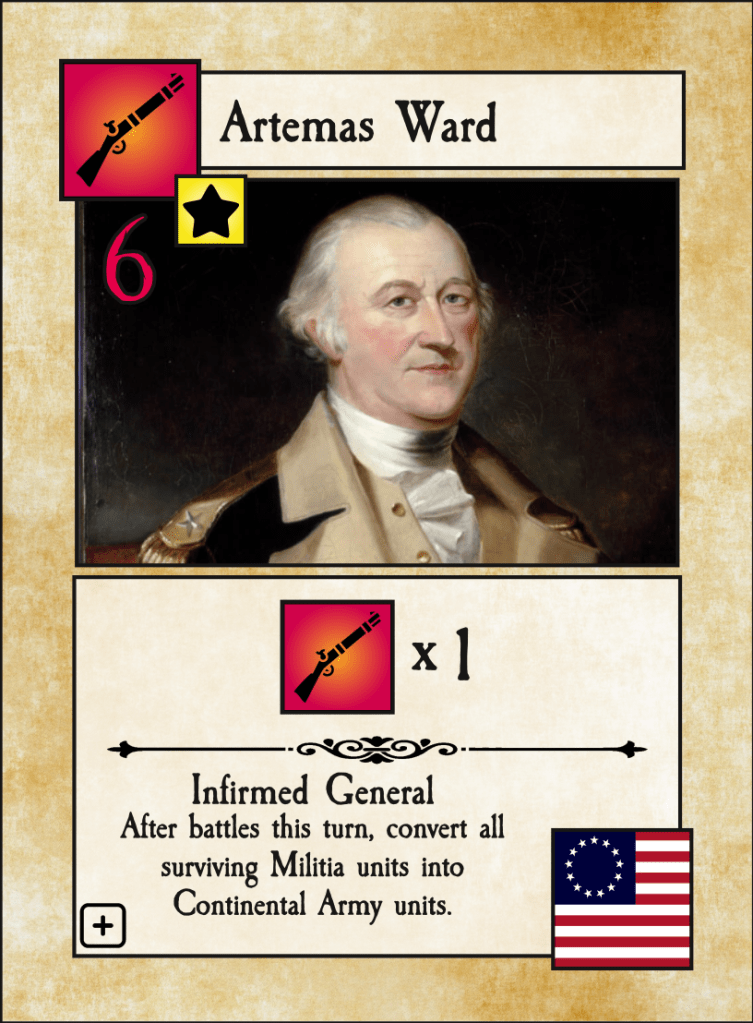
Sam: Each year players will begin their turn with a ten card hand. They can perform a strategic mulligan of up to 5 cards each year. This is not in case a player got a “bad hand” but rather so they can try to postpone getting cards that do not fit their strategic objectives at the start of the year. The year is then played out over a series of ten “clashes” in which the initiative player plays a card face up and then the other player does the same. The initiative player’s card sets the suit for the clash and the non-initiative player must follow the suit of that played card if able. Then the player who played the card with the higher initiative value (ties going to the non-initiative player) resolves their card.
In this example (all placeholder art at this point in the game’s development by the way), the Colonial player has initiative and plays the Artemis Ward card into the clash who is a 6 value of the Battle suit. The British player then plays Battle of Quebec into the clash which is a 7 value of the Battle suit. Battle of Quebec then resolves.

The British player immediately gains a supply (the orange wagon in the upper right corner). This is a special bonus effect present on some cards. The equivalent effect for the Colonials is to go up on the Continental Congress Track. They now have the option to cancel the resolution of the card to perform any one of their available actions. If they choose to continue to resolve the card they resolve its event first. Battle of Quebec’s event is of the type “special action,” which offers additional effects to the action on the card. In this case, if the Battle action is used to resolve a battle north of the Winter Line, the Colonial player must reroll all their successful hit dice once. The last piece is the yellow star under the Battle suit icon which indicates Battle has “advantage” over the Special suit. This means that if the non-initiative player does not have a card of the clash’s suit to play into the clash, any Battle card will always beat a Special card.
Grant: What different suits are included? What use does each have for players?
Sam: There are three common suits which are universals and one special suit which is player specific. The three common suits are March, Battle, and Recruit. March is used to move armies about the board, Battle is used to fight, and Recruit is used to get more units to fight with. There are asymmetries in how these resolve but the goals of their use are the same, which is why they are considered the common suits.
Grant: What is different about the Special Suit? How does it benefit players?
Sam: The Special suit is different for a couple of reasons. First all of the actions contained in the Special suit cards are unique to that player. The Colonial player can train their militia units into the Continental Army and negotiate with the French, eventually bringing in and performing actions with French pieces once they enter the conflict. The British player can recruit, move, fight, and raid with Native units and move and battle with the British navy. A lot of the flavor of the two sides are contained in the Special suit. The other thing that is different about the suit is that the Special suit allows you to resolve any combination of these actions. For example a Battle x 3 card allows you to resolve up to three Battle actions. A Colonial Special x 3 on the other hand will allow them to perform a mix of any 3 train and French actions which offers flexibility.

Grant: What is the purpose of the Resolve Track?
Sam: I mentioned the Resolve Track earlier when I was describing how most of the asymmetrical concerns of the players coalesce into a singular concept. The Resolve Track serves three purposes. Firstly, it is the game clock. While the game can end in the event that you completely resolve the year 1783, it will more commonly end when the British and Colonial Resolve markers cross. Each player’s Resolve marker starts on opposite ends of the track and moves towards the other end as they lose resolve. Once they cross, the year is completed and final scoring occurs.
Grant: How do players manipulate this track? What benefits or detriments does it provide to players?
Sam: This is where the other functions of the Resolve Track come in. The second purpose is that many of the points for determining final score and victory come from the Resolve Track. Finally, resolve has a tremendous impact on both sides’ ability to recruit new units, the Colonials in particular. This is another demonstration of the game’s asymmetries actually, as the Colonials are far more impacted by resolve loss both from a scoring perspective and a recruitment perspective than the British. In regards to how the track is manipulated, common track manipulations only cause a loss of resolve. There are several ways resolve is regained, but they are all due to specific card effects. The British primarily lose resolve by losing British Regulars in battle and by being overcommitted to the American conflict at the expense of their other global conflicts. They can also lose resolve by overusing Hessian mercenaries, who are good and reliable but cost money that parliament is loath to spend. The Colonials on the other hand will lose resolve mostly due to the British seizing control of colonies, Winter Attrition, and failure of the Continental Congress to offer a believable alternative as a governing power to the crown.
Grant: What is dynamic about the initiative system?
Sam: I said I would come back to this when I was describing why I went with trick taking as a core mechanism. Essentially, you are the active (initiative) player for as long as you continue to win subsequent clashes. For the duration the other player is what I would consider a “reactive” player. They still have choices to make of course, for example which card to play into clashes, whether to resolve combat as a siege or not in fortified spaces, how much supply to commit to a protracted battle, etc. The point however is that while by sheer odds you are guaranteed to eventually get your turns in, the duration of the runs of turns is strongly connected to the skill of the player and their familiarity with the game. This is very much a game where a player will become far better after repeated plays. The other cool thing about this is that the events on cards require skill and forethought to combo them together. You may have the thought that if cards A, B, and C resolve in order you will have all but won the game, only to lose the clash for card C and have to pivot. This dynamism does a lot to keep the game fresh and challenging rather than thinking “I have cards A, B, and C so I already know how I will play this out.”
Grant: What different unit types does each player have access to? How does each type benefit them?

Sam: Again pursuing asymmetry I wanted to give each unit type its own character. Each unit has a potency and a resilience but this is just the tip of the iceberg. Militia are able to pop up virtually anywhere and are able fire first in battles where they are the aggressor, but they are poorly trained and can’t leave where they are recruited unless they are picked up by an army. British navies can contribute to naval sieges and amphibious assaults while they are also required end points for British supply lines. French regulars are able to operate as a distinct force while also being able to launch coordinated actions with the Continental Army, offering them incredible command flexibility. British Field Artillery is powerful, but is unable to retreat quickly when the battle is lost, meaning it will be commandeered by the Colonials (and may exchange hands several times over the course of the war). There are also Continental Army, Native Warband, Hessian Mercenary, French Navy, Tory Loyalist, Colonial Artillery, and British Ranger units. Each has its own complement of traits to figure out how to employ them optimally.
Grant: How does combat work in the design?
Sam: As I have alluded to, there are a variety of special combat resolutions possible like Attrition Combat, Sieges, Naval Bombardment, Raids, and Surprise Attacks. I will just be describing the standard battle procedure here though. Each unit has a number of dice they grant during battles. The British player will have to pay a supply for each unit they want to activate to gain dice this way. Players then roll all their dice simultaneously. Dice come in three flavors, red, white, and blue (see what I did there?). Red dice hit on 3 or better, blue on 4 or better, and white on 5 or better. No matter the die color, a 6 counts as 2 hits. The other player then takes as many dice as they have incoming hits (at this point color doesn’t matter) and rolls them. For each 6 they roll, they discard the lowest die among their rolled dice. They then go from their lowest rolled die to their highest, assigning dice to their units if possible. Each unit has a limited range of dice values they can be assigned which represents their morale. For example, the British and French Regulars are a professional army and so they can only be assigned 1s and 2’s. The Colonial Militia and Tory Loyalists on the other hand can be assigned anything from a 1 to a 4. After all dice have been assigned or there are no more rolled dice that can be assigned to any units legally, all units with a die assigned to them are eliminated. Then, if the resolving card grants additional Battle actions, the initiative player can choose to either resolve another round of battle in this space, or not, potentially beginning to resolve another battle in a different space. If no further battle rounds will occur in the current space, the total number of casualties is compared. If one side took fewer casualties and did not control the space, they gain control of the space. Then, if the side that took more casualties lost at least as many units as half the size of their army (stack), they are forced to retreat from the space.

Grant: What is the British Commitment Check? How does it work?
Sam: The British player uniquely tracks the number of clashes they win each year on their own “British Perception” Track. At the end of the year, they add their current level on this track to the number of British Regular and Navy units outside of the American Colonies available to fight the French and the Spanish. If this total is less than 10, they lose 1 level of resolve for each point of shortfall. This means that if they have run the table the entire year, they are free to overcommit to the colonies, thematically because the optics are good back home. If however they have a rough year, they may have to hold some forces back to avoid the war being cut short by Parliament because opinions have turned against it.
Grant: What is the Continental Congress Level? How does it work?
Sam: On average, every card in the Colonial deck is one initiative value lower than every card in the British deck. However, every card in the Recruit suit grants the Colonial players levels on the Continental Congress Track. Levels can be spent from the track as cards are played to increase the initiative value of the played card. The problem is that at the end of the year, the Colonial player is expected to have an ever increasing level on the Continental Congress track or they will lose resolve equal to the shortfall. This obligation is an even bigger potential headache for the Colonial player as the Continental Congress isn’t just a track on the board, it’s also a piece on the map. If the Continental Congress is forced to relocate (retreat) because their current space falls into British control, the Continental Congress levels reset to 0. Done later in the war this can be devastating to the Colonial player. Even worse, if the Continental Congress would have to retreat, but it has no valid place to do so since it is surrounded by British Controlled spaces, the Congress surrenders and the Colonial player loses the game outright with no points counted.
Grant: I have seen where you describe the game as a sandbox. What does this mean and how does it benefit the design?
Sam: I think this can best be demonstrated by the card I showed earlier, Battle of Quebec. Now of course, the Battle of Quebec occurred when Richard Montgomery and Benedict Arnold attempted to siege Quebec City on December 31, 1775. The Colonials suffered heavy losses and were soundly defeated by the elements as well as the British. Nowhere in that card does it specify that the battle needs to occur on a specific date, or at a specific location, just that it must be north of the Winter Line for the event to have an effect. There have been plenty of times in playtests where the card has been resolved in 1775 in Canada, but also many times where it hasn’t. This approach enables me to inject historicity into the game without shackling the player to recreate historical decisions. I think many historical gamers want experiences where they can recreate history, but they are not obligated to do so. Roughly paraphrasing what Gene Billingsley said about the game, “all the events are there, all the major players, and the outcomes, even though potentially very different from history, are entirely conceivable.” Put differently, it’s like the game hands you a toy box filled with American Revolution action figures to play with as you will. There will of course be some players who will miss some rigidity holding them to a more strictly historical course. However, I think this sandbox approach offers an opportunity to sink your teeth into the history and better appreciate the moving parts by seeing the different ways they could have fit together.
Grant: What are some general strategies for both sides?
Sam: From a general strategy perspective things are very historical. The British want a quick war. The fastest way to do this is to take the more valuable northern colonies which will tank the Colonial resolve and secure most of the significant strategic locations. By doing this they can force the Continental Army to suffer brutal winters away from the cities and put enough pressure on the Continental Congress that their resolve rapidly drains and they are forced to surrender. The Colonials want the opposite. They just want to hold out long enough using delaying tactics to organize a proper army, get the French into the war, and retake whatever key fortified locations they ceded to the British in the early war so they can force the British to the bargaining table.
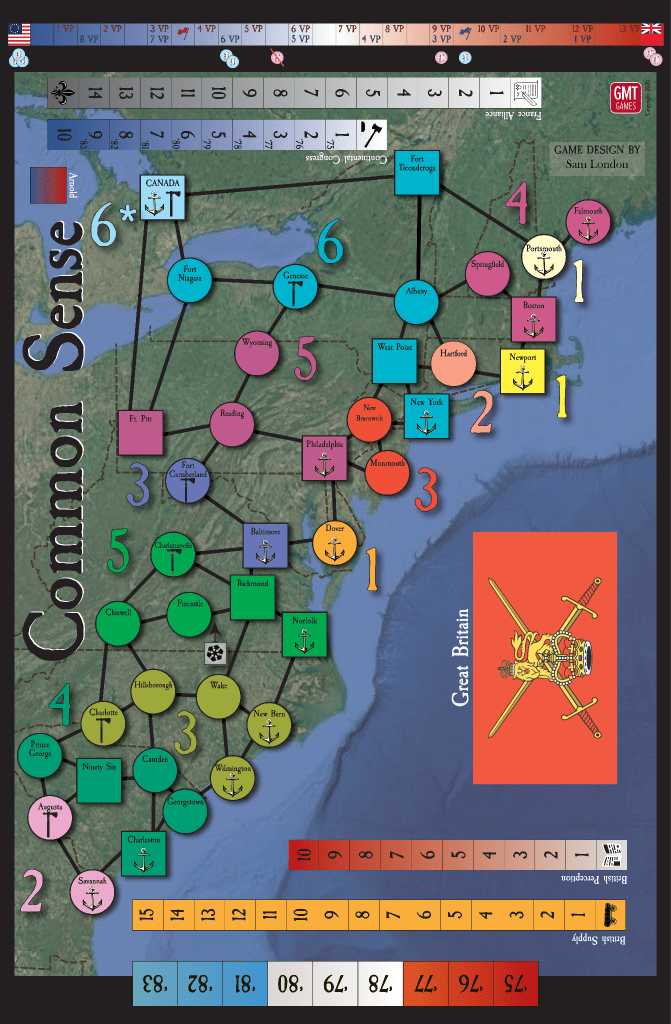
Grant: What is the layout of the board?
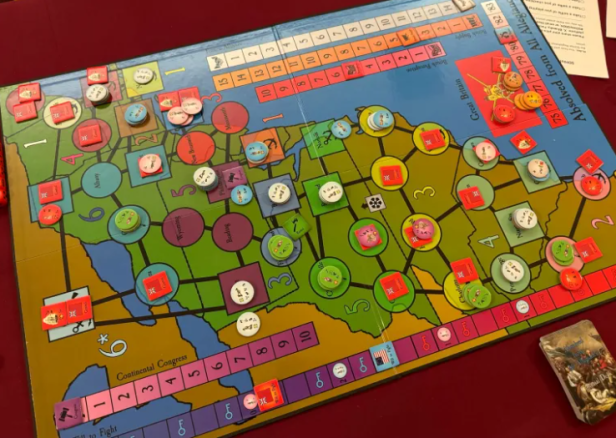
Sam: Again, this map is placeholder art. The game uses point to point movement, with some spaces representing precise fortified locations and some representing large tracts of land (even entire colonies in some cases). Spaces are grouped into colonies that each have an associated hit to Colonial resolve if they are lost. There is also a British “in Europe” area and a number of tracks tied to the various game mechanics.
Grant: Why did you feel point to point movement was best?
Sam: The only two contenders here were point to point vs area based movement. Given the level of abstraction the system uses, any sort of hexed based representation was never an option. I decided to go with point to point because the game’s focus is really on the narrative more than anything else. An area based map would have forced me to have the visual importance of areas be at least somewhat to scale by the size of the colony. Instead by doing point to point I can give a colony as many spaces and fortifications as are thematically appropriate for the importance of that colony in the actual conflict.
Grant: What type of an experience does the game create?
Sam: The game is punchy. It is very competitive and intentionally so. You are only able to achieve so much on a given turn, and at the end of each turn you have another clash and a chance for your opponent to seize the initiative. The elation when the other player plays a card out and you realize you can beat it and put out Benjamin Franklin when you thought you weren’t going to get a turn for at least 2 more clashes is fantastic. It also plays very quickly for a game of its weight. Most games between players who know how to play will be under 2 hours.

Grant; What are you most pleased about with the design?
Sam: I would say three things. First, because it’s top of mind as I just finished it, the solo play. I knew how I wanted the solo to feel, but I wasn’t quite sure how I was going to make it happen mechanically. I will be putting out some videos soon showing how it works, but suffice it to say for the moment that I am very pleased with it. Second, every game I design, I design to create stories at the table. If it always tells the same story it isn’t memorable. If there are never any surprises it isn’t memorable. Common Sense succeeds in both of these areas to a tremendous degree. Each time I catch up with a player I have played Common Sense with before they are able to remind me of our whole game by invoking strange or exciting moments from our game a year ago like it happened yesterday. Finally, when I design a new game I generally try to think about what aspects of it are specific to the topic and which could be modified slightly to make it work for other topics. I have my own plans for a Vietnam War version of this system that I am very excited about. What surprised me though was how many great designers have been inspired by the system and want to do their own designs with it. At the moment I am only at liberty to say that Ananda Gupta wants to do a French Revolution game with the system, which is such an incredible honor since Twilight Struggle is the primary inspiration for it.
Grant: What other designs are you working on?
Sam: I am always working on something. I have a non-historical game I am working on that has been picked up but I cannot talk about it yet. I have a train game that I may be able to talk about more publicly soon and an American Civil War game that I will be debuting at HistCon North. Oh, and I have a Sengoku Jidai wargamer’s party game that I am tooling around with. There are more, but that’s enough of a teaser. Thanks for the interview!
Thank you Sam for your thoughts on your game and for the effort you have obviously put into it. Having played the game while attending SDHistCon ta few years ago, I can say that we had a great time with the game, felt all of the aspects you discussed and very much enjoyed the way cards were played, how the initiative kept with the winner and the various frustrations of the asymmetry of each of the sides. I think that this one will be a winner and I look forward to playing it further in the future!
For a bit more information, we posted a quick video interview with Sam while at SDHistCon and you can view that at the following link:
If you are interested in Common Sense: An American Revolution, 1775-1783, you can pre-order a copy for $58.00 from the GMT Games website at the following link: https://www.gmtgames.com/p-1217-common-sense-an-american-revolution-1775-1783.aspx
-Grant


This was a great interview, and helped me to form an opinion.
LikeLiked by 1 person
I am glad that you enjoyed it and found it useful.
LikeLike
Great interview! It looks like the beginning of a very interesting series of games!
LikeLiked by 1 person