With this My Favorite Wargame Cards Series, I hope to take a look at a specific card from the various wargames that I have played and share how it is used in the game. I am not a strategist and frankly I am not that good at games but I do understand how things should work and be used in games. With that being said, here is the next entry in this series.
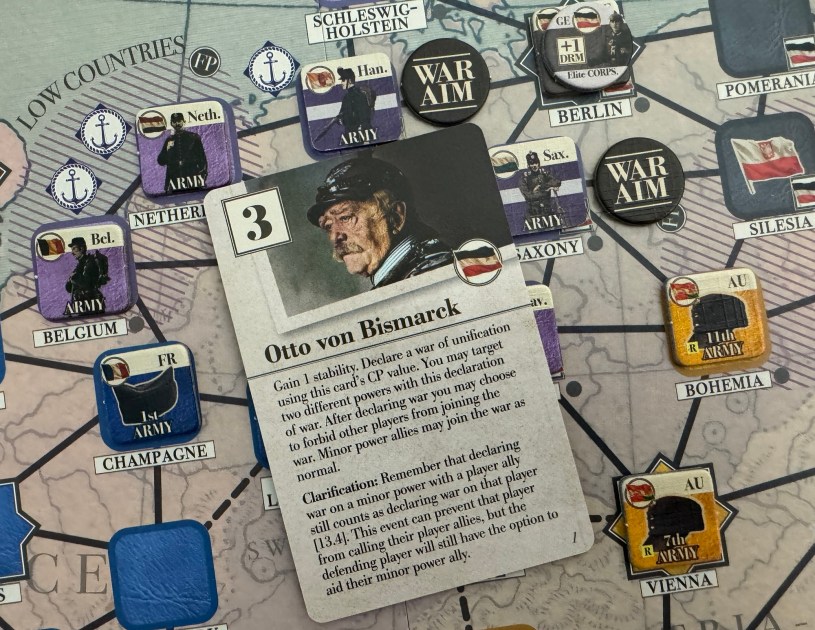
#93: German Home Card Otto von Bismarck from Imperial Elegy: The Road to the Great War 1850-1920 from VUCA Simulations
Imperial Elegy: The Road to the Great War 1850-1920 is a massive card driven game that blends diplomacy, warfare, and statecraft and feels a bit akin to games like Here I Stand and Virgin Queen from GMT Games, which are both grand scale sweeping epics that play multiplayers and take a day to play. Players play as 1 of 6 major powers in the game including Germany/Prussia, the United Kingdom, France, Austria-Hungary, Russia and the Ottoman Empire. The game is quite grand and ambitious as it covers 70 years near the end of the Victorian Era and the Progressive Ear and sees quite a lot of global change and competition between the great powers of the time. The game is a Card Driven Game and uses Action Cards as a type of currency to spend for their Command Points or the printed event to take actions such as recruiting armies and navies, industrialize, moving fleets and armies around the globe, influencing minor powers and establish colonies in Africa, India and the Pacific Ocean. The cards are all tied to the history of the period but the game can be played very much as a sandbox allowing players to explore strategies by trailblazing new horizons or following history.
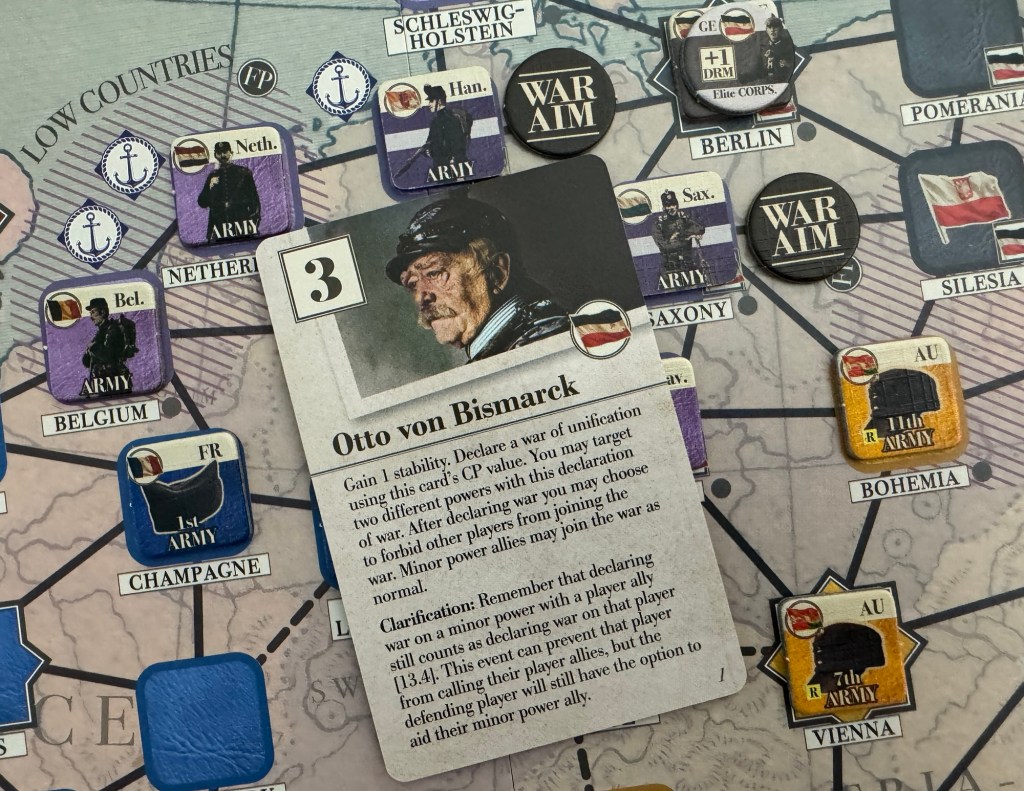
In Imperial Elegy: The Road to the Great War 1850-1920, the Otto von Bismarck Card is a powerful and extremely important German Home Card. Rather than being shuffled into the common Action Card Deck, it belongs exclusively to the Prussian/German player’s unique toolkit to represent the historical trajectory of German state-building. The card is mechanically tied to the first few turns of the grand 7-decade timeline and acts as a get started quickly card for the German player as they begin the long and somewhat difficult task of attempting to unify the Germanic peoples under one banner. The German player can choose to execute it on Turn 1 to abstractly simulate Bismarck’s rapid real-world rise to power and kickstart early diplomatic maneuvers or wars. Playing as Germany, the player should be focused on attempting the Unification of Germany and will most likely choose the Unification National Goal card as a standard at the beginning of games. The Bismarck Home Card is the primary historical vehicle used to achieve this unification and simulates driving the annexations or alliances needed to claim crucial minor regions including Saxony, Schleswig-Holstein, Denmark and Alsace Lorraine. And like standard Action Cards in Imperial Elegy, the card presents a choice. The German player can either choose between using its high Command Point (CP) Value of 3 for a massive push focusing on industrial development or military actions, or using the card for its printed Event text. One of the really nice parts of the card is the way that it effects Stability in the game. Stability is a core national resource and rating that measures a major power’s internal political health, structural integrity and capacity to wage war or absorb setbacks such as economic downtown and social upheaval. Typically, when you declare war, your Stability will degrade but not in the case of a War of Unification. And with Bismarck, Germany will gain 1 Stability when they declare a War of Unification. This is such a powerful effect for the early game as it will allow the German state to build up their capacity and increase Stability to be able to perform later in the game.
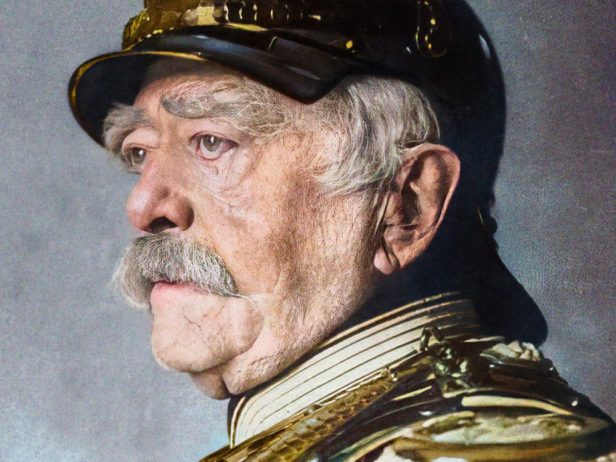
Otto Eduard Leopold, Prince of Bismarck, Duke of Lauenburg, known as Otto von Bismarck, was a conservative German statesman who masterminded the unification of Germany in 1871 and served as its first chancellor until 1890, in which capacity he dominated European affairs for two decades. He had previously been Minister President of Prussia from 1862–1890 and Chancellor of the North German Confederation from 1867–1871. He provoked three short, decisive wars, against Denmark, Austria, and France.
Following the victory against Austria, he abolished the supranational German Confederation and instead formed the North German Confederation as the first German national state, aligning the smaller North German states behind Prussia, and excluding Austria. Receiving the support of the independent South German states in the Confederation’s defeat of France, he formed the German Empire – which also excluded Austria – and united Germany.
With Prussian dominance accomplished by 1871, Bismarck skillfully used balance of power diplomacy to maintain Germany’s position in a peaceful Europe. To historian Eric Hobsbawm, Bismarck “remained undisputed world champion at the game of multilateral diplomatic chess for almost twenty years after 1871, and devoted himself exclusively, and successfully, to maintaining peace between the powers”. However, his annexation of Alsace-Lorraine (Elsaß-Lothringen) gave new fuel to French nationalism and Germanophobia. Bismarck’s diplomacy of Realpolitik and powerful rule at home gained him the nickname the “Iron Chancellor”. German unification and its rapid economic growth was the foundation to his foreign policy. He disliked colonialism but reluctantly built an overseas empire when it was demanded by both elite and mass opinion. Juggling a very complex interlocking series of conferences, negotiations and alliances, he used his diplomatic skills to maintain Germany’s position.
A master of complex politics at home, Bismarck created the first welfare state in the modern world, with the goal of gaining working-class support that might otherwise go to his Socialist opponents. In the 1870s, he allied himself with the low-tariff, anti-Catholic Liberals and fought the Catholic Church in what was called the Kulturkampf (“culture struggle”). He lost that battle as the Catholics responded by forming the powerful German Centre Party and using universal male suffrage to gain a bloc of seats. Bismarck then reversed himself, ended the Kulturkampf, broke with the Liberals, imposed protective tariffs, and formed a political alliance with the Centre Party to fight the Socialists. A devout Lutheran, he was loyal to his king, Wilhelm I, who argued with Bismarck but in the end supported him against the advice of his wife Queen Augusta and his heir Crown Prince Frederick William. While Germany’s parliament was elected by universal male suffrage, it did not have much control of government policy. Bismarck distrusted democracy and ruled through a strong, well-trained bureaucracy with power in the hands of a traditional Junker elite that consisted of the landed nobility in eastern Prussia. He largely controlled domestic and foreign affairs, until he was removed by the young new headstrong Kaiser Wilhelm II. He retired to write his memoirs.
We have put out several pieces of content covering Imperial Elegy and find it to be a fantastic game. These include written posts and videos. You can visit those by following the links below:
Unboxing Video:
Video Review:
Summary of Solitaire Bots presented by our friend James:
Written First Impressions Post on the blog: https://theplayersaid.com/2026/05/06/first-impressions-imperial-elegy-the-road-to-the-great-war-1850-1920-from-vuca-simulations/
In the next entry in this series, we will take a look at Hamet’s Army Created from The Shores of Tripoli from Fort Circle Games.
-Grant


Looks like an elegant way to include the limited wars which did not escalate into pan-European conflagrations in the mid-19th century!
I really need to give Imperial Elegy a try.
LikeLiked by 1 person
Yes you do. You will like it.
LikeLiked by 1 person