With this My Favorite Wargame Cards Series, I hope to take a look at a specific card from the various wargames that I have played and share how it is used in the game. I am not a strategist and frankly I am not that good at games but I do understand how things should work and be used in games. With that being said, here is the next entry in this series.
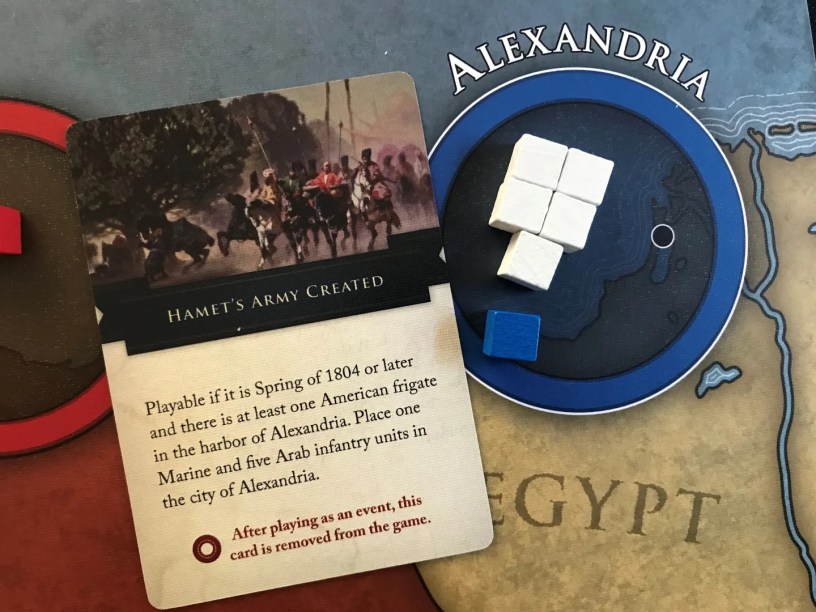
#94: Hamet’s Army Created from The Shores of Tripoli from Fort Circle Games
I have never played a historical wargame on the First Barbary War, which if you didn’t know was one of the first major wars the young United States of America participated in that was situated far outside their sphere of influence in North and South America. Shortly after the end of the American Revolutionary War, commercial vessels of the United States were being attacked and raided by the pirates of the Barbary coast in the Mediterranean Sea. In 1801, newly inaugurated President Thomas Jefferson was eager to put an end to this threat and sent a “squadron of observation” to the Mediterranean to deal with the threat. The Shores of Tripoli covers this conflict and does so using a card driven game mechanic that works really well in this instance. The game is a little deceiving, as at first it appears to be pretty introductory with simple rules and mechanics, but the depth for the game lies in the strategy for each side and the fact that their victory conditions are asymmetric.
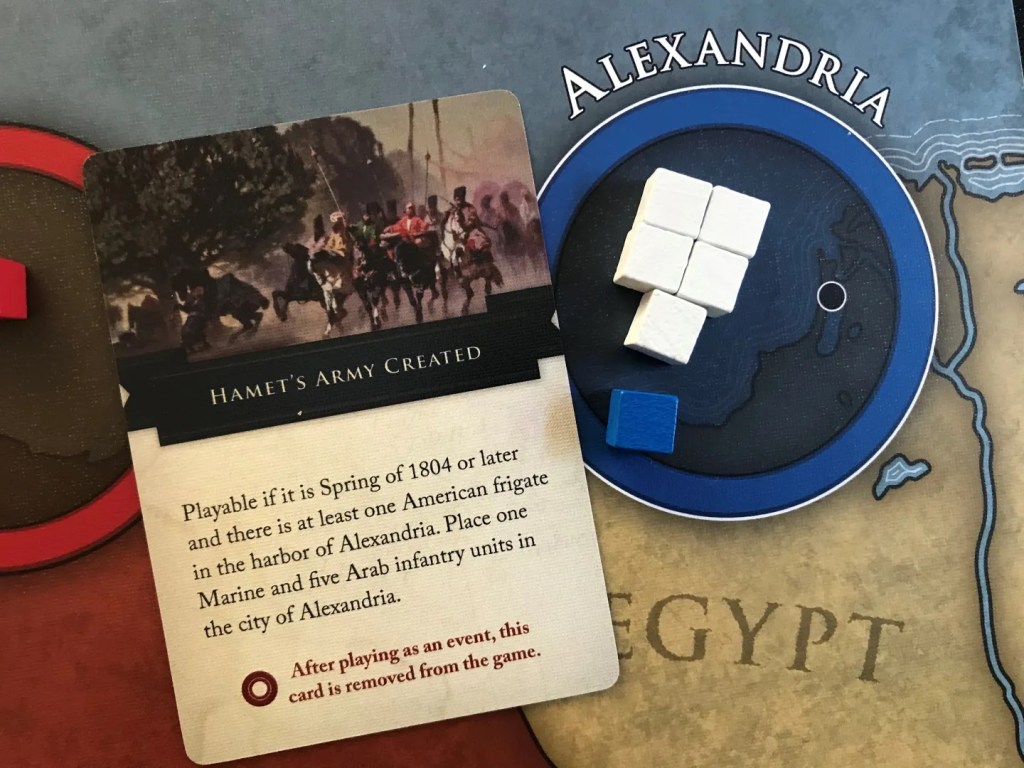
While the main combatants in the game are naval units, there are ground units as well that must be used to try and take Tripoli to win the game. The American ground units consist of Hamet’s Army, which is a combined force of Arab and American infantry units that are dedicated to the mission of installing the pro-American Hamet Qaramanli on the Tripolitan throne. These ground units consist of white cubes that represent the Arab Infantry and blue cubes that represent American Marines. In Ground Combat, each Infantry unit rolls one die and it takes one hit for them to be eliminated.
Hamet’s Army will be created if the United States player plays the card Hamet’s Army Created for the Event. There are several conditions to the card being played though as it must be the Spring of 1804 or later and there has to be at least one American Frigate located in the Alexandria harbor. Once played to bring on Hamet’s Army the card is removed from the game and placed in the box. The newly created army will have to fight their way through 2 locations, Derna and Benghazi, for a final confrontation at Tripoli. I think that I very much enjoy this card because it is a necessary step in the game that the player has to plan for and be prepared to play when it does reveal itself. The player must be ready by using a portion of their limited actions to move at least 1 American Frigate to the harbor of Alexandria and then play this card for the printed event. Keep in mind that this is just the start though as there is a long way to go from here and many more things that must be completed to setup the final showdown.
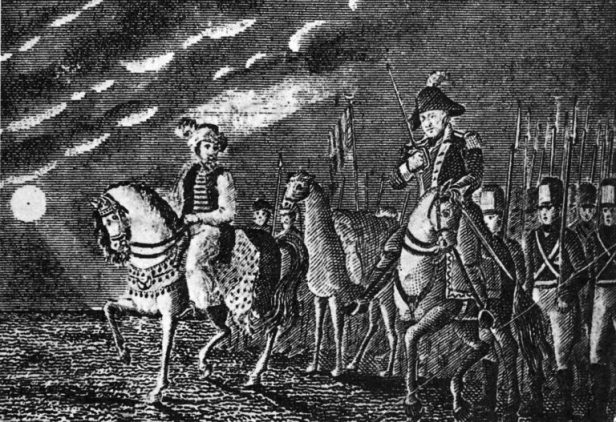
Hamet Qaramanli’s army was a mixed mercenary force of several hundred Arab and Berber fighters, European cannoneers, and Greek infantry led by U.S. Army Captain William Eaton and U.S. Marine Lieutenant Presley O’Bannon during the First Barbary War. The goal of the expedition was to successfully march across the North African desert, capture the city of Derna, and depose the ruling Pasha of Tripoli, Yusuf Qaramanli in favor of his exiled older brother Hamet Qaramanli. In early 1805, the force marched roughly 500 to 600 miles across the Libyan Desert from Egypt to the Tripolitan border. The force consisted of 8 U.S. Marines, a small group of U.S. sailors, 26 Greek volunteers, a company of cannoneers and roughly 1,000 Arab and Berber mercenaries loyal or allied to Hamet. On April 27, 1805, aided by U.S. Navy warship bombardments, the force successfully stormed and captured the strategic port city of Derna in the Battle of Derna. But before Hamet’s army could advance further toward Tripoli, the United States signed a peace treaty with Yusuf Qaramanli, abandoning Hamet’s claim to the throne in exchange for freed American prisoners and an end to tributes.
In the next entry in this series, we will take a look at Flying Ace from The Republic’s Struggle: Battle for the Republic, Spain 1931-1939 from NAC Wargames.
-Grant


Very cool card! I’ve been playing the heck out of this game on Rally the Troops. It’s a relatively quick playing game and tends to come down to 1805 or 1806 when I play.
LikeLiked by 1 person