With this new My Favorite Wargame Cards Series, I hope to take a look at a specific card from the various wargames that I have played and share how it is used in the game. I am not a strategist and frankly I am not that good at games but I do understand how things should work and be used in games. With that being said, here is the next entry in this series.
Card #58: Siege Engines from Stilicho: Last of the Romans from Hollandspiele
Stilicho: Last of the Romans is a very well designed and interesting solo experience that plays in 60-90 minutes. But, due to the unforgiving nature of the random card draws and its reliance on dice luck, that admittedly can be mitigated through cagey card play and proper decisions, the game can be over very quickly. In fact, my very first play a few years ago lasted only 2 rounds and was over in about 15 minutes. Remember that the historical Stilicho only made it to Round 3! The cards are at the heart of the game here and make it a very tense and decision filled experience. Having to analyze each card, measuring its utility against the board state and what pressing matters the player must address while also fretting over having to discard a good Event Card that just isn’t useful at this point in time to take an action can be really agonizing. I think that this design works even better than its predecessor Wars of Marcus Aurelius.
One of my favorite parts of the game is the combat. You have a standing army that you assign a leader and also place on a specific track that is attacking Barbarian hordes in that region and have to go about trying to destroy them and quell their resistance to Roman rule. This combat is brutal and sometimes is very challenging if you don’t have the right leader, enough soldiers and the right cards in hand. As you drive the Barbarians back toward their homeland though, their defensive abilities improve as they are more familiar with the terrain as they are fighting on their home court. When you get to the very end of their tracks at their Home space, this Terrain Value bonus will increase to +7 or higher and makes winning combats very, very difficult…unless of course you have the right cards in your hand! One of these cards is Siege Engines and it is absolutely vital when attacking these Barbarian and Usurper Home Spaces.
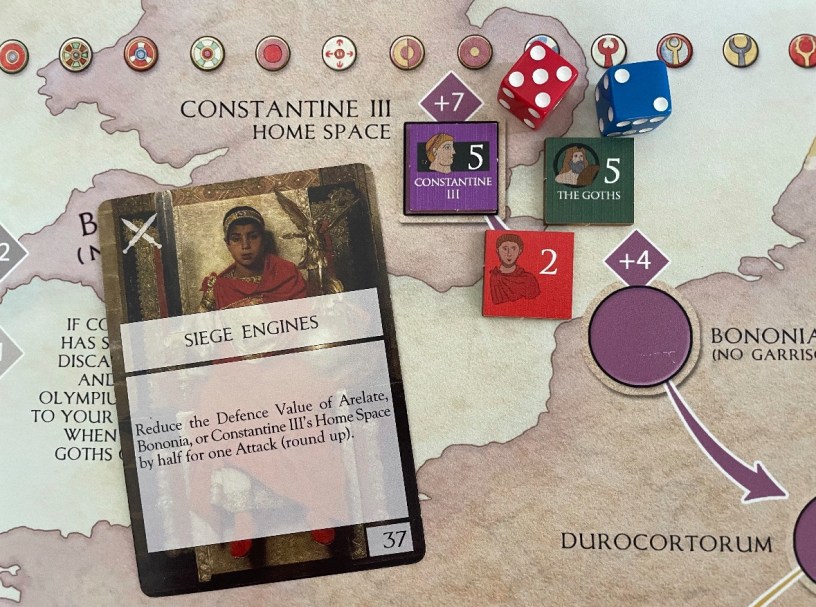
Let’s take a look at an example of how it works. Constantine III occupies his Home Space in Britannia and has a base Attack Value of 5 as he has been previously Demoralized, which is further modified by the +7 Terrain Bonus that the space provides. This means that the Attack Value of Constantine is 12 (5 for printed Attack Value on counter + +7 for the Terrain Bonus = 12). Compare this to Stilicho’s army Attack Value of 11 (5 for the Comitatenses + 2 for Stilicho’s Attack Value + +4 for The Goths who are aiding the Romans = 11). So as you can see, the Romans are behind the eight ball and will need to have some good luck or good cards to best the defenders. But never fear as the Romans have some tricks up their sleeves in the form of a few cards in their hand. The one card that they decide to play before the battle is called Siege Engines and this is a very powerful card that will halve the Defense Value of Constantine III’s Home Space by half rounded up so it gets reduced to a 4. This means that Constantine now has an Attack Value of 9 as compared to a 12. That is better but there is still some work to do.
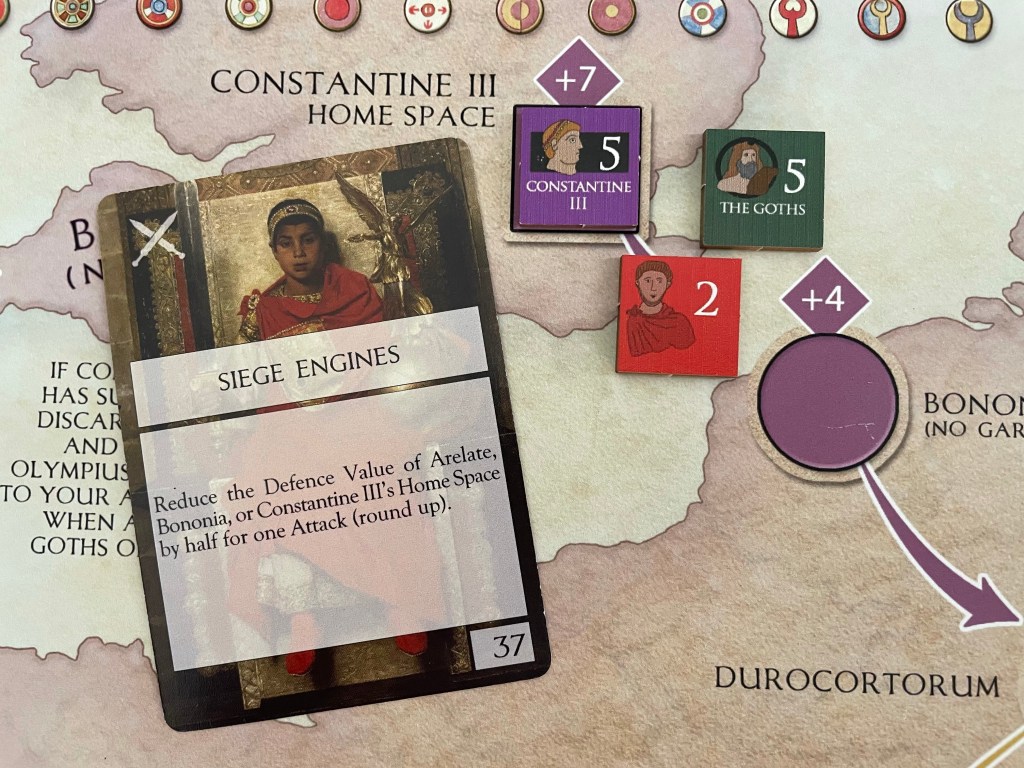
Dice are rolled and Constantine III gets a result of 5 as compared to the low Roman roll of just 2. This means that Constantine III appears to have won the battle with a Total Attack Value of 14 as compared to the Roman Total Attack Value of just 13. You might be asking why doesn’t Stilicho use a couple of Reserve Actions by discarding 2 cards to give a +2 bonus which would be enough to win the battle? He would if he only had the cards as he only has one card in his hand!
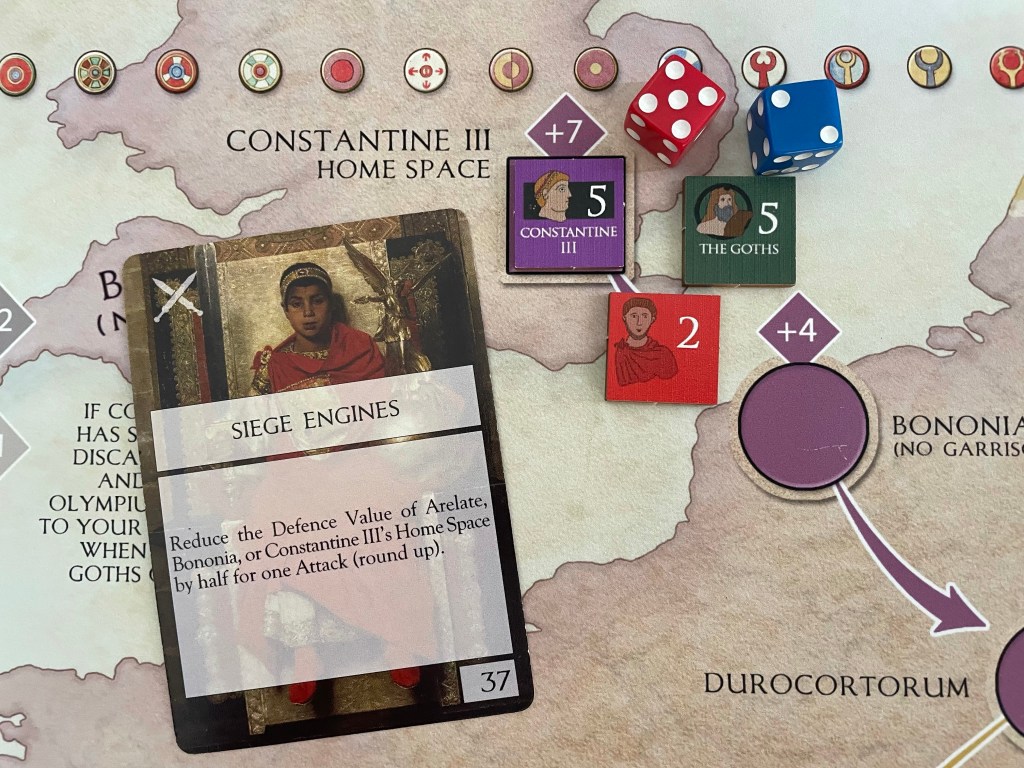
But that one card is a good one named Scholae Palatinae. It allows the card to be played after the Total Enemy Attack Value is determined to add a +2 to the Roman Attack Value. So in this case, after the result is determined to be just one less than Constantine III’s, playing this card will give the Romans a +2 modifier making their Total Attack Value a 15 rather than a 13 which means that they have put down the pretender Constantine III and are one step closer to winning the game.
Roman siege engines were adapted from Hellenistic siege technology. Relatively small efforts were made to develop the technology; however, the Romans brought an aggressive style to siege warfare that brought them repeated success. Up to the first century BC, the Romans utilized siege weapons only as required and relied for the most part on ladders, towers and rams to assault a fortified town. Ballistae were also employed, but held no permanent place within a legion’s roster, until later in the republic, and were used sparingly. Julius Caesar took great interest in the integration of advanced siege engines, organizing their use for optimal battlefield efficiency.
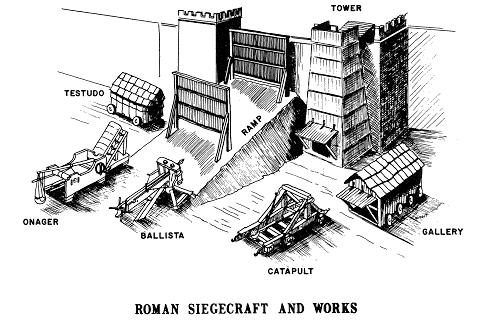
These machines included things like the Onager (type of catapult that uses torsional pressure from twisted rope), Ballista (a winch driven machine that hurled stones or bolts), Catapult and Scorpio (dart thrower). In order to employ these machines and to keep them functional, the Romans facilitated an engineering corps. An officer of engineers, or praefectus fabrum, is referenced in armies of the late Republic, but this post is not verifiable in all accounts and may have simply been a military advisor on the personal staff of a commanding officer. There were legion architects (whose rank is yet unknown) who were responsible for the construction of war machines who would also assure that all artillery constructions in the field were level. Ensuring that constructions were level was the job of the libratores, who would also launch missiles and other projectiles (on occasion) during battle. The engineering corps was in charge of massive production, frequently prefabricating artillery and siege equipment to facilitate its transportation.
I truly love the work of Robert DeLeskie on this game, as well as the predecessor Wars of Marcus Aurelius. The system and how it uses cards is really a classic CDG model but the events are so very unique and I have found create some extremely difficult choices for the player. I have played this one about 30 times and always have a great time with it and how it uses cards.
I wrote a series of Action Points on the various aspects of the game and you can read those at the following links:
Action Point 1 – the Mapsheet focusing on the three Fronts down which your enemies advance, but also covering the different spaces and boxes that effect play such as the Olympius Track, Game Turn Track, Army Box, Leader Box and Recovery Box
Action Point 2 – look at the cards that drive the game and examine the makeup of both the Enemy Deck and the Roman Deck.
Action Point 3 – look into the Roman Phase and examine how cards are discarded to take one of nine different actions.
Action Point 4 – look at a few examples of Battles and how they are resolved.
Action Point 5 – look at a few points of strategy that will help you do better in the game.
I shot a playthrough video for the game and you can watch that at the following link:
I also followed that up with a full video review sharing my thoughts:
In the next entry in this series, we will take a look at Sullivan Expedition vs. Iroquois and Tories from Liberty or Death: The American Insurrection from GMT Games.
-Grant
 The Players' Aid