
With this new My Favorite Wargame Cards Series, I hope to take a look at a specific card from the various wargames that I have played and share how it is used in the game. I am not a strategist and frankly I am not that good at games but I do understand how things should work and be used in games. With that being said, here is the next entry in this series.
Card #42: Frankish Mercenaries from Stilicho: Last of the Romans from Hollandspiele
Stilicho: Last of the Romans is a very well designed and interesting solo experience that plays in 60-90 minutes. But, due to the unforgiving nature of the random card draws and its reliance on dice luck, that admittedly can be mitigated through cagey card play and proper decisions, the game can be over very quickly. In fact, my very first play a few years ago lasted only 2 rounds and was over in about 15 minutes. Remember that the historical Stilicho only made it to Round 3! The cards are at the heart of the game here and make it a very tense and decision filled experience. Having to analyze each card, measuring its utility against the board state and what pressing matters the player must address while also fretting over having to discard a good Event Card that just isn’t useful at this point in time to take an action can be really agonizing. I think that this design works even better than its predecessor Wars of Marcus Aurelius.
One of my favorite parts of the game is the combat. You have a standing army that you assign a leader and also place on a specific track that is attacking Barbarian hordes in that region and have to go about trying to destroy them and quell their resistance to Roman rule. This combat is brutal and sometimes is very challenging if you don’t have the right leader, enough soldiers and the right cards in hand. As you drive the Barbarians back toward their homeland though, their defensive abilities improve as they are more familiar with the terrain as they are fighting on their home court. When you get to the very end of their tracks at their Home space, this Terrain Value bonus will increase to +7 or higher and makes winning combats very, very difficult…unless of course you have the right cards in your hand! One of my favorite cards for this situation is Frankish Mercenaries.
Today’s card is as simple as it gets but these type of Battle Cards are very important for the game. The Battle Cards are denoted by a pair of crossed Gladii (plural form of Gladius) in the upper left hand corner and means that the card can be played as a part of a battle to provide buffs and extra abilities. The Frankish Mercenaries card is a key card to be used in battle, especially as you push the Barbarian armies back toward their Home Spaces and the Defense Values offered by the spaces increase dramatically. Frankish Mercenaries is a simple Battle Card that will add +2 to the Total Combat Value of the attacking Romany Army.
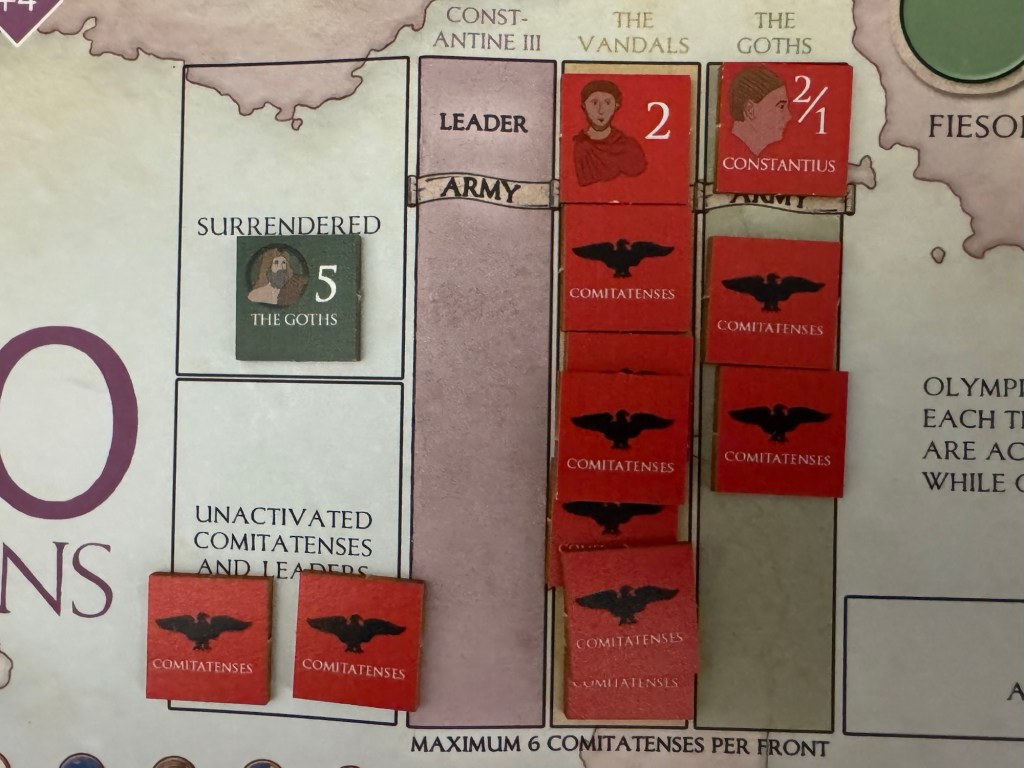
In the picture below, you can see that the Romany Army lead by Stilicho himself is attacking the Vandals in Germania Magna (the home of the Vandals) and you can see that this Vandals Space named Locoritum has a Defense Value of +6 and this will be added to their Combat Value printed on their counter which is a 5. This will give the Vandals a base Combat Value of 11 while located in this Space and to that you will add the results of a D6 roll to create a final Combat Value of between 12-17. This range is a very hard range to defeat as the Romans will typically have a base Combat Value of 8 or 9 as long as their Legions are fully healthy and capable (+1 per Comitatenses in the Army) and if they have a good leader as well (Stilicho in this case grants a +2). This will mean that they have a final Combat Value range of somewhere between 9-15. This makes the use of the Frankish Mercenaries card, which will add a +2 to the Total Combat Value, very important and it will make a victory here much more attainable. This means that this becomes more of an even fight and the use of this card at the right time is the key to being able to defeat the Barbarians and quell their resistance so you can focus on the other marauding tribes. I will say that the roll will still has to be very favorable, even with the bonus +2, and it would be wise to pair this card with a card like Supply Lines that we covered previously in a post in this series.

Now to the historical connection to the game. In the late Roman Empire, the Romans tended to use Frankish mercenaries to assist their campaigns on the frontier. Germanic peoples, including those tribes in the Rhine delta that later became the Franks, are known to have served in the Roman army since the days of Julius Caesar. After the Roman administration collapsed in Gaul in the 260’s, the armies under the Germanic Batavian Postumus revolted and proclaimed him emperor and then restored order. From then on, Germanic soldiers in the Roman army, most notably Franks, were promoted from the ranks. A few decades later, the Menapian Carausius proclaimed himself a co-emperor and based himself in Britain. His military included Frankish soldiers. Later Frankish soldiers such as Magnentius, Silvanus, Ricomer and Bauto held command positions in the Roman army during the mid 4th century. From the narrative of Ammianus Marcellinus it is evident that both Frankish and Alamannic tribal armies were organized along Roman lines.
In the fifth century, the Roman armies at the Rhine border became a Frankish “franchise”, and Franks were known in the region and the Empire to levy Roman-like troops that were supported by a Roman-like armor and weapons industry. This lasted at least until the days of the scholar Procopius (c. 500 – c. 565), more than a century after the demise of the Western Roman Empire, who wrote describing the former Arborychoi, having merged with the Franks, retaining their legionary organization in the style of their forefathers during Roman times. The Franks under the Merovingians melded Germanic custom with Romanized organization and several important tactical innovations that made them very sought after as mercenaries to bolster armies of the time.

I truly love the work of Robert DeLeskie on this game, as well as the predecessor Wars of Marcus Aurelius. The system and how it uses cards is really a classic CDG model but the events are so very unique and I have found create some extremely difficult choices for the player. I have played this one about 30 times and always have a great time with it and how it uses cards.
I wrote a series of Action Points on the various aspects of the game and you can read those at the following links:
Action Point 1 – the Mapsheet focusing on the three Fronts down which your enemies advance, but also covering the different spaces and boxes that effect play such as the Olympius Track, Game Turn Track, Army Box, Leader Box and Recovery Box
Action Point 2 – look at the cards that drive the game and examine the makeup of both the Enemy Deck and the Roman Deck.
Action Point 3 – look into the Roman Phase and examine how cards are discarded to take one of nine different actions.
Action Point 4 – look at a few examples of Battles and how they are resolved.
Action Point 5 – look at a few points of strategy that will help you do better in the game.
I shot a playthrough video for the game and you can watch that at the following link:
I also followed that up with a full video review sharing my thoughts:
In the next entry in this series, we will take a look at Joseph Stalin from Churchill: Big 3 Struggle for Peace from GMT Games.
-Grant
 The Players' Aid
Looks like a cool game. I’m going to take a look at your video. Aritgato Grant-san
LikeLiked by 1 person
do itashimashite
LikeLike