With this new My Favorite Wargame Cards Series, I hope to take a look at a specific card from the various wargames that I have played and share how it is used in the game. I am not a strategist and frankly I am not that good at games but I do understand how things should work and be used in games. With that being said, here is the next entry in this series.
Card #10: Outwit Your Foes from Stilicho: Last of the Romans from Hollandspiele
Stilicho: Last of the Romans is a very well designed and interesting solo experience that plays in 60-90 minutes. But, due to the unforgiving nature of the random card draws and its reliance on dice luck, that admittedly can be mitigated through cagey card play and proper decisions, the game can be over very quickly. In fact, my very first play a few years ago lasted only 2 rounds and was over in about 15 minutes. Remember that the historical Stilicho only made it to Round 3! The cards are at the heart of the game here and make it a very tense and decision filled experience. Having to analyze each card, measuring its utility against the board state and what pressing matters the player must address while also fretting over having to discard a good Event Card that just isn’t useful at this point in time to take an action can be really agonizing. I think that this design works even better than its predecessor Wars of Marcus Aurelius and is slowly starting to overtake the affection of my heart…..but not quite yet!
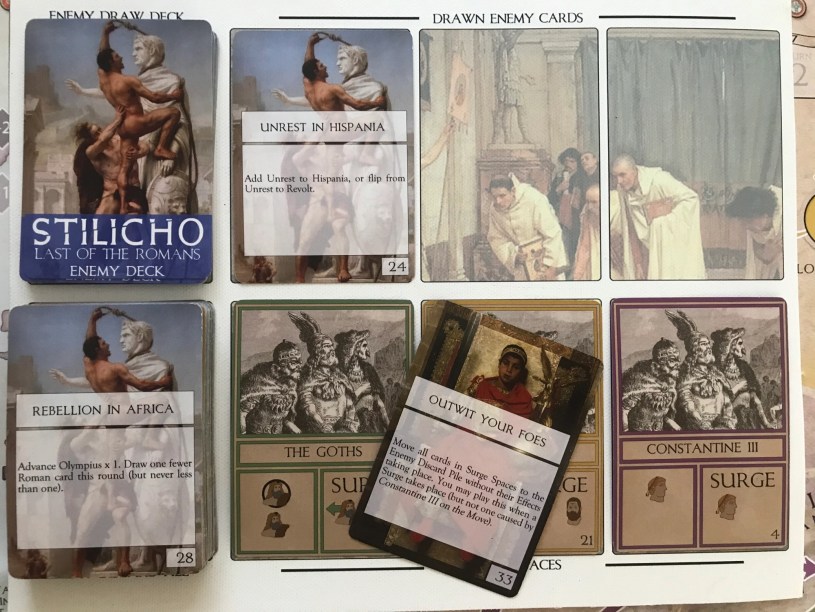
Surges are the newest and most devious addition to the system used in Stilicho and they simply make the game that much more difficult but I do enjoy having to figure out how to deal with this new mechanic. The Surge Display holds enemy cards that have a Surge effect and once the row is full with 3 of these cards, they will trigger the Surge Effects which do things like advance the enemy on a Front, or sometimes twice, reinvigorate a demoralized enemy army or even advance the deceiver Olympius on his track which will lead to you losing your head as the Emperor listens to his honeyed words and begins to lose faith in you and you military prowess! Luckily, there are 4 Roman Cards found in the deck that specifically address the Surge mechanic and provide the player with ways around the nasty effects. I really keep an eye out for these 4 cards and protect them in my hand so that I can use them when things are getting bad!
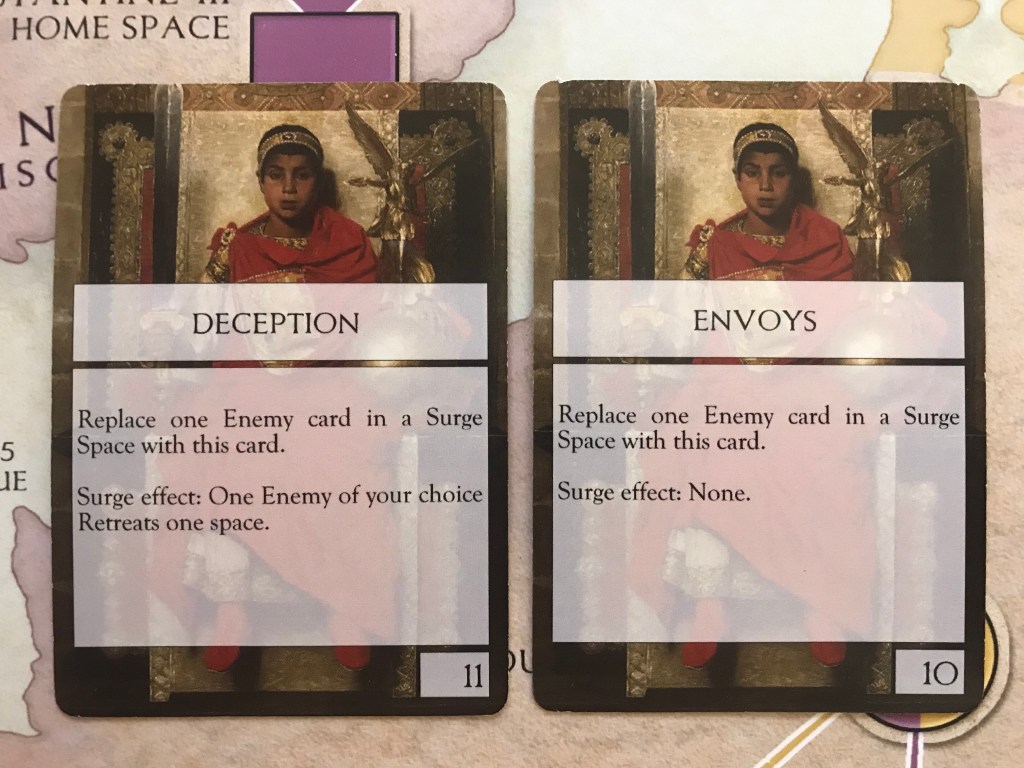
The basis of these four cards is that they either replace an Enemy Card located in a Surge Space (such as Defectors, Envoys and Deception) or they get rid of the cards in the Surge Spaces and allow the Surge effects to be skipped (like the card we are focused on called Outwit Your Foes). The best part about these cards that replace an Enemy Card in a Surge Space is that they not only get rid of the nasty card but they actually can provide you with an additional positive benefit. For example, Deception (shown below) actually allows you to Retreat an Enemy of your choice one space on their Front, while Defectors allows the player to deploy one Comitatenses (army) from the Recovery Box to an Army Box or to place them on the map as a Garrison. Envoys doesn’t offer a benefit.
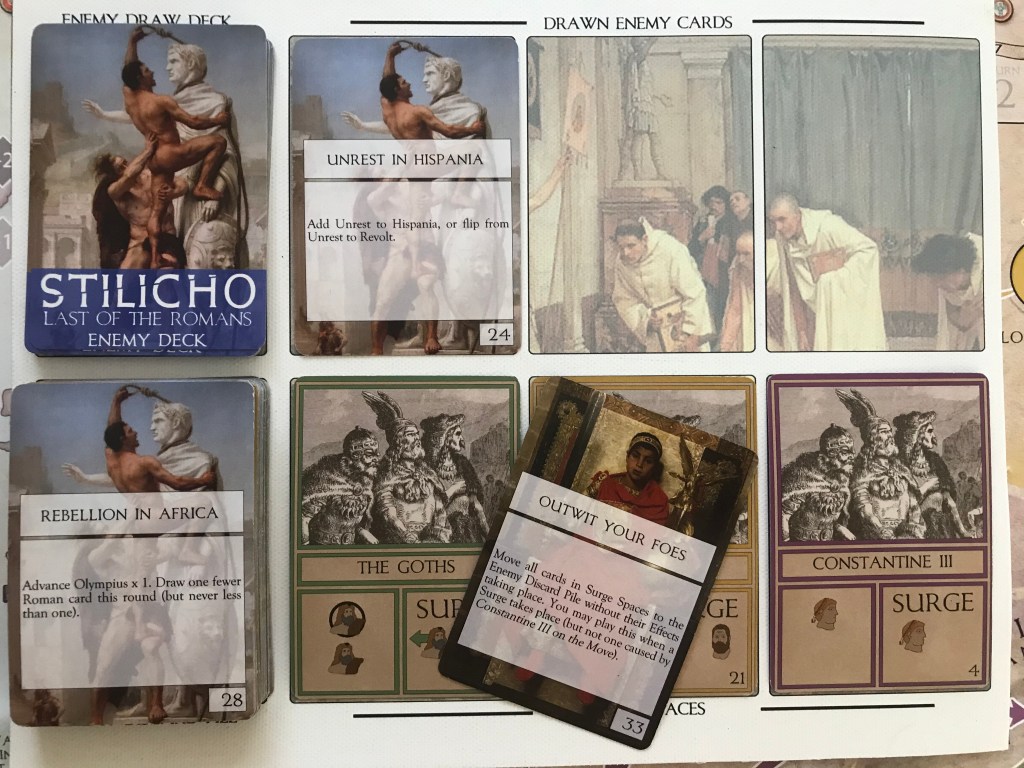
The best card of the bunch though is Outwit Your Foes as it simply allows you to move all cards located in Surge Spaces to the discard pile without their nasty effects taking place. This card can also be played when a Surge is triggered by the placement of the third Enemy Card. I love this card for its benefit but also for its flexibility. Having this type of card in your hand for that one right time is key and will save you from the nasty effects of a Surge.
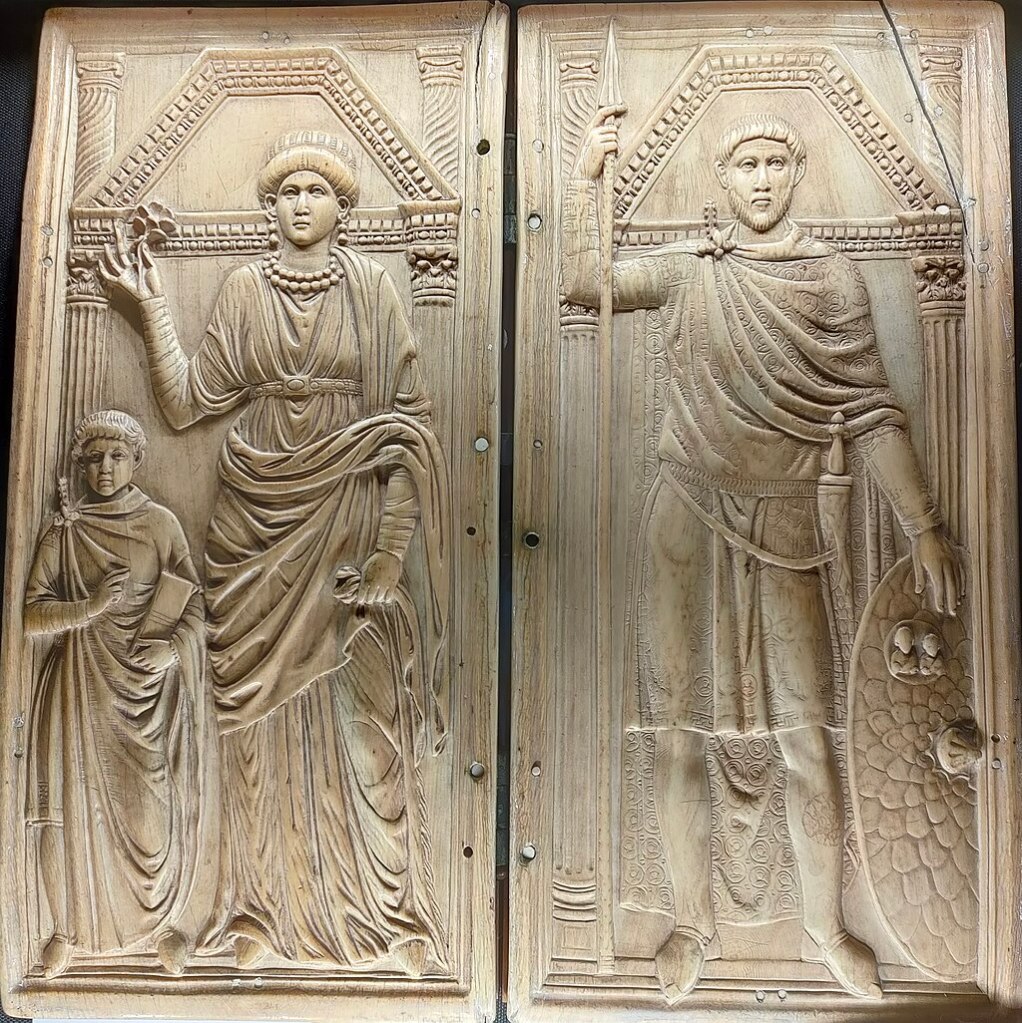
Stilicho was a military commander in the Roman army who, for a time, became the most powerful man in the Western Roman Empire. He was partly of Vandal origins, the son of a Vandal cavalry officer and a provincial woman of Roman birth named Serena, the niece of emperor Theodosius I. Despite his father’s origins there is little to suggest that Stilicho considered himself anything other than a Roman, and his high rank within the empire suggests that he was probably not an Arian like many Germanic Christians but rather a Nicene Christian like his patron Theodosius I, who declared Nicene Christianity the official religion of the empire. He later became guardian for the underage Honorius and worked with him during his rise to become Emperor. After nine years of struggle against barbarian and Roman enemies, political and military disasters finally allowed his enemies in the court of Honorius to remove him from power. His fall culminated in his arrest and execution in 408.
I truly love the work of Robert DeLeskie on this game, as well as the predecessor Wars of Marcus Aurelius. The system and how it uses cards is really a classic CDG model but the events are so very unique and I have found create some extremely difficult choices for the player. I have played this one about 30 times and always have a great time with it and how it uses cards.
I wrote a series of Action Points on the various aspects of the game and you can read those at the following links:
Action Point 1 – the Mapsheet focusing on the three Fronts down which your enemies advance, but also covering the different spaces and boxes that effect play such as the Olympius Track, Game Turn Track, Army Box, Leader Box and Recovery Box
Action Point 2 – look at the cards that drive the game and examine the makeup of both the Enemy Deck and the Roman Deck.
Action Point 3 – look into the Roman Phase and examine how cards are discarded to take one of nine different actions.
Action Point 4 – look at a few examples of Battles and how they are resolved.
Action Point 5 – look at a few points of strategy that will help you do better in the game.
I shot a playthrough video for the game and you can watch that at the following link:
I also followed that up with a full video review sharing my thoughts:
In the next entry in this series, we will take a look at Single Combat from Wars of Marcus Aurelius from Hollandspiele.
-Grant
 The Players' Aid