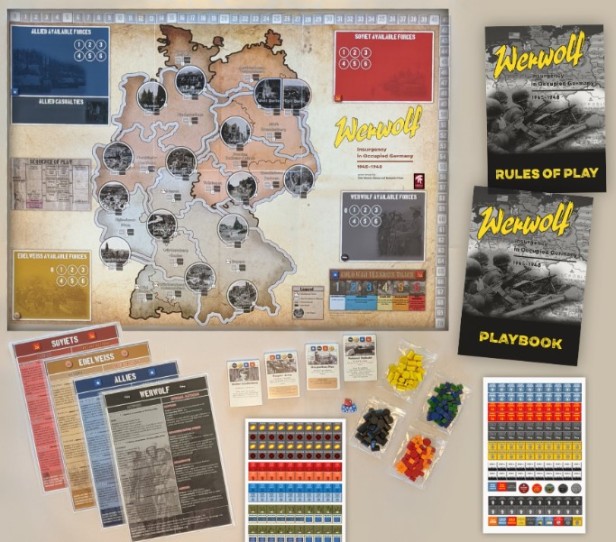
Last year, we were contacted by our good friend Randy Lein from Legion Wargames about a new project called Werwolf: Insurgency in Occupied Germany, 1945-1948, which is a COIN Series inspired multi-faction game taking a look at a what if situation at the end of World War II with various possible insurgencies. He asked if we would be interested in doing some coverage through an interview and possibly some other mediums, such as our Event Card Spoilers format that we have used in other games, and we were immediately intrigued by the concept and the fact that the game uses some of the elements of one of our favorite series. I have been in communication with one of the designers Clint Warren-Davey since that time and he has shared lots of information with me, including the rules and some of their background work on this one, and I wanted to make sure we gave it some light to give you a chance to understand what the game is so that you can make an informed decision about whether you plan to order this one or not. Clint has been great to work with and has agreed to write a series of short articles on the Event Cards and their basis in history as well as how they are used in the game.

If you are interested in ordering Werwolf: Insurgency in Occupied Germany, 1945-1948, you can pre-order a copy for $72.00 from the Legion Wargames website at the following link: https://www.legionwargames.com/legion_WER.html
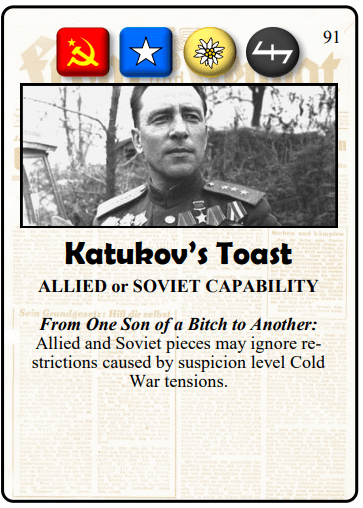
#91 Katukov’s Toast
Mikhail Katukov was a Soviet Marshal of Armoured Troops and successfully led the 1st Guards Tank Army in many battles from Kursk all the way to Berlin. The title of this card comes from a famous anecdote from 8th May 1945 (Victory in Europe Day), when Katukov met American General George S. Patton to toast their combined victory over Germany with a shot of vodka. Patton said he refused to drink with Katukov or “any other Russian son-of-a-bitch.” Through translators, Katukov replied that he would toast “from one son-of-a-bitch to another.” Amused by this, Patton agreed to drink with him, and the American and Russian soldiers present proceeded to drink vodka together as well!
In the spirit of such co-operation, this card provides a powerful capability for both the Allies and the Soviets – they may ignore the restrictions of suspicion level Cold War tensions and therefore move past each other’s pieces on the map without stopping. Cold War tensions put a significant break on the operations of the occupying factions and can be a real pain when you are trying to do patrol or search actions close to the Inner German Border (the line between Soviet and Allied occupied territory). Raising Cold War tensions can also cost you the game. If a Crisis Card is drawn when tensions are at 6 – “War Imminent” – the Allied and Soviet players automatically lose and victory is decided between the two insurgent factions.
So, this card is actually hugely beneficial, especially if played early in the game so that the capability will remain in effect longer. The Soviet player may be more inclined to play this card, as they are more likely to be entering Allied territory than the other way around. The ability to move past Allied troop or police cubes can allow the Soviets to reach deep into the occupation zones of their Cold War rivals and grab cities or provinces – all under the pretext of helping their American friends hunt down fascist scum!
If you missed the previous entries in the series, you can catch up on the posts to date by following the below links:
There will be more card spoilers to come in the near future. In the meantime, if you are interested we posted an interview with the designers and you can read that at the following link: https://theplayersaid.com/2022/06/27/interview-with-clint-warren-davey-and-ben-fiene-designers-of-werwolf-insurgency-in-occupied-germany-1945-1948-from-legion-wargames/
-Grant
 The Players' Aid