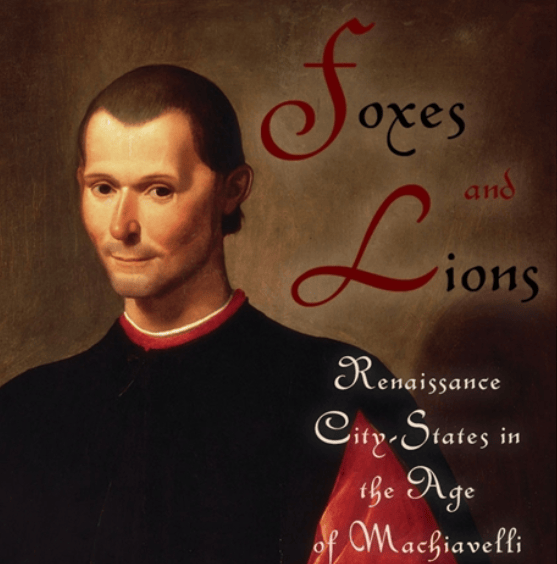
We have played all of the games in the Reivers and Reformers Series designed by Ed Beach, including Here I Stand (multiple times), Virgin Queen (multiple times but not as many as HIS), Tanto Monta (once) and Border Reivers (twice) with our most recent play being a full 5-player game in March while attending Buckeye Game Fest. This series is just special and I very much enjoy our experience with these games each time we play them. The card driven mechanic simply makes the series and it really is a bit of a sandbox as you can win in various and sundry ways. Several months ago, GMT announced the fifth entry in the series called Foxes and Lions: Renaissance City-States in the Age of Machiavelli designed by the duo of Paul Wright and Liz Davidson. This one looks to be epic and is set during warring city-states and dominions of Renaissance Italy during the era known as the Italian Wars (specifically, the period from 1494 to 1527). I am very keen on a new addition to the series and look forward to diving in and learning more about the game over the next year or so. My first step was to reach out to the design team to do a designer interview and Paul Wright was more than willing to answer our questions.
*Note: The pictures used in this interview showing the various components and cards, are still in the design and development process and as such rules, event effects and text might still change prior to final development and publication. Also the art and layout of the components are only for playtest purposes at this point and the game will enter the art department as it nears publication.
Grant: Paul welcome to our blog. First off, please tell us a little about yourself. What are your hobbies? What’s your day job?
Paul: From Chicago originally, I’m a cultural historian by training, having taken my doctorate in Comparative Literature at Princeton and worked with the masterful historian Anthony Grafton. I’m happy if even a tiny percentage of his vast knowledge has lodged itself in me. My focus in my doctoral research was Renaissance humanism in Italy and England, including work on Leonardo Bruni, Pico della Mirandola, Machiavelli, Gabriel Harvey, and John Milton. I have been dialoguing with Machiavelli ever since my undergraduate days at Northwestern, when one of my mentors (the wonderful Albert Ascoli) tasked me with translating long sections of The Prince into English. I’m certain those early efforts were awful and too literal-minded, but what an instructive exercise that has only made me more admiring of great translators. Alongside Machiavelli remaining a key part of my research, I have also been working on the political and social impact of Savonarola.
I taught for three decades in higher education, including my graduate T.A. days at Princeton, as well as teaching posts at Osaka University, Villanova University, and Cabrini University. That last school, sadly, closed in the wake of all the pressures on higher ed in the last fifteen years or so. I then turned to teaching in the independent school world, which brought me to Main Line Classical Academy in Bryn Mawr, PA, where I teach English and History, as well as a games-based learning history elective funded by a grant I recently received from the Renaissance Society of America.
In my games-based learning exercises in my classrooms over the years, I have used analog board games as well as the occasional computer game (Europa Universalis in particular), but I also use role-immersion pedagogies like Reacting to the Past; I serve on the national consortium board for RTTP (for more info, see https://reactingconsortium.org/). I’m currently developing a RTTP game on Florence in the period 1494-1512, the era of the republic with the Medici in exile. In that game students may take on one of over thirty historical roles, including Piero Soderini, Da Vinci, Da Vinci’s portrait subject Ginevra de Benci, followers of Savonarola, condottiere Fabrizio Colonna, or even Machiavelli himself. Think of this as a role-playing game that zooms in even further than does Foxes and Lions. The game has been tested by professors at over a dozen institutions so far; it will be used in a high school setting for the first time this year.
My hobbies include film and media studies. I have taught film and media courses (on everything from the Coen Brothers to Kurosawa to The Sopranos) at the Bryn Mawr Film Institute for some twenty years now. I also have a screenplay (in painfully drafted form) on Machiavelli’s time spent with Cesare Borgia, which certainly informed Machiaveli’s thinking and later writing.
I also treasure any chance to travel abroad, and it was a big part of my higher ed career in international affairs. I hate how expenses have curtailed that experience for so many of us, as well as how the U.S. has become less welcoming to international students. Not surprisingly perhaps, Italy is my favorite destination, with Albania (home country of my wife) and China (home country of my daughter) tied for a close second. I also lived and taught in Japan for four years from 1996-2000, and it was one of the most formative times of my life; I treat any chance to return as a treat.
Grant: What motivated you to break into game design? What have you enjoyed most about the experience thus far?
Paul: I waded into game design after decades of intensive play of wargames, euros, RPGs, and so many other types of games that I’m clearly an omni-gamer—certainly on the heavier side of the complexity scale with a focus on historical games. I’ve always been happy to solo (even multi-handed) because playing more games teaches you so much about how games are put together and how they try to model complex realities, including the past. I’m an admirer of David Lowenthal’s classic book, The Past Is a Foreign Country, which certainly evokes how games draw me into historical eras and crises.
I’ve also been blessed in Philadelphia, my home of 26 years now, with the best gaming group anyone could ask for—a group of people who are kind, seriously competitive yet never obnoxious, while also being sharp and funny as hell. Between my own solo forays and playing with them, it has been an education that led to this first ever design for me. My Philadelphia group are truly shadow co-designers in their way.
What I’ve most enjoyed about design is the sense of something evolving before your eyes that captures the history as I understand it, but I also love designs that challenge or revise my understanding. Collaborating with an amazing co-designer in Liz Davidson and developer extraordinaire Joe Dewhurst has been an absolute treat. I’m spoiled by having these two on my team.
Grant: What have you learned about design over the years?
Paul: Like many designers, I have many designs that never saw the light of day; some of these will come to fruition, I think, once Foxes and Lions is released. What I do know is that I’m a designer by theme and subject who looks far and wide for mechanics that will capture the historical complexities that fascinate me. I know many work in the opposite direction starting with mechanics, but that’s not how I’m wired. I start with a theme or problem that haunts me, then see if a game (mine or someone else’s) can help to illuminate it—or at minimum, reframe my questions more powerfully.
I also see historical game design as a way of testing and modifying (not merely reinforcing) my own interpretive and historiographical assumptions. One of the reasons I began the journey with Foxes and Lions over a decade ago now is that I had deep questions about Machiavelli, his theories, his playful will to narrative, and the era through which he lived, an era that we all too facilely collapse under the rubric of the “Italian Wars” or “The Renaissance.” Game design can be a heuristic tool that can bear fruit eventually in a new interpretation or synthesis that we hadn’t anticipated. At minimum, it clarifies my own tortured thinking and reading of the sources.
Grant: What is your upcoming game Foxes and Lions: Renaissance City-States in the Age of Machiavelli about?
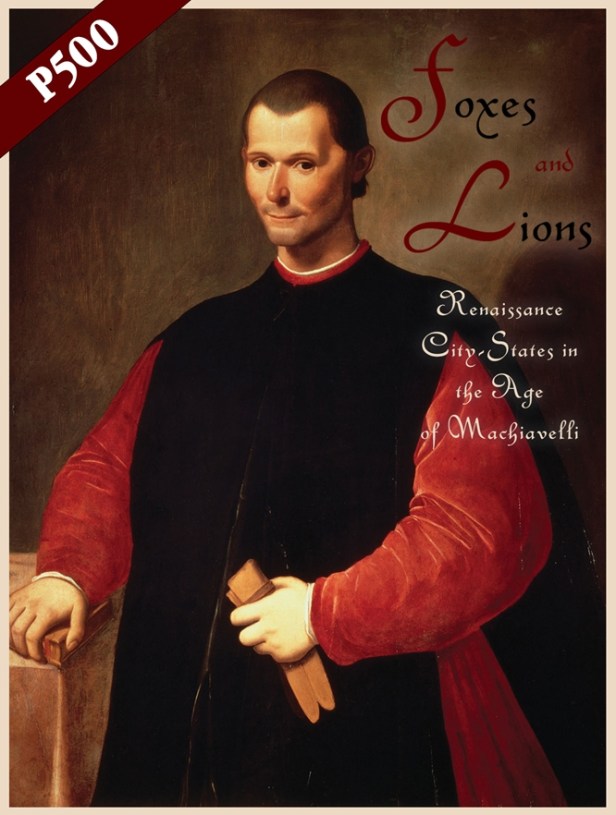
Paul: Foxes and Lions: Renaissance City-States in the Age of Machiavelli is the next game in the GMT series that includes Here I Stand, Virgin Queen, and Tanto Monta. Focused on the warring city-states and dominions of Renaissance Italy during the era known as the “Italian Wars” (specifically, the period from 1494 to 1527), this game zooms in on the Italian peninsula. Unlike many other games on the Italian Wars, Foxes and Lions puts the focus on Italian experiences of this era of enormous upheaval, which also saw some of the greatest cultural splendors that we now associate with the period known, not without controversy, as the Renaissance. The game depicts the political, military, economic, religious, and cultural affairs of five key Italian powers brought to life by players (Florence, Milan, Naples, Venice, and the Papacy).
Players struggle to create political legitimacy for themselves while contending with both Italian rivals and non-player great powers intent on conquest of their own objectives in Italy; namely, France, Spain, the Holy Roman Empire, and the Ottoman Empire. For those who have played other series games, much will be familiar mechanically, but there are many new concepts and mechanics to enjoy, including experimenting with different government types, managing local sentiment, and gathering precious florins to pay for mercenaries and their fickle condottieri captains.
Furthermore, players will be faced with the possibility of collective defeat to the non-player great powers. Players will individually pursue Virtù Points, drawing on Machiavelli’s famously pliable conception of political ability and military strength, while at the same time striving to avoid collective defeat by loss of Italian Virtù Points. Dwindling Italian Virtù embodies Machiavelli’s abiding fear of great power domination of Italy. Players will each attempt to win without Italy falling into the subjection that was historically its fate, and should they fail to prevent that, the game ascribes blame to the specific players viewed as the scourge of Italy and the new lapdog of the great powers. Can you thread the needle between your Italian rivals’ ambitions and the threat posed by the great powers of Europe?
Grant: Why was this a subject that drew your interest in making a game?
Paul: This subject got under my skin as an undergrad as I mentioned above. I first fell in love with Dante in multiple courses with terrific and yet very different teachers. They graciously invited me to join their graduate courses as an undergrad. Milton, Spenser, and a host of political poets in the epic tradition caught my eye there too, but I fell hardest for Dante and his era. As I went on to graduate school, that love of Dante abided, but Machiavelli re-entered the chat, as it were.
After my graduate experience with Machiavelli (thanks especially to one of my teachers, Victoria Kahn), I was never quite the same. Machiavelli embodied someone both deeply troubled and somehow deeply amused by a world that was falling down around him. His political career began in the wake of the 1494 Medici exile, the rise of Savonarola, and the restoration of a republic that had long been under the Medici yoke. His career ended the first time in 1512 with the Medici restoration. It ended again with another Medici exile in 1527, with yet another republic that didn’t really trust Machiavelli anymore given his courting of Medici patronage in the intervening years. Above all, the traumatic Sack of Rome in 1527 really shook Machiavelli. He died just over a month after the Sack, witnessing exactly the kind of Italian nightmare that he had warned about for years. Someone who had lived that much life and turmoil became endlessly fascinating to me. I know Machiavelli will be a part of my scholarship and design life for the duration.
Grant: How did you come to team up with Liz Davidson on this project?
Paul: Liz has become a dear friend as well as collaborator and sounding board on everything from our shared gaming interests to our broader professional and personal lives. We met because I invited her to be a keynote speaker at a Reacting to the Past game design conference at my former institution. She was not only awesome in that role, but we immediately hit it off as people. It wasn’t long till we were talking regularly cross-country and at conventions, then talking about collaborations.
Grant: What strengths did each of you bring to the design process?
Paul: In the case of Foxes and Lions, I obviously brought the historical background and scholarly passion to the project, which I had first formulated about six or seven years before Liz and I met. But in all candor, I was spinning my wheels. I was swamped with the faculty and administration politics of a dying institution, and I was smack dab in the middle of all that drama in a leadership role for our faculty. It took Liz to help me see the real comfort of game design and of throwing myself back into my true passions, especially for Foxes and Lions.
It also helps enormously that Liz is a doctorate-holding historian of religion herself with a focus on the ancient world. And as anyone passionate about the period knows, the Renaissance was defined in many ways by its relationship to the classical world, so while Liz wasn’t an early modernist or medievalist, she understood intuitively and on a deep level why a classicist would enjoy and contribute to a game about the Renaissance. Simply put, without Liz, there is no Foxes and Lions for the world, just the game in my head. Liz also has a sharp sense of end-user needs in game design. How something will play to a more general audience and not just specialists or heavy gamers. To be clear, our game is a heavy game situated within a heavy (yet beloved) series, but Liz is working hard on materials to onboard people as only she can, including training guides, videos, and more. She is doing an amazing service with this in relation not only to our game, but also the series at large. Stay tuned for more of these things in the months to come.
I’d also be remiss not to mention the support and encouragement of Volko Ruhnke. After he visited my former university as keynote panelist for a games-as-scholarship workshop, we talked about Foxes and Lions possibly joining the COIN series in the vein of other pre-modern titles like Falling Sky and Pendragon. Liz and I even prototyped a first COIN version of our game. It was fun and quirky; it could have possibly thrived in COIN world, but at the end of the day GMT’s Jason Carr wisely suggested a retooling to the Here I Stand line. That was preaching to the choir for me given my admiration for Ed Beach and for the series. Ed became yet another guiding light as we got to know him. One of my proudest moments was having Ed participate in a play of the game at WBC this past summer. They say don’t meet your heroes; both Volko and Ed prove that dictum wrong.
Grant: What has been the division of labor between you?
Paul: Liz and I both have day jobs that are very consuming. She as creative director at Leder Games, myself as an educator (a role Liz had also previously played in independent schools). Yet we both get up incredibly early, whether we are meeting or not. We are always busy with our games at every spare moment. Liz has so many games on her plate, including with other collaborators like David Thompson, another designer for whom I’m an unabashed fanboy. I’ve got Foxes and Lions of course as my primary focus, but also a book project on Machiavelli and the Reacting to the Past role-immersion game on Machiavelli’s Florence that I mentioned earlier.
I would call our division of labor something like triage; think ER or The Pitt. We are each picking up the slack when needed, prioritizing one thing or another. If there is a functional division right now, I’m heavy into the rules and component revisions, as well as early TTS testing, about to go wider as of November 2026. Liz is contributing to the InsideGMT articles we are posting on the game; her favorite subject, not surprisingly if you know her, being espionage for an upcoming piece. Liz is also there anytime we need to vet some unusual change or some stubborn holdover of mine from earlier iterations of the game. Liz will give you her most honest take on how something plays and how it will feel in the game experience. Liz has an reliable, sure sense of that. As I mentioned, she is also developing onboarding materials for newbies that I think will be awesome.
The few times we have not seen eye to eye (and I can count them on one hand), we have always had principled discussions of where each of us is coming from, and that has always lit the way to a solution. Like myself, Liz is an omni-gamer with an historian and educator’s perspective on things. That fundamental commonality has always carried us through. Having Joe Dewhurst as our developer has been equally essential as he too is an educator and scholar, and his sharp eye for what will make a game its best is invaluable. As with Liz, no Foxes and Lions in its current exciting form without Joe.
Grant: What is your design goal with the game?
Paul: If I have an historian’s axe to grind with many games on the Italian Wars and Renaissance, they have never quite to my satisfaction captured the cultural dynamism, complexity, and sheer messiness of the period. There are success stories among Renaissance games to be sure. Many games attempt to capture the military picture and do so well; on the tactical front, Rich Berg’s Arquebus comes to mind here as well as the lesser known and under-appreciated Brien Miller game, Fornovo 1495.
Other games attempt to integrate military concerns with politics and economics on a grand scale, and of course Eivind Vetlesen’s Europa Universalis: The Price of Power comes to mind here as a masterful and inspiring example, although the cultural and political front in that game is more driven by events than player agency compared to Foxes and Lions. Pascal Ribrault’s Virtù is also an interesting euro that tackles some of these concerns in an accessible way.
And of course, we have the crowded field of games tapping into Renaissance commercialism. Brasini, Gigli, and Luciani’s Lorenzo il Magnifco and Fabiano Lopiano’s Calimala come to mind here. An underappreciated and roughhewn gem is Mario Papini’s Siena; his better-known De Vulgari Eloquentia is terrific. On the art front, Stefano Groppi’s Florenza looms large in my mind for its attention to both Florentine art and the material and political considerations behind that art; it’s also just a beautiful game to look at.
Yet for all those examples above, Ed Beach’s Here I Stand and Virgin Queen were the guiding lights to Foxes and Lions—alongside the interest in political asymmetry that transcends the traditional wargame fixation on “control,” a paradigm shift displayed so beautifully in Volko’s COIN series. What Morgane Gouyon-Rety attempted so ambitiously in Pendragon also figures in my original thinking about the game. Morgane and I have chatted of late about how the character-driven conceptualization of ever-shifting rulers has serendipitously shaped both her Hubris game and Foxes and Lions.
Yet for my design purposes, what Ed’s work on Here I Stand proved was that a wargame could tackle vitally important and culturally adjacent aspects of the period that impact things happening on the strategic battlefield—in Ed’s case the religious strife of the Reformation and Counter-Reformation. COIN demonstrates to us that the sentiment and shifting support of an administered population is just as important as the intentions of those controlling a space—or trying to convince themselves that they do. This was very much on Machiavelli’s mind too.
In addition to wanting to make a game that captures the overdetermined messiness and intricacy of the Italian Renaissance, especially during the Italian Wars per se, we also wanted a game that “consciously uncoupled” (to riff on Gwyneth Paltrow’s marital breakup language) from reliance on “great power” narratives. Those narratives and the assumptions implicit in them are a recurring feature of most games on the Italian Wars and even of the Here I Stand series to date. We wanted ultimately to put the focus on Italian experiences of those conflicts—in the process creating a HIS series game about underdogs.
This was more than about zooming in on the map of Italy as depicted in earlier series games, something Carlos’s Tanto Monta did to a degree that left me hungry to do far more given my own scholarly interests in Italy. Yet it was above all about letting players personify powers that were otherwise total underdogs (or minor powers at best) in the context of the rest of the series and most other games on the period.
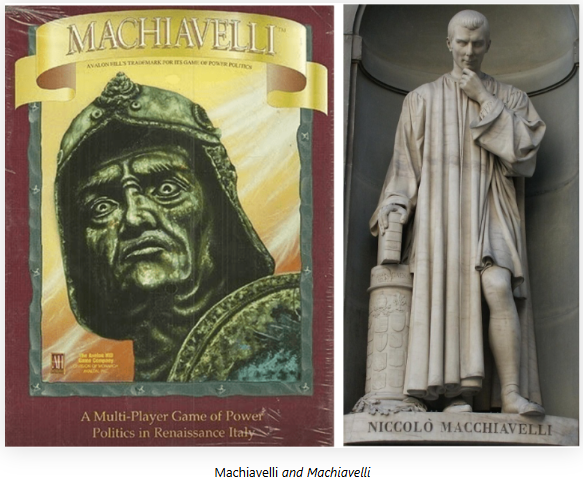
In this way, Avalon Hill’s out-of-print classic Machiavelli comes to mind for its attention to Italian powers alongside the greater powers of Europe and the Ottoman world. Our elevator pitch for Foxes and Lions remains a good formula—the old Machiavelli game brought to life in the mechanical exoskeleton of the Here I Stand system. Finally, as I get into in more detail below, we wanted a game that honored the messy contradictions and true interests of Machiavelli and didn’t simply replicate the many misleading stereotypes about him.
Grant: How have you modified the Here I Stand System to recount the story of the rise and fall of Renaissance City-States in the Age of Machiavelli between 1494-1527?
Paul: In addition to the non-player great powers mentioned earlier, the game features other significant additions or changes to series conventions.
- Political traditions—These are the governments (current and past) that define the political character of any given space in the game (featuring merchant republics, feudal aristocracies, princedoms, theocracies, tribute states, and vassals). In keeping with Machiavelli’s respect for founders of institutions, lawgiving will be an available action that permits you to attempt to alter governments in your dominion. Each space under your control may have a very different political arrangement, which affects its prosperity, unit construction capability, and many other things. Your central government (that of your capital) may also change over time.
- Sentiment—This captures the current attitude of the local population to the government overseeing it. The scale of sentiment reflects Machiavelli’s own terminology, ranging from “Hated” to “Feared,” to “Feared and Loved” (the latter an ideal Machiavelli thought hard to achieve, opting instead for being “Feared” whenever a choice between fear and love was unavoidable).
- New unit types—Regulars are split into citizen militia and feudal levies, alongside a more detailed look at mercenaries (with elite variants including the Swiss reisläufer and the Imperial landsknechte).
- Condottieri captains—Twenty of the colorful, talented, and sometimes treacherous mercenary captains of the era will be available to players in competitive blind bidding for their services, with each captain reflecting unique battlefield abilities, vulnerabilities, and other surprising game impacts. Captains are essential to success in the game, and if not properly paid and retained, will go up for auction again; they may even be suborned and taken from you by nefarious rival actions. Among the captains are the infamous Cesare Borgia, Fabrizio Colonna, Giovanni delle Bande Nere, and “El Gran Capitán” himself, Gonzalo Fernández de Córdoba. Yet the captains also include those who are captains for our game, but not condottieri narrowly defined; these include militaristic cardinals like Francesco Alidosi as well as the famously defiant Caterina Sforza.
- Money economy—Alongside the high-level political capital of command points (CP) already familiar to CDG players, Foxes and Lions features the cold, hard cash that mercenaries and dominions crave. Florins are collected by a trade action connected to the prosperity of the various governments in one’s dominion. The florin economy will be necessary not only to pay or bribe mercenaries and captains, but also for espionage, government maintenance, and more. Player treasuries are hidden behind a screen, so no one is ever quite sure of a rival’s wealth. Should you run out of florins for a required or desired expenditure, the banks will be available to lend to you at exorbitant interest rates, and failure to repay may cost you dearly.
- Espionage available from turn one—Nefarious measures are available to players from the outset of the game, including familiar operations from Virgin Queen like Gain Intel and Assassination, now supplemented with Appeasement, Foment Rebellion, Sabotage Fortifications, and Suborning others’ employed condottieri to your cause.
- New patronage systems and figures—For those familiar with Virgin Queen, patronage now features three tracks (artists, scientists, and humanists) with 10 figures of each type. Each patronage target affords unique game effects. Among the 30 patronage subjects are figures such as Michelangelo, Da Vinci, Botticelli, Copernicus, Pacioli, Paracelsus, Machiavelli, Manutius, and even a prying poet-courtesan, Tullia d’Aragona.
- New ruler dynamics—Each player will have an often-volatile lineup of rulers who will transition based on circumstances in the game (26 rulers in total across five player powers). In the case of the Papal States, a conclave procedure involving all five players will determine the next pope whenever the current pope dies, however mysteriously.
- Variable impulse order—Players may bid their florins to change the impulse order for a given turn, creating dynamic opportunities for surprising your enemies—or lying in deadly wait for them.
- More opportunities to declare war mid-action phase—No game about Machiavelli’s era would be complete without the temptations and risks of back-stabbing rivals, even erstwhile allies, including in the middle of a turn. Great coalitions (like the historical “Holy League”) may form, but no alliance is ever truly safe.
Grant: What elements do you feel are most important to model from the period?
Paul: If there was one thing that consumed me more than anything else in formulating this game years ago, it was the desire to make the best possible game on the richness, diversity, and contradictions in Machiavelli’s whole body of work—a game that would capture Machiavelli the writer and, above all, the human being as I’ve come to know him.
I didn’t want a game that just brought The Prince to life, or that just reveled in the skullduggery so often associated with Machiavelli, even in games that somehow invoke him. I wanted a game that also featured the other Machiavelli(s). The celebrator of republics in the Discourses on Livy who also knew just how fragile republics really are, a lesson for today if ever there was one. Machiavelli the historian in his state-sponsored Florentine Histories, an example of urban history compromised by political pressures to dance around certain uncomfortable truths. Machiavelli the military theorist of The Art of War, who appreciated the potentially dangerous impact of militarism on civic life in addition to the positive virtues of citizen soldiers (there is something of both James Madison and Stephen Ambrose in Machiavelli here). And finally, even the Machiavelli of La Mandragola (“The Mandrake Root”), a viciously funny sex comedy about cuckolding with a sly political subtext commenting on the differences between classical virtues and Renaissance realities. Further down in this interview, you can see three event cards that were inspired by Machiavelli’s diverse array of writings.
In all that effort, we also want to be sure that Foxes and Lions never simply takes Machiavelli at his word or at face value. Given his own internal contradictions, that would be unwise. We instead see the game as interrogating Machiavelli’s assumptions and claims. His critique of mercenaries versus citizen militia is explored both in design and in actual play, never simply rehearsed uncritically. His appreciation for the libertà of republics is tempered by his continued recognition of their fragility and their vulnerability to other powers with more direct mechanisms of control and decision-making; think here of today’s debates about democracy and autocracy.
Machiavelli’s sense was that Italy might be doomed by great power intrigue—exacerbated by Italian powers courting the greats to their own ends rather than looking to Italy’s good. This was always balanced with a deep yet tortured belief in the possibility of resuscitating Italian virtù. In addition, we wade in this game into Machiavelli’s discussion of virtù itself, a term almost untranslatable given its variety of uses in his works. The tension between individual and communal greatness was always on Machiavelli’s mind in using that term—with a preference at last for the latter as it was most pursuant to true glory and historical legacy, as well as most compatible with republics. Lawgivers (as opposed to generals and strongmen) were always most admired by Machiavelli, I would say. The serendipity of our victory points in the game easily transmuting into “Virtù Points” was an early discovery, as was realizing that we should also track Italian Virtù Points to gauge the threat of collective defeat.
To say that this is a game of ideas in the crucible of conflict is an understatement, but even more vital to us is that the game’s ideas should be tested in a sandbox of historical conditions that confronted the historical actors, both individual and collective. We want a game that is not on historical rails, but that instead allows for historically plausible surprises and strange developments. So far testing has provided just that. Thankfully, the game allows shockers—the imperial troops of Charles V against Cesare Borgia; Savonarola arranging a cuckolding of the “Warrior Pope” Julius II; Piero de’ Medici lingering on for multiple turns as the hapless ruler of Florence. Testing has seen a lot of these unanticipated “what ifs,” and we imagine even more strange developments over the life of the game. Above all, testers have stressed just how fun and crazy the game can be. Mission accomplished, to my mind.
Grant: What major design challenges did you encounter and how did you overcome them?
Paul: I go into more detail on this below, but one of the challenges I personally faced is the same that confronts any designer—the old “kill your darlings” mantra. This is why I’m especially grateful to Liz and to our amazing Joe Dewhurst on the development end. While there are many things in Foxes and Lions that I deem “thesis-level” in importance and non-negotiable, there are plenty of things I fell in love with early on that it took me time to see were hampering the design and gameplay.
Sometimes you don’t have to kill the “darling” as much as reshape it. One example is sentiment, discussed above. At one point, we really needed to find a way to make sentiment matter more to the game mechanically. We had it as conceptually important, and it truly is, but it wasn’t doing what we needed to make players care about it. Once Liz and Joe encouraged connecting sentiment to espionage, battlefield impacts, and other power-specific concerns, I saw the light. We didn’t jettison sentiment, but we made it matter to players and to the thesis of the game. A similar thing happened with political traditions. Originally, we were tracking up to four governments (current and previous) in each space’s political traditions box. We wisely revised so that now you only trace the current government and any previous dominant political tradition in that space; that simplification kept the interest in government forms without creating a truly unwieldy board state.
In other cases, you do just need to kill the “darling” altogether, as we did with dynamic prosperity management for each space. While each space still has a political traditions box and its current government affords a trade value to that space impacting your power’s florin economy, originally I was foolishly insistent that each space have dynamic prosperity that you could spend CP to raise or lower (subject to caps by government type). That might have worked for a computer version of the game, but it was decidedly awful for a game that already has lots of moving parts and elements new to the series. Dynamic prosperity was not only killing the delicate Command Point economy of the game, but it was also just boring to players. They definitely wanted florins and economics, but they didn’t need that much granularity. Again, so grateful I had Liz and Joe to help me see the light. The game is way better for all these refinements.
Grant: How does designing a game in an established system work? Any constraints on your thoughts for the period?
Paul: One might think designing within an existing series framework is an easier task. There is a template, a style, and a set of mechanics and design assumptions. And to an extent, this is true. It’s nice to “stand on the shoulders of giants” like our predecessors in the series, Ed Beach and Carlos Diaz Narvaez.
The difficulties I encountered, however, were met and overcome thanks to a 2025 game designer retreat hosted on Beaver Island, Michigan by Central Michigan University’s Center for Learning through Games and Simulations, run by my friend and an intrepid scholar of colonial Mexico, Jon Truitt. In that weeklong retreat in a remote, beautiful setting, I spent uninterrupted days studying the entire Here I Stand series and its rulebooks. I wrote the new rules for Foxes and Lions from the ground up there, with an eye toward retaining what was essential to the series while weaving in what was of thesis-level importance to our game and its historical setting.
The real challenge of adapting to an existing series framework is not so much what you will keep, but what you will add or change altogether. If you are standing on that giant’s shoulders, you never want to annoy (let alone topple) the giant carrying you by flailing around thoughtlessly in a shared design space. In this case, the giant isn’t just someone like Ed; it’s a community of dedicated series players who have made HIS games a lifestyle choice. Many of them are making series games of their own, such as the gracious and supportive Luis Rubio, whose game Primus Inter Pares is of great interest to me.
We know this community will put Foxes and Lions through its paces. We know too that GMT is seeking a game about the complexity of Virgin Queen, a design goal we share and think we have met. Things that we don’t fret over in our game (e.g., the religious mechanics of Here I Stand) are replaced by things that we feel we must have (e.g., political traditions).
The way Liz and I have tackled any additions or changes to the sturdy, muscular frame that is this series is always to ask a fundamental question of anything new. Does it support a “thesis-level” contention or historical organizing principle of the game? Does it add something to the series that offers a new, welcome dimension to gameplay that shakes things up for the better? If something didn’t speak to one of those needs, we generally ended up revising it until it did or dumping it.
Ultimately, we never felt the series hamstrung our vision of the period, but it enriched it. What we kept our attention on was how you can redeploy series conventions to treat a more focused region that would be a mere few spaces in the larger scale games like Virgin Queen. This change of scale and perspective was a challenge, but the system opened itself to that. To borrow from my side work as a teacher of film, we think of Foxes and Lions as zooming the camera in from the eagle-eye view of the great powers in the other series games. Like Norma Desmond in Sunset Boulevard, the Italian Wars (and as I keep stressing, the Italian experience of those conflicts) were ready for their closeup.
Grant: What sources did you consult for the historical details? What one must-read source would you recommend?
Paul: I could be here all day talking about the game’s primary and secondary sources, but I’ll keep it brief. Liz and I recently did a video about precisely this topic of sources or ancillary readings for the game and you can watch that at the following link:
The books we mentioned there are terrific places to begin. Some commentary follows the list here.
The Essential Writings of Machiavelli (translated by Peter Constantine)
Foxes and Lions: Machiavelli’s Confidence Men by Wayne A. Rebhorn
The Civilization of the Renaissance in Italy by Jacob Burckhardt
The Beauty and the Terror by Catherine Fletcher
The Machiavellian Moment by J. G. A. Pocock
Niccolo’s Smile by Maurizio Viroli
Inventing the Renaissance by Ada Palmer
Florentine Histories by Machiavelli (translated by Laura Banfield and Harvey Mansfield)
A History of Florence 1200-1575 by John Najemy
Fortune is a Woman by Hanna Pitkin
The Tigress of Forlì by Elizabeth Lev
Fortune is a River by Roger Masters
Mercenaries and their Masters by Michael Mallett
The Italian Wars 1494-1559: War, State and Society in Early Modern Europe by Christine Shaw and Michael Mallett
This is very much a partial list. Of these, the most welcomely irreverent in terms of pieties about the Renaissance is Palmer’s Inventing the Renaissance. Great stuff that explodes many preconceptions and has some great sections on Machiavelli. That side, the pieties deserve their day in court too though, and no one was more influential there than Burckhardt. It has become fashionable to pile on Burckhardt for his missteps, which is a shame because there is much he got right to which it is worth returning.
Mallet and Shaw are terrific on the Italian Wars proper, as well as the role of condottieri, whom they treat evenhandedly and with nuance missing elsewhere. Roger Masters in Fortune Is a River illuminates a lesser-known military plan to deploy terraforming of all things; the book explores a collaboration between Da Vinci and Machiavelli to divert the Arno River to strike at Florence’s favorite obsession, Pisa. The book puts into dialogue two of the most unique figures in the Renaissance; it remains a proud moment for me that I introduced my dissertation Tony Grafton to this book, as it is quite rare to find anything on this period that Tony hasn’t already read.
I’d of course recommend reading Machiavelli himself, but please, read widely, not just The Prince. There is as much to learn in his Discourses on Livy, Florentine Histories, Art of War, and his sex comedy Mandragola as there is anywhere else. Machiavelli even wrote some historical and political poetry (Decennali) on the dramas of his day.
John Najemy offers what I view as the single best modern history of Florence in English. Pocock’s classic, The Machiavellian Moment, is a most ambitious attempt to trace Machiavelli’s ideas about republics backwards to the ancient writer Polybius, but most compellingly forward to the English Civil War and the American Founding. A truly monumental book that loomed large in the conceptualization of the game.
Grant: What are the playable factions?
Paul: The player factions are the Republic of Venice, the Duchy of Milan, the Republic of Florence, the Kingdom of Naples, and the Papacy. These are the “big five” mentioned by Machiavelli in The Prince. They are confronted not only by each other, but also by four non-player “great powers”—France, Spain, the Holy Roman Empire, and the Ottoman Empire. Some have asked why Genoa is not among the playable powers; Machiavelli’s “big five” aside, this is because Genoa finds itself under the thumb of Milan at game start. It is a minor power held hostage by a player power, but it may break free and find new allies. I do have in mind a prequel expansion in which Genoa is playable though (see below for more on that).
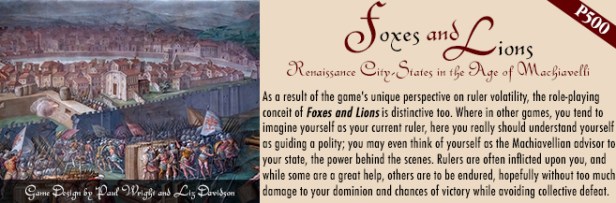
Grant: How did you try to differentiate them in their style of gameplay?
Paul: The asymmetry of the playable powers is deeply baked into the game, both in the event deck featuring events drawing on their histories, but also in the mechanics, victory conditions, and play styles.
Venice begins the game leading the pack by a good margin. An economic powerhouse of merchant republican bent, Venice has wealth coming from its colonies abroad, especially the Balkans in our game. Yet, what was often called Venice’s “Long Decline,” which would not be completed until Napoleon’s era, was already in motion at the start of our game. The Ottomans threatening the colonies, combined with Venice’s own dangerous ambitions on the Italian mainland, would lead to disaster at Agnadello in 1509, with what must have felt like the world arrayed against Venice.
Milan begins as a powerful duchy, wherein the Visconti had been replaced by the condottieri family of the Sforzas long before game start. Milan has its thumb on Lombardy, but also Genoa. Genoa is a source of wealth and prestige, but also a constant headache and a state that might break loose. Milan is a viable threat for autowin and may expand south (as they did in the early 15th century), but it is also surrounded by great powers (notably, France and HRE), as well as neighboring Venice, their closest rival at game start.
Naples has the stability of a feudal kingdom to support its military and political cause, but it is also torn between the dynastic claims of the French and Spanish, which go back centuries. Naples is in a great position to keep what it has, but expanding toward victory is a major challenge unless it chooses to cross swords with the Papacy and others. Naples cannot rely on the status quo, even though the French armies of the time were already threatening that.
The Papacy is vexed by a roster of alternately skilled and disappointing rulers, as well as internal divisions in Roma between the Orsini and Colonna families, whose vendetta threatens both the city and papal stability. The Papacy has considerable spiritual powers with material benefits for its allies and punishments for its enemies. Occasionally it boasts military leadership to boot; think Cesare Borgia and Pope Julius II, the “Warrior Pope.” The Papacy’s advantages are often situational and fleeting though, and it is surrounded by rivals, not to mention great power intrigue (above all, from the Holy Roman Emperors, such as Charles V).
Finally, my beloved Florence. It begins with the single greatest mess of any of the powers. Piero de’ Medici, hapless and unprepared son of the late Lorenzo il Magnifico, is alienating citizens left and right. He is in the pocket of French interests and will controversially cede Pisa to King Charles VIII. In his wake comes someone no less controversial, Friar Savonarola, whose apocalyptic vision of Firenze as the “New Jerusalem” will bring it into direct conflict with the Papacy of the Borgia Pope Alexander VI. Their confrontation is an early set-piece in most games. The other rulers who follow the Friar (Piero Soderini and two Medici) offer radically different political visions for Florence. Of all five player powers, Florence must wrestle with the most political instability, particularly in a difficult starting position.
With Venice, Milan, and Naples functioning as the “big dogs” (at least among Italian player powers), both Florence and the Papacy have their work cut out for them, but many avenues to victory. Florence can play the patronage game like few others, and the Papacy will have opportunities for expansion as long as they also maintain their influence over the Christian great powers and keep the Orsini and Colonna in stalemate. Florence and the Papacy also have the game’s only option for a joint victory. Provided a Medici rules both powers (a thing not always easy to coordinate), they can win the game together by one of them achieving an autowin (i.e., military victory) on the map. This assumes of course both players are interested in and capable of this coordination.
Grant: As a CDG, how does the game utilize cards?
Paul: Our game uses the classic CDG framework of multi-use cards pioneered by Mark Herman and used to such great effect in the Here I Stand series. We have added some wrinkles, however. First, there are 26 rulers in the game (4 for Venice, 5 for Florence, 5 for Milan, 6 for Naples, and 6 for the Papacy). There are two home cards for each power, available from game start. Each home card can be used for varying purposes unique to that power, but one of the two home cards benefits more from that player having allies, who will also appreciate that card’s advantages to them. The other home card tends to be best when going it alone with few or no allies, but players are free to use either home card each turn. There are some events that impact this; one (“Well Governed Dominion”) allows a player to use both home cards that turn, while another (“Confused Administration”) allows a rival to force you to pick a home card of the rival’s choosing, while also saddling you with -1 card next turn.
Finally, we introduce an important new type of mandatory event card: Captain auction cards. These 20 figures represent the condottieri and other influential figures (even ostensibly non-military figures who nonetheless have a powerful effect on the battlefield and other arenas). Captains are the subject of aggressive florin bidding wars in secret auctions (or sometimes, assigned to a player with highest influence on a specific great power). As these captains are the most decisive on-map leaders in the game, accumulating them is vitally important, especially given the vagaries of a captain’s fate on the battlefield (a captain is a potential casualty in any battle, even a victory) and off (being subject to assassination attempts or certain events). Being a power without any captain at all is the surest way to be easy prey in a land of many predators.
Grant: Can you share a few examples of individual cards with us and explain how they work?
Paul: Here are some examples of the types of cards in Foxes and Lions, especially those that break with series conventions in one or more ways. Please note that all card images here are prototypes and will undergo further graphics work, refinement, etc. Some commentary follows the images.
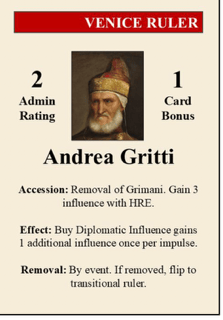
First, let’s consider one of our rulers: Venice’s Andrea Gritti, not to be confused with the mind-warping mascot of the Philadelphia Flyers. In addition to typical Admin and Card Bonus ratings familiar to series veterans, each ruler card also includes important additional information. Every ruler in the game has conditions for accession and removal (if a game start ruler, removal only). These conditions are almost always situational in nature, and in Gritti’s case, depends on his predecessor Doge Grimani having been removed. Doges and Popes are most typically removed by failing a survival roll at end of each turn; some, but not all rulers have these rolls. Elderly doges and popes always do. We also see here Gritti’s effects on the game—a helpful boost when paying CP for diplomatic influence. Other leaders may have disadvantages and outright weaknesses (e.g., Piero de’ Medici’s awful Admin rating of 0).
In a sense, you must endure and exploit the ruler you have rather than necessarily embodying that ruler, as is more the role-playing conceit in other HIS series games. For example, in HIS, you feel you are Suleiman the Magnificent, and that’s great for that game with all its high-level great power shenanigans. But in Foxes and Lions, it might be most helpful to think of yourself as a Machiavelli-type advisor behind the scenes, and you certainly won’t relish embodying the weaker and more problematic rulers when navigating their serious tradeoffs. I sometimes think of the role-playing conceit of this game as you portraying no mere ruler or advisor, but perhaps an entire polity, a people weathering the rulers they’ve been dealt. The conceit at last is up to you and your play group.
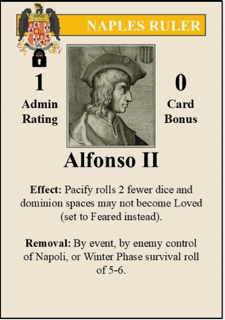
Alfonso II of Naples is a different ruler example. He is the starting ruler for Naples. Alfonso is awful at Appeasement (formerly “Pacify” as seen here), which is the effort to improve sentiment in your dominion; he is so poor at this that no dominion space may even reach the coveted Feared and Loved status. Note too that while he does have a survival roll, he may also be removed if Napoli (the capital space proper) is enemy-controlled. This is a situational timer on this ruler, and other situational timers apply to many rulers (in Milan, Florence, and Naples especially).
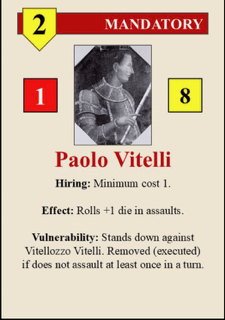
The captain examples here include one conventional condottiere, Paolo Vitelli. You bid on captains when they are played as mandatory events. Some turns there will be few or no captains on which to bid; on other turns, they will appear in great waves. Each game play is very different on this front. Our Paolo, adept at siege assaults, nonetheless has an Achilles’ Heel—if he doesn’t assault at least once a turn, he is executed by his employer! This reflects the curious history of the real Paolo, whom the Florentines accused of treacherously soft-pedaling the siege of Pisa on their behalf. His execution enraged his brother Vitellozzo (another captain in the game), who will become an inveterate enemy of Paolo’s former employer if this happens (and it might be another power that employs Paolo, not necessarily Florence).
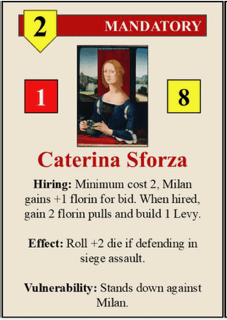
Then we have the illustrious Caterina Sforza, scion of a family of condottieri, but not herself one as classically defined. We felt it important that our game have a preponderance of captains who do fit that classic description, but we also wanted a few, unusual “captains” who don’t, but nonetheless had battlefield and even other impacts. Caterina is celebrated in Machiavelli’s Prince as a commanding leader defending the siege of Forlì, with Machiavelli (perhaps apocryphally) crediting her with this infamously defiant statement to her besieging enemies, who had kidnapped her sons and threatened their lives: “To show them that she did not care about her sons, she revealed her genitals, saying that she still had the means to produce more” (trans. Peter Constantine). Accordingly, in the true Man Who Shot Liberty Valance spirit of “printing the legend,” our Caterina excels in siege defense alongside other advantages upon “hiring.” If she has a vulnerability, it is that she will stand down and not fight against her beloved Milan. Every captain has a downside of sorts to go with the silver lining.
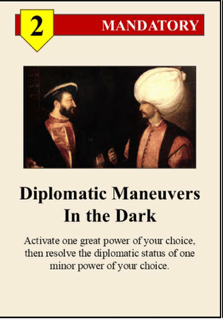
Finally, we have two card types familiar to series players, but with wrinkles. “Diplomatic Maneuvers in the Dark” is in one way your typical mandatory event; the event player gets 2 CP to spend after the mandatory event fires. What is important here is the event itself reminds us that a good number of event cards will drive the activities of the non-player great powers. Some of those events are optional, but many are mandatory to ensure regular activity on the part of the greats threatening Italy. This card also nicely pairs activation of one great power with evaluation of one minor power, the latter something quite familiar to series veterans.
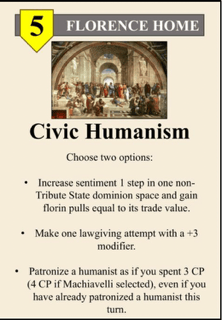
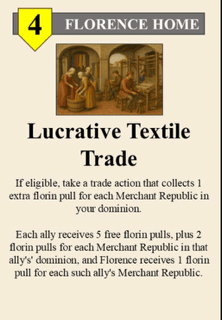
The Home card example pairing here is also instructive. Both are from Florence. The first, “Civic Humanism,” exploits Florence’s advantages in patronage, lawgiving, and maintenance of dominion sentiment. The second, “Lucrative Textile Trade,” focuses on Florence’s distinctive economy in wool and cloth, but it also rewards Florence and its allies with additional florin generation beyond what is typical in the trade action. As remarkably different as the home cards of the others player powers are, this template of one ally-focused and one other home card is consistent throughout. Either card can be used with or without allies, but the ally-focused cards are especially attractive to courting, rewarding, and retaining allies. Until of course, they see you as being in the way of their own ambitions.
Grant: What role does Patronage play in the design? How have you modified the system used in Virgin Queen to fit this era and your focus?
Paul: The biggest change to patronage compared to Virgin Queen is the addition of humanists (broadly defined to include literary creators of all kinds) to the original categories of artists and scientists (also more broadly defined for our game’s purposes). We now have thirty patronage subjects (ten in each category), with two figures having different potential contributions in different categories (Michelangelo in both the arts and humanism for his poetry, and Da Vinci in both the arts and sciences for his engineering gifts).
Speaking to the broad definitions by category, a few examples suffice. Among the more predictable artists of the era, off the beaten path we have Jan Cornelisz Vermeyen, a chronicler commissioned by Emperor Charles V. Vermeyen eventually designed the “Conquest of Tunis” tapestry series, and in some ways can be viewed as a proto-journalist. Among scientists in our game, we have Luca Pacioli, often credited as the “father of accounting.” And among our humanists (extended to include classicizing poets), we have Tullia D’Aragona, a brilliant courtesan-poet who can function as an espionage informant inflicted upon a rival; the rival must both pay Tullia and can never shake her off.
Another significant change from VQ is that for the most part, patronage figures are available for any power to patronize. A few have some restrictions; for example, Machiavelli is for Florence only, while Pico della Mirandola is available to any power except the Papacy given his storied troubles with the Church’s reaction to his more provocative ideas about syncretism. These less common examples aside, most patronage subjects are open to all comers.
We also modify the rollout of our many patronage subjects with only three in each category randomly selected from the available pool on turn 1, then three more added each turn thereafter (with all having appeared by turn 4, albeit in a different order each game). This creates a bit of uncertainty about when your preferred patronage target will become available; it also afford players less cognitive overload than were all ten figures of each type available from game start. Each patronage figure has unique game effects, some immediate and some long-term, and the effects run the gamut of applications to war, politics, economics, other patronage endeavors, or entirely different effects.
Unlike VQ where artists offered VP and scientists VP and/or abilities, every subject of each type in Foxes and Lions has a completely unique patronage ability and the capacity to reward VP. No two figures are the same, and each effect is tailored to the historical achievements or longer term influence of that person.
Grant: How important is Espionage? Why is it available early from Turn 1?
Paul: We wanted the cutthroat environment and skullduggery of Renaissance Italy to be captured from game start. We understand why Virgin Queen delays those things, but we felt Foxes and Lions needed it right off to be a believable recreation of that brutal environment in Italy. No one held back historically, so why should our players?
Espionage is one of the most effective tools at any power’s disposal in the game, but only if you really commit to it. We have seen some players go hard on it, while others stay focused on patronage, conquest, their own victory conditions, etc. If you are to make espionage work for you, having informants and (when possible by event) the cypher key (another holdover from VQ) goes a long way toward exploitation of these tools.
In addition to classic VQ-style espionage actions such as Plant Informant, Gain Intelligence, and Assassination, we also have Foment Rebellion to cause sentiment problems and unrest in enemy territory, as well as Appeasement to address or put down such problems.
We also offer a Sabotage Fortifications action that can remove fortified status from a target space—a nice complement we think to the ability in other series games to build fortifications. Successful sabotage doesn’t change a space’s key status (if any), and it can thematically be understood as anything appropriate to the space; in other words, it could be a literal sabotaging of town walls, but it could easily represent traitors in the leadership ranks of that town, undermining of garrison readiness, or anything else imaginatively appropriate. Fortifications themselves should also be understood in our game to be thematically diverse. In Forlì, there may be literal walls at Ravaldino, but in Volterra, this may additionally represent the natural defenses of high ground. In Venice, imagine the natural defensibility of Venice’s storied lagoon.
Lastly, the espionage action Suborn Captain allows a power to attempt corruption of a rival’s captain (i.e., a battlefield leader), causing that captain to join your cause and possibly causing defection of some of his mercenaries too. Our research has shown that, Machiavelli’s opinion notwithstanding, captains did not defect quite as often as is held by some, but we certainly allow for it to happen in the game as it did occasionally take place. It just won’t be a slam dunk without significant effort and investment (including florins).
In sum, we think espionage is especially robust in our game. Many creative uses are already being discovered in testing.
Grant: How is the next Pope decided when a change is called for? What dynamic does this create between players?
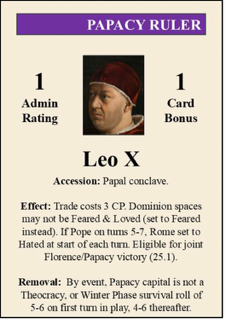
Paul: Pope Leo above is a good example of how the Papacy’s rollout of rulers is different from any other player power. You will note Leo becomes Pope by accession in Papal Conclave.
The Papal Conclave process is used anytime a pope has “shuffled off this mortal coil,” for whatever natural or nefarious reason you imagine. Other player powers have a fairly linear progression of rulers, who change based on shifting game conditions and/or survival rolls as specified on each ruler and discussed above. Yet early on, Liz and I decided it would be delicious fun to allow the popes of this era to roll out in a potentially different order based on conclave intrigue.
The short version is that a conclave does favor the Papacy player with some extra voting power, and any ties will be decided by that player. Ties are rare though as each player power in the game will have some voting power, which can be modified by territories lost to or taken from the Papacy. Having high influence on the Christian great powers (France, Spain and the HRE) can help one’s voting power, but having too much Ottoman influence will hurt it since you are viewed as consorting with an enemy of Christendom.
Finally, we allow players to spend their precious florins to bribe their way to an outcome in secret bidding, wherein even the preferred candidate of a player is not known till everyone reveals their pick and any florins spent.
So while the game begins with the Borgia Pope Alexander VI, it may wind its way to out-of-order candidates of the era succeeding him. Sticking the Papacy with a weaker pope (hello, scrupulous Adrian VI, who foregoes espionage altogether) may hinder the Papacy’s efforts, while the Papacy’s desire for the “Warrior Pope” Julius II will often be transparent. That said, sometimes a wise Papacy player will support a weaker candidate in hopes of drawing out financial support for that weaker candidate, with the knowledge that a better pope will come down the road at perhaps a more opportune time. The Conclave, like bidding on Captain auctions, is one of the major “head games” of Foxes and Lions.
You will also note in the Leo example above a great example of a ruler with downsides. Limitations on dominion sentiment are paired with higher costs to trade. The latter reflects Leo’s tendency to spend papal resources on his own extravagances; the saying ascribed to him comes to mind, “Since God has been pleased to give us the Papacy, let us enjoy it.” It doesn’t help either that Leo causes sentiment problems in Roma, in part due to his refusal to take seriously emerging threats to church authority, including Luther as the game reaches its end stage. At least Leo opens the possibility of a joint Florence / Papacy victory as described earlier. As with so many rulers in our game, there are always tradeoffs and always ways to exploit even a troubling ruler.
Grant: How do players bid for Impulse Order? Why was this important to include?
Paul: Impulse order might be the most debated subject among designers, developer, and testers so far. We decided to include secret florin bidding for variable turn order to create yet another arena in which to angle toward your goals and thwart those of others. We also see it as appropriately reflecting the chaos of Italy compared to the great power canvas of other series games.
Variable impulse order also allows us to use the current order (established after bidding each spring) as a tiebreaker for just about any situation in the game. We have found our current group of ten veteran testers to be unanimously in favor of the variable order bidding. Winning a bid only allows you to move one power’s marker (it need not be your own), thereby altering the impulse order in the Action Phase and impacting the tiebreaker mechanic I mentioned above.
That said, some players will surely not like it, and we had some recently who were new to the game at conventions argue that having a set table order is just easier to keep track of with seating, and we acknowledge this is valid concern for some groups. Online it might not matter, but in person with limited table space, it really might. My group of ten is vocal about keeping variable order bidding as a unique feature of the game, but who knows what wider testing will show.
The upshot is that we are most likely to have a set impulse order as the default rule, but with two variants. In one variant, you can embrace the full “wild west” of variable order bidding described above. For groups that like such volatility, they’ll still have the option. Another variant we have in mind is that you can bid, but all you are changing is which player goes first, while the order proper doesn’t change. We are happy for play groups to use whatever approach they prefer. If fully variable order bidding is not used, the tiebreaker that mechanic affords disappears and is replaced by a dice off. The argument for fully variable order could be that its tiebreaker usage will entail less dice rolling in a game series that is already chock full of that.
Grant: I see there are more ways to declare war during mid-turn. How does this work?
Paul: We knew early on that we needed shifting alliances, betrayals, and overall volatile situations of war and peace in the game. While we love the other series games, we tend to find them a bit too stately for Italy in this period. Yes, some of the other games have a card that lets you start a war mid-Action Phase (famously, Machiavelli’s Prince card in HIS), but we wanted more of this to be possible and more of it to happen!
Originally, we had a mechanism that allowed mid-turn betrayal of allies and declarations of war on the fly at any time provided a cost in CP and florins was paid. This still proved to be too easy and common. It was more in keeping with the wildness of the original Machiavelli game from Avalon Hill, itself a nasty and rich Diplomacy variant.
When we discovered that process was making mid-turn betrayal and declaration of war too common and easy for the good of the game, we compromised. Most declarations of war and making of alliances will happen as normal in the Diplomacy Phase in Foxes and Lions. We still want uncertainty about the reliability of an ally (or the intentions of a possible attacker), so we created four event cards that involve the option of a) attempting to suborn a rival captain on the eve of a battle or b) declaring war mid-Action Phase, even against a current ally. The latter is relevant to this discussion.
There are a few other cards that might situationally create such an opportunity, but these are the big four that clearly do. And so long as you haven’t accounted for those four cards in the discard pile (or preferably, your own hand), you just don’t know who might be able to stab you in the back at any moment. This approach has preserved the paranoia that is necessary for the game, while at the same time preventing a betrayal from happening just anytime on a pure whim. Marshaling your hand effectively is always important in any CDG, but arguably even more so in Foxes and Lions. “Suborn” cards (that include the betrayal and DoW option) are worth their weight in gold, and smart players try to hold onto them for future use.
Grant: How is ultimate victory obtained?
Paul: We have a few types of victory, most recognizable to players of other series games. We have the classic, end-of-last turn race to highest VP (Virtù Point) total; our game is 7 turns long maximum. We have the possibility of the series-typical domination victory from turn 4 on, whereby if you are leading all other players by 5 or more VP at turn end, you can claim victory that way. Finally, we have the traditional autowin condition (getting all your key markers out on map), in essence a military victory, although diplomacy and the minor power influence game may play a large role in that outcome too. What we tinkered with was adding to autowin another requirement for each power. For example, for Florence to autowin, it must retain control of Pisa-Livorno, an historical objective that obsessed many a Florentine government. For Venice to autowin, it must have a certain number of Balkans colonies still in it is possession. And so forth with other playable powers. Autowin isn’t automatic unless you meet that power’s sine qua non condition too.
Frankly, the biggest change in our game is not to victory conditions so much as the introduction of collective defeat. Having all players lose to the “great powers” (France, Spain, HRE, and Ottomans) because Italian Virtù has tanked is our favorite innovation and very appropriate to the situation historically. The game also specifies in the rules which one or two players at your table the others get to blame (perhaps unfairly, but who said life or games are always fair). The lapdog in a collective defeat will be the player with the most VP at the time of that outcome. Many in Italy see the lapdog’s ambitious rush to personal glory as the cause of the great power triumph. The scourge in a collective defeat will be the player with the most influence on all four great powers at the time of that outcome. That influence will not reflect all the influence invested over the course of the game, but those looking for an easy scapegoat will find one in the player currently dallying most with the great powers at that moment. It is even possible for one player to be both the scourge and lapdog; no greater infamy in our game is possible.
One inspiration here is another Avalon Hill classic, Republic of Rome (soon to be back in print, it seems). In that game, players are Roman patricians battling each other, but they are also battling the game, which throws challenges at them like the Carthaginians, Gauls, manpower shortages, etc. We felt Foxes and Lions absolutely needed that possible outcome of collective loss. We are also working on variants to calibrate how likely that is to happen in any given play. The default will be collective defeat as a serious threat, but we will have variant options to make that outcome more or less likely depending on a group’s wishes. If a group wants the focus to be on a likely player triumph, they can reduce the impact of the greats; if a group wants players constantly on their heels, they can increase it.
One can reliably argue that the Italian Wars ended in great power triumph by 1559. As our current game ends with the year of the Sack of Rome in 1527, we allow the game to put that writing on the wall sometimes, but it doesn’t have to be that way if players stand tall against the great powers as Machiavelli wished—often far easier said than done. We are estimating collective defeat to be less common an outcome in the game, but a constant worry. Testing will tell on that front, but we will certainly allow play groups to calibrate this possibility to their tastes as mentioned above.
Grant: What are some general strategies for each of the sides?
Paul: We will have eventually have detailed strategy guides for each power in upcoming InsideGMT pieces and of course, in the eventual Playbook. For now, referring to my answer above about player power asymmetry, the short version for strategies would look like this.
Florence
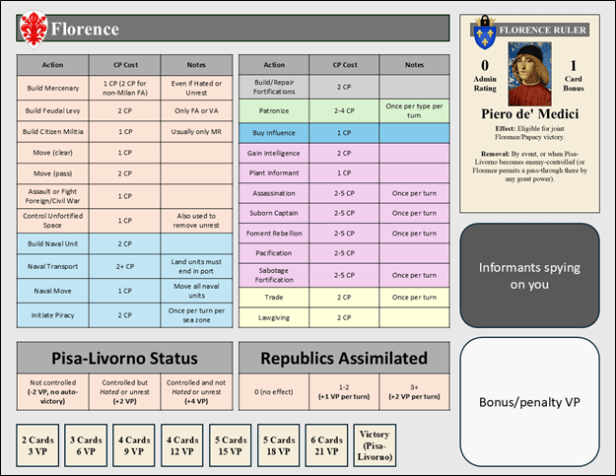
Put your messy house in order early. Try to move past Piero de’ Medici, even if you must play cards and create conditions for that yourself (Piero’s awful 0 Admin rating is a killer). We did once in testing see Piero persist three turns and threaten a joint victory with a Clement-led Papacy, but Piero is overall a drain on your prospects. You will also have to adapt to each of your next rulers in turn; Florence has perhaps the most dizzying political dance to do in the game. They also begin with serious sentiment problems in their dominion (Pisa, for example, is not particularly thrilled about losing its republican liberties to Florence).
Milan
Keep Genoa under thumb at all costs and find ways to expand into the Romagna, Tuscany, or the Veneto Region at the expense of the Venetians. Alternatively, play nice or even ally with Venice until it’s just the two of you with a viable shot at victory, bearing in mind other players will have a lot to say about such an alliance.
Naples
Continue your investment in Feudal Aristocracy in your capital and beyond. While your kingdom is safe on most sides, you need to expand to win. Papal territories seem the best and nearest opportunities for that, but you can get creative. Even Roma itself is calling you, but you must remove some pesky exclaves of Milan and the Papacy from your dominion before you truly commit to broader expansion. You will also need to play the patronage game like anyone else.
Papacy
Manage the flow of your popes through the conclave process to your advantage whenever possible. Don’t rush to get Julius II till you feel you are ready militarily. It would be premature to install him as pope, then have him die due to a survival roll before you can fully exploit him. Learn to manage the weaker popes (Adrian VI and Pius III), sometimes opting for them when your enemies least expect it and may have spent precious resources trying to inflict them on you. And above, make hay while the sun shines with Cesare Borgia. He is called “Darth Vader” by our testers for a reason. He will burn out at some point once Daddy (Alexander VI) dies, but like Roy Batty in Blade Runner, he should burn “so very, very brightly.”
Venice Maintain your top dog status as the game begins. Your bigger problem is growing into actual victory, which will take playing every aspect of the game wisely lest you be overtaken by lesser lights. You must preserve your colonies in the Balkans against often constant Ottoman threats. You need to expand on the mainland where you can without courting the wrath of all others upon you; historically, this was the disaster of Agnadello, which Machiavelli said cost Venice the efforts of eight centuries. You should patronize strategically to boost your VP total and ability profile. And you should always ensure lots of florins in your treasury; each turn end that you have 20+ florins brings VP to you. Weather your weaker doges and exploit your best; above all, the incomparable Leonardo Loredan
Grant: What has been the feedback of your playtesters?
Paul: One recent tester, Stephen Franco, made a comment that was truly gratifying: “Similar to what actually happened historically, the game is a free for all in a confined space, making for entertaining and unexpected outcomes. Great game.” That “knife fight in a phone booth” vibe, which I’ve always loved in games like Cuba Libre, has been shining forth in Foxes and Lions.
There has been a similar reaction from testers both internal and external at select conventions. That said, we are about to extend TTS testing more widely, followed by Vassal testing down the road. There may be very different reactions, concerns, and suggestions there. We look forward to all of it. Like myself, my core testing group of ten people has been very appreciative of the “thesis-level” interests of the game, and they have been amazing with suggesting how to capture the game’s theses in a way that is compelling for players while faithful to the history, as much as any game can be.
The area in which testers have been the most helpful is with implementation of the non-player great powers. That took a lot of play and effort on their part, and their ideas got us to a place where we are now very happy. Joe Dewhurst has also been terrific in helping us calibrate the greats too.
Grant: What do you feel the design excels at?
Paul: Recreating the feeling of the political and cultural climate in which Machiavelli labored, and in which he continually agonized over his beloved Florence’s fate, not to mention Italy’s. The game also has plenty of the paranoia, second-guessing, and treachery that characterized the era, but as I mentioned earlier, above all it’s a game about Machiavelli’s ideas and ideals, however pragmatically or provocatively he expressed them.
That testers have talked mid-game and afterward about Machiavelli’s deepest political concerns—that they have gotten beyond the image of the treacherous Machiavel of the Shakespearean stage in Richard III or the like—is what most gratifies me. Foxes and Lions is meant to stimulate conversation, including about our own political moment when democratic republics are in grave danger indeed. The “Machiavellian moment” is that invoked by John Pocock’s great book—the moment when any state, especially a republic, realizes its utter, temporal fragility in the wake of Fortuna. And when such a state realizes its own contradictions and failings are as dangerous to its survival as any external threat.
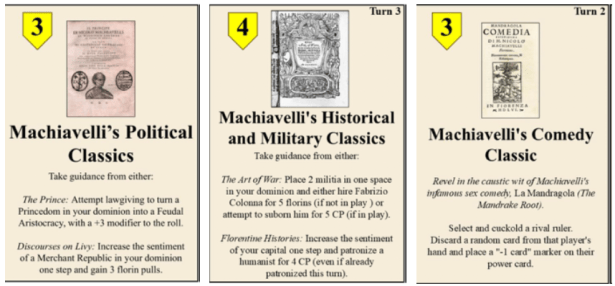
An example of how Machiavelli remains front and center in our game is found in three event cards dedicated to his incredible body of work, not just The Prince. Here are these cards, with a brief comment following.
We wanted our game to have some events that reflect the diversity of Machiavelli’s thought and literary output. We also wanted the event effects to tie into those key works and to be usable by any player. With the first card above, the focus is squarely on The Prince and the Discourses on Livy as political explorations of de facto princedoms and republics respectively (bearing in mind that each text explores the ostensible subject of the other too). The second card puts us in the realm of military theory and historiography; the Florentine Histories are in fact the subject of a scholarly book on which I have been working for years now, so I really wanted it to appear. Lastly, the third card always generates the most belly laughs at the table, focused as it is on Machiavelli’s scandalous sex comedy, a tale of cuckoldry and trickery worthy of the ancient comedian, Plautus. The card effect puts quite a hit on a rival, but the mockery the player endures is perhaps even more stinging. This card has had some wonderfully odd uses (e.g., as mentioned above, Savonarola instigating a cuckolding of Julius II has gone down in my tester group as legendary).
Grant: What other designs are you currently working on?
Paul: My next game, a design on my own and not in any existing series framework, is called Catasto. I have a prototype now that I plan to share at Circle DC next spring. This is another Renaissance game, but about something that hasn’t been treated before in games to my knowledge—Renaissance tax evasion. The Florentine catasto of 1427 is an extraordinarily important document in late medieval and Renaissance social history. In essence a combination of census and property assessment, the catasto permitted political appointees the right to dig into their fellow citizens’ wealth and other holdings to be sure everyone was paying their fair share. This was especially important in the context of ongoing military conflicts between Tuscany and the ambitious Visconti of Milan, all of which had to be funded.
The game explores how far Florentine families would go to hide their assets, and how far their enemies would go to expose those assets while protecting their own from scrutiny. An especially influential (yet very different) design is Tyler Brown’s 23 Knives on the conspiracy to eliminate Julius Caesar. That game uses some very clever mechanics to show how Romans hid, revealed, or unwillingly had exposed their positions on Caesar. The game also allows that the assassination may or may not ultimately succeed. This has been helpful in thinking through how my Florentine players in Catasto might go about concealing their wealth (or excusing it somehow once uncovered). There will also be a tension between seeking to be the catasto investigator and effectively hiding your family’s gains, however ill-gotten.
I’m also working on outlines for a prequel and sequel expansion to Foxes and Lions—no promises and don’t take this as anything from GMT! Just exploring so far, but very much on my mind. The prequel would be set in the 1464-1493 timeframe and feature the Italy of Lorenzo il Magnifico. While military matters remain important there (and Genoa would be a playable power too), there is overall less chance of collective defeat to the great powers. There is much more focus on behind the scenes skullduggery and espionage in that one, including conspiracies like the infamous Pazzi Conspiracy to eliminate the Medici hatched by factions across Italy, including Pope Sixtus IV.
As the main Foxes and Lions game covers the 1494-1527 period, any sequel would cover 1528-1559 (the year of the Treaty of Cateau-Cambrésis that in essence ended the Italian Wars). That era would see a very high chance of collective defeat throughout and great transformations in the situation (e.g., Florence and Tuscany morphing into an eventual Grand Duchy, Venice’s overseas position worsening, Naples finally accepting its dependent status, etc.). If this envisioned triptych for Foxes and Lions comes to pass, I imagine it along the lines of the amazing Fire In the Lake with its prequel and sequel, and the last bit of Foxes and Lions would definitely have a “Fall of Saigon” feel of desperation. Again, no promises, but lots of passion and research on my part in these early days. We have to finish the main stage drama of Foxes and Lions first!
And after (or perhaps a bit alongside) all that, I am working on a CDG game on Skanderbeg, hero of my wife’s home country of Albania, as well as a game on Savonarola and the power of Renaissance rhetoric. I have no lack of projects, but of course the contingencies of time and space remain challenges. Still, good challenges to have!
If you are interested in Foxes and Lions: Renaissance City-States in the Age of Machiavelli, you can pre-order a copy for $88.00 from the GMT Games website at the following link: https://www.gmtgames.com/p-1229-foxes-and-lions-renaissance-city-states-in-the-age-of-machiavelli.aspx
-Grant

