
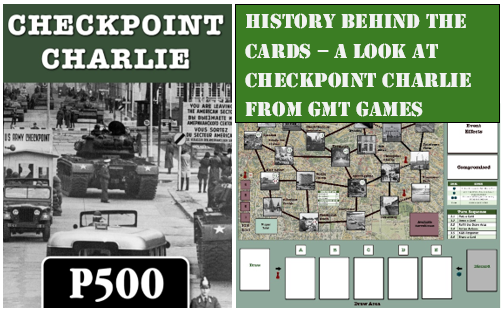
I love a different style and focus of wargame. A game that takes a look at an important but somewhat obscure or rarely addressed historical topic, such as espionage or intelligence, and creates a gaming experience tailored around the events to highlight and evoke the difficulties and tension that would have been present. In January 2026, GMT Games announced such a game in Checkpoint Charlie, which is a solo or cooperative game focused on SIS espionage missions in Berlin in the 1960’s designed by Russell Brown. We have posted an interview with Russel and it was very well received and he has now agreed to create a series of History Behind the Cards to highlight the events of the 1960’s Cold War struggle in West Germany but also to share aspects about the game play and how it models the history.
*Note: The cards highlighted in this series and their event text, as well as any pictures used showing any of the various components, are still in the design and development process and as such event effects and text might still change prior to final development and publication. Also the art and layout of the cards are only for playtest purposes at this point and the game will enter the art department as it nears publication.
History Behind the Cards – Checkpoint Charlie from GMT Games – Card #2: Cuban Missile Crisis
In response to the US placing nuclear missiles in the UK and Turkey, within range of Moscow, and in an effort to protect Cuba and keep it within the Soviet sphere of influence, Khrushchev made a deal with Castro in July of 1961 to base Soviet nuclear missiles in Cuba, within range of most of the southeastern United States.
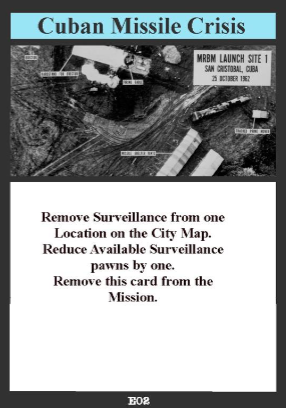
The US knew the Soviet Union was training and supplying Castro’s army and inserting specialists, and CIA assets in Cuba had seen Soviet surface-to-air missiles. This led to suspicion that the Soviets were intending to place ballistic missiles in Cuba.
The best US assets for confirming the presence of these missiles were high-altitude U-2 Spy plane flyovers. However, the loss of Francis Gary Powers’s U-2 over the Soviet Union to a SAM missile (Event Card #12 The Powers Abel Exchange) created reluctance, since the US now knew the Soviets had deployed similar SAM’s to Cuba. U-2 flights were finally authorized in October of 1962, and it was these photos that confirmed the presence of Soviet nuclear-capable missiles.
The status of Berlin, halfway around the world, played an important role in the Cuban Missile Crisis. From 1958 until the discovery of the missiles, the relationship between the US and the Soviets was dominated by the “Berlin Crisis,” which consisted of a series of military and diplomatic moves by Khrushchev to outmaneuver the Americans and annex West Berlin into East Germany. The Cuban Missile Crisis not only brought the conflict over Cuba to a head, but also brought new attention on the status of Berlin. The two became linked. A ground invasion of Cuba might result in a military annexation of West Berlin by the Soviets, and it was not out of the question for the Americans to concede to the Soviets in Berlin to get the missiles out of Cuba.
President Kennedy avoided direct military conflict and responded with backchannel diplomacy and a naval blockade of ships coming into Cuba. The crisis continued for two weeks, with US ground forces readied for an invasion, Soviet ships attempting to run the blockade, and the US strategic nuclear forces going to Defcon 2. The tensions eased when Khrushchev agreed to remove the missiles in exchange for an agreement that the US would never invade Cuba. In addition, Kennedy secretly agreed to remove US nuclear missiles from Turkey.
In Checkpoint Charlie, the Cuban Missile Crisis is assumed to have diverted Soviet attention from espionage activities in Berlin. This card not only removes surveillance from any location of the player’s choice; it also reduces the number of available surveillance pawns for the rest of the mission.
In the next article in this series, we will take a look at Demonstrations and what effect these student run organizations had on operations in West Berlin and West Germany.
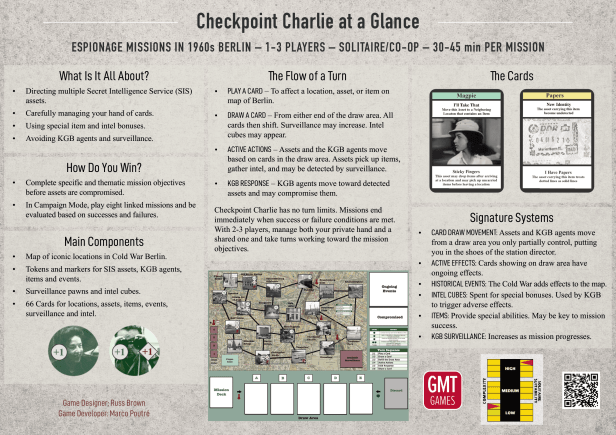
In my opinion, this game looks extremely interesting and I am very much excited to learn more about it. I am appreciative to Russell and his efforts to bring us these cards and to write these entries to share with our readers. I am also very glad that this topic is being covered in a game and look forward to playing this one day soon.
We published an interview with the designer Russell Brown on the blog and you can read that at the following link: https://theplayersaid.com/2026/02/23/interview-with-russell-brown-designer-of-checkpoint-charlie-from-gmt-games/
You can catch up on the posts in this series to date by following the below links:
If you are interested in Checkpoint Charlie, you can pre-order a copy for $48.00 from the GMT Games website at the following link: https://www.gmtgames.com/p-1211-checkpoint-charlie.aspx
-Grant

