An Impossible War: The First Carlist War in the North, 1834-1838 from Bellica Third Generation is a block wargame that recreates the First Carlist War in the North of Spain which was a civil war between the Carlists who supported the succession of the late king’s brother Carlos de Borbón and the progressive and centralist supporters of the regent Maria Christina acting for Isabella II of Spain who were referred to as the Liberals. The game uses blocks representing units but also includes counters and uses cards. I was able to play the game about a month or so ago with Francisco Ronco who owns the publishing company Bellica Third Generation and very much enjoyed the game and how it represented this interesting struggle.
In Action Point 1, we took a look at the Game Map, discussing the point-to-point movement configuration, the various spaces and the delineation of the Carlist versus the Liberal Zones, as well as explained the use of the Rest of Spain smaller map. In Action Point 2, we examined the units available to both sides and covered the importance of Supply. In Action Point 3, we took a closer look at the Carlist Uprising Phase and what it means for the game. In Action Point 4, we examined the activation system and the use of Action Point Markers. In this Action Point, which is the conclusion to the series, we will take a look into how Battles work, focusing on the tactical aspect of combat with the use of the Battle Board.
Battle
One of my favorite parts of the game is the Battle mechanic. With Battle, I very much enjoy the use of the Battle Board but also like that there are several different types of combat. Battles focus on asymmetric combat rather than massive open field engagements and are typical of the First Carlist War. These Battles boil down to 3 primary types including Skirmishes, Battles and Assaults and each type have their benefits and uses and one of the important things about the game is the need to learn their best uses and then how to perform them. If both sides have at least 3 Infantry or Cavalry units in a contested space, then there is a Battle. Also if 1 or both sides has less than 3 Infantry and Cavalry units in the space, or only has Cavalry units, then there will be a Skirmish. And finally, in order to launch an Assault on a Fortress, the besieging player must have a Field Artillery unit of any value in the enemy Fortress space.
But before we take a look at these different types of Battle, I want to cover the Combat Cards. Combat Cards provide background events and assist tactical maneuvers without running the game on their own. Each player holds a distinct 36-card deck (Liberal or Carlist) representing historical, operational, and tactical modifiers. These cards simulate unpredictable elements, like sudden skirmishes, political shifts, or logistical hurdles. The Liberal Player generally leads larger, but lower-quality forces plagued by supply issues. Their Combat Cards tend to focus on maintaining order, quelling uprisings on the Rest of Spain Map and chasing Carlist expeditions. The Carlist Player will command smaller, high-quality troops. Their Combat Cards focus on exploiting superior mobility, terrain knowledge, and sudden strikes. Since this is an “impossible” war featuring guerrilla tactics, siege warfare, and frequent skirmishes rather than massive battles, the cards adapt to these asymmetric scenarios.
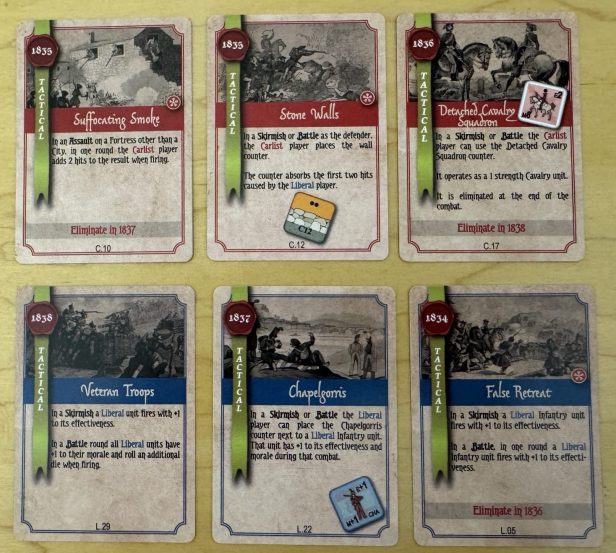
There are 3 types of cards found in the decks, including Event Cards, Operational Cards and Tactical Cards. Event Cards are played immediately when drawn and provide both positive and negative benefits to the players. Operational Cards can be played when the conditions stated on the card are met, during the player’s own Player Phase or sometimes during the opponent’s Player Phase. Tactical Cards can be played in combat as stated on the card. Each player can use a maximum of one tactical card in each Skirmish, Battle Round or Assault Round.
At the beginning of a player’s Player Phase each Turn, that player will take the top card from their draw deck. If it is an Event Card then it is applied immediately. If it is not an Event Card, the card is kept in the hand so that the other player cannot see it. A player can have up to 8 cards in their hand and these can be played as indicated on the card itself.
These cards are very well done and keep the game very interesting and tense as you just don’t know what type of cards your opponent has that they can spring on you in combat. These cards alter the conditions of the battle and cannot be planned for but must be kept in mind as players enter conflicts. From adding defenses that absorb hits (such as the Stone Walls Tactical Card) or provide additional Effectiveness Rating to units in battles when they are firing (such as the False Retreat Card), these cards make a difference and keep the game feeling like a game.
Now that we have looked at the cards, let’s now take a quick look at the various forms of Battle. A Skirmish consists of just 1 single round of fire. First the defender will fire and applies all hits to the attacking units, then the attacker will fire and applies hits to the defending units. There are no morale rolls in the game. In a Skirmish a player fires with a maximum of 3 Infantry and Cavalry units. The player must choose which units will fire with several limitations. maximum of 1 Cavalry unit in rough terrain and a maximum of 2 Cavalry units in open terrain.
A player always fires with all Artillery units.
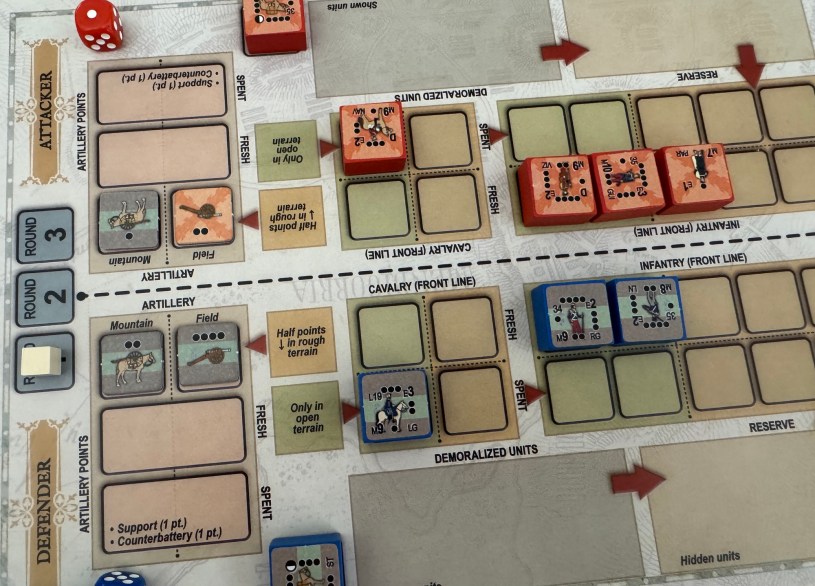
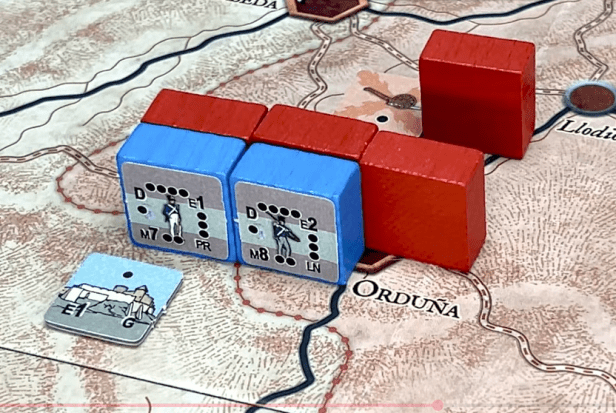
The Battle Board operates as a dedicated, zoomed-in tactical area where the details of combat are resolved. When opposing blocks meet on the main strategic map, units are moved to this board to fight out the encounter safely separated from global troop movements. When a Battle begins, players move their hidden army blocks from the main map onto the Battle Board. Depending on the terrain where the battle takes place (such as rough terrain for a city or plains for the countryside), players deploy their units into specific zones on the board. The Flanks are outside positions that trap or outmaneuver the enemy. The Front Line are the units taking the direct hits and dealing the damage to the enemy and the Reserve is where extra units are kept on standby to join the battle as losses are suffered.
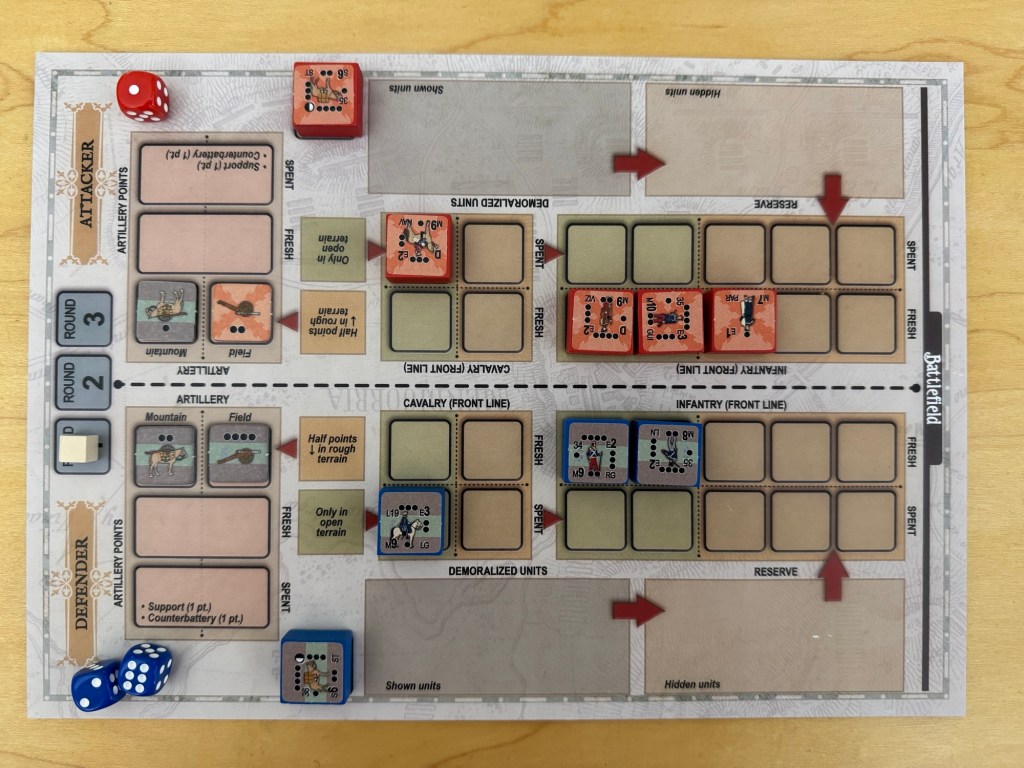
Combat on the Battle Board happens in rounds. As a block wargame, the number of dice rolled by any unit is based on the number of pips shown on the block and the to hit number is equal to or less than their Effectiveness Rating printed on the block. Modifiers may be added from terrain or from the play of Combat Cards. Dice are then rolled and hits are determined with the defending units taking losses by reducing their pips by rotating the block counterclockwise. It is as simple as that.
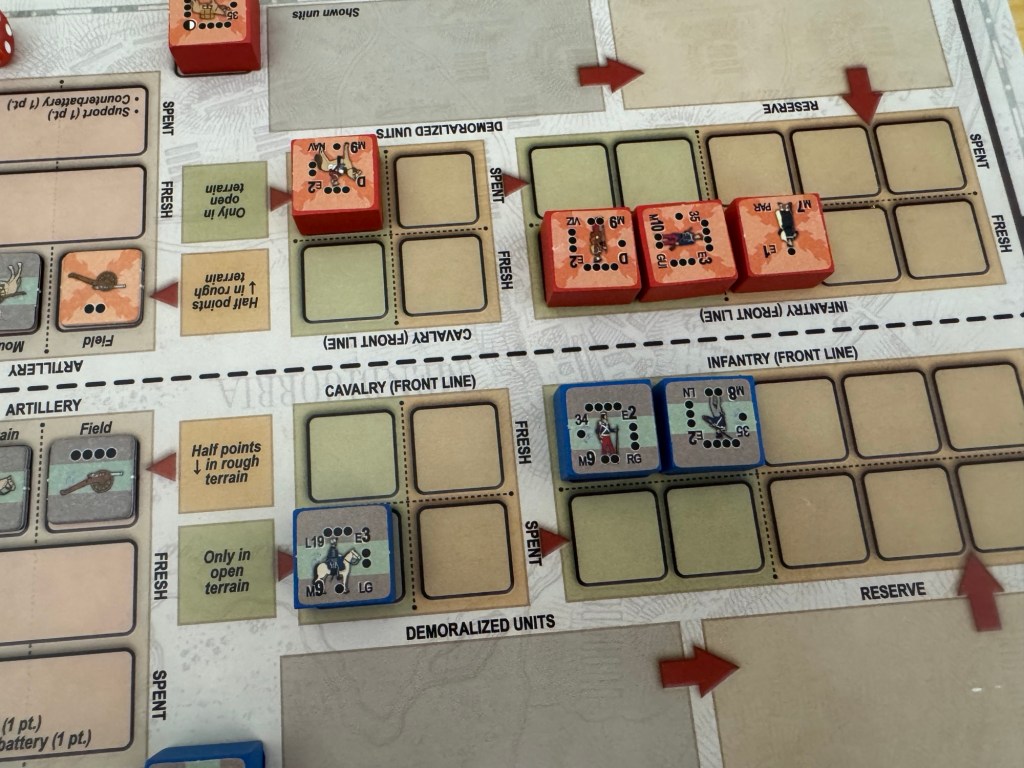
The big difference in the types of Battle are the duration. A Skirmish last only 1 round while a Battle can last up to 3 rounds. The Battle ends immediately when 1 of the following situations arises. If the Battle lasts the full 3 round, when the 3rd Battle Round ends the defending player remains in the space and the attacking player retreats. There is no Rout or Pursuit A player has no Infantry units in the front line. The other player wins,
gains 1 VP, and causes a Rout by the losing side, which will then retreat. Or, a player decides to retreat voluntarily in the End of Battle Round phase. The other player wins and can carry out Pursuit.
The Battle mechanic in An Impossible War captures perfectly the frustration of asymmetry in both competing sides and their troops. The name of the game is specifically reference to the the Liberals’ massive, clunky numbers versus the Carlists’ nimble, guerrilla style of warfare. 2 different armies with 2 different philosophies has created a situation where neither side can feel comfortable with the war and their chances at winning it. I frankly think that the designer David Gómez Relloso did an exceptional job at creating this asymmetry and creating a highly playable and engaging game. If you didn’t know, I chose to add An Impossible War to my Top 10 Wargames of 2025!. It landed at #8 on the list, and probably would have scored higher had I had a chance to play the game further and experience all of the parts of the design.
If you are interested, we posted an interview on the blog with the designer and you can read that at the following link: https://theplayersaid.com/2025/07/14/interview-with-david-gomez-relloso-designer-of-an-impossible-war-the-first-carlist-war-in-the-north-1834-1838-from-bellica-3rd-generation/
I also was able to shoot a fairly short video summary of my game play with Francisco Ronco who is the owner of Bellica Third Generation and you can watch that at the following link:
-Grant


Thanks for this magnificent review of the game and its mechanics. Glad to know that you enjoy it, I expect that you will be able to play it again soon.
LikeLike
You did well on this one. I also wanted to do a bit more of a deep dive in this last post on the actual mechanics of Battles but the time passing since I played has eroded my confidence in getting the details correct. So I just went with a higher level overview of the procedures, types and focused on the cards a bit.
LikeLike