
I love a different style and focus of wargame. A game that takes a look at an important but somewhat obscure or rarely addressed historical topic, such as espionage or intelligence, and creates a gaming experience tailored around the events to highlight and evoke the difficulties and tension that would have been present. In January 2026, GMT Games announced such a game in Checkpoint Charlie, which is a solo or cooperative game focused on SIS espionage missions in Berlin in the 1960’s designed by Russell Brown. We have posted an interview with Russel and it was very well received and he has now agreed to create a series of History Behind the Cards to highlight the events of the 1960’s Cold War struggle in West Germany but also to share aspects about the game play and how it models the history.
*Note: The cards highlighted in this series and their event text, as well as any pictures used showing any of the various components, are still in the design and development process and as such event effects and text might still change prior to final development and publication. Also the art and layout of the cards are only for playtest purposes at this point and the game will enter the art department as it nears publication.
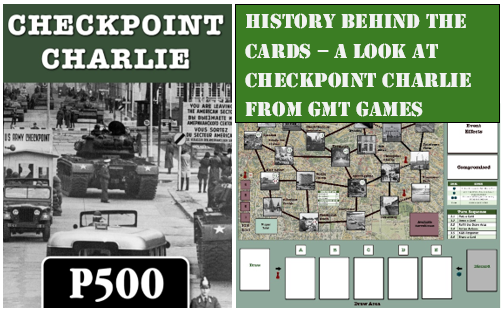
History Behind the Cards – Checkpoint Charlie from GMT Games – Card #4: Faceoff with the Soviets
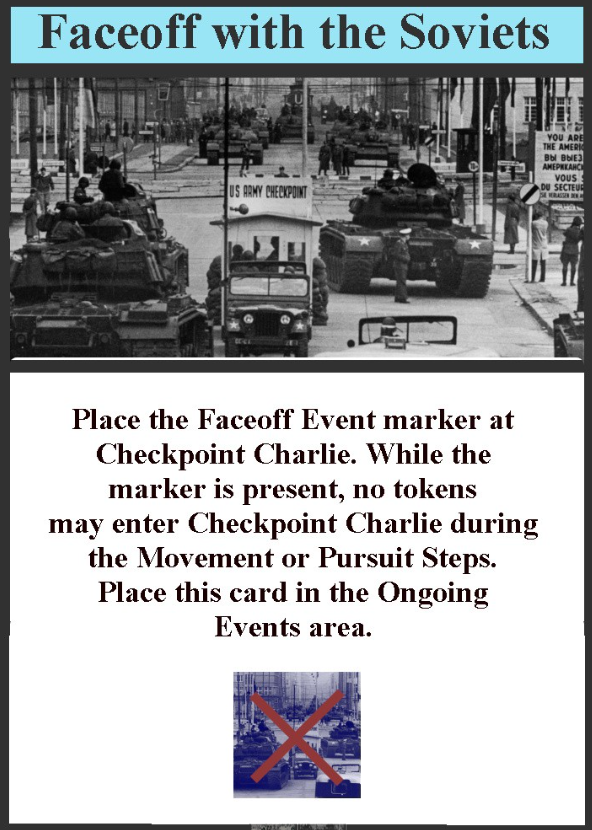
On August 13th, 1961, in a dramatic move to stop the flow of millions of East Germans defecting to the West, East German police placed miles of barbed wire overnight, cutting off access between East and West Berlin and catching the western powers by surprise. It wasn’t clear what the response of the west would be, and whether it would ultimately lead to the war with the Soviets that many people felt was inevitable.
For days there seemed to be no reaction. West Berlin and Mayor Willie Brandt looked to U.S. President Kennedy to respond quickly and forcefully to the wall, but U.S. troops in Berlin made no move to intervene. Instead, on August 16th, Kennedy sent Vice President, Lyndon Johnson, and General Lucious Clay (more about him on card #6) to deal with the situation. At the same time, he ordered the U.S. 18th Infantry regiment in West Germany to cross East Germany on the autobahn to Berlin, along the access corridor established by the Potsdam Conference. The troops came equipped for battle and paraded through the streets of West Berlin with Johnson and General Clay. This showed U.S. support for Berlin, but did nothing to remove the wall, which quickly turned from barbed wire to concrete.
Over the next two months, disputes arose over the rights of French, British and U.S. troops to travel in the Soviet sector of Berlin, which were also established by the Potsdam Agreement. Tensions came to a head when a U.S. diplomat was stopped at Checkpoint Charlie while crossing into East Berlin. On October 27th, after heated exchanges, mostly between the Soviet Commandant and General Clay, Clay attempted to send another diplomatic mission through Checkpoint Charlie, this time accompanied by ten jeeps full of American soldiers, with ten U.S. tanks in reserve back in West Berlin. The crossing succeeded, but the Soviets responded by sending ten of their own tanks right up to the Checkpoint Charlie crossing. The U.S. tanks moved up to face them.
The standoff lasted nearly a full day, with the tanks and soldiers facing each other, ready for battle. Kennedy and Khrushchev managed to negotiate a resolution and the Soviet tanks pulled back slightly first (presumably because they had moved up to the border first), then the U.S. tanks pulled back. This gradual retreat alternated until the faceoff was at an end and traffic through the checkpoint resumed.
The Faceoff with the Soviets card in Checkpoint Charlie places a Faceoff marker in the Checkpoint Charlie location, which prevents any assets and KGB agents from entering this location during the Movement step of the turn (though some played card effects still allow this). This marker can only be removed by the General Clay Steps In event (card #6).
In the next article in this series, we will take a look at Berlin Film Festival and how its effect caused some issues with various locations operating as Honey Traps about the city.
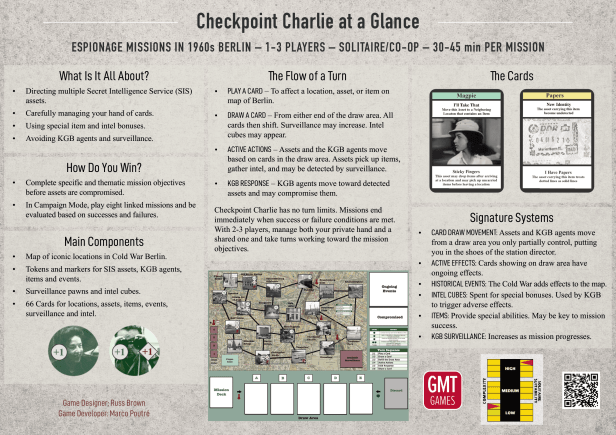
In my opinion, this game looks extremely interesting and I am very much excited to learn more about it. I am appreciative to Russell and his efforts to bring us these cards and to write these entries to share with our readers. I am also very glad that this topic is being covered in a game and look forward to playing this one day soon.
We published an interview with the designer Russell Brown on the blog and you can read that at the following link: https://theplayersaid.com/2026/02/23/interview-with-russell-brown-designer-of-checkpoint-charlie-from-gmt-games/
You can catch up on the posts in this series to date by following the below links:
If you are interested in Checkpoint Charlie, you can pre-order a copy for $48.00 from the GMT Games website at the following link: https://www.gmtgames.com/p-1211-checkpoint-charlie.aspx
-Grant

