With this My Favorite Wargame Cards Series, I hope to take a look at a specific card from the various wargames that I have played and share how it is used in the game. I am not a strategist and frankly I am not that good at games but I do understand how things should work and be used in games. With that being said, here is the next entry in this series.
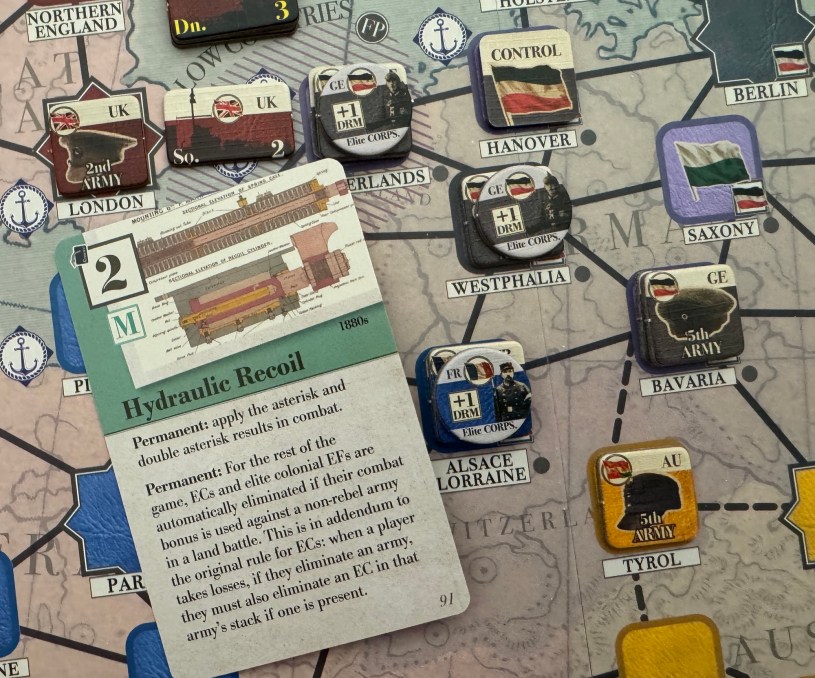
#85: Hydraulic Recoil from Imperial Elegy: The Road to the Great War 1850-1920 from VUCA Simulations
Imperial Elegy: The Road to the Great War 1850-1920 is a massive card driven game that blends diplomacy, warfare, and statecraft and feels a bit akin to games like Here I Stand and Virgin Queen from GMT Games, which are both grand scale sweeping epics that play multiplayers and take a day to play. Players play as 1 of 6 major powers in the game including Germany/Prussia, the United Kingdom, France, Austria-Hungary, Russia and the Ottoman Empire. The game is quite grand and ambitious as it covers 70 years near the end of the Victorian Era and the Progressive Ear and sees quite a lot of global change and competition between the great powers of the time. The game is a Card Driven Game and uses Action Cards as a type of currency to spend for their Command Points or the printed event to take actions such as recruiting armies and navies, industrialize, moving fleets and armies around the globe, influencing minor powers and establish colonies in Africa, India and the Pacific Ocean. The cards are all tied to the history of the period but the game can be played very much as a sandbox allowing players to explore strategies by trailblazing new horizons or following history.
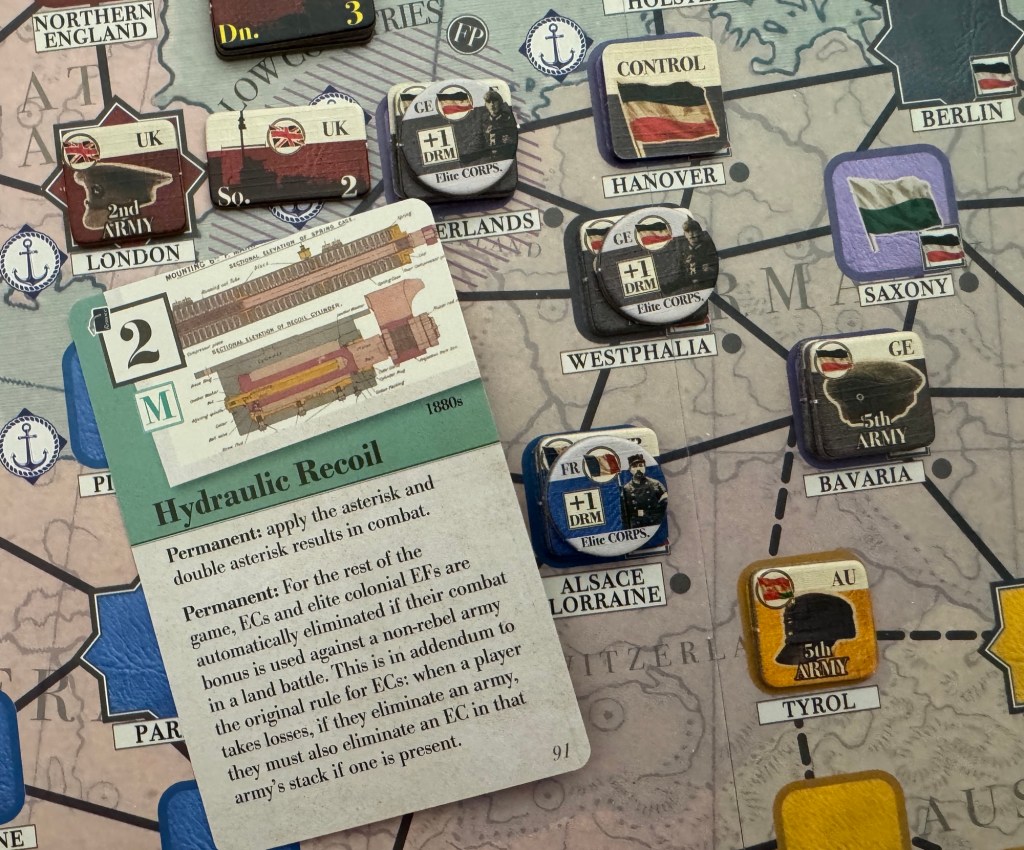
As you might imagine, the game contains combat and wars of both unification and conquest as each of these empires attempt to grow and expand their borders and the game can end with the outbreak of the Great War. These combats are referred to as Land Battles or Sea Battles. Combat is a very well designed part of the game and involves lots of maneuvering of troops on the board to get into position to have a powerful 2 unit stack be the lead attack but also to be supported by adjacent armies providing strength in the land battle. Each nation has a limited number of armies and also has access to what are referred to as Elite Corps and Expeditionary Forces that can be used to supplement goals of conquest. These Elite Corps units are represented by circular counters and are placed atop an army counter they are attached to and provide a +1 Dice Roll Modifier in combat.
When the game hits the 1880’s, which is turn 4, the Hydraulic Recoil Mandatory Event Card will be added to the deck. When this card is drawn and played, the Mandatory Event will go off and become a permanent change to how combat works. First off, the asterisk and double asterisk printed on the Combat Results Table will now be in effect. The asterisks referenced are summarized as follows from the rules:
Only apply the * and ** portions of the combat results if the Hydraulic Recoil Mandatory Event has been played. *The victor may opt to inflict +1 loss to both sides. ** Both sides take +1 loss.
But other than just the additional losses and choices about how best to use them, there are other big changes that come as a result of the Hydraulic Recoil Mandatory Event. After its play, machine guns give non-rebel units a minimum die roll of a 3 in Land Battles (in other words, rolls of 1 or 2 are now 3’s). But also anytime an Elite Corps and its +1 DRM is used in a land battle, that unit will be eliminated. This automatic elimination cannot be taken as a loss inflicted by the CRT but is in addition to those losses. Big guns equipped with new hydraulic recoil mechanisms were, by far, the number one killer during the Great War, and machine guns made most pre-war tactics obsolete. Coupled together these two technologies made combat much more deadly and far less “swingy”. These mechanics are meant to model these technological shifts on a strategic level.

The hydraulic recoil mechanism in machine guns was pioneered by inventor Sir Hiram Stevens Maxim in the 1880’s. He developed it as part of his 1883 and 1884 patents for the world’s first fully automatic, recoil-operated machine gun called the Maxim gun. The Maxim gun has been called “the weapon most associated with imperial conquest” by historian Martin Gilbert and was heavily used by colonial powers during the “Scramble for Africa”. Afterwards, Maxim guns also saw extensive usage by different armies during the Russo-Japanese War, the First and Second World Wars, as well as in contemporary conflicts.
The Maxim gun featured one of the earliest recoil-operated firing systems in history. Energy from recoil acting on the breech block is used to eject each spent cartridge and insert the next one. Maxim’s earliest designs used a 360-degree rotating cam to reverse the movement of the block, but this was later simplified to a toggle lock. This made it vastly more efficient and less labor-intensive than previous manually operated rapid-firing guns, such as the manually cranked Mitrailleuse of 1851, the Gatling gun of 1861, the Gardner gun of 1874, or the Nordenfelt gun of 1873. The Maxim gun is water cooled, allowing it to sustain its rate of fire far longer than air-cooled guns. The extra weight and complexity this added, however, made it heavier and less flexible in use.
Trials demonstrated that the Maxim can fire 600 rounds per minute (equal to 60 riflemen at the time). Compared to modern machine guns, the Maxim is heavy, bulky, and awkward. A lone soldier can fire the weapon, but it was usually operated by a team of men, usually 4 to 6 in number. Apart from the gunner, other crew are needed to speed reload, spot targets, and carry and ready ammunition and water. Several men are needed to move or mount the heavy weapon.
The Maxim gun was greatly influential in the development of other machine guns, and it has multiple variants and derivatives, such as the Vickers, PM M1910 and MG 08. Some are still in service to the present-day, such as in the Russo-Ukrainian War.
In the next entry in this series, we will take a look at LRRP from Fire in the Lake: Insurgency in Vietnam from GMT Games.
-Grant


Hard to overstate the effect this had on unprepared opponents!
“Whatever happens, we have got
The Maxim gun, and they have not.”
LikeLiked by 1 person