With this My Favorite Wargame Cards Series, I hope to take a look at a specific card from the various wargames that I have played and share how it is used in the game. I am not a strategist and frankly I am not that good at games but I do understand how things should work and be used in games. With that being said, here is the next entry in this series.
#83: British Leader Wellington from Congress of Vienna from GMT Games
Congress of Vienna from GMT Games is a diplomatic card driven wargame based on Churchill and is the 4th game in the Great Statesmen Series. The game is set during the years of 1813-1814 and sees players take on the role of the main characters of the struggle between the Napoleonic Empire and the coalition of Russia, Austria, and Great Britain with their Prussian, Spanish, Portuguese, and Swedish allies. Congress of Vienna has two different but related phases including the conference table where players first debate over the control of issues germane to the factions and the period of the war and second these issues are then used on the battlefield to recruit units, attack and take overall command of battles. The players will be playing cards from their hands to “debate” over the various issues that were placed on the table, which include all types of things such as Military Operations, Recruitment, who will lead the combined Coalition forces (Generalissimo), Future of French Government, British Financial Aid, Liberalism vs. Absolutism, Austrian Neutrality and several other issues, and then later the players will use their accumulated Resources gained from the issues to enact action on the Military Map and do things like mobilize troops, place Military Support Markers and the ultimately to conduct warfare.
The game relies on cards and cards can be used to negotiate, i.e. move an issue to your National Track. Cards can provide a particular issue with positive and negative DRM’s depending on which nation plays them and can also be traded with another player during the Diplomacy Phase. Certain cards are better than others for debating an issue moved by another player; and finally, if they are saved for the War Phase, staff cards can be used to modify dice rolling in battles. These are very versatile cards and the players will have to learn them and their benefits in order to be effective at the game.
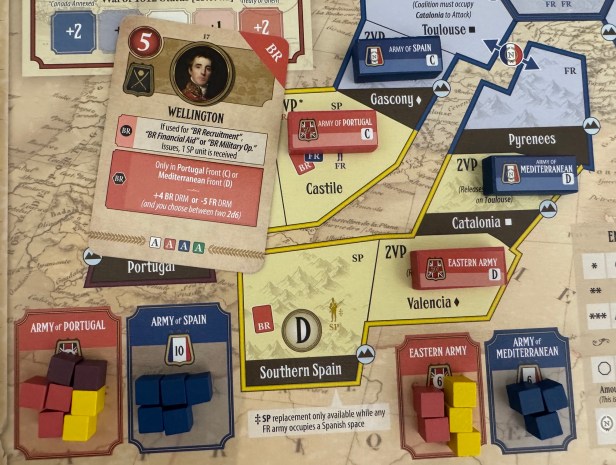
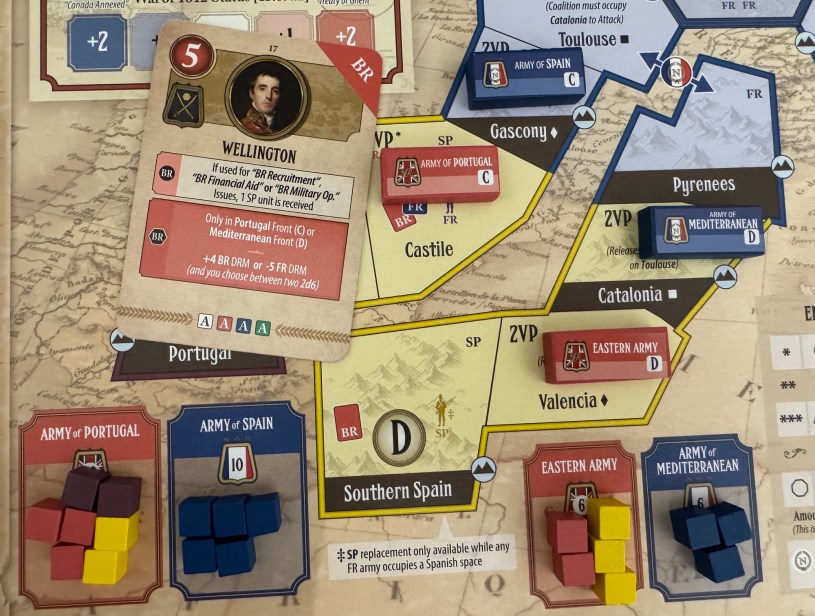
In this entry, we are going to take a look at the British Leader Wellington card. The Wellington card is the most powerful British military asset available and the British player should work hard to make sure that they get the card either by luck of the draw or by attempting to trade cards with other players. The major benefit of the card is during the War Phase, as it provides multiple benefits that can make combat much easier for the British. The bottom part of the card gives a boost during combat by granting an impressive +4 DRM in battles or to make the French have a -5 DRM. This is a very important decision and will mainly come into play to ensure losses are greater for the French or to make sure that a battle can we won. The combat benefit can only be used in the Portugal or Mediterranean Fronts but that is fine as this is where a majority of the British military actions will occur. But even more important than the DRM’s is the re-roll of the combat dice for the British. The other part of the combat benefit shown on the card is that the British player will get to roll 2d6 twice and then select the highest result during battles, greatly mitigating their risks of rolling poorly. Just a very powerful card for battles and I would definitely recommend its use in this fashion.
But, the top part of the card is also very important, particularly in the early part of the game, as when the card is used to move a British Recruitment, Financial Aid or Military Op Issue at the negotiating table they will gain a 1 SP unit that can be placed in the future into Fronts. This extra unit recruitment allows the British to slowly build up their forces without having to solely focus on choosing Recruitment Issues. This gives them the opportunity to focus on other Issues which can be very beneficial and give them a more well rounded approach.
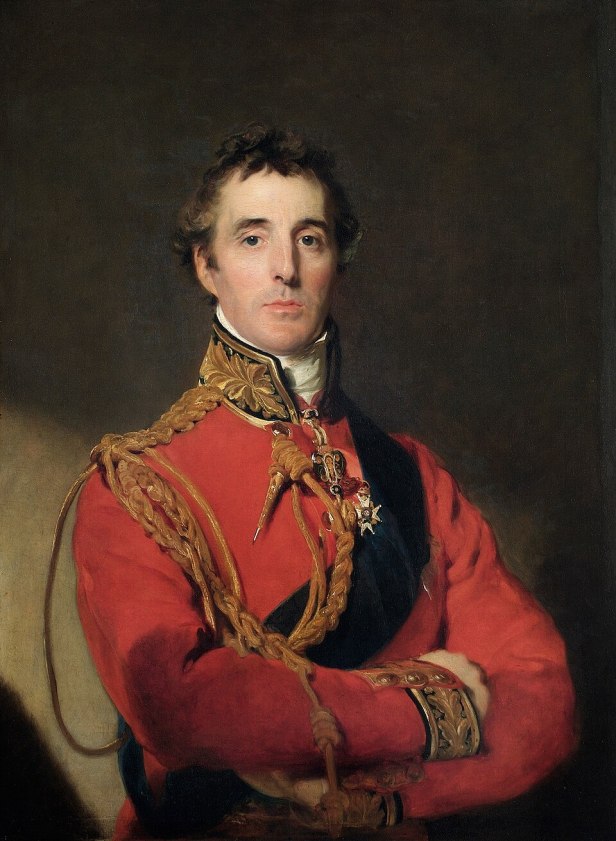
Field Marshal Arthur Wellesley, 1st Duke of Wellington was a British Army officer and statesman who was one of the leading military and political figures in Britain during the early 19th century, twice serving as Prime Minister. He was one of the British commanders who ended the Anglo-Mysore wars by defeating Tipu Sultan in 1799, and was among those generals who ended the Napoleonic Wars in a major Coalition victory when the Seventh Coalition defeated Napoleon at the Battle of Waterloo in 1815.
Wellesley was born into a Protestant Ascendancy family in Dublin, in the Kingdom of Ireland. He was commissioned as an ensign in the British Army in 1787, serving in Ireland as aide-de-camp to 2 successive lords lieutenant of Ireland. He was also elected as a member of Parliament in the Irish House of Commons. Rising to the rank of colonel by 1796, Wellesley served in the Flanders campaign before being sent to India, where he fought in the Fourth Anglo-Mysore War, ending the conflict with a victory at Seringapatam in 1799. He was appointed governor of Seringapatam and Mysore and, as a newly appointed major general, won a decisive victory over the Maratha Confederacy at the Battle of Assaye in 1803.
Rising to prominence as a general officer during the Peninsular War, Wellesley was promoted to field marshal after leading British-led forces to victory against a French army at the Battle of Vitoria in 1813. Following Napoleon’s first exile in 1814, he served as the British ambassador to France and was made Duke of Wellington. During the Hundred Days campaign in 1815, Wellington commanded another British-led army which, together with a Prussian army under Field Marshal Gebhard von Blücher defeated Napoleon at Waterloo.
After the end of his active military career, Wellington returned to politics, becoming a prominent member of the British Tory party. He served as prime minister from 1828 to 1830, as well as on an interim basis for a little less than a month in 1834. Wellington oversaw the passage of the Roman Catholic Relief Act 1829 and opposed the Reform Act 1832. He continued to be one of the leading figures in the House of Lords until his retirement in 1846 and remained Commander-in-Chief of the Forces until his death in 1852.
We have done 2 videos on this game including the following RAW Video after out 1st play at Buckeye Game Fest in May 2025:
We then did the following full Review Video after our 2nd play at WBC last July:
In the next entry in this series, we will take a look at Marconi’s Transmitter from The Hunt from Salt & Pepper Games.
-Grant


thank you sir.
LikeLike