With this My Favorite Wargame Cards Series, I hope to take a look at a specific card from the various wargames that I have played and share how it is used in the game. I am not a strategist and frankly I am not that good at games but I do understand how things should work and be used in games. With that being said, here is the next entry in this series.
#82: Good Omens from The Wars of Marcus Aurelius: Rome 170-180CE from Hollandspiele
The Wars of Marcus Aurelius: Rome 170-180CE is a solitaire only game that uses cards similarly to a CDG to simulate the strategic level struggle of the Romans led by Marcus Aurelius to stave off the invasions of Germanic tribes and Sarmatian raiders as they encroach on Roman territory across the Danube River. That’s the history. And it is really well integrated. The game play is very fun, strategic, with lots of decision points about what to do and what cards to use, and it is really challenging.
In the game, the Roman player has a deck of Roman Cards that can be used for the printed events for various effects or that can be discarded to take any number of actions such as attack a Barbarian army or Off-Map Conflict enemy, advance the marker on the Imperium Track, add two Level 1 Forts to any eligible map spaces, flip one Level 1 Fort to a Level 2 Fort among several other actions. Sometimes the printed events in the game are just more powerful than discarding a card for just 1 action so you have to pay attention to this economy and make sure you get the most out of your cards. Now, keep in mind, sometimes discarding a good card whose ability is not right for the current situation you find yourself in is part of the game but you have to use these cards wisely to do well in the game.
The game uses two separate decks of cards including the Barbarian Deck (Green) and The Roman Deck (Red). Both of the decks are made up of 50 cards each but each have very different purposes. The Barbarian Deck is used to determine the actions of the invading Germanic tribes as well as events that effect the war effort including mutinies, plague and the will of the people. While the Roman Deck provides the resources and events that are used by the Roman player to mount a defense against the invasions and to fight back each of the different barbarian tribes. There are unique cards called Late War Cards in the deck that will be held out until the start of the 175CE turn at which time they will be mixed in with the cards to form a new Late War Deck. There are also special cards that are marked with an asterisk that if played for the event will be discarded from the game to form what is called a History Pile.
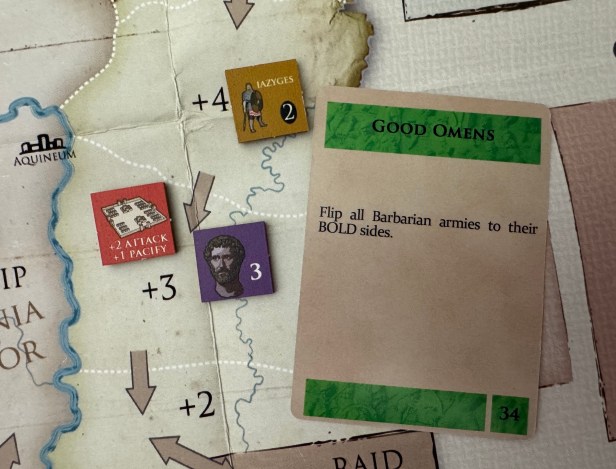
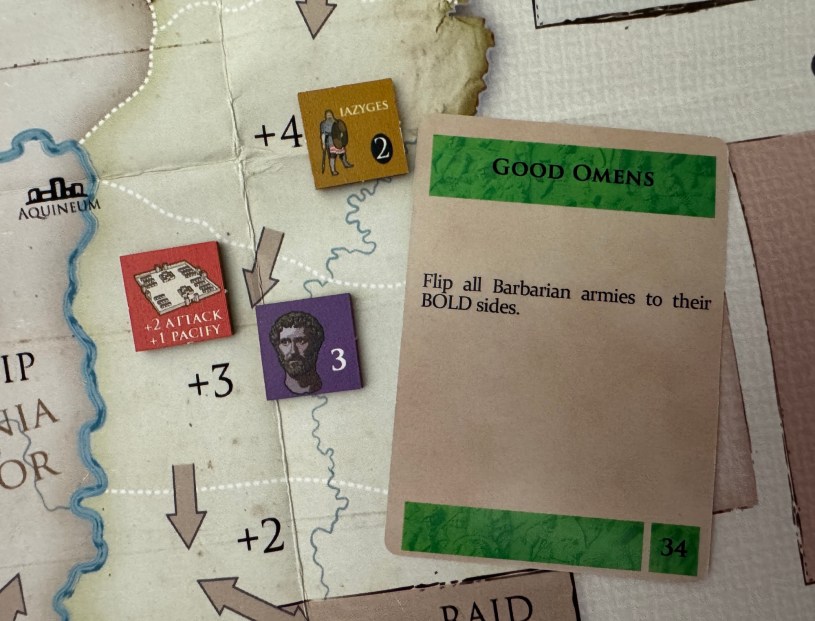
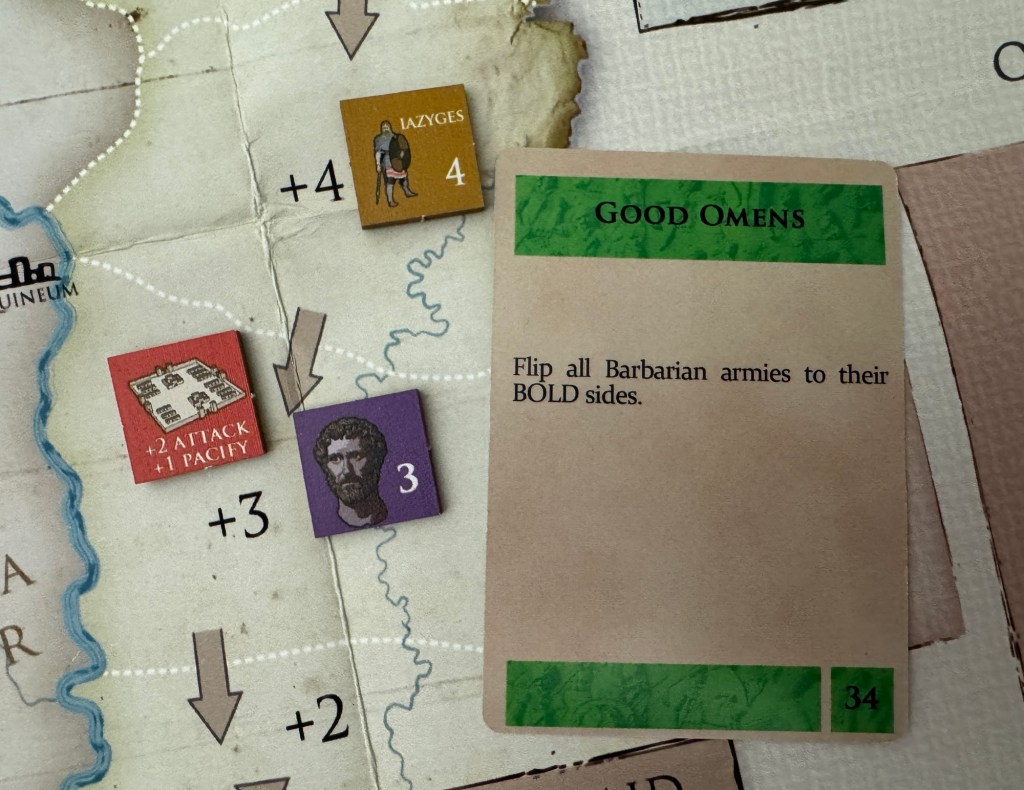
In this entry, we will focus on our first Barbarian Card from the game, as almost all of these cards are really bad for the player, called Good Omens. The “Good” portion of the card’s name doesn’t refer to the Romans but is a benefit for the Barbarians. This card can undo the hard fought victories of Marcus Aurelius and his commanders as its effect is immediate and cannot be cancelled like a Barbarian Surge effect can be by discarding a card. The Good Omens Barbarian Card will immediately cause the player to flip all of the Barbarian armies to their Bold side. Well that doesn’t sound so bad you say? Well, remember that each of the Barbarian army counters is double sided with one side being their Bold side and the other their Demoralized side. On their Bold side, the army is at its strongest with its Combat Value being higher than on the Demoralized side. In our pictures, you can see that the Iazyges army counter has a 4 Combat Value on its Bold side while the Combat Value on the Demoralized side is 2 less at just 2 Combat Value. During combat, or even due to some of the events on the Roman Cards, if a Roman army defeats a Barbarian army, their counter will be flipped from their Bold side to their Demoralized side and they will also have to retreat backward 1 space. I know that the difference here is only 2 but that is in essence gaining a +2 to the Barbarians Combat Value and in a game where the differences between the 2 armies can be just 1 or 2 or even no difference at all, this makes a huge difference and can sometimes feel like you are having to climb a mountain to overcome these Barbarian foes.
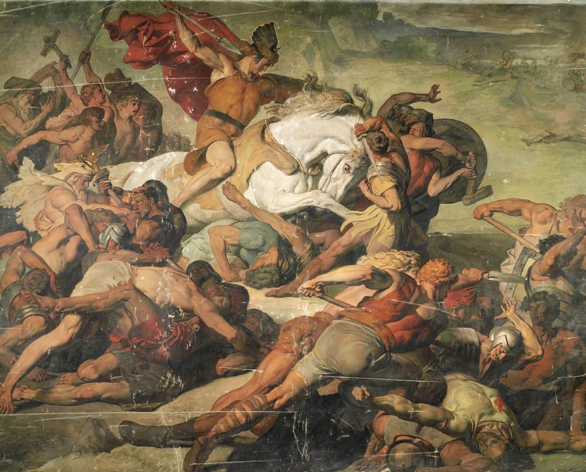
Ancient peoples believed deeply in their gods and traditions and would watch for signs in the heavens or from other sources when making key decisions about many things including military campaigns. Good omens would be seen positively as they believed that their decision was favored by the gods and that they would have a good outcome. The Romans believed these things as well but unlike the highly structured Romans, who read omens by sacrificing animals or watching birds fly, barbarian armies like the Germans and Celts relied on signs from nature or even from dreams. These signs when seen would boost morale and gave tribes the psychological edge they needed to fight the powerful armies of the Romans. Germanic tribes believed sacred groves and rivers were portals to their gods and if they were fighting near these places they would take greater strength. Weather was also seen as a major sign and roaring winds, dark storms or rivers that suddenly flooded were viewed as the gods fighting on their side.
The most famous “omen” came from the Battle of the Teutoburg Forest in 9 AD, which occurred over 100 years before the events of the game. A fierce storm, combined with the clever planning of the Germanic leader Arminius, allowed Germanic tribes to completely trap and wipe out 3 Roman legions. The Romans viewed the loss of their legionary eagles and this devastating defeat as a terrible omen for their empire’s future.
I shot a playthrough video for the game and you can watch that at the following link:
I also followed that up with a full video review sharing my thoughts:
In the next entry in this series, we will take a look at British Leader Wellington from Congress of Vienna from GMT Games.
-Grant

