We have come to the final month of the year and the final entry of 2025 for the Wargame Watch Series. I love doing these each month and spend hours scouring the internet to find those games that are new, upcoming or on pre-order. This month, I was able to find 15 games to highlight plus an additional 11 that were announced or mentioned by our sponsor VUCA Simulations (so really we are talking about 26 games)! Of that total, 2 games were offered on Crowdfunding.
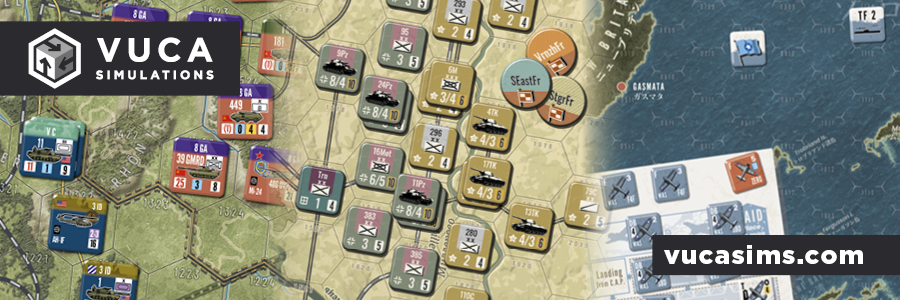
Again this month, we have a sponsor for the Wargame Watch in VUCA Simulations who is a newer German publisher that is really crushing it with their graphics and production. Their games are also very good and we have really enjoyed several of their titles including Donnerschlag: Escape from Stalingrad, Traces of War and most recently New Cold War. They recently had several titles that released in November including Imperial Elegy: The Imperial World at War 1850-1920, Traces of Victory and Modern Tactics #1 – Afghanistan. I have already got new copies and have unboxed 2 of those and am currently preparing Imperial Elegy for a play.
But I also want to point your attention to their In Development Section of their website to show you all of the great projects that they are currently working on.
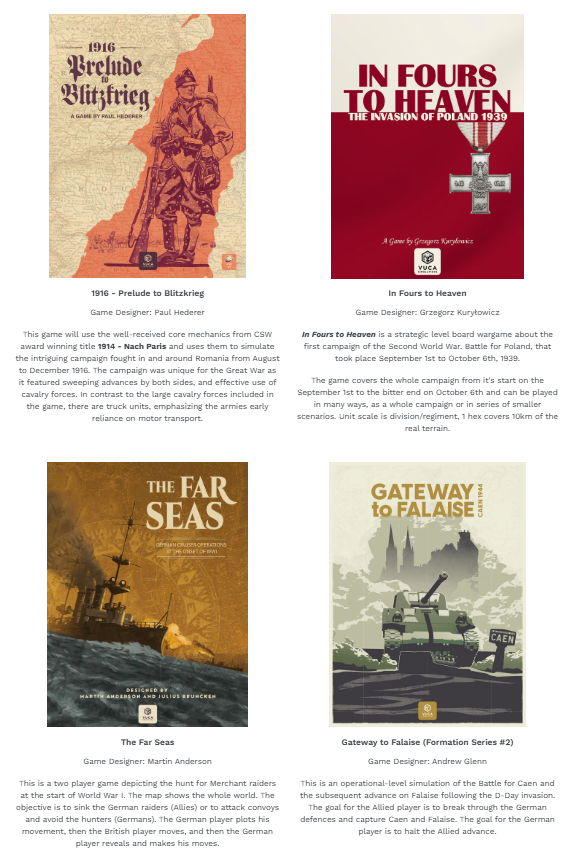
This batch has 4 really interesting titles including 1916 – Prelude to Blitzkrieg (game will use the well-received core mechanics from CSW award winning title 1914 – Nach Paris and uses them to simulate the intriguing campaign fought in and around Romania from August to December 1916), In Fours to Heaven: The Invasion of Poland 1939 (strategic level wargame about the first campaign of the Second World War the Battle for Poland), The Far Seas: German Cruiser Operations at the Onset of WWI (the hunt for Merchant raiders at the start of World War I) and Gateway to Falaise – Caen 1944 (operational-level simulation of the Battle for Caen and the subsequent advance on Falaise following the D-Day invasion). There is a further description on each of these titles on the site and I am very much interested in all 4 of these games.
1. Romans vs Zombies in Zilight: Pax Romana from The Grinning Frog Currently on Kickstarter
I am starting this month off with a non-wargame. No I do not do this often but this one just looks really interesting and is tied to history so I feel like it counts. But, Romans vs Zombies in Zilight: Pax Romana from The Grinning Frog is currently on Kickstarter and is a solitaire card based game and I think that it looks pretty interesting. Interesting enough that I jump on and backed the project.
From the game page, we read the following:
This campaign is for an exciting gamebook/card based game where you see if you can survive for 28 days (turns) against a zombie uprising in ancient Rome!
How you play is up to you. Will you save yourself, even if that means you become infamus, or will you rise up, and battle to save the Immortal City itself?
We are catering for all budgets, you can purchase simply a PDF of the gamebook (add your own playing cards and dice and you can enjoy the game) or go full Roman and indulge in the deluxe boxed set. (And there are other options in-between.)
Each turn represents one day in Rome.
Morning Phase – This determines daily variations, will the zombies be faster, weaker or more numerous than normal? Roll and find out!
Day Phase – Draw the top card of the deck, look up what it represents (or read it straight from the card if you have the bespoke card deck) and face the main event of the day! (See below.)
Evening Phase – Choose between find resources for the sanctuaries, or for yourself. Allies can be sent out separately. Also, later in the game, roll to see if your sancturies come under attack!
It’s important to us that budget is not a barrier to enjoying our games. Whilst we have spent many tens of hours designing the custom card deck that goes with the game, you can play it with a regular deck of cards. Consider the custom deck a value of life upgrade, not a requirement.
As of December 1st, the Kickstarter campaign has funded and raised $9,592 toward its $655 funding goal with 109 backers. The campaign will conclude on Monday, December 8, 2025 at 5:50am EST.
2. Conquest & Tragedy Kit from GMT Games
One of the common elements in wargames is a focus on historicity and simulation of historical events. We want to be given the same assets as the great commanders of the past, under the same conditions they experienced and attempt to equal or even best their outcome. In stark contrast to this regimented look at a historical engagement is the so called “sandbox” style game. Typically a sandbox is described as a system where players are not restrained in their choices and have the option of doing actions or attacks that would be considered alternate history. So there are different degrees of “sandbox” war games. Some allow you to change the initial order of battle. Some have different than historical objectives. Some even allow for planned invasions, such as D-Day or Sicily, to change their beaches. I personally love sandbox games and the ability to take a look at history in a little different light. Triumph & Tragedy: European Balance of Power 1936-1945 and Conquest & Consequence: Asian Balance of Power 1936-1945 are such sandbox games and delves a bit into alternative history in the European and Pacific Theater of Operations of World War II. These are big games that we have all wanted to combine into one in the past and now they have the vehicle that will allow this ultimate combination in the Conquest & Tragedy Kit.
From the game page, we read the following:
Conquest and Tragedy allows players to combine Triumph and Tragedy (T&T) and Conquest and Consequence (CnC) to play out the events of 1936-45 on a worldwide basis using the popular T&T System. Three partnerships oppose each other, and only one of them will win. Each partnership has one faction in the European Theater (ETO) and one in the Pacific Theatre (PTO). The game allows for 3-6 players, so players may control one or both factions of a partnership.
The Communist factions are the “USSR” (European Russia) and the “Soviets” (Siberian Russia plus Mao’s Red Chinese). With east and west Russia being a single nation, this naturally is a tight cooperative partnership with the advantage of geographical unity.
The Militarist factions are the Axis (Germany-Italy) in Europe and Japan in Asia. They have a solid but more limited partnership that suffers from severe geographical separation. They do have a military head start on the other factions.
The Capitalist factions are “Western Europe” (Britain and France plus the Asian/Pacific British Empire) and the USA, which has a seaboard in each theatre. The Capitallists initially do not cooperate but with diplomatic effort can become the most effective partnership of all. They begin unprepared militarily but have superior economic potential.
Gamers Playing Conquest &Tragedy
Team play and world-wide perspective make this combined game even more interesting and challenging than the standalone games. Playing time is 6-8 hours, with 6 players making the fastest games.
*Ownership of both Triumph & Tragedy and Conquest & Consequence is required to play this game.
3. Plantagenet: Cousins War for England, 1459-1485 2nd Printing from GMT Games
A few years ago, the Levy & Campaign Series burst on the scene with Nevsky: Teutons and Rus in Collision, 1240-1242 from the gifted and beautiful mind of Volko Ruhnke. A series focused on medieval logistics and the feudal system where the arts of war and careful building of alliances were so important to the fabric of society all boiled down into a very playable game was like catnip to the wargame masses. Since that time, there have been several new designs in the series come about including Almoravid: Reconquista and Riposte in Spain, 1085-1086 from Volko as well as from other designers including Inferno: Guelphs and Ghibellines Vie for Tuscany, 1259-1261 from Enrico Acerbi and Plantagenet: Cousin’s War for England 1459-1485 from Francisco Gradaille. That game has also appeared on Rally the Troops! recently and it has generated some buzz and obviously has created a demand for the physical game so it is now being offered as 2nd Printing on the P500.
From the game page, we read the following:
England, 1459. The son of the great Henry V has not lived to fill his father’s shoes. England has lost the Hundred Years War, and mighty lords amass lands and wealth rivaling the King’s own. Henry IV left the door open for any such powerful lord with good pedigree to reach for the throne, and the best candidate is Richard Plantagenet, Duke of York.
Mounting tension over the Crown leads to armed clashes, under the excuse of freeing the king from his evil counsellors, and finally ignites the Wars of the Roses that William Shakespeare would immortalize in his plays:
A Yorkist rebellion that succeeds in placing Edward IV on the throne and exiling the Lancastrians to Scotland and France.
A civil war pitting Warwick the Kingmaker and King Edward’s brother Clarence against the King and his other brother Richard Gloucester.
The reinstatement for a few months of Henry VI and the invasion from France by his son and wife leading to a final contest between Richard III and Henry Tudor (later known as Henry VII) and the Battle of Bosworth that ends the Plantagenet dynasty.
Treason, bravery, political maneuver, and a cast of memorable characters mark one of the most intense and divided periods of English history.
In Plantagenet—the newest volume in Volko Ruhnke’s Levy & Campaign Series—players lead one of the two factions across the three main periods of war, as individual scenarios or the entire Wars of the Roses.
Designer Francisco Gradaille adds overall and local political influence to Volko’s medieval operation system to reflect the ever-changing loyalties of the time while keeping play familiar to fans of the Series. Players will create and maintain a network of allied lords and nobles in order to obtain the provender and coin needed to supply and pay their armies. As ravaging and looting will damage each side’s reputation, each faction will strive to convince cites to join its side. Great battles will seek to kill or capture enemy lords—perhaps even a king. Two kinds of operational moves will be in play: the military and the political.
In the end, when the dust settles and all arrows have flown, one rose will sit on the throne. White or Red, York or Lancaster, gather your troops and banners and join the fight.
4. Triumph & Tragedy: European Balance of Power, 1936-1945 4th Printing from GMT Games
Several years ago, I purchased my copy of Triumph & Tragedy: European Balance of Power, 1936-1945 2nd Edition and a few years later, (in June 2018) got to get it to the table and it was an amazing experience. If you don’t know, the game is designed as a 3-player game where each player controls one of the major countries of the time, including the USSR, the Axis (Germany and Italy) and the West (Great Britain and the USA). The only difficulty I had with the game is finding 3-players that have 4-5 free hours. This is a challenge and was the only reason that kept the game from seeing my table until we convinced our Euro-gamer friend Matt to host us and play this great game. He agreed but was hesitant, mainly due to the length of the game, but played with gusto and eventually won a victory for his Soviets. During our end game wrap-up, he told us that he was simply playing the game as any other Euro by doing set collection of technologies and building up his points. He took home an economic victory without ever having to be in a battle with the Axis. That great game is now being offered on reprint as its 4th Printing. That is an amazing feat and should tell you that the game is very, very good.
The map at the end of 1936. The Axis powers have moved their influence to the Nordic States while the USSR are moving into the Eastern Bloc.
From the game page, we read the following:
Triumph and Tragedy is a geopolitical strategy game for 3 players (also playable by 2) covering the competition for European supremacy during the period 1935-45 between Capitalism (the West), Communism (the Soviet Union) and Fascism (the Axis). It has diplomatic, economic, technological and military components, and can be won by gaining economic hegemony or technological supremacy (A-bomb), or by vanquishing a rival militarily.
The 22” x 34” mounted area map covers Eurasia to India and the Urals, with the Americas and the eastern British Empire represented abstractly. Military units are 1/2” blocks, of 7 types (Infantry/Tank/Fortress/AirForce/Carrier/Fleet/Submarine), in 6 different colors (Germany/Italy/Russia/Britain/France/USA). The mix of approximately 200 blocks allows great flexibility of force composition. There is a 55-card Action deck and a 55-card Investment deck, plus 30 Peace Dividend chits and 50 markers of various types.
The game starts in 1935, with all 3 Great Powers virtually disarmed: Germany has repudiated the Versailles Peace Treaty, initiating an arms race in Europe. With blocks, the nature of military buildups remain unknown to rivals unless/until military conflict breaks out. The game may end peacefully or there may be war. There are game sanctions for attacking neutral minors or declaring war on an opponent, and rewards for remaining peaceful (you get a Peace Dividend chit of value 0-2 for every year you remain at Peace).
You can win peacefully by:
Economic Hegemony (total of Production + secret Peace Dividend values is the greatest in 1945, or reaches 25 at any time) OR
Technological Supremacy (build the A-bomb — which takes 4 stages).
If there is war, you can still win by either of the above methods, or by:
Military Victory (capture of TWO enemy capitals – each Great Power has 2).
Economic production underlies all forms of power in the game. Production is the LEAST of controlled Population (cities), controlled Resources, and Industry (which starts low and can be built up with Investment cards). Powers can spend their current economic Production on either:
Military units (new 1-step units or additional steps on existing units), OR
Action cards, which have Diplomatic values (to gain Population and Resources without conflict) and a Command value (to move military units), OR
Investment cards, which have Technological values (to enhance unit abilities) and a Factory value (the only way to increase Industry levels).
Building a unit step or buying a card costs 1 Production. Simple. You can’t inspect cards bought until after you have spent all Production.
Initially, the Axis economy is Population/Resource limited, but ahead in [war] Industry, while the West and Russia are Industry-limited, with adequate empires of Population and Resources. Throttling/limiting rival economies by denial of Population/Resources is a key form of competition. In peacetime, this is primarily done via Diplomacy, committing Action cards to gain control minor nations and their Population/Resources, or to deny or reduce Rival control of them. At war, this can be done more directly by military conquest on land, by Naval/Submarine blockade of trade routes at sea, and by Strategic Bombing of enemy Industry by air forces.
5. La Der des Ders – The War to End War from Hexasim
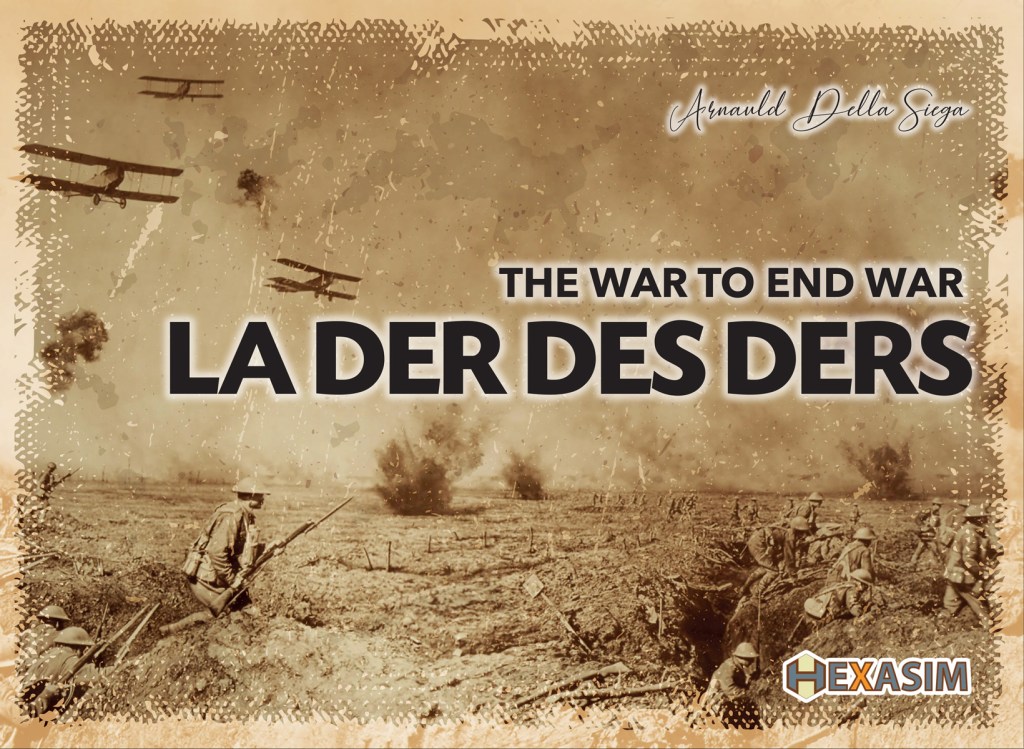
Hexasim has really been stepping up their game recently with some great looking wargames. This month, they announced their newest called La Der des Ders – The War to End War, which focuses on World War I and is designed by Arnauld Della Siega.
From the game page, we read the following:
In La Der des Ders, you take command of the Entente or the Central Powers to relive the entire First World War at a strategic level. Manage your resources, develop your technologies, launch offensives in Europe, Africa or the Middle East, and try to break your opponent before the war consumes you. Far from the din of shells and the incessant rain that seeps in everywhere, you will decide the fate of your armies.
How to win
One game turn equals four months of real time. A game can last up to 14 turns, unless the war is won – or lost – before then, or peace talks have begun. Victory is achieved by launching powerful offensives that will undermine the morale of enemy nations, forcing them to withdraw from the conflict. But each battle will come at a high cost to the attacker.
How to play
Turn after turn, players must make crucial choices: with limited resources, they guide their strategy by reinforcing their troops, developing new technologies or launching decisive offensives.
Reinforcements: these allow you to make up for losses. A weakened sector will be less effective during offensives and will be closer to surrender.
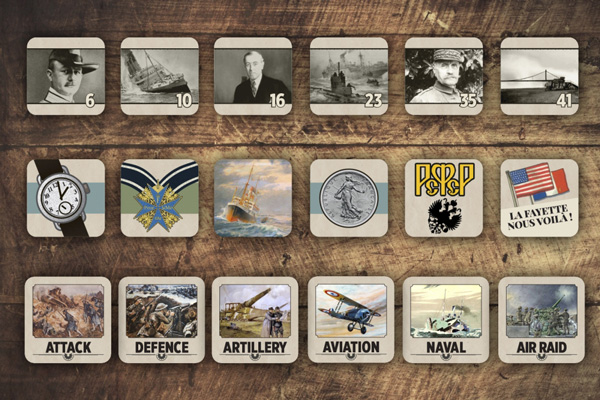
Technologies: Each side has its own technology tree, offering around twenty technologies each divided into six categories:
Attack (attack bonus)
Defence (defence bonus)
Artillery (more dice during offensives)
Aviation (roll again for Artillery dice)
Naval (reduction of enemy resources)
Raid (influence on Events)
Offensives: a player who launches an offensive rolls as many dice as the operational value of the attacking sector (a value that decreases as losses are suffered). Bonuses are applied according to the technological levels of the two opponents. The defender suffers a loss for each die showing a result greater than or equal to 5 (4 for Germany, 6 for Greece). The larger the offensive, the more resources it will cost.
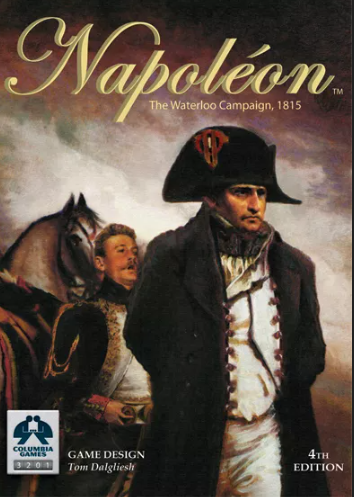
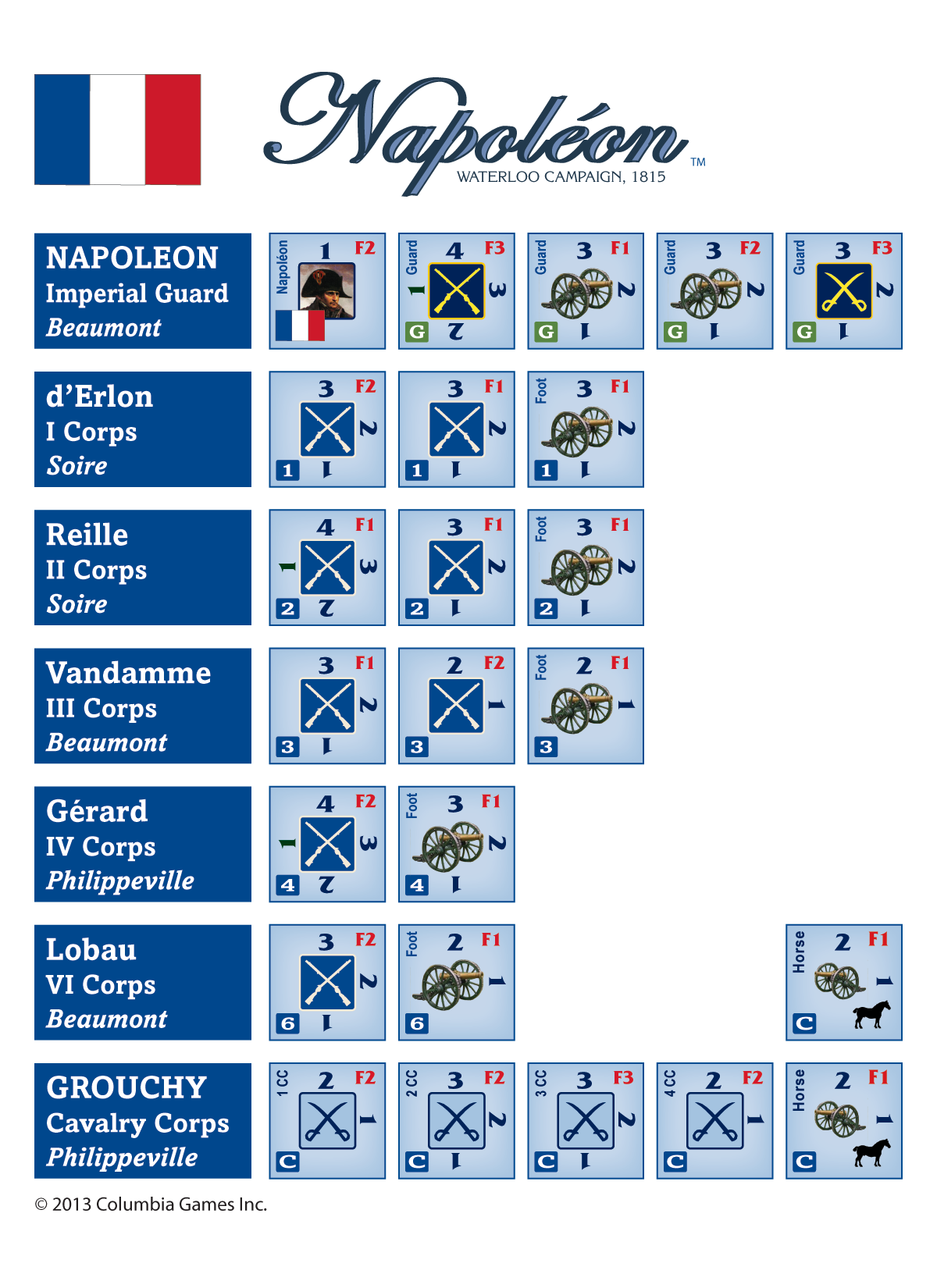
6. Napoléon: The Waterloo Campaign, 1815 5th Edition from Columbia Games
A classic from 1974 that has had 4 previous printings and is going on its 5th? What does that tell you? Well, it should say something loud and clear and Napoléon: The Waterloo Campaign, 1815 5th Edition has just ended a successful Kickstarter campaign but you are in luck as it can still be pre-ordered for a limited time.
From the game page, we read the following:
The 5th Edition of this classic wargame brings the game back to its 1st edition roots with some improvements. Napoléon can be played by two, three, or four players using the new Grouchy block.
On June 18, 1815, one of the most decisive battles in military history was fought in fields ten miles southeast of Brussels. Within a short 100 days, Napoléon, former emperor of France, had returned from exile on the island of Elba, again seized power, quickly assembled an army, and marched to attack the dispersed British and Prussian armies now preparing to invade France.
Napoléon attacked on June 15th, defeated the Prussians at the Battle of Ligny on the 16th and after a day of pursuit, faced the British and Dutch army commanded by Wellington. Aided by superb defensive tactics and the timely arrival of Prussian reinforcements, Wellington defeated the French in the great Battle of Waterloo, ending forever the military ambitions of the great Napoléon.
If you are interested in Napoléon: The Waterloo Campaign, 1815 5th Edition, you can pre-order a copy for $89.98 from the Columbia Games website at the following link: https://secure.columbiagames.com/product/3201
7. Insurgent Tide: Counter Insurgency in Iraq, 2003-2008 from Compass Games
Over the past few years, while attending the World Boardgaming Championships, we have met with Gregory M. Smith and discussed many of his ongoing designs. One that we have chatted about a couple times has been his upcoming Insurgent Tide: Counter-Insurgency in Iraq 2003-2008 from Compass Games. Insurgent Tide deals with the Iraq War from 2003-2008 and if you didn’t know, Greg was a tanker and in Iraq during that time and knows a few things about the landscape and politics. The game uses the popular Tide Series and is a 2-player card driven game. I have very much enjoyed this series and look forward to seeing how this one plays.
From the game page, we read the following:
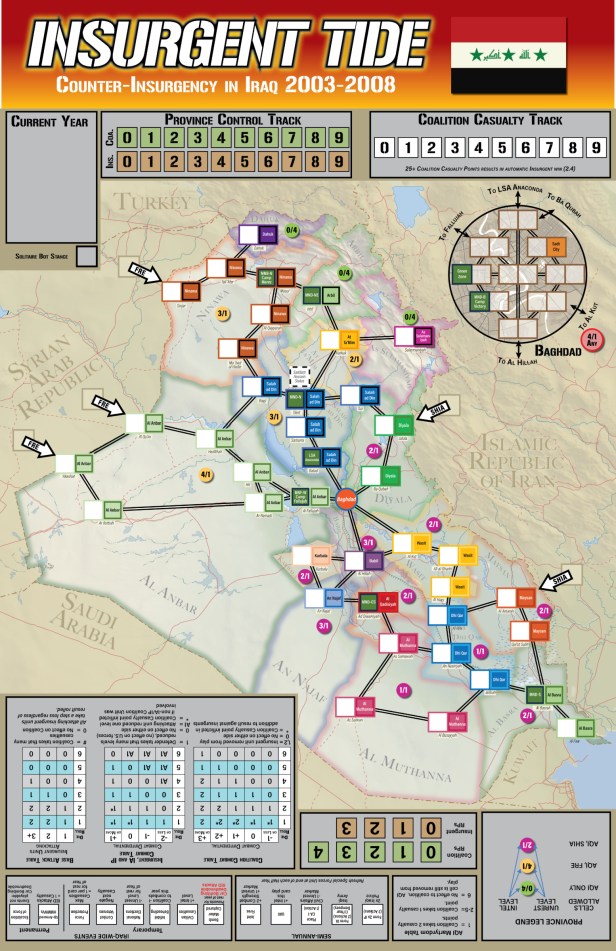
Insurgent Tide: Counterinsurgency in Iraq, 2003-2008 is a 2-player operational/strategic level game covering the Coalition’s counterinsurgency effort in Iraq from 2003-2008. Each year is a turn, but is composed of alternating card plays between players. Units range in size from Multinational Divisions down to Insurgent cells.
The Coalition’s objective is to exert control over Iraq’s provinces; the Insurgent player seeks to prevent that and/or do it himself, and to wage Jihad to inflict as many Coalition casualties as possible. The game lasts 5 full turns (2004-2008), with 2003 consisting of just a few cards to get things started.
Each turn consists of a year, during which multiple card plays occur. These give the players movement, combat, and other actions. At the end of each year, players must make critical decisions on which cards to re-buy in an attempt to win the battle for control of Iraq. Insurgent Tide is based on the popular, action-packed Pacific Tide game system by Gregory M. Smith, with many combat and strategic decisions to challenge players in just a single evening’s game.
The core of the game is the unique card re-buy system, in which players take their annual production and decide which cards they need for the upcoming year. Cards not only provide for reinforcements, but also allow for movement, combat, and other actions. Which cards to rebuy is, without question, one of the key decisions the player must make to prepare for next year’s operations.
The Insurgent player’s build points are based on how many provinces he controls: to control them, he must activate his cells. When active, they contest control of a province but are also vulnerable to Coalition attack. The Coalition player needs to build control via the creation of Iraqi Police and Iraqi Army units, but has political concerns to deal with, from high levels of casualties to inflaming anger in the population due to excessive use of force.
Besides the focus on card play, the game features a small footprint (one standard map) and is also designed to be played in just a single evening – estimated at 3 hours for experienced players to fight the entire war.
While Insurgent Tide is designed as a 2-player gaming experience, an additional option for solitaire play is provided by the inclusion of a Solitaire Bot. This “bot” creates action priorities for the non-human player and has the advantage of being simple enough to implement without spending an inordinate amount of time as the non-player.
Joe Fernandez is really doing a lot of games and most of those are solitaire focused, which is a good thing as we all look for new games to play when we can’t get together with a buddy. His newest announced offering is called Crossed Rifles: Cold War and is a solitaire tactical game set during the late Cold War era.
From the game page, we read the following:
Crossed Rifles: Cold War is a solitaire, tactical infantry game set during the late Cold War period. Built for the Crossed Rifles system, it is designed for quick set-up and fast play, with games lasting between thirty minutes to an hour.
You will select and equip your soldiers to carry out missions, with counters representing soldiers, equipment, enemies, and non-combatants. The dual-purpose mounted game board portrays a birds’-eye view of the Patrol Area to track enemy locations relative to your soldiers, as well as a Team Area where you will manage each soldier’s current status, gear, and resources.
Terrain, events, and enemy actions are generated via random card draw. Leadership and communications are also modeled and play an integral part in the game. Crossed Rifles has a small table footprint, short learning curve, easy setup, meaningful choices, and high replayability.
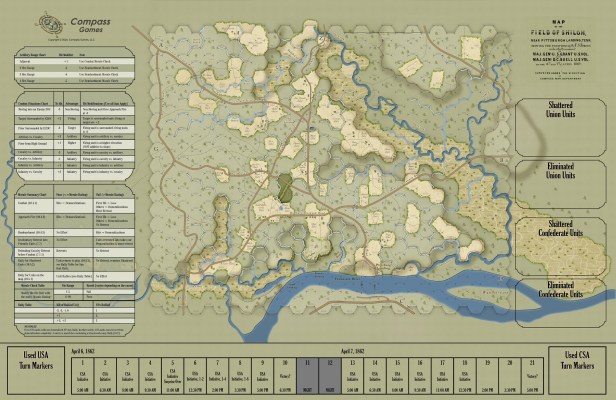
9. Battle Hymn Volume 2 – Shiloh and Bentonville from Compass Games Currently on Kickstarter
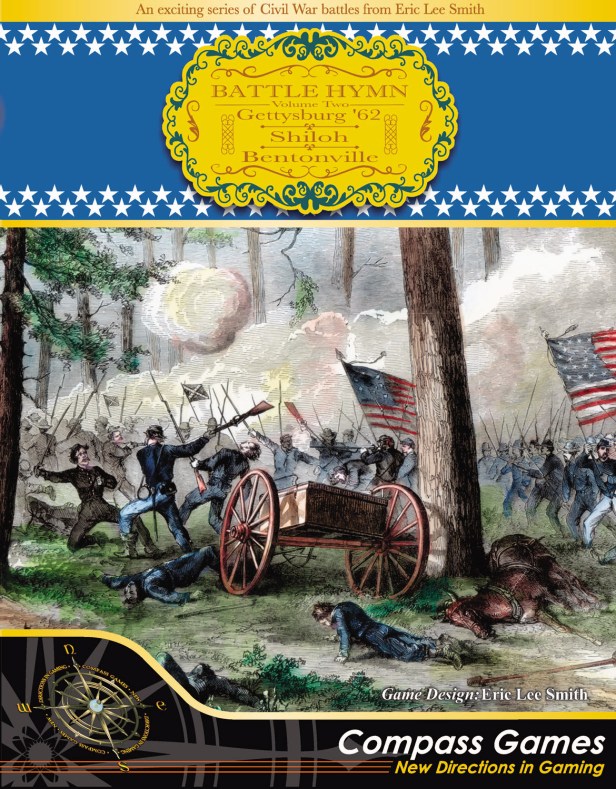
We really enjoyed our play experience with Battle Hymn Volume 1: Gettysburg and Pea Ridge from Compass Games in 2019. The rules were very approachable with lots of good details that were based in history, a good combat system that keeps the battle interesting and engaging but is simply withering and the game evokes a lot of emotions. I played as the CSA and it was heart breaking knowing the outcome and seeing what those men would have encountered going against those formidable Union defenses as they had the high ground and were not going to give it up easily. The newest volume in this series is now out and is called Battle Hymn Volume 2 – Shiloh and Bentonville.
From the game page, we read the following:
Battle Hymn Volume 2 is the long-anticipated sequel game release to Volume 1 and includes two complete games: Shiloh and Bentonville. Battle Hymn is the new brigade-level system based upon the latest research into Civil War combat. This new entry introduces an extension map for Gettysburg (Volume 1) for a complete alternative history of the entire battle. Designed by Charles S. Roberts Award-winning designer Eric Lee Smith.
As of December 1st, the Kickstarter campaign has funded and raised $5,474 toward its $2,500 funding goal with 53 backers. The campaign will conclude on Saturday, December 13, 2025 at 5:10pm EST.
New Release
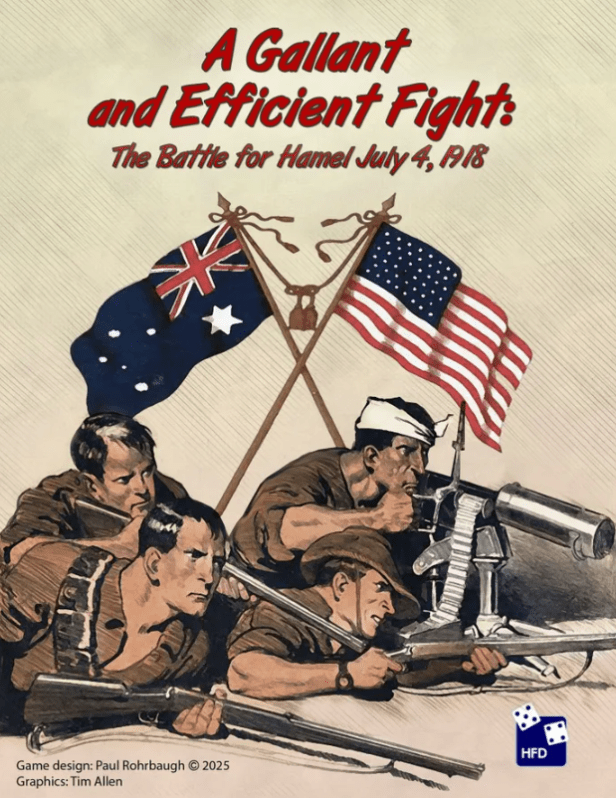
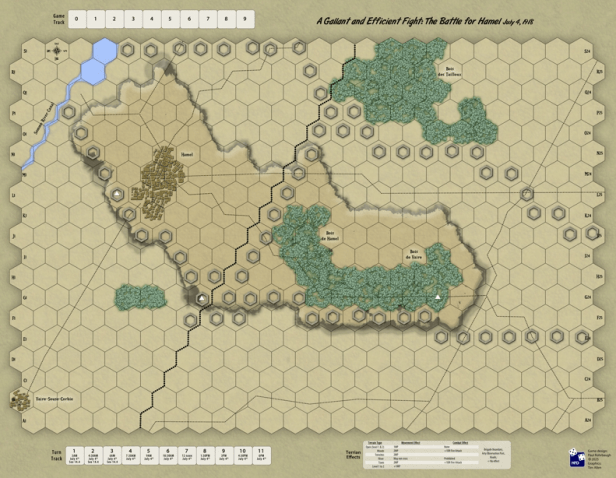
1. A Gallant and Efficient Fight: The Battle of Hamel, July 4, 1918 from High Flying Dice Games
Small format wargames on lesser gamed subjects are always welcome at my table. And High Flying Dice Games and Paul Rohrbaugh seem to just specialize in these types of unique games and this month have a very interesting looking game on the first joint attack by US and Australian forces in World War I called A Gallant and Efficient Fight: The Battle for Hamel, July 4, 1918.
From the game page, we read the following:
A Gallant and Efficient Fight: The Battle of Hamel is a wargame simulation of the first joint attack by US and Australian forces in World War I. While US forces had fought battles on their own or in conjunction with their French ally, questions still remained if any US forces would fight well in coordination with forces from the British Dominion. The US 33rd (Prairie) Division had been training with the Australian Corps. The Australian Corps was decimated earlier during the German Spring offensive, with many units at half strength. It was hoped that the Americans could fill out the ranks of the decimated Australian units, a process that could improve the novice Yanks’ performance by working closely with the Australian veterans, as well as securing a vital section of the Allied front line.
By July the German Spring offensive on the Western Front had been stopped, but the Germans still held ground that needed to be taken if an Allied counter-offensive was to be launched in the coming weeks. One key location the Allies needed to take was at the heights near the town of Hamel, not far from where the Australians and US forces were located, and from which the Germans could direct artillery fire upon the key rail and road junction at Amiens. On July Fourth the Yanks and Aussies, supported by British tanks, launched an offensive to take the high ground and town.
If you are interested in A Gallant and Efficient Fight: The Battle of Hamel, you can order a copy for $22.95 from the High Flying Dice Games website at the following link: https://www.hfdgames.com/hamel.html
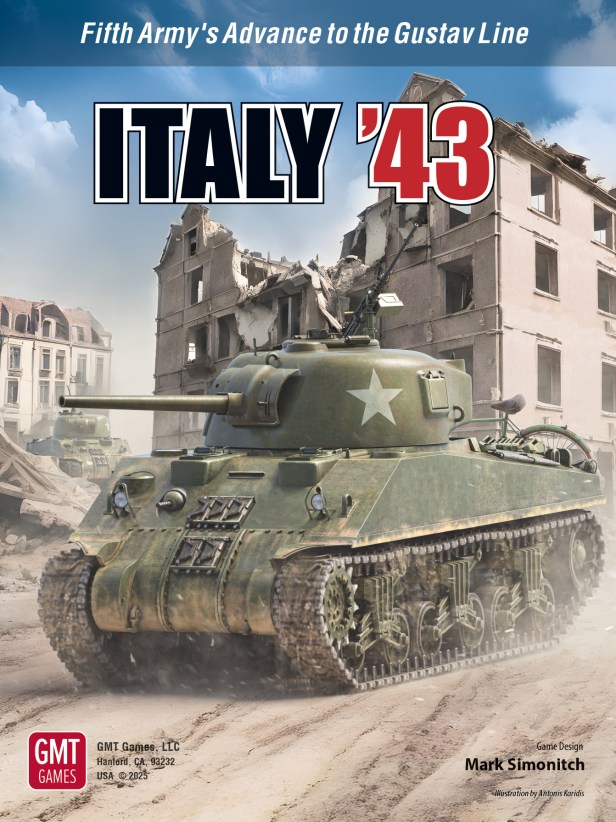
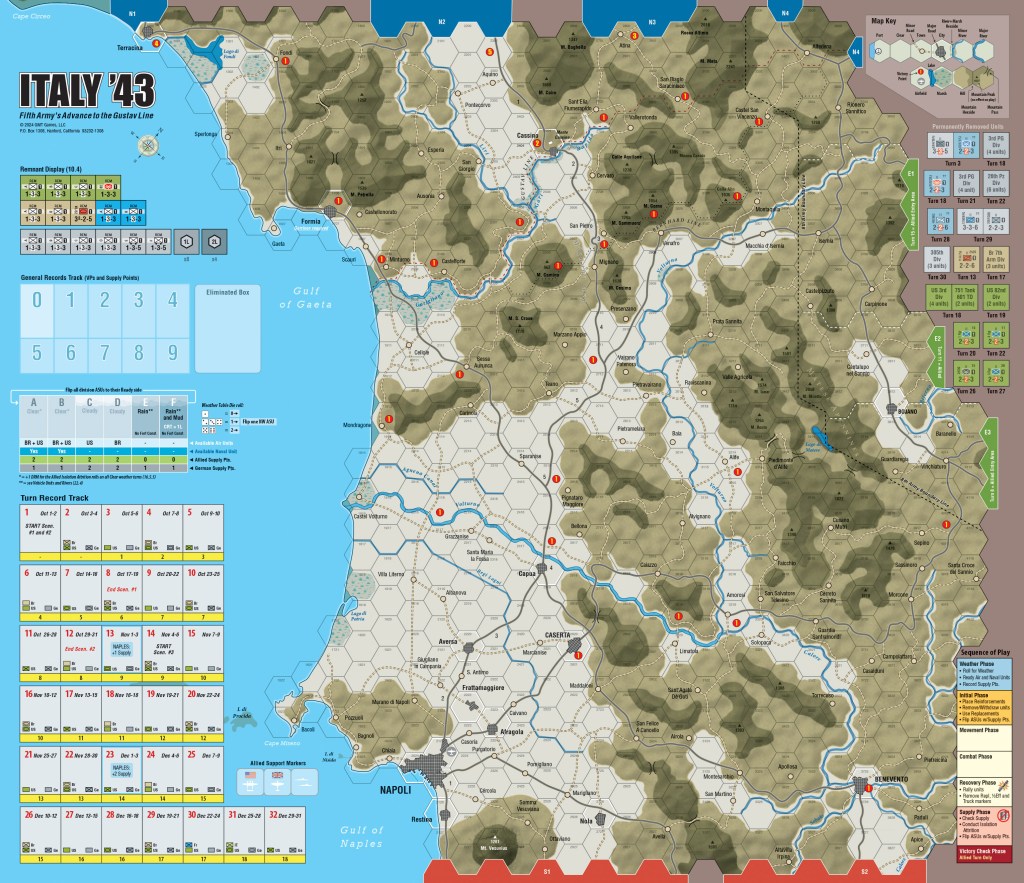
2. Italy ’43 from GMT Games
As you know, we have really enjoyed our plays of games designed by Mark Simonitch, including Holland ’44, Stalingrad ’42, Caesar: Rome vs. Gaul and most recently North Africa ’41. He has an amazing ability to boil down all the elements involved and come out with a very playable simulation of the historical event. A few years ago, his focus on the Italian campaigns of WWII started with his game called Salerno ’43, which covers the Allied invasion of mainland Italy in September 1943. Since that time, we had heard rumors of his plans with the game to include a few additional volumes as the Allies moved north up the peninsula towards Rome. With the update, we got the next volume in the series called Italy ’43.
From the game page, we read the following:
Italy ’43 is a two-player game depicting the U.S. Fifth Army’s advance from Naples to the Gustav Line in 1943. The game (picking up where Salerno ’43 left off) covers the time period from October 2nd to December 31, 1943. Initially, the Allied advance moved quickly with the Fifth Army crossing the Volturno River on October 13th. But from then on, the Germans began to fight a stubborn delay action as they slowly withdrew to their prepared defense lines — The Barbara Line and then The Gustav Line. For the next two and a half months, the Allies advanced slowly north, fighting for practically every village and mountain top to even reach the Gustav Line. It was a grueling campaign known for the battles of San Pietro Infine, Monte Lungo, and Monte Camino.
Italy ’43 uses the exact same map and unit scale as Salerno ’43 and Normandy ’44. Italy ’43 uses the same game system used in Salerno ’43 with some modifications and rule improvements.
Italy ’43 includes four scenarios: Across the Volturno, The Barabara Line, The Mignano Gap, and the full Campaign Game.
As in other 19xx games, the rules include ZOC Bonds, Determined Defense, Extended Movement, and a straightforward CRT. New rules include: Construction of Defense Lines, Mountain units, and two new attack options: Prepared Offensives and Sustained Attacks.
Players will find the game and order of battle extremely useful in understanding what happened in this campaign. It allows players to experience and understand how a depleted German army was able to slow and then stop the Fifth Army at the Gustav Line.
Salerno ’43 was a well designed game that has a short scenario of 8 turns and a full campaign game of 22 turns. I think that this game is very good and will be one that you can play over and over again until you get the strategies down and can really stretch its legs at that point. But the game plays fast and furiously and was frankly a very good way to spend a Friday evening for 4 hours. If you are a fan of the ZOC Bond System, then this is a no brainer for you as it carries out that system well. If you are wanting to get into that system, this is probably the very best place to start. And as stated above, Italy ’43 is going to use the same system with some new rules.
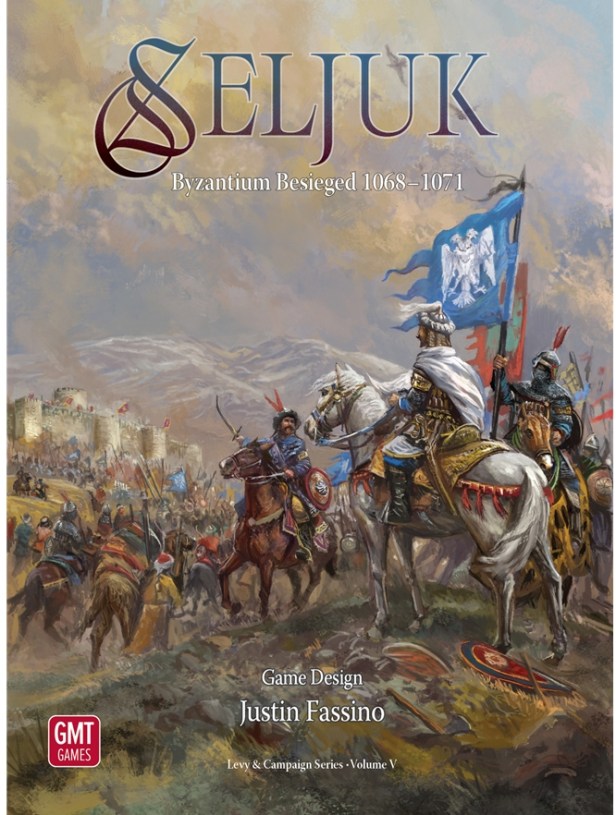
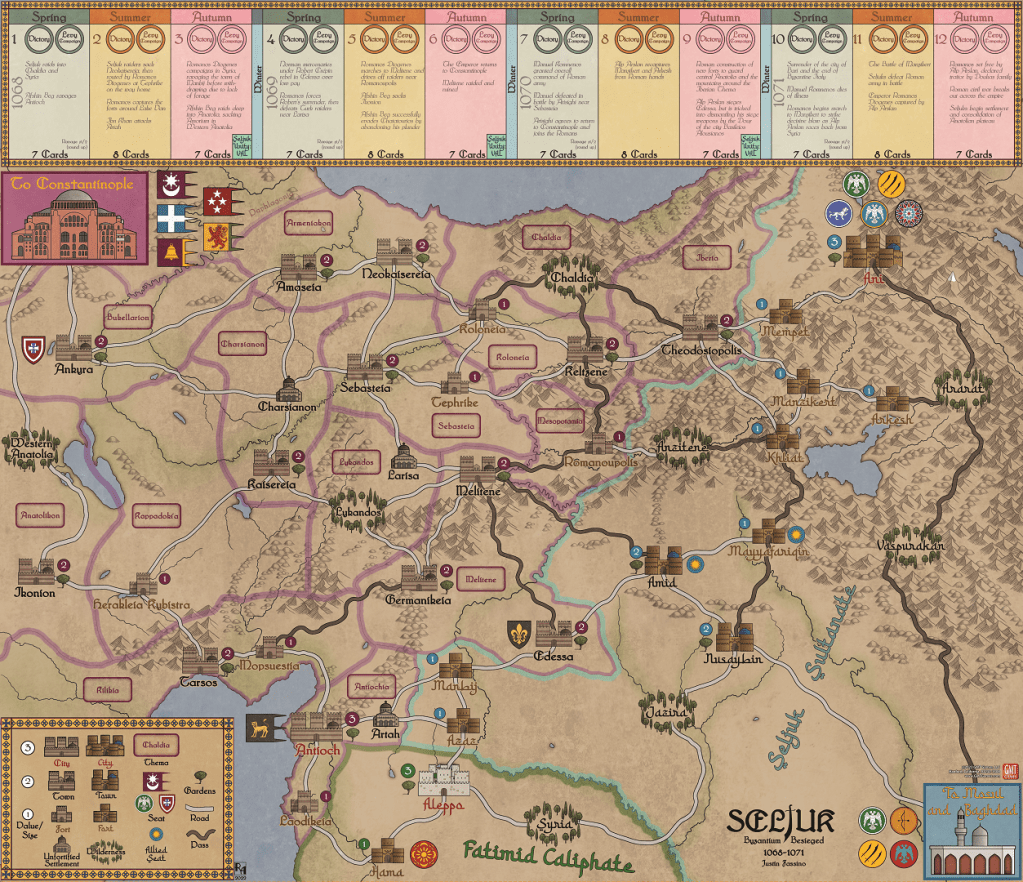
3. Levy & Campaign Series Volume VI Seljuk: Byzantium Besieged 1068-1071 from GMT Games
It seems that the hottest series out there today is the Levy & Campaign Series from GMT Games. Initially started by Volko Ruhnke with his Nevsky: Teutons & Rus in Collision, 1240-1242 and then followed up with Almoravid: Reconquista and Riposte in Spain, 1085-1086 there are 2 other titles currently listed on the P500 as well at least another dozen (or more) that have yet to be announced but are being developed and playtested. The newest release is Seljuk: Byzantium Besieged 1068-1071 that pits Romans versus Turks and will be shipping later this month.
From the game page, we read the following:
Anatolia, 1068. Romanos Diogenes has assumed the imperial throne of the Eastern Roman Empire. Ferocious armies of Seljuk Turks are on the doorstep, ravaging the border cities of the East and sending yearly raids and campaigns into Roman lands. Beset by political intrigue in Constantinople and assuming command of a fragile military, Romanos has only a short time to assemble the largest Roman army in over a century to drive off the forces of the Sultan Alp Arslan before the Empire collapses.
Seljuk—Volume VI in Volko Ruhnke’s Levy & CampaignSeries—brings players into the challenges of medieval logistics and maneuver across Asia Minor during the clash between Orthodox Christian and Muslim power in the lead-up to the climactic Battle of Manzikert. Players will assume the role of either the Eastern Romans or Seljuk Turks as they seek to make their mark on this historic land. Asymmetric victory objectives and new and unique additions to the Levy & Campaign system mean a dynamic game of cat and mouse between these two great powers.
I am glad to see that these new entries are not just pumping out the same product, even though the system is really good and creates some very interesting challenges, but are innovating in order to meet the demands of the historical actors and periods covered. In Seljuk, it appears that both sides have to confront the real possibility that some of their allied Lords might switch sides which is always a fun mechanic.
4. Stalingrad ’42: Southern Russia, June-December, 1942 2nd Edition from GMT Games
We love Mark Simonitch designs here and really had a good time with Holland ’44 and The US Civil War. We also played and really had a great experience with Stalingrad ’42 a few years ago and see now that it is coming out with a 2nd Edition.
From the game page we read the following:
Stalingrad ‘42 is a division-level game on the Axis 1942 summer offensive towards Stalingrad and the Caucasus. Historically, this epic struggle lasted for 6 months and saw the Axis armies reach the Volga and the Caucasus Mountains. But Soviet resistance stiffened and final victory eluded the German army at Stalingrad and in the Caucasus. The ensuing November Soviet offensive trapped the Wehrmacht’s largest army (the 6th) at Stalingrad and marked the beginning of the end for Axis fortunes in WW2.
Stalingrad ’42 uses the same scale and nearly all the rules of Ukraine ’43. Many modifications have been made to improve the system and to show crucial features of the campaign. New rules include leaders, elite panzer divisions, planned operations, hidden Soviet buildup, and Army/Front offensive support.
With three maps and low unit density, the game delivers a grand view of the campaign, where decisions about movement and direction of attack have lasting effects that propel or curtail your future strategic plans. The effect is like watching a story unfold and noticing a growing emotional involvement with your forces and plans. In the end, whether in victory or defeat, players of Stalingrad ’42 will enjoy an epic gaming experience.
Like most East Front games, this one is a long line of counters that attack and get pushed back, especially the Soviets, but the design allows room for the Soviets to counterattack at key times and circumstances and it boils down to knowing when that time is for the Soviets. This system is really great as it keeps the counter density low while giving the feeling of the game being a real wargame and we really enjoyed it.
5. Unconditional Surrender: Western Campaigns from GMT Games
Unconditional Surrender is one of Alexander’s favorite wargames of all time and now it looks like there is an expansion of sorts that takes the game action to focus on the Western Front rather than the whole of the war in Europe, which should be very interesting and also allow many new gamers to dip their toes into this one before jumping into the full Unconditional Surrender! experience.
From the game page, we read the following:
Unconditional Surrender! Western Campaigns is an operational/strategic-level game covering World War 2 campaigns fought between the Axis and Western Allied factions in Western Europe. With its emphasis on force projection, players focus on the big picture of managing their military forces. Using simple mechanics and low on-map counter density, players easily handle the action without complicated subsystems or tall stacks of counters.
This game is billed as a smaller, faster playing version of Unconditional Surrender and should allow for greater exposure due to its small footprint. The game also can be used as a gateway to the larger Unconditional Surrender game for new players. There are 6 scenarios in the game that appear to be designed to expose the player to new mechanics as they progress through them. From the game page, we read the following:
From the air and ground mechanics in Poland 1939 to the airborne-assisted invasion in Denmark-Norway 1940, players learn the basic operational rules to the game that they can tune in the Balkans 1941 or French North Africa 1942 campaigns. They can then take that experience to larger, competitive scenarios like France 1940 and France 1944. You will decide how far to push your successful spearheads, not knowing how far the rest of your units will advance. You will have to decide what the right balance between timidity and recklessness is and where to commit your air and other assets for success.
This one looks amazing and I am definitely interested in seeing how it differs from the original. Differ is a bad word as it is the same system, but how they differentiate.
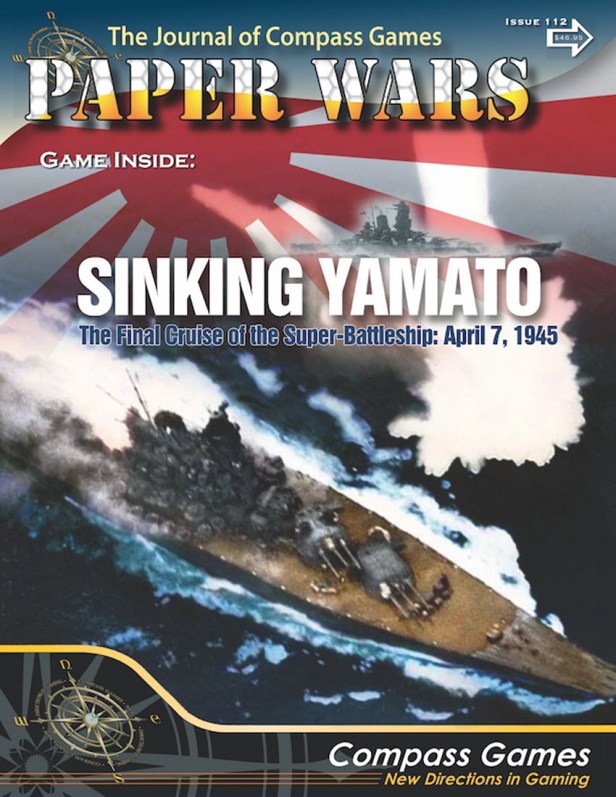
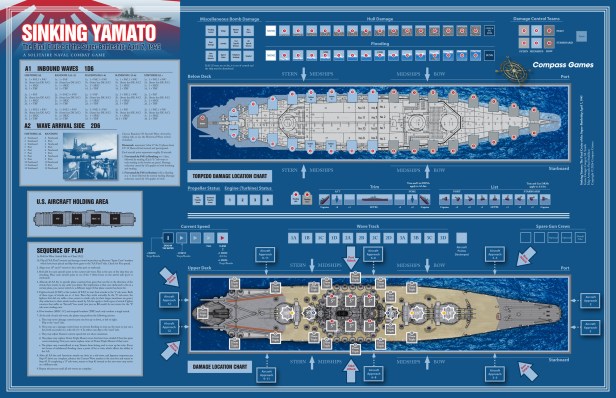
6. Paper Wars Magazine Issue #112: Sinking Yamato from Compass Games
Our friend Gregory M. Smith is a solitaire genius and has done many of these solo, narrative driven wargames that we have all enjoyed for hours on end while we have been unable to find an opponent or just because we want to play a game on our timeline. We have interviewed him many times for his games such as Zeppelin Raider, Interceptor Ace, The Hunted, Western Front Ace, Amerika Bomber, Defending America, American Tank Ace and most recently British Tank Ace. Greg always has something cooking in his game design kitchen and recently I saw that his game called Sinking Yamato: The Final Cruise of the Super-Battleship: April 7, 1945, which I had a chance to play at WBC last year, was shipping in Paper Wars Magazine from Compass Games.
From the game page, we read the following:
Sinking Yamato is a low-complexity, solitaire, tactical-level (single ship versus aircraft formations) game, with three waves of incoming aircraft broken down into four sub-waves each, with each aircraft marker representing roughly 20 attacking aircraft. The player controls the decisions on starting preparations, facing the larger gun turrets, firing decisions of the multitude of AA guns, movement and use of damage control teams, and when to counter-flood to prevent capsizing. There are options for a historical or random setup and a hypothetical scenario with additional U.S. aircraft. The rules cover fires and fire spreading, counter-flooding, strafing, damage control radar warning, and spare gun crews. One 34×22” small-hex map and over 100 counters.
As usual, thanks so much for reading along and sticking with me this month as I navigated through the many websites and game pages looking for new and interesting games to share.
Finally, thanks once again to this month’s sponsor VUCA Simulations!










 The Players' Aid
FYI – looks like Battle Hymn Vol 2 is still just a pre-order at this point.
LikeLiked by 1 person
I agree but I saw where it could be shipping this month. I could be wrong though.
LikeLike
And it looks like my intel was a bit off as they just put Battle Hymn Vol 2 onto Kickstarter as of yesterday.
LikeLike
Which I promptly ordered!
side note: I never understand why they make their incoming links invalid. Not a good way to actually, you know, sell stuff.
LikeLiked by 1 person
Agreed. If you are a publisher, you should want me to find your games and even for us on the blog know about those games.
LikeLike