It seems that one of the hottest series out there today is the Levy & Campaign Series. Initially started by Volko Ruhnke with his Nevsky: Teutons & Rus in Collision, 1240-1242 and then followed up with Almoravid: Reconquista and Riposte in Spain, 1085-1086, Inferno: Guelphs and Ghibellines Vie for Tuscany, 1259-1261 along with the most recently shipped Plantagenet: Cousins’ War for England, 1459 – 1485 there are 3 titles currently listed on the P500 (Henry, Seljuk and Žižka) with at least another dozen (or more) that have yet to be announced but are being developed and playtested. Now the series is not growing in the traditional way with a new volume but is expanding into a new period with a new series called Levy & Campaign Ancients. This series initial game is designed by a newcomer in Jason Walonoski, whom we had the pleasure of meeting while attending the San Diego Historical Games Convention last November, and is called Epipolae: The Athenian Expedition in Sicily, 415-413 BCE. I reached out to Jason for one of our interviews and he was very interested in answering my questions.
*Please keep in mind that the artwork and layout of the various components shown in this interview are not yet finalized and are only for playtest purposes at this point. Also, as this game is still in development, rules and scenario details may still change prior to publication.
Grant: First off Jason please tell us a little about yourself. What are your hobbies? What’s your day job?
Jason: In terms of hobbies, I like the outdoors: hiking and camping, I grow my own hops and use them to brew beer, I love reading (history, fantasy, sci-fi), games (role playing, board games, video games), and I play soccer once or twice a week.
I was inspired to explore history and deep dive into wargames during the pandemic when many of us were stuck at home, mostly playing with my children or solo.
My educational background is in software, and in my day job I work for a not-for-profit.
Grant: What motivated you to break into game design? What have you enjoyed most about the experience thus far?
Jason: I joined the Levy & Campaign Discord server back in 2021, but I mainly lurked and watched the projects until I made a PNP version of Henry (designed by Joe Schmidt) in 2022 and started playing it repeatedly with my son. We loved it.
I realized that there were some parallels to Joe’s game and the Athenian Expedition during the Peloponnesian War, a historical topic I was fascinated with at the time (and still am).
From there, I thought I would try out some ideas with a hasty prototype. I shared my initial attempts with Joe, and he encouraged me to share it more broadly.
What I’ve enjoyed most about the experience so far is meeting so many friendly people in the historical gaming and wargaming community, going to conventions (shoutout to the SDHistCon team), sharing and playing games, and of course – playing more games with my kids.
Grant: What is your upcoming game Epipolae about?
Jason: Epipolae is an operational-level wargame set in the Ancient era. The game’s setting is the ill-fated Athenian Expedition to Sicily during the Peloponnesian War in 415 – 413 BCE.
The Peloponnesian War started in 431 BCE and lasted for 27 years: 10 years of war, 8 years of peace (the “Peace of Nicias” is infamous for the lack of peace), and then 9 more years of war.
The Athenian Expedition to Sicily was essentially a foreign war (outside Greece itself) conducted in the last 3 years of “the peace” which ultimately reignited the wider conflict and set the stage for the events that finally ended in Athens’ defeat to Sparta.
Finally, the expedition historically featured the Athenian Siege of Syracuse. Because this is an operational game – the path to victory may or may not involve sieges. Historically, and in the game, there were many plans and possible paths to victory.
Grant: What is the Levy & Campaign Ancients Series? How is this series distinct and different from Levy & Campaign?
Jason: While specifically designed for the medieval era, the Levy & Campaign model is also sufficient to represent the dynamics of ancient operational-level campaigns. Though various ancient cultures did not have a medieval European-style feudal system of fealty and service obligations, the basis of the Levy mechanics function equally well for the Greek city-states (or even Persia, Carthage, Rome, and Egypt).
Similarly, the “plan and command” mechanics of the Campaign phase are able to recreate ancient campaigns. The actions of these armies — marching, foraging, ravaging, besieging, battling, and so on differ from their medieval descendants only in size, temporal scale, and technological effectiveness.
I wrote an entire InsideGMT article on “Why Levy & Campaign Ancients?” that goes in depth into this topic.
Grant: Whose idea was it to create this separate but related Levy & Campaign like series?
Jason: I wasn’t there, but at the dawn of the L&C Series, Gene Billingsley at GMT was interested in Volko Ruhnke exploring where else beyond medieval warfare the core engine in L&C could go.
Years later, I happened to design Epipolae. With Volko’s permission I brought a physical prototype of the game to SDHistCon 2022 to run demos and playtests. At that time, the first eight volumes of the L&C Series had already been determined, and Epipolae was obviously not a medieval setting. There were discussions about what – if anything – should be the future of this design. My recollection is that Volko and Jason Carr (head of development at GMT games) discussed a variety of options at that conference, and there were probably further discussions inside GMT. Later I was asked if L&C was the best fit, or fit of convenience, and I responded with my thoughts that eventually turned into the “Why Levy & Campaign Ancients?” article. In the end, all credit for the series goes to the series creator: Volko Ruhnke.
Grant: Why was this a subject that drew your interest?
Jason: I first read about the Athenian Expedition at home during the pandemic, reading the Twenty Decisive Battles of the World by Lt. Col. Joseph B. Mitchell. His brief overview, originally summarized by Sir Edward Creasy in 1851, just shocked and blew me away…
Ten years of war had concluded with the “Peace of Nicias”, and while the Athenians were still in the midst of recovering, they had the audacity to send an expeditionary force of 134 triremes (each with a crew of 200 men), 5,100 hoplites, and more than a thousand skirmishers to conquer a remote island larger than the Peloponnesian peninsula. When that didn’t go so well, the city sent a second expeditionary force nearly as big as the first! And both of these forces were completely annihilated, to the point where it was months before Athens learned what happened.
The mind just reels thinking about it all, the scale, the ambition… and it raises many questions.

Grant: What is your design goal with the game?
Jason: The design goal was to present a historically plausible model, that was a smaller game (in terms of physical space and play time), where players could explore the campaign – and as Volko is fond of saying, be a time tourist.
The outcome of the historical campaign was a complete disaster for the Athenians with a shocking amount of casualties, but it started promisingly enough and deteriorated over the three years it lasted. I wanted a game that explored all the questions I had about the historical campaign. What was the goal? The answer to that question is not as straight-forward as it might appear. What was the plan? It turns out all of the leaders on both sides had different strategies and objectives. How was it executed? There was a lot of ingenuity, cunning, and innovation on the battlefield (some of this is represented by Events or Capabilities in the game). Why did they do the things they did, and what could have been?
Grant: What sources did you consult to get the historical details correct?
Jason: The only surviving primary source is Thucydides’ History of the Peloponnesian War, but there are many supplementary sources both ancient (e.g., Xenophon, Plutarch) and modern (e.g., Kagan, Hale, Hanson, Ray) about the war and expedition. There are also a number of sources on related topics such as ancient Sicily (e.g., Holloway, Hansen, Nielsen, De Angelis), the ancient Greek Economy (e.g., Migeotte), and ancient campaigns (e.g., Engels, Xenophon’s Anabasis), nevermind a plethora of academic journal articles. The game features an extensive bibliography.
It was important to me that the game was free of anachronisms, was not on historical rails and allowed for a variety of historically plausible outcomes. For me, understanding the broader setting and environment, the geopolitical situation, the cultures, the actors and their motivations, was important to assembling all the pieces together.
Grant: Who is your developer Christophe Correia? What abilities and skills does he lend to the process?
Jason: Christophe is the Levy & Campaign Series developer, credited on 6 of the 8 L&C games currently on GMT’s website. Christophe built and maintains the VASSAL module for Epipolae, and has playtested the game scenarios repeatedly. He asks good questions, identifies balance problems and issues that could negatively impact certain player strategies, and provides situational awareness of where the game fits, adjusts, or breaks with other L&C volumes.
Grant: What lords are available to both sides?
Jason: In a bit of chrome, we refer to the leaders as Strategoi (plural) or Strategos (singular).
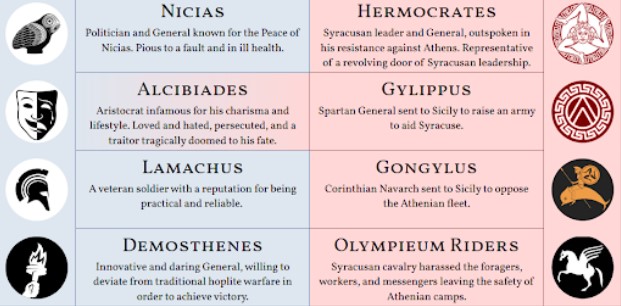
On the Athenian side, there are the three original leaders: Nicias, Lamachus, and Alcibiades (who is the best of the three in terms of in-game leader ratings). The Athenian player will eventually lose Alcibiades (historically he was recalled to Athens to be punished for alleged crimes). Later, the Athenians might be reinforced by Demosthenes, depending on play or scenario.
On the Syracusan side, they begin with Hermocrates (who actually represents himself as well as a panoply of various minor leaders), and maybe the Olympieum Riders (unfortunately, the historical commander of this group was not named by Thucydides). Depending on events, the Syracusans might be reinforced by allied leaders: Gylippus (from Sparta) and Gongylus (from Corinth).
For playtesters not familiar with the history, I sometimes offer an analogy to the Battle of the Bulge (a topic most wargamers are familiar with). The Athenians start out with the advantage and on the offensive – they need to make as much progress as possible as quickly as they can. Because sooner rather than later, they will lose Alcibiades, and the tide will turn giving the Syracusans the advantage, who will likely be coming in from behind to finish the game with strength.
Grant: How have you modeled the differences in leadership and strategy in the game?
Jason: Leadership is modeled as each leader’s Command Rating and Logistikos Rating.
Command determines how many actions a leader can take when their command card is played during the Campaign phase (each seasonal turn has a varying amount of cards per turn). The Logistikos rating determines how effective a leader is at mustering forces, assets, and capabilities during the Levy phase, as well as their ability to conduct some Campaign actions (e.g., foraging, diplomacy, taxing).
For players that are unfamiliar with the history, the background book explains the various plans and strategies each leader favored. It is up to the players to pick which of these strategies they wish to follow, or create their own.
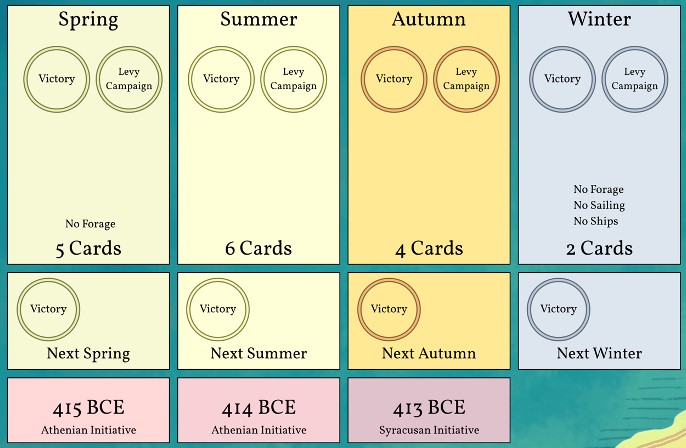
Grant: What is the makeup of the calendar?
Jason: Calendars in Levy & Campaign are used to track a variety of things: turn and phase (Levy or Campaign phases), victory points, availability of reinforcements, and service obligations (how long each leader is willing to stay in the field).
The calendar in Epipolae is seasonal with the traditional Spring, Summer, Autumn, and Winter – each with a different number of Command cards to be played, and their own seasonal challenges and restrictions (for example, you cannot Sail in Winter).
The number of Command cards per season was tuned to be able to roughly recreate the events recounted by Thucydides.
Grant: What is the scale of the design?
Jason: The turns are seasonal, with a maximum of three years for the full campaign, while the point-to-point map covers Sicily and the “toe” of Italy (approximately 10 thousand square miles and roughly 130 miles across).
The cavalry units represent 250-500 horse, the infantry units 500-1,500 foot, and each naval unit 10-15 Triremes.
Grant: What different types of units are available to each side?
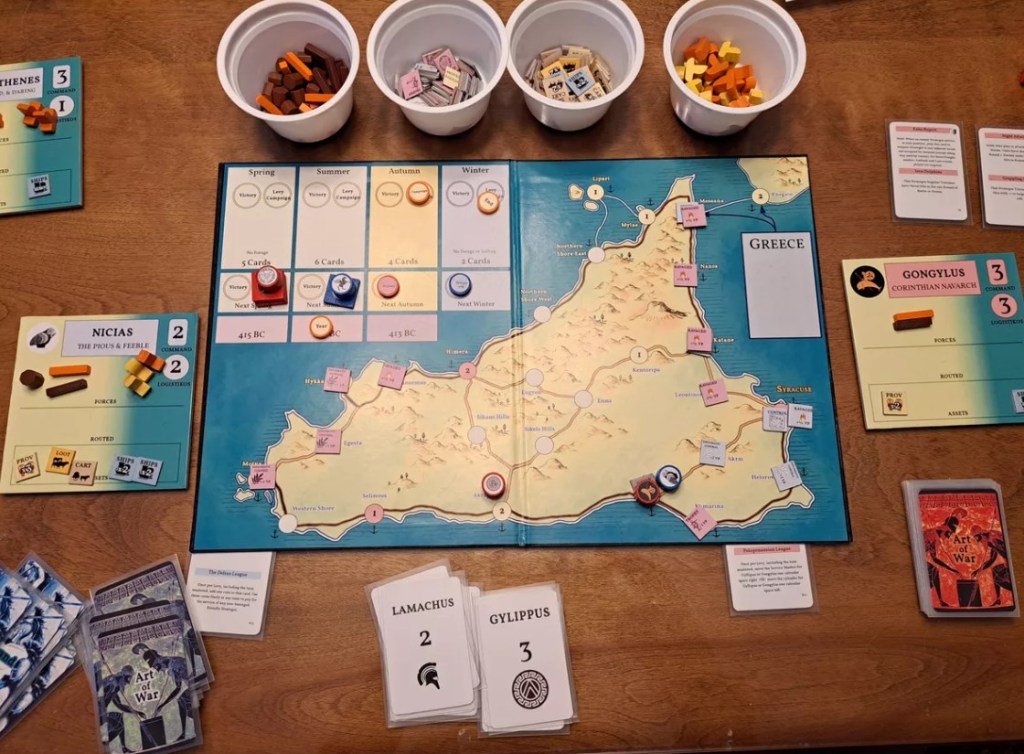
Jason: Epipolae is the first Levy & Campaign game to be published that features naval units and naval combat. A battle can feature both land and naval elements, depending on where it is fought (for example, in an area on the coastline).
The basic military units available are: Triremes (regular and Elite), Cavalry, Skirmishers, and Hoplites.
In each round of battle, the units hit in the above order (naval units first, and hoplites last) – with simultaneous hits per side.
Grant: How are naval and land forces different in the game?
Jason: Land units are used to fight over and control locations.
Naval units are used to fight over and control the seas, and an advantage in Triremes can be used to blockade cities under siege. A leader without Triremes also leaves their transport ships vulnerable to capture, a potentially fatal mistake for supply.
Trireme crews can also come ashore and fight as skirmishers under certain conditions.
Grant: Why was it so important to include a focus on the naval aspect?
Jason: Athens was primarily a naval power, and the initial expedition included 134 triremes and a “supply train” of 30 merchant ships loaded with grain, workers, and cargo, and 100 boats following for trade. Control of supply is critical in any campaign, and in this era and theater, the sea was the most efficient mechanism and route of supply. Whoever controlled the seas, could control supply.
In the historical campaign, Athens’ fleet deteriorated over the course of the expedition, and eventually was destroyed. Once Athens lost their fleet, they were in a bad situation.
Grant: How do these forces compare in martial abilities?
Jason: Elite Triremes have better stats than regular Triremes – reflecting the importance of highly skilled crews and pilots. Cavalry are light, route easily, but live to fight another day. Skirmishers (primarily Peltasts) are unarmored missile troops. Hoplites are your heavy infantry that deal and soak up damage.
During the Levy phase of the turn, these basic units can be recruited, and then enhanced with Capabilities that offer a variety of in-game effects.
Grant: What is the layout of the game board?
Jason: The game board consists of the calendar (a multi-purpose track, as I described earlier) and the geographic map. The calendar and its effects are an important component of any Levy & Campaign game, because it controls the availability of leaders, how much campaigning is possible, and limitations on commands.
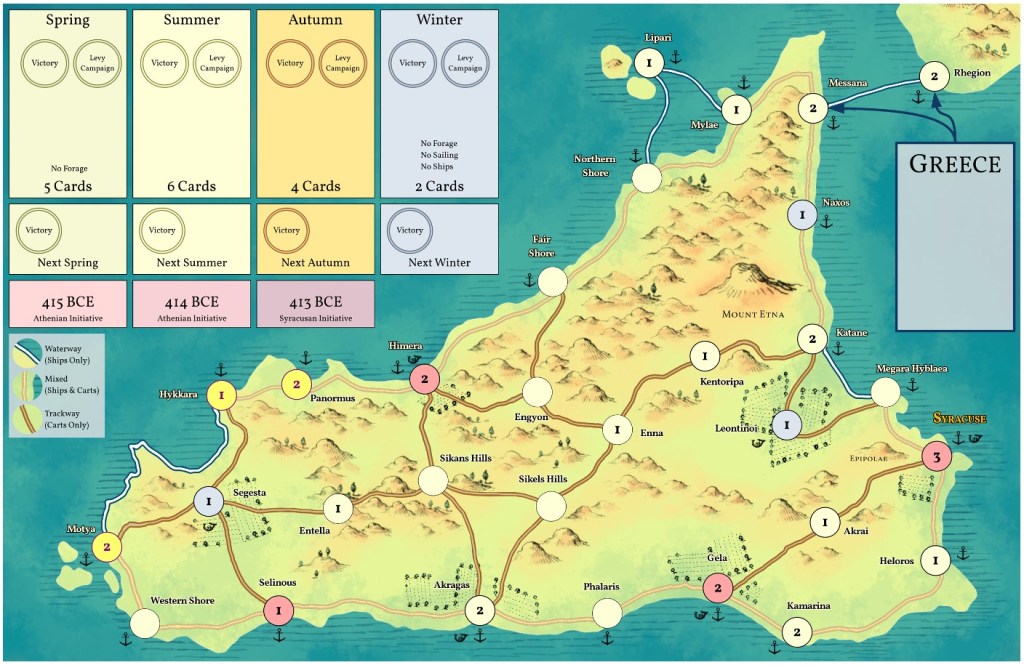
The map is point-to-point, with three different types of connections (waterway, trackway, and mixed). The type of connection affects transportation.
On this map with prototype/playtest artwork, the blue-tinted cities are initially aligned with Athens, red-tinted cities are aligned with Syracuse, gold cities are Phoenician or Carthaginian, and pale-yellow are neutral.
Grant: As a smaller geographic area, how did you go about laying out the spaces on the board?
Jason: The spaces on the board were initially chosen based on the narrative of the Athenian expedition to Sicily as told by Thucydides – what cities were mentioned, under what circumstances, and how they were aligned with Athens or Syracuse, and what actions they took (if any).
The connections (called Ways in the game) were based on modern maps of Roman roads built centuries after this historical era, on the presumption that the Romans took the path of least resistance and built their roads over existing paths that had connected existing settlements for centuries. A few connections were added based on Thucydides’ vague descriptions of overland travel, or based on disputes between neighbors.
In addition to testing for gameplay, the connections were tested to ensure that the movement of leaders and forces were able to recreate the events recounted by Thucydides.
Grant: What strategic considerations are created by the layout?
Jason: In terms of strategic considerations, there are two. First, supply sources. Second, routes that are used for supply and maneuver. It is possible to cut supply, or out-maneuver and surround a reluctant opponent and force them to battle.
The Athenians have two land-locked supply sources: Leontinoi in the East, and Segesta in the West. The Athenians need to secure these supply sources and make sure they are accessible by sea. If the Athenians cannot secure their supply, they’ll need to rely on Foraging and silver Coin from the Delian League.
The Syracusans have three supply sources: Syracuse, Gela, and Himera. All three are ports, so Syracusan supply is plentiful and flexible — not an immediate concern — but the Syracusans need to be careful not to get boxed in. The Syracusans should turn their attention towards disrupting or capturing the Athenian supply, if possible.
There is a neutral supply source in the south: Akragas. If a player can capture this city – either by diplomacy or by force – the additional supply could be theirs. Historically, both sides made overtures to Akragas, which were rebuffed.
Grant: How are the Art of War Cards used?
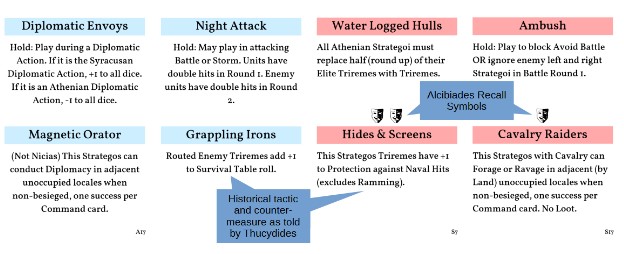
Jason: As in all Levy & Campaign games, the Art of War Cards are dual-use. The top-half of each card is used to draw random Events each seasonal turn, one event per side. Some of these events have immediate effects, and some can be saved for later surprises (for example, an ambush). The bottom-half of each card is a Capability, which can be purchased using Logistikos points by leaders to enhance their forces (or the entire side, in some cases) during each Levy phase. Each leader can have a maximum of two capabilities.
Grant: Can you show us a few examples of these cards and explain their uses?
Jason: There are 18 Art of War Cards per side, so 36 in total. That means there are 36 Events and 36 Capabilities.
Some of the Events include the symbol for Alcibiades (one of the leaders), and depending on the scenario, the accumulation of these symbols being revealed triggers the recall of Alcibiades to Athens (in terms of gameplay, he permanently disbands), which in turn initiates a cascade of reinforcements.
The Events are primarily taken out of Books 6 and 7 in Thucydides, which are the portions that detail the Athenian expedition to Sicily. Other events are reflective of activities that commonly took place throughout the Peloponnesian War, such as ambushes, disease outbreaks at sieges, and so forth. A few are events that might have happened, that Thucydides discussed as possibilities, or happened within a few years of the historical campaign. All of the events have a detailed historical basis in the Background book.
Likewise, the Capabilities broadly reflect the strategies and tactics used by the belligerents during the Peloponnesian War at large, but especially this expedition, and the escalating tit-for-tat innovations that the leaders employed. Capabilities can be “purchased” by leaders using Logistikos points during the Levy phase of each turn.
In terms of emphasis, there are currently 6 Capabilities for Cavalry, 8 for Triremes and Ships, and 7 for Sieges. There are also Capabilities to effect Diplomacy, Taxation, Foraging, Supply, Movement, as well as the Delian League and the Peloponnesian League.
Some examples are below, Athenian cards in blue, and Syracusan cards in red (subject to change):
Grant: How is victory achieved?
Jason: Victory is measured with Victory Points. Victory points can be earned in a few ways, which are emblematic of how the ancient Greeks conducted their operations during the Peloponnesian War.
- Adding a city into your alliance using Diplomacy (1 VP).
- Conquering a city through Siege or Storm. (VP determined by size).
- Destroying an enemy leader in Battle causing them to forcefully Disband (1 VP).
- Erecting a battlefield Trophy (½ VP).
- Ravaging the cities and territory of your enemies (½ VP).
Capturing Syracuse is not an instant win condition for the Athenians, because I don’t believe that capturing the city would have caused the rest of Sicily to fall in line. It is entirely possible it would have had the opposite effect.
Grant: What are you most pleased about with the outcome of the design?
Jason: From the beginning, one of the things that intrigued me about the expedition was that each historic leader had separate plans and overall strategies, and we’re fortunate enough that Thucydides described these ideas and alternatives. I wanted to make sure that very different strategies are possible to try, and that the siege of Syracuse (if it happens at all) was not inevitable. There are so many ways the expedition could have turned out, and I want the players to be able to have the agency to determine what they want to do, and how to do it.
Also, the team put a lot of historical research into this game, and I feel like the tweaks we’ve made to the Levy & Campaign system and tuning we’ve made through analysis and playtesting, have resulted in an approximation to the historical era and conflict that I am happy with.
Grant: What has been the feedback of your playtesters?
Jason: Generally the feedback has been positive, and the playtesters seem to have fun. We’ve had a good mix of L&C veterans and newbies. Questions and suggestions have made the game better.
I think that playtesters have enjoyed how the design leaves room for each player to determine their own strategy to conduct (or defend against) the expedition. For instance, in one play test, the Athenian player decided they were going to avoid battle and attempt to win completely through diplomacy – and it worked.
Grant: What other ancient battles would be good candidates for this system?
Jason: Any topic that could be captured within an operational-level campaign perspective, where logistics and supply, proper planning, and maneuver played an important role in the outcomes. Historical campaigns with more than one leader or army per side (even if minor subordinates) translate best in my opinion.
Just from the Peloponnesian War itself (it did last for 27 years after all), I think there are probably 4 or 5 other operational campaigns that could be made into good games.
On the L&C Discord server, there are other Ancients designs in progress (from other designers). Some of these I categorize as “deep cuts” of Ancient history, which is great, because we need more Ancient games that aren’t just another take on Alexander, Caesar, or Hannibal.
Grant: What other designs are you currently working on?
Jason: There are a number of other historical topics I’m interested in exploring, but I’m not actively working on any other designs. As a first time game designer, I’m focused on navigating through the process, and making sure Epipolae is as good as it can be.
Thank you for your time in responding to our many questions Jason. I really am impressed with your story and the path that lead you to this point and cannot wait to get this one on the table.
If you are interested in the Levy & Campaign Ancients Volume I Epipolae: The Athenian Expedition in Sicily, 415-413 BCE, you can pre-order a copy for $58.00 on the P500 game page at the following link: https://www.gmtgames.com/p-1066-epipolae-the-athenian-expedition-in-sicily-415-413-bce.aspx
-Grant


Excellent interview. This is my most anticipated GMT game currently in development. Having a smaller footprint Levy & Campaign title will help me introduce this system to others.
I was a classical humanities major in college and favor the ancient period (C&C Ancients and GBoH feature prominently in my collection). I owe my entree to historical wargames to The Player’s Aid, drawing me from the euro side of tabletop games. Many thanks and keep up the great work.
LikeLiked by 1 person
Awesome! Thanks Eric. I too am very interested in this one as I want to see how a different focus works in the system and it is smaller and should be more manageable. I get lost a bit in these larger L&C volumes.
LikeLike
Looking forward to playing this game. I love ancients and I agree we need to expand from the usual topics.
LikeLiked by 1 person