
It seems that the hottest series out there today is the Levy & Campaign Series from GMT Games. Initially started by Volko Ruhnke with his Nevsky: Teutons & Rus in Collision, 1240-1242 and then followed up with Almoravid: Reconquista and Riposte in Spain, 1085-1086 there are 2 titles currently listed on the P500 (Henry and then the topic of this interview Seljuk) as well as the most recently shipped Plantagenet: Cousins’ War for England, 1459 – 1485 with at least another dozen (or more) that have yet to be announced but are being developed and playtested. We reached out to the designer of Seljuk Justin Fassino and he was more than willing to give us answers to our many questions.
*Please keep in mind that the artwork and layout of the components used in this interview, including cards and the board are not yet finalized and are only for playtest purposes at this point. Also, as this game is still in development, rules details may still change prior to publication.
Grant: First off Justin please tell us a little about yourself. What are your hobbies? What’s your day job?
Justin: I work in communications for a video game developer up in the Seattle, WA area and have worked in games my whole career. I’m originally from Los Angeles, but about 10 years ago after moving to the Pacific Northwest, I started dabbling in wargames with Andean Abyss and the COIN Series. That sparked a major interest in history and a revival of my childhood tabletop games enthusiasm, and ultimately when I am not outside in the summer hiking, paddling, or traveling, I am inside during the gray winters playing wargames and video games.
Grant: What motivated you to break into game design? What have you enjoyed most about the experience thus far?
Justin: It was entirely by accident. I’ve always had ideas for games that I thought would be cool, but it wasn’t until a few years ago that my first plays of Nevsky crossed over with a podcast episode about the Battle of Manzikert; my mind immediately had an almost fully realized vision of something I could create (thanks in large part to Volko’s excellent model of medieval operations in the Levy & Campaign Series). The narrative history was so rich, and my enjoyment of Nesvky so great, that I wound up sending Volko an email about how his new system would work perfectly for the time period. He responded with a very nice “you should give designing it a try” encouragement message, and that’s how I found myself down the rabbit hole of trying to design my own game. Thankfully, with not much to do during the pandemic, I was able to pour a ton of hours into the research and prototyping in ways I wouldn’t have been able to otherwise.
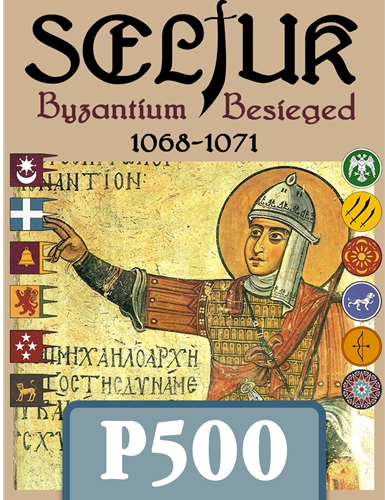
Grant: What is your upcoming game Seljuk about?
Justin: Seljuk is about the four year period leading up to the Battle of Manzikert in 1071 in today’s eastern Turkey between the Seljuk Turks and the Eastern Roman/Byzantine Empire. Many historians mark that battle, which was a calamitous Eastern Roman defeat, as one of the key turning points that would lead to the decline of the empire over the next several centuries.
The game, which will be Volume V of the Levy & Campaign Series, will cover the years 1068-1071. One player will take control of the Eastern Roman Empire and its newly minted Emperor Romanos Diogenes. The other player will assume the role of the Seljuk Turks and their Sultan Alp Arslan.
Grant: What is the history behind Seljuk?
Justin: I could probably write thousands of words on this one, but I’ll try and give the short version. In the 11th Century, the Eastern Roman Empire enjoyed a resurgence of power, expansion, and influence in Asia Minor, but all that success fueled internal power struggles that left the military underfunded and the gravity of political strength solely in the hands of the elites in Constantinople. Meanwhile, the Turks had consolidated military and political power in the great Muslim cities of Central Asia, and allied with their tribal cousins from the steppe, and they were entering an age of dynastic expansion and conquest. The ideological struggle between the Shi’a Islam court of the Fatimids in Egypt and the Sunni Islam court at Baghdad meant that the Eastern Romans were right at the crossroads of a global realignment of power. Endless raids from the Turks in the east necessitated a military response to secure the empire’s borders, and as it turned out, they were not equipped or prepared to fight an enemy they had ignored for decades.
Grant: Why does this conflict fit the Levy & Campaign Series parameters?
Justin: Ultimately, what really evoked the fit for Levy & Campaign for me was how heavily the campaigns of this period were influenced by logistical concerns. There were various battles in those four years, but really the conflict was punctuated by quick, violent raids and sacks by the Turks on frontier Eastern Roman cities, and the challenges facing the empire with moving through the tough terrain of central and eastern Anatolia, gathering supplies, and organizing their resources and troops. Many of the key events from history are easily modeled by the Levy & Campaign game system.
Grant: What needed to change in the system to properly tell the story of the Byzantium Besieged in Asia Minor?
Justin: The biggest change was the goals and objectives for each side. The Romans were fighting primarily defensively to maintain their state cohesion. The Turks were not on a mission of conquest; they were a loose coalition with common cultural cause, and thus were more interested in raiding the frontier to find resources and land for their pastoral animal herds. The Turkic Muslim elite and organized military structures in Baghdad actually were more concerned with the Fatimids in Cairo.
This political situation necessitated the way that each faction would have to try to win the game, which meant the game naturally became an asymmetric contest. The Eastern Romans will score VP’s very similarly to other factions in other Levy & Campaign Series games. The Seljuks will actually not score for conquering territory (though they still have the option to do that); instead, their VP’s will come from ravaging the Eastern Roman Empire, obtaining loot, and trying to get that loot home at the end of the campaign year to score it. They’re also against the clock as the confederation of Turkic factions demand more success each year, raising the stakes of how much ravaging must be done. Failure to make enough progress to keep the alliance alive will result in a subtraction of VP’s from the Seljuk side.
Grant: Why was this a subject that drew your interest?
Justin: I have to 100% credit my interest in the history to Robin Pierson and his incredible podcast “The History of Byzantium”. He manages to track the narrative history of Eastern Rome from the 450’s all the way to (eventually) 1453. His episode on the Battle of Manzikert is an incredible achievement in storytelling, history, and entertainment, and is a great primer for playing Seljuk.
Grant: What is your overarching design goal for this entry in the Levy & Campaign Series?
Justin: Primarily for people to have fun learning about a period of history that is woefully under-gamed. Secondly, I hope the game finds an audience that enjoys it and inspires other designers to explore the drama, action, intrigue, and history of the medieval Eastern Roman Empire. It’s such a neglected part of history in the western world, and it’s just as thrilling as anything happening in Europe or Asia at the same time.
Grant: What are the two competing sides and how do they differ from each other?
Justin: The Eastern Romans will be very familiar to other L&C factions. The challenge they face is that they must march their armies every year from Constantinople to the conflict zone, some 300-400 miles. This will stress their ability to respond to Seljuk incursions efficiently. Secondly, their army is partially constituted of unreliable mercenaries: Norman Knights from France look to carve out their own petty kingdoms and pagan Turkic warbands who don’t share the loyalty to Christian Orthodoxy or the institution of the state. The advantage the Romans have are standing provincial levies called Themata that can garrison Strongholds, defend against ravaging armies, and be recruited mid-campaign to the imperial army.
The Seljuks are lightly armored and rely almost exclusively on their expertise with the bow from horseback. In a straight fight, they do not have the staying power of armored European soldiers; however, they are extremely mobile and hard to pin down. Their focus on quick in-and-out raid campaigns means they provide a serious whack-a-mole challenge to the Romans, with victory lying in making sure they cause enough damage and get enough loot home in winter to assert their dominance on the frontier.
Grant: What specific unique units does each side have?
Justin: I was very excited to come up with new units to the series in Seljuk. The Roman bread and butter unit will be the Tagmata, a horse unit comprised of professional soldiers equipped with armor and adept at fighting both from horseback and on foot. They don’t specialize in any one phase of battle, but are decent at all three. They will be joined by special units such as the Hetaireia, the Emperor’s personal mercenary cavalry, and the legendary Varangian Guard, elite Norse infantry whose fighting skill was renowned all over the world. A small complement of western European knights, the same found in other L&C games, will be commanded by the aforementioned Norman lords.
The Seljuks will field legions of lightly armed Turkic Horse and be supported by Ghilman (singular: Ghulam), elite heavy cavalry taken as boys and trained to be deadly, loyal fighters for the Seljuk Sultanate.
Both sides will also have a core of standard infantry units that share similarities to the series’ Men-at-Arms, and some Militia.
Grant: Can you show us a few of the Lord Mats and explain the different parts?
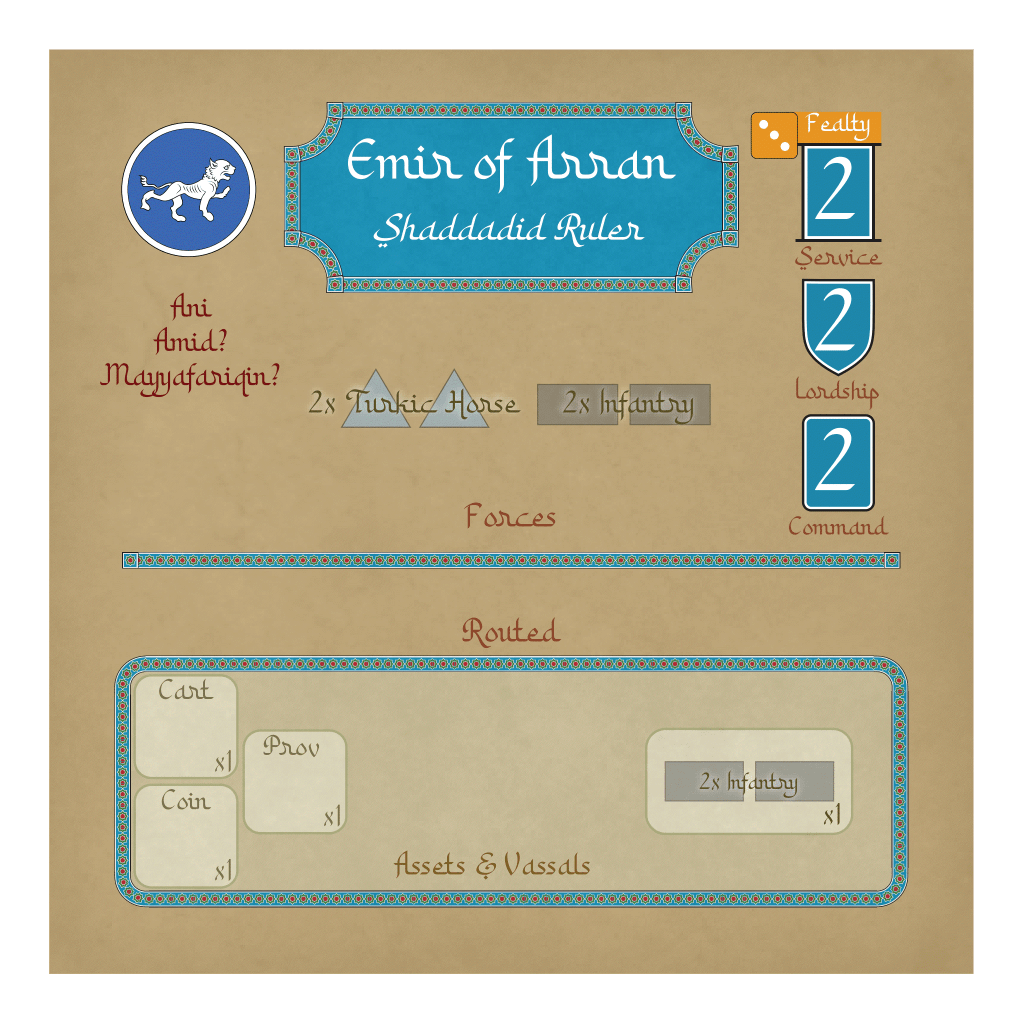
Justin: Below you can see two of the minor Lords from each side (please note that art is not yet final on these). On the left is the Emir of Arran, the head of the Shaddadid Dynasty in what is today Armenia and Azerbaijan. On the right you have his values for Fealty (chances of entering the game), Service (length of time he will stay in the game), Lordship (his ability to prepare for campaigning), and Command (the number of actions he has on his turn). In the middle are his starting forces, and on the left are his Seats, with Amid and Mayyafariqin being locations that can become Seljuk Seats if certain conditions are met. At the bottom are the emir’s starting assets and vassal units that can be mustered into the game.
Next is the infamous mercenary ‘Roussel de Bailleul’, who was present in the Roman army at the Battle of Manzikert, but who rebelled shortly thereafter as he attempted to carve out a kingdom for himself near his home base of Ankyra (Ankara) in the 1070s.

Grant: What is the Command and Valor Rating on the Lord Mats? How do these values compare across the different Lords for both sides?
Justin: Command is the state that governs the number of actions each Lord will get when their card is revealed. These will range from between two and four (for each side’s overall commander). Seljuk does not actually feature Valor as a Lord rating.
In general, the Roman Lords have slightly higher Command Ratings, but lower numbers of troops, while many Seljuk Lords have Command Ratings on the lower end, but have many more Turkic Horse units in their armies. There are exceptions, however. Both Alp Arslan and Romanos Diogenes were extremely capable heads of state and commanders-in-chief, which will be reflective in their ratings, and each of them had capable sub-commanders as well.
Grant: How can Lords be persuaded to switch sides? What type of tension does this mechanic create?
Justin: So right now we’re testing out a system that borrows somewhat from Inferno‘s Treachery mechanic, but also functions somewhat differently. Specific Lords on each side have the potential to switch factions (or at least rebel and work against their starting faction’s best interests) as they did historically. For the Romans, that is the Norman mercenaries Robert Crépin and Roussel de Bailleul, and for the Seljuks it’s the Sultan’s brother-in-law Arisighi.
Certain Random Events, when drawn, will instruct you to place a Treachery Card in your Campaign Deck for the upcoming season. When revealed, you will have the option to target one of the Lords depicted on the Treachery Card to make a Loyalty Check. You then make a roll against that Lord’s Fealty, and if it’s higher than his Fealty, that Lord will join your faction the campaign phase after next. The catch: both sides can pay Coin to give the die roll a +1/-1 die roll modifier. So making sure you have Coin at the right time and in the right ways is one of the tensions of the game’s asset management.
So far in playtesting it’s working quite nicely, and thanks to feedback from the game’s developers Christophe Correia and John Campbell, it’s evolved from its original implementation early on.
Grant: What role do the cards play in the design?
Justin: In typical L&C fashion, the dual-use nature of the cards is one of the most interesting parts of bringing out the history of the game. I have opted to make some Events (and a few Capabilities) once-per-game occurrences. For example, the Siege of Bari Event (which historically concluded in 1071) can only happen once in the game, and it siphons off some of the Romans’ manpower to deal with the Norman threat in Italy. Once it’s happened, if that Event Card is drawn again, there will either be a secondary minor effect that triggers, or you will discard the card and draw a new Event. Each side has a few of these cards that represent key moments in the period, and they usually have significant effects.
I’ve also tried to bring about a lot of counter-play options for the Capabilities in each deck. Both sides will have ~25 cards to play with, and there will be ample opportunity to enhance your various units with different combat and movement options to try and gain the advantage over your opponent.
Grant: Can you show us some examples of cards and explain how they work?
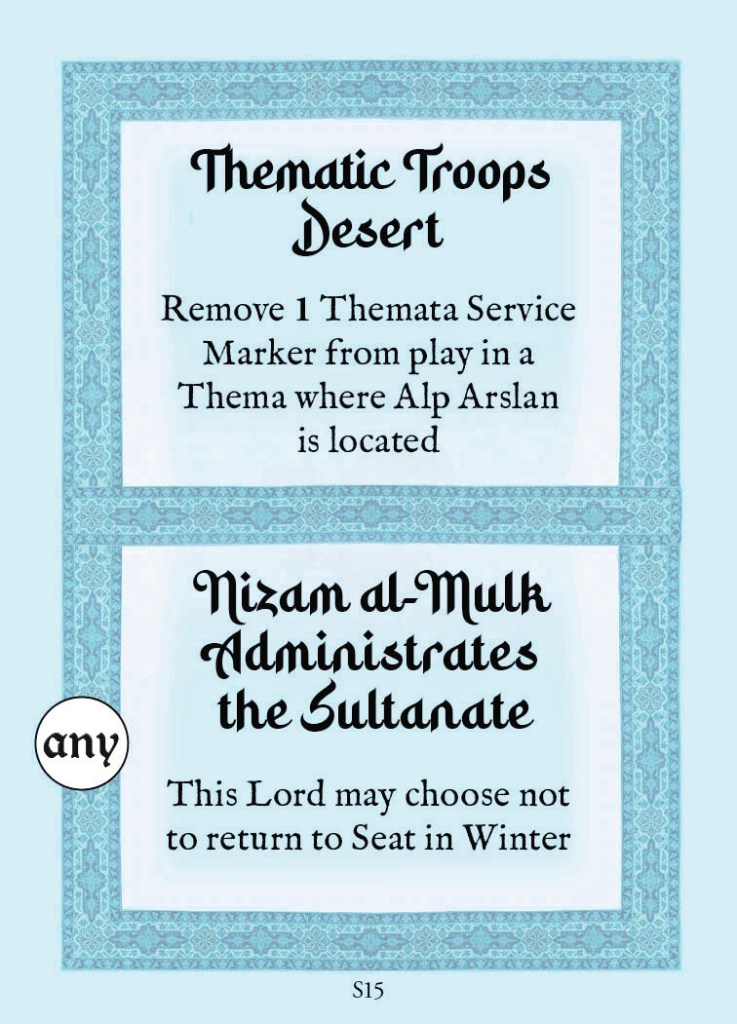
Justin: Sure! In typical Levy & Campaign fashion, the text on the top of the cards are the Random Events that each side will pull at the start of each turn. I’ve included an example of a once-per-game event with the Roman card. The bottom of the cards are Capabilities that can be mustered during the Preparation Phase of each turn and equipped to your Lords.
The Seljuk card below is a Capability that any Seljuk Lord can muster and allows them to stay in the field over winter (something that was not common but happened occasionally during this period). The Roman card is an ability that only the Normans can use, and increases their ability to muster during the Levy Phase.
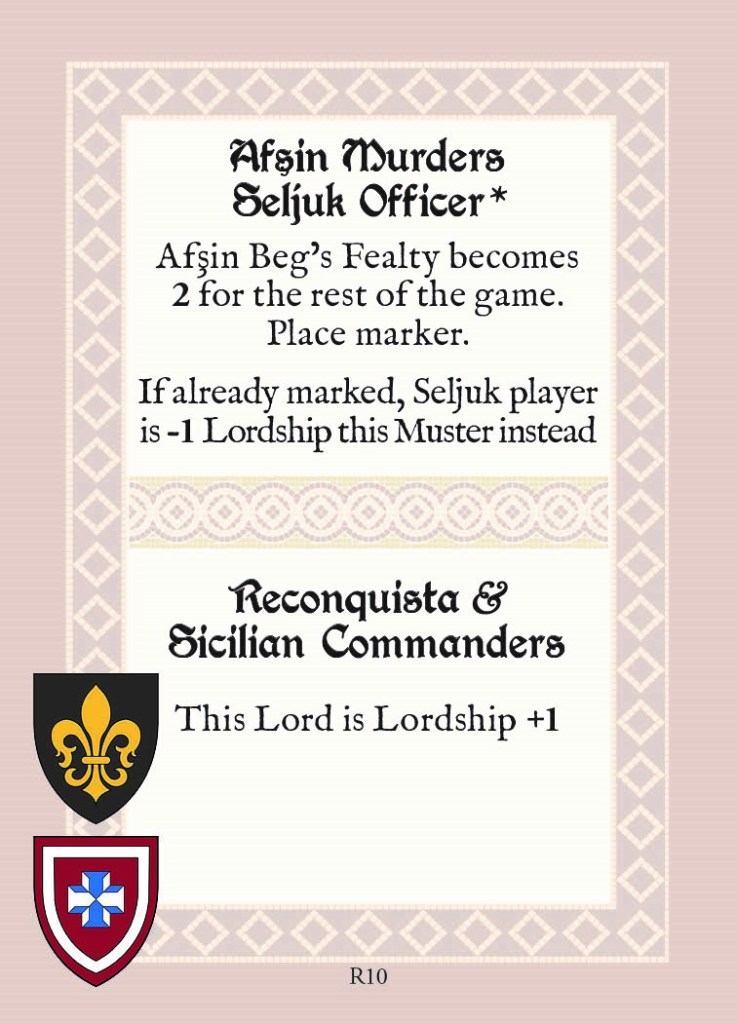
I should note that we are in the process of finalizing the text on all the cards, and there may be revisions in the final versions of what is seen here. Volko recently took a fine-toothed comb to all the cards, and we’re getting closer and closer to final content on these.
Grant: How does combat work? How did you go about deciding to assign relative strengths to different unit types? What is the best unit on the field?
Justin: Combat will be very familiar to those experienced with Levy & Campaign, I am trying not to reinvent the wheel here. There are a couple minor tweaks; for example, a single Lord with only Turkic Horse units facing off against a single enemy Lord, when choosing to concede the field in combat, actually swaps around who does x1/2 hits. In a normal L&C battle, the conceding Lord would only do x1/2, however in this specific instance, it will actually be the enemy Lord who suffers this penalty, which is a reflection of the masterful feigned retreat tactics of mounted steppe warriors.
Grant: What area of Asia Minor does the board cover? What strategic considerations are forced on players by the terrain?
Justin: The map will cover the area between the Black Sea in the north to northern Syria in the south, and the city of Ankyra (modern day Ankara) in the west to Lake Van and the Armenian Highlands in the east.
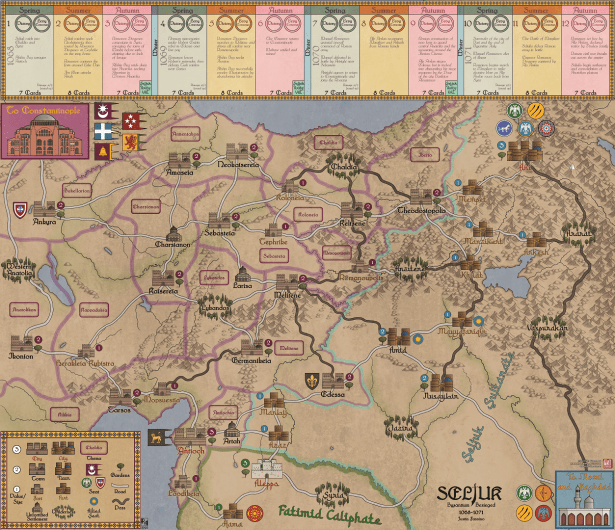
As one would expect, the terrain in such a harsh part of the world was a key obstacle and strategic consideration when it came to military campaigning. The map has both roads and passes connecting the locales, and passes cost extra commands to move and supply across and are also pivotal to certain card effects that can happen if a Lord is on a location connected to a pass, including bad weather, which will close all the passes on the map in spring and autumn if it’s pulled as a Random Event. I wanted the harsh seasons of this arid, high-elevation part of the world to play a big role in the game, and without letting players have control of it. In playtests, we sometimes see Lords get socked in between passes during the shoulder seasons, and that level of push-your-luck cause and effect creates really memorable narrative moments.
Grant: What have been some changes that have come about through the playtest process? What still needs work?
Justin: I love this question, because without a doubt this game has been a design journey. As I mentioned before, the Treachery mechanic is a result of the development team’s dedicated playtesting. Feedback from people on social media and boardgamegeek have also refined the historical research and led us to changing the titles of cards and locations to be more historically accurate.
We’re still working on making sure there are no card effects that are too overpowered (or underpowered), and we’re continuing to refine the Seljuk Unity values for each year (this is the amount of ravaging success the Seljuk player is required to achieve each winter season); getting that right is critical to making sure we have a balanced, competitive, and enjoyable game.
Grant: What role has your development team of Christophe Correia and John Campbell played in the design?
Justin: They have been amazing contributors! Christophe helped me repeatedly playtest the game over and over when it was still going through design iterations on Tabletop Simulator. He’s also been instrumental in pushing along the art process and evaluation of the game in relation to the rest of the series for GMT. John has also playtested quite a bit, and has helped with the historical research. Both of them have keen mathematical minds, so they’re able to spot balance issues pretty quickly (and they’re both insanely good L&C players to boot).
Grant: Who is your artist? How has their style helped solidify the theme of the time?
Justin: Robert Altbauer and Matthew Wallhead, the team behind Inferno, are lending their amazing talents to the game. We’ve also got a third artist who I am a big fan of doing the cover, and I’m looking forward to sharing that with everyone when it’s ready.
Grant: What are you most pleased about with the design?
Justin: I think mainly how accurate to history all the games I’ve seen played wind up being, whether in big ways or small ways. It’s so hard to design a game that doesn’t spin off the historical rails into ridiculousness while at the same time giving players lots of decisions or the ability to explore counterfactuals. The game just feels really good in that regard, and achieving that was one of my goals right from the very beginning. It definitely gives me a new perspective and respect for wargame designers who are able to do that every single time they release a product; it’s not easy.
Grant: What has been the response of playtesters?
Justin: So far it’s been great! I’ve been taking the physical prototype to game conventions around the west coast for the last couple years, and everyone who has played has told me they enjoyed it. I’ve even got fellow Byzantine-philes approach me to talk about history. For people who are aware of the period and topic, I think there’s a lot of excitement for a game in this setting.
As I write this, the design and development team of The British Way are playing a campaign game of Seljuk on VASSAL, and they seem to be having a great experience, even organically recreating historical moments through their gameplay.
Grant: What other games are you currently working on?
Justin: Right now all my design time is in making sure Seljuk is the best game it can possibly be. After it’s ready to fly, I have some preliminary research done about the Pig War of 1859, an obscure conflict-that-was-not-a-conflict between the US and Britain in Washington State right before the American Civil War. There are to my knowledge no games about this history, and outside of the local area here, not much popular knowledge. I am hoping to make that the subject of my next game design, whenever that happens to be.

Thank you so much for your effort in answering our questions Justin and for the great information you have shared. I am even more excited about Seljuk now that I have heard the inside information and also felt your passion and energy for the subject.
If you are interested in Seljuk: Byzantium Besieged, 1068-1071, you can pre-order a copy for $69.00 from the GMT Games Website at the following link: https://www.gmtgames.com/p-1025-seljuk-byzantium-besieged-1068-1071.aspx
-Grant
 The Players' Aid
Grant, could
LikeLiked by 1 person
Sorry, misfire….
Grant, you forgot to mention the other L&C (Medieval) P500: Žižka: Reformation and Crusade in Hussite Bohemia, 1420-1421…
LikeLiked by 1 person
Yes you are correct. There are so many it’s hard to keep up! I’ll be doing an interview on that one soon as well as the new Levy & Campaign Ancients volume Epipolae.
LikeLike