I have had my eye on a certain wargamer/new designer/innovator/solo bot expert since I came across his great Twitter feed about 5 years ago. VPJ Arponen has delighted many of us with his interesting play pictures of various COIN Series games and his insights into the world of solitaire bots. In fact, last year, we worked with Vez on posting 2 Guest Blog posts on our site covering his experiences with solitaire bot design. Volume 1 was titled “The Science of the COIN Bot” and was a very interesting look into some of Vez’s work on COIN games such as A Distant Plain and Colonial Twlight and Volume 2 was titled “Hitler’s Reich, or a “Bot” Driving Toward Moscow”, which focused on his efforts to assist with the solitaire side of Hitler’s Reich designed by Mark McLaughlin. We also worked with him on an interview for his great 3-player COIN Series game entry All Bridges Burning and also posted about a dozen Event Card spoilers from that same title. A few months back, his new design called Order & Opportunity was announced by GMT Games and we reached out to him to get an idea about what this new game focused on the making of the post-Cold War World is about.
*Please keep in mind that the artwork and layout of the various components shown in this interview are not yet finalized and are only for playtest purposes at this point. Also, as this game is still in development, card and rules details may still change prior to publication.
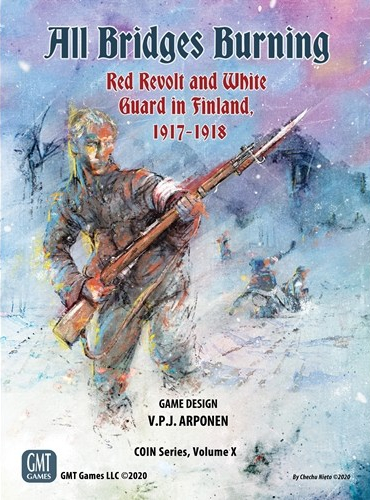
Grant: How has the experience of working on your 2nd design been different from your first game All Bridges Burning?
Vez: Oh, it’s been a wildly different experience! With All Bridges Burning I had the tried and tested frame of the COIN Series mechanics and dynamics to build upon — even while All Bridges Burning does diverge from many of the other COIN titles.
By contrast, with Order & Opportunity I didn’t have a precedent of any kind to build upon, no set of mechanics and dynamics to guide the design process. I was free to choose any starting point I fancied. Freedom like that can be daunting.
And so, it took some time, a considerable length of time, to explore that universe. That has been an immensely rewarding but, also at times, a taxing experience — and it didn’t help that we had the Covid pandemic right in the middle of the design process.
I want to highlight that Volko Ruhnke (the COIN Series originator) and GMT Games are doing an excellent and very generous job with allowing their established series, like COIN and now the Levy & Campaign Series, to act as platforms for bringing in often young and inexperienced designers into the design hobby. I will be eternally thankful for the opportunity I received with All Bridges Burning. Without that opening, it would have been much harder to be here today talking about Order & Opportunity.
Grant: What is the focus and historical period covered by your new design called Order & Opportunity?
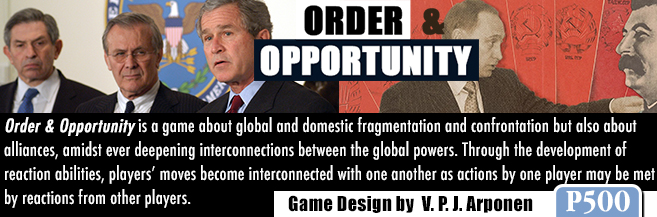
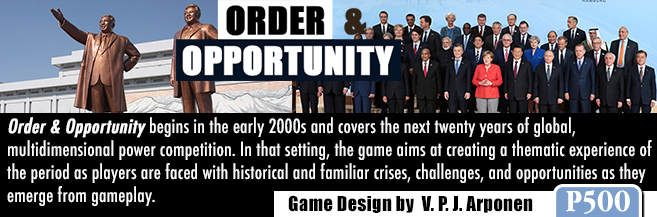
Vez: Thematically, Order & Opportunity is focused on the post-Cold War period from around the year 2000 to the present.
Order & Opportunity takes a global view of the situation trying to say something about selected political, military, and economic factors that have shaped the world over the last two decades of the post-Cold War period — a formative period for many of us younger folks in the historical gaming hobby.
Come to think of it, in hindsight, I think every design I have done (including many of those still “in the drawer”) have been autobiographical somehow, and so it is also with Order & Opportunity.
All Bridges Burning was an attempt to understand a foundational period in the origins of my country of birth, Finland. It was a very difficult and tragic birth process characterized, among others, by grave political polarization.
With Order & Opportunity, I began from a similar place. Many of us in the Western world have been touched by increasing polarization in our societies. I became interested in the phenomenon of polarization and in its many roots, among others in economic globalization — a quintessential process of the post-Cold War period.
From there the game expanded into looking at what had come in the post-Cold War period of the promises made at the “end of history”, that is, at the end of the great ideological rivalry as Democracy defeated Communism. Those promises forecasted global freedom, trade, and prosperity, but instead what we got were excesses of globalization, military adventurism and challenges from China’s “peaceful rise”, not to forget a resurgent Russia under Putin.
And so, at some point I found myself designing a game on the post-Cold War period more broadly.
Grant: What does the name signify in regards to the game and the situation it covers?
Vez: The name denotes two big themes of the (still young) post-Cold War period as the game understand it.
The word “order” denotes the idea that, with the end of the Cold War, the so-called liberal rules-based order seemingly won the day. Democracy won the great rivalry of ideas. Democracy was now to flourish powered by freedom, trade, and prosperity for all. That promise sets the stage for the post-Cold War period.
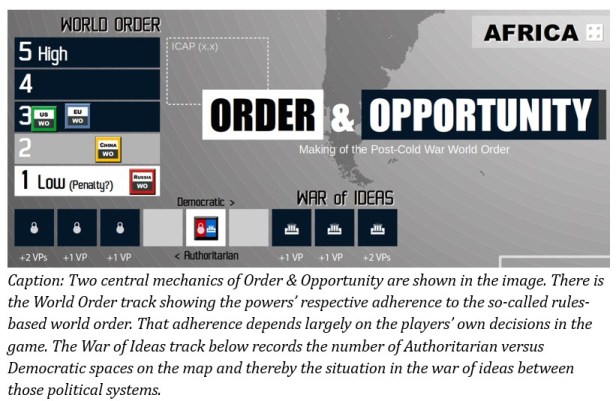
By contrast, the word “opportunity” denotes the kind of short-sighted opportunism that soon began to undermine the beautiful vistas that seemed to lay before us at the end of the Cold War. That is a central theme in the game: with every action you take tangled in the web of your own creation and struggle to maintain the foundations of the rules-based order. Central dimensions of this undermining are the Western military adventurism and the excesses of economic globalization.
I wrote about the “academic” side of these dimensions at length in a number of articles for the GMT Games’ blog, InsideGMT. [https://insidegmt.com/order-opportunity-a-perspective-to-the-post-cold-war-period/]. Interested readers can find out more about details of the game’s perspective in those sources.
Grant: What powers are playable by players? How much asymmetry is found in their makeup?
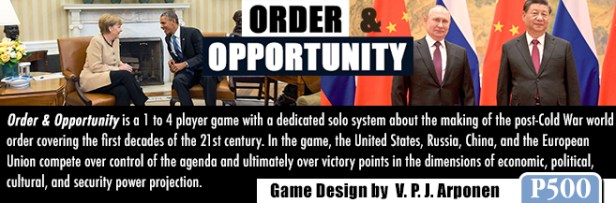
Vez: The four powers in the game are the United States, European Union, the People’s Republic of China and the Russian Federation.
I should note that, while it features four powers, the game is by no means an exclusively four-player game. The game will ship with variants for one, two, and three players, and we’ve had great playtest experiences with all those counts.
But I digress.
In regards to asymmetry, each power in the game has their own, partly unique and asymmetric deck of cards.
In addition, there are some asymmetric ways in terms of which powers may inflict VP losses on each other. For example, the democracies — the US and EU — have their military strategic preponderance to lose while the Authoritarians — Russia and China — can challenge it.
Then there is the EU who does not have its own military influence pieces at all. Instead, if they wish to be active in the military influence dimension, it has to by way of using NATO influence — which the EU shares and uses jointly with the US. From there, a complex alliance relationship emerges that the US and EU players have to somehow negotiate while only one of them can emerge victorious at the game end.
Further asymmetry comes from the differing board positions of the sides. For example, the US starts in a dominant position while China considerably less so and so, China has to build up their position as a global super power.
From those asymmetric positions, the powers launch into the pursuit of victory points in symmetric ways, chiefly by resolving so-called World Events and by bringing regional scoring cards, so-called Pivotal Events, into play and seeking to score them in terms favorable to them.
Grant: I notice the game is an area control design using a card driven engine with some deck building. How do these three mechanics work together?
Vez: The area control, or better the area influence aspect of the game, is fairly simple and intuitive. You add your influence and remove opponents’ influence from the map spaces in order to control them or even just exert sufficient influence for resolving World Events. The complication is that there are three different types of influence — Economic, Political, and Military. It seemed important to me to allow a differentiation in terms of the dimension in which a given power can be a global power.
The area influence game is played by using a card driven engine. Instead of the familiar operations points, the cards have a suit that enables them to be used for one of a menu of actions corresponding to each particular suit.
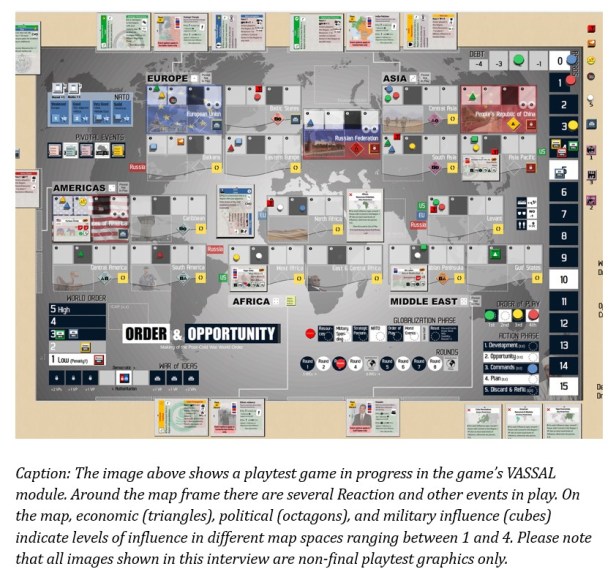
The cards also have an event part as is familiar from card driven games except a bit different. The main difference is that many of the cards can be turned sideways and placed onto the map. When on the map, a different part of the card is activated. One of these is the so-called Reaction ability that allows players to take actions outside of their own turn as reactions to other players’ actions.
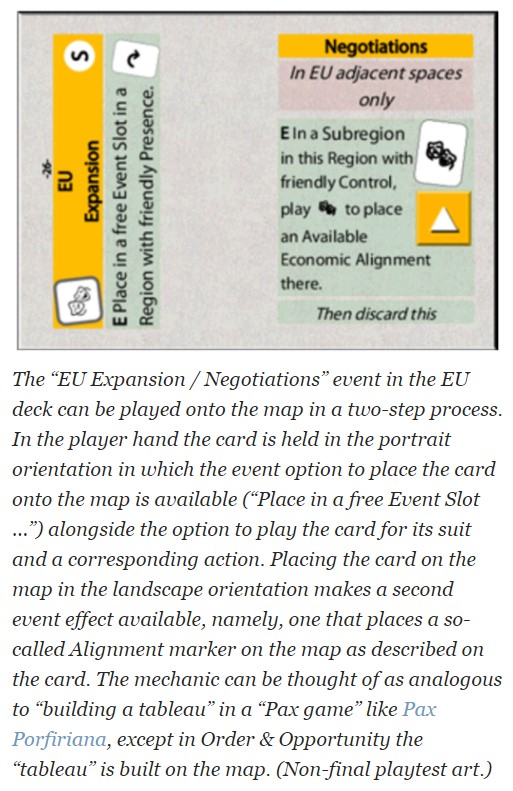
Finally, the deck building element is about allowing players to customize their decks of cards as the game goes on. In a classic deck building manner, players can acquire new cards and get rid of others in order to create decks better at pursuing whatever dimension or dimensions of the area influence game they wish to build their strategy on.
Grant: Can you share with us a few of these cards and explain how they are used?

Vez: Here’s a sample card from the US Deck:
On the top left, the card shows its suit: the shield icon indicates the Security Suit. The player may play this card for one of the two Security Actions: either to Place Military Influence or to Contest, that is, to remove opponent’s influence.
Alternatively, the player may trigger the event part of the card shown below the “War on Terror” title. As the text says, this simply leads the card to being placed onto the map, in a particular region chosen by the player.
With that placement, the sideways Reaction ability is activated. During a later turn, should another player, or indeed the player themselves, conduct a Political or a Security Action in the card’s region, the player could react by conducting a Security Action themselves in response.
Grant: What are World Events and how are they triggered? What type of effects do they have?
Vez: World Events are half-sized cards that get randomly drawn and placed on the map. The World Events represent different historical crises and the like of the period. In the game, the World Events represent something like “battlegrounds” or hot spots around which player activity tends to focus.
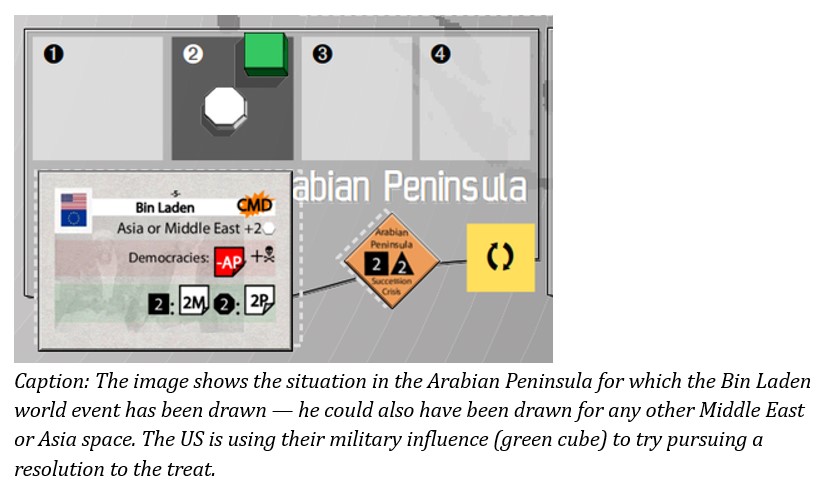
In the game, players can attempt to get sufficient influence in place in order to get to resolve the World Event and earn some rewards. Thematically, as a super power, or a prospective super power, one of your aims in the game is to demonstrate your global leadership credentials by resolving World Events. But beware: other players as well as so-called “neutrals”, regional and other minor actors, might get in your way.
As mentioned above, there are three different types of influence in the game. Accordingly, most World Events can be resolved by more than one type of influence and they yield different rewards accordingly. That is to say, you might decide to seek to bring Gaddafi to his knees militarily or enter the economic or diplomatic negotiation table with him.
There is some diversity to the World events as Well. We’ve got a classic civil wars and rogue regimes of the historical period to deal with (the Taliban, for example), but we also have other challenges like climate change, shipping lane piracy, the Brexit talks, and the Partisan Divide in the United States.
Grant: How does the solo mode operate?
Vez: Often you hear designers say that the solo mode is the last thing to design in a game. You do that when the base game is finished.
Not so for me!
I’ve worked out a design practice whereby I use a solo system, even if a rudimentary one, to test and develop the base game itself. This approach has its blind spots but generally it has worked well for me.
And so, the solo system for Order & Opportunity is pretty much up and running, has been for a while — subject to on-going refinements and fine-tuning, naturally.
As always with solo system design, you are aiming at a sweet spot between usability and challenge.
Usability involves keeping the non-player opponent’s turns as short and straight-forward as possible. For example, in Order & Opportunity, the non-player play is based on drawing cards from the non-player’s deck, then executing the drawn cards according to their suit and a set of decision criteria. Sounds simple, huh?
A complication arises when it is time to figure in which of the game’s almost twenty map spaces the non-player wishes to execute their action. The solo system uses simple and easy to parse criteria like “does the space have a World Event in it?” to guide the non-player decision making.
A classic design technique here is to make the non-player relatively “dumb” and coarse in terms of the criteria it uses to check the map state. After all, what we do NOT want is to have the solo player spend valuable brain power cross checking the map state and the non-player decision criteria.
Part of this technique is that you compensate the dumbness by giving the non-players on average more actions, more card plays, than the player. For example, in Order & Opportunity the non-players don’t generally use any event effects, save very few easy to execute ones. Again, the aim is to make the non-player turns as “no brainer” as possible.
I can safely say that in Order & Opportunity the time you spend playing your own turn is quite a bit longer and involved than what you need to devote to the non-players.
A rarely noted aspect of designing solitaire systems is that, alongside criteria based decisions, an excellent solo system also incorporates a good degree of randomness. Randomness is important for generating surprises for the non-player as well as for allowing the game to produce different trajectories from game to game. In Order & Opportunity, the card draw based non-player turns works to that end.
The end result is a give-and-take solo system that needs to be endlessly stress-tested and put through as many diverse game play situations as humanly possible.
Let me add this. For a long time, and today still, I’ve been a predominantly solitaire gamer. This has had to do with life’s circumstances — you know, the usual thing: family, day job, limited amount of time (and energy!). Also, I’ve got a longer solitaire design history as well (several COINs, Hitler’s Reich, all from GMT Games). Produced in cahoots with Jason Carr and GMT One, gamers can expect a high quality solitaire game product to be delivered with Order & Opportunity.
Grant: What are you most pleased about with the design?
Vez: Oh, this is a great question — and a tough one!
Let me answer it like this. As noted above, due to circumstances, I do a lot of my gaming with the family. And so, we play a range of classic family games — like Wingspan, like Dominion, like Catan (RIP Klaus Teuber). Jump Drive by Tom Lehmann is another favorite. We played some Richard Garfield’s Keyforge lately as well.
What I love about many of those games is the players’ ability to extend and sort of “snowball” their turn as they go.
Dominion may be the best example of this. In that game, you draw your hand of cards for the round, then start playing them in an as favorable sequence as you can think of, generating more actions, more things to do as you go.
I wanted the card play in Order & Opportunity to have a similar quality, that your turn is this process that you can plan and then extend as you go. Not only is this fun, but it let’s you feel like a true mastermind statesman — or stateswoman! — as you plan your activities and let huge turns that just never seem to end roll over your opponents.
I will leave it to the players to decide whether Order & Opportunity achieves this, but that’s been the aim. It’s one thing that I am the most pleased with and proud about the game.
Thank you Vez for your time in answering our questions. I am very much interested in this very engaging looking game and await further information on the game as it plows through design and playtesting. I also want to remind you that we would love to host a series of World Event and Pivotal Event Card spoilers when you are ready.
If you are interested in Order & Opportunity, you can pre-order a copy for $55.00 from the P500 game page on the GMT Games website at the following link: https://www.gmtgames.com/p-1027-order-opportunity.aspx
-Grant


Vez is a genius in working out an AI Bot for various designs. Together with Jason Carr he is one of my top solo designers, along with John Butterfield and Jeremy White.
The bots in both Hitler’s Reich and the Bridges Burning are awesome. Despite these games being burnt down by players no longer able to read … simple rules.
I am VERY interested in this new project by Vez.
LikeLiked by 1 person
Vez is a budding superstar. We loved All Bridges Burning and have used the bits on 2 separate plays. We didn’t love Hitler’s Reich but see why some would. I tried the bit in that one and it seemed arduous.
LikeLike
Wow, putting his name alongside Jason Carr and John Butterfield?! Big praise! Time I pull ABB off the shelf…
Wonderfully insight interview. I initially thought from the name this was another title in the Triumph & Tragedy / conquest & consequence series. Clearly it’s not. After reading this article I’ll need to investigate this game more (and inevitably p500 it… damn it Grant 😜🤣)
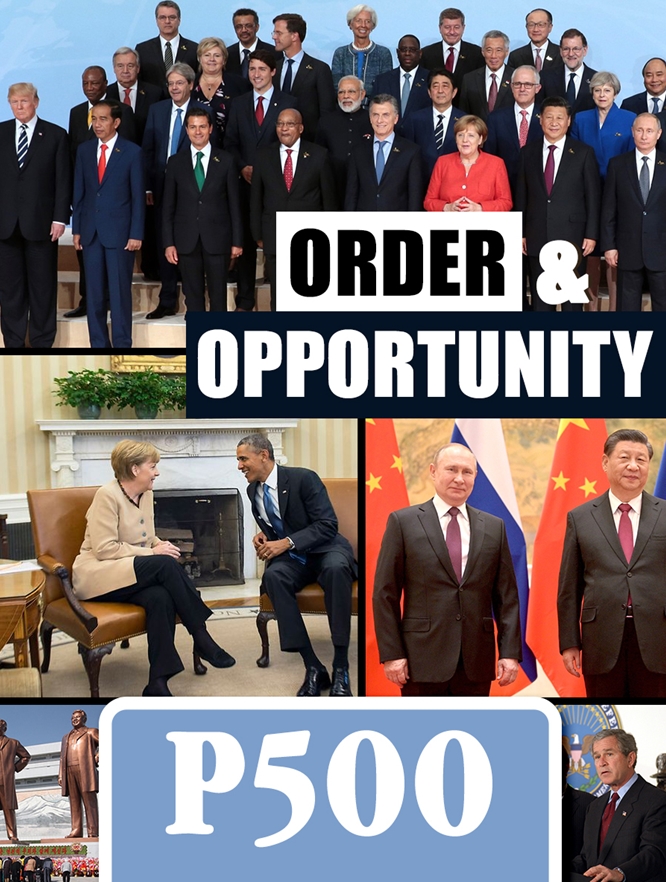
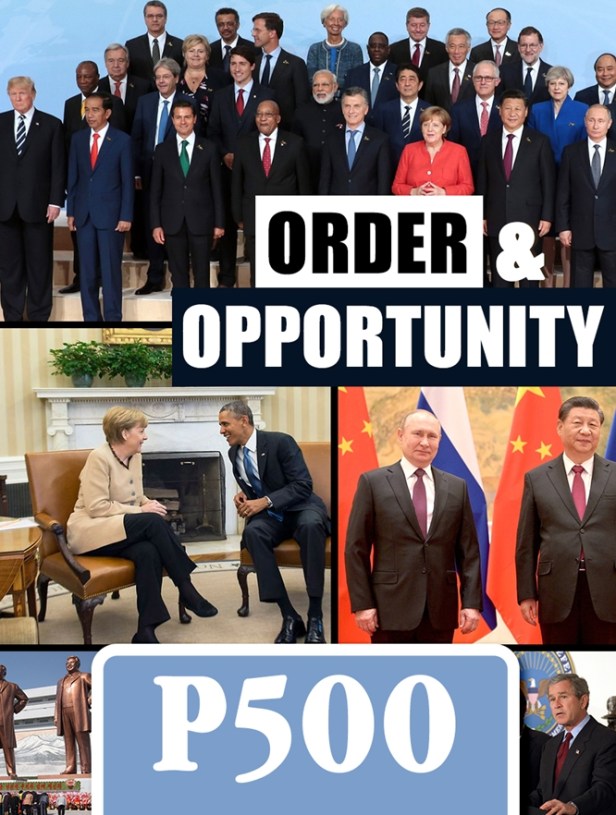
One last thought; with the design, if Putin is on the cover, how about putting the title over most of his face to hide and minimise him. 😉 Just throwing that idea out there…
LikeLiked by 1 person
I agree: Vez is a talent in many areas, and quite pleasant to work with!
LikeLiked by 1 person
Thanks everyone for their kind words and thanks for your support of O&O!
Carter: We did worry about the structural similarity of the title to those you mention, but it was tough enough to come up with a title as it was, so this is what we went with.
PS. I’ll pass that cover graphics design idea to the art department.
(Needless to say, the P500 thumbnail images and the rest of the art you’ll see on the game anywhere is very much playtest art only. GMT’s artists will make it all pretty in due course.)
LikeLiked by 2 people
Thanks Vez for doing the interview. Great views already. I hope it helps move the needle in the P500 orders. Also we would be more than willing to host card spoilers on the game if you are willing.
LikeLiked by 1 person
Thanks, Grant. I‘ll get to work on some of those card spoilers! O&O isn‘t your standard CDG so this could be a great chance to shed some light on the cards in the game.
LikeLiked by 1 person
Exactly! I think it would help people really get a feel for the game and how it plays but also what the cards are really like. Thanks Vez.
LikeLiked by 1 person
Yes – to card spoilers. 😎 They bring anticipation and excitement (and teach a little history) to a game before it arrives. Thanks Vez.
LikeLiked by 1 person