We became acquainted with Maurice Suckling with his game Freeman’s Farm 1777 from Worthington Publishing in 2019 and really enjoyed the different mechanics of that game and how they all came together to create an interactive and interesting look at the Battle of Saratoga during the American Revolution. Since that time, Maurice has designed several games that have went onto successful Kickstarter campaigns including Hidden Strike: American Revolution, Chancellorsville 1863 and 1565 Siege of Malta all from Worthington Publishing. He is now codesigning a game with Daniel Burt called Rebellion: Britannia that is the first entry in a future series from GMT Games and we agreed to host a series of Event Card Spoiler posts here designed to give our readers a look into how the game works.
If you are interested in Rebellion: Britannia, you can pre-order a copy for $52.00 from the GMT Games website at the following link: https://www.gmtgames.com/p-989-rebellion-britannia.aspx
*Please keep in mind that the artwork and layout of these cards is not yet finalized and is only for playtest purposes at this point. Also, as this game is still in development, card details may still change prior to publication.
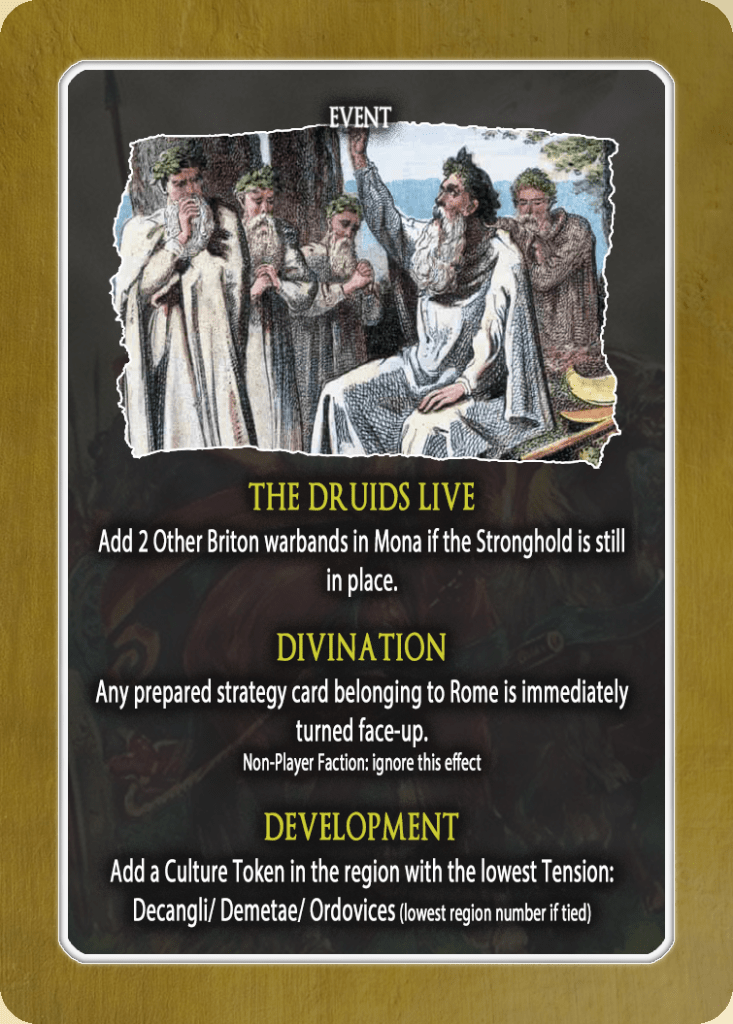
Card #8
The Druids Live
This part of the card spawns two Other Briton Warbands in Mona if there is still a Stronghold at that location. Mona was the center of druid culture at the time, and as such was considered a sacred and important place to all of the Briton Tribes and was therefore fiercely defended. These types of cards keep the Rome player unsure about what may or may not happen in areas that they control or are in the process of controlling. This uncertainty is key to the design and never allows players to get comfortable with their position on the board.
Divination
The druids were believed to have the ability among many things to see the future, and this step forces the Rome player to immediately turn any prepared card face-up. As the Briton players act before the Rome player, this allows them to be aware of, and react to, any prepared strategy that the Rome player had in play for this turn. This advantage is very important to the Tribes and must be used in order to get a head start on reaction to Roman plans.
Development
We have already covered Development on a previous Card (Card #1) but it is important to the game for the Tribes and was included on several cards to give it a better chance of appearing.
Development concerns indigenous British culture. It’s a later addition to the design and something we are still exploring in development. Early playtesting exposed the possibility that we weren’t giving the British factions enough interesting opportunities to earn early VP’s. We also had a concern that we weren’t representing enough of indigenous British culture within the design – there was some reference to the destruction of it through the rise in British Tension as a result of Roman buildings and roads – ‘Romanizing’ the British landscape and scarring and irretrievably altering it – but no real reference to its growth or sustenance. These were omissions we sought to address through a new system. This system would incentivize a more pliant approach to Rome and discourage military resistance. British factions would now have a reason to focus on non-military actions, and to therefore highlight other strands of their cultural identity within the framework of the game. It would theoretically be possible to win without ever fighting, but through careful management of cards to secure hegemonies in trade, agricultural production, the generation of crafts, the protection and development of ceremonial sites and customs. But this system would need to have a light design footprint – meaning it would be easy to learn and to integrate into the existing game.
All Briton Faction Deck cards belong to one of four suits:
- Agriculture
- Crafts
- Ceremony
- Trade
Each of these suits reflects a key aspect of British culture at the time. At the end of the game the Briton player with the highest sequential run of each suit in their discards wins that suit (i.e. unbroken by cards of a different suit) and is awarded the number of VP’s equal to the sequential run.
This incentivizes British tribes to prioritize cultural concerns over making war. But then, for Rome this could be bad news as immensely stable and culturally successful but placid tribes might ultimately be a threat to Roman hegemony.

If you missed the previous entries to date in the series, you can catch up on the posts by following the below links:
Card #1 Roman Supply Lines Tested, The Tribes Bristle and Development
Card #2 Military Occupation, Clash of Cultures and Prasutagus Dies
Card #3 Bountiful Land, The Tribes Bristle and Venutius Rebels
Card #4 The Power of the Druids, The Tribes Bristle and Petuaria
Card #5 Salt Trade, The Tribes Bristle and Prasutagus Dies
Card #6 Tin Mines, The Tribes Bristle and Cartivellaunos
Card #7 Roman Britain and Caratacus Captured
This is the last of our Event Card Spoilers for Rebellion: Britannia and we wish to thank Daniel Burt and Maurice Suckling for their effort in preparing these posts for us. There are more cards in the game than we could show here so there is plenty for you to explore in the game when released in the future. In the meantime, if you are interested we posted an interview with the designers and you can read that at the following link: https://theplayersaid.com/2023/01/09/interview-with-maurice-suckling-designer-of-rebellion-britannia-resistance-against-rome-in-1st-century-britain-from-gmt-games/
If you are interested in Rebellion: Britannia, you can pre-order a copy for $52.00 from the GMT Games website at the following link: https://www.gmtgames.com/p-989-rebellion-britannia.aspx
-Grant
 The Players' Aid