
After a pretty rough day of travel yesterday, our plane landed in San Diego around 11:45pm. By the time we got to the rental car center to get our car and made it to the air bnb it was 12:30am. I only got about 5 hours of sleep due to a combination of the room having no curtains, an early sunrise and the time difference. But we made it out of the accommodations around 7:30am and ate breakfast at the very popular Point Break Cafe where we saw plenty of gamers, designers (David Thompson and Liz Davidson), content creators (ZillaBlitz and Grant Linneberg with Pushing Cardboard) and friends we had a fantastic Southern California breakfast and arrived at the S.E.S. Portuguese Hall of San Diego at 8:30am and began setting up for our first game of the day Baltic Empires from GMT Games.
Baltic Empires covers the period in the Baltic region from the collapse of the Teutonic Order in 1558 to the end of the Great Northern War in 1721. The game really focuses on representing both the mercantilist economic thinking of the time, the very limited resources at hand on the state/ruler level and the destructive nature of warfare and its effects on the local economy. When war occurs in spaces infrastructure can be destroyed and it is very expensive to keep replacing units that just die on the battlefield.
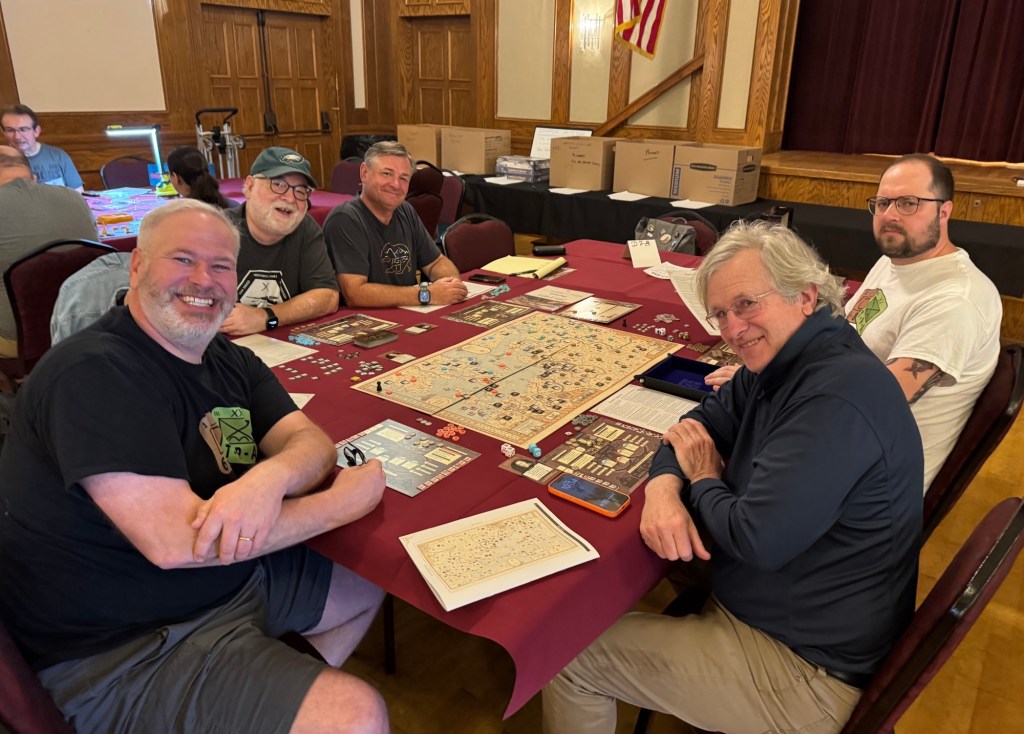
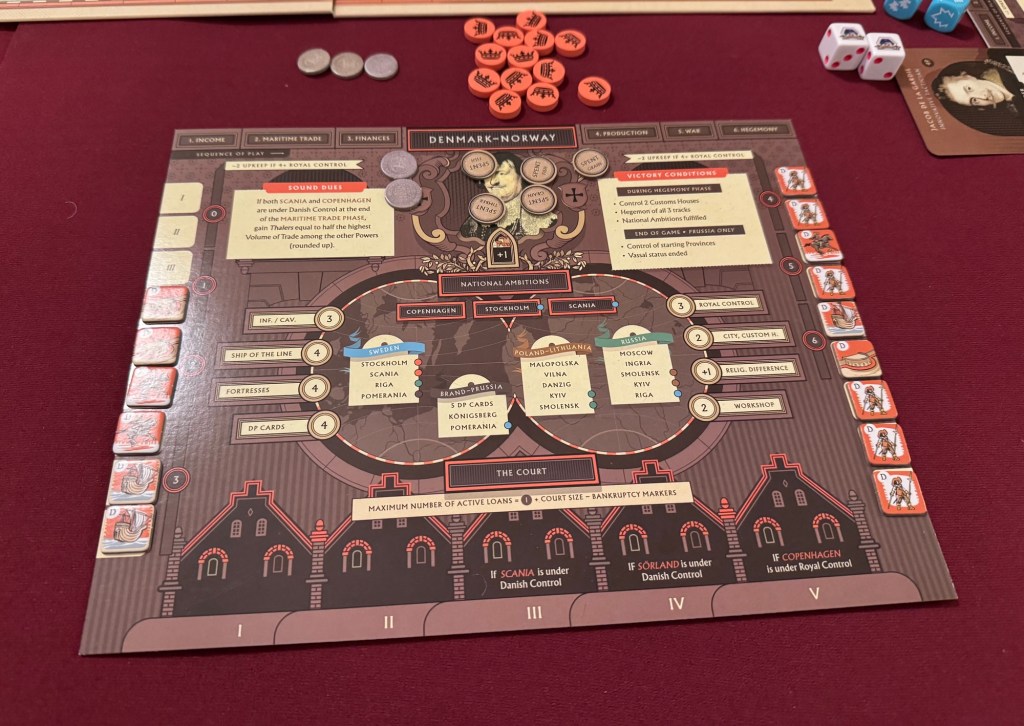
The game has 5 factions including Denmark-Norway, Sweden, Poland-Lithuania, Prussia-Brandenburg and Russia. Each power has 2 common victory conditions and 1 or 2 that are specific to that power. The shared victory conditions are either control of 2 custom houses or being the hegemon on all 3 tracks at the same time.
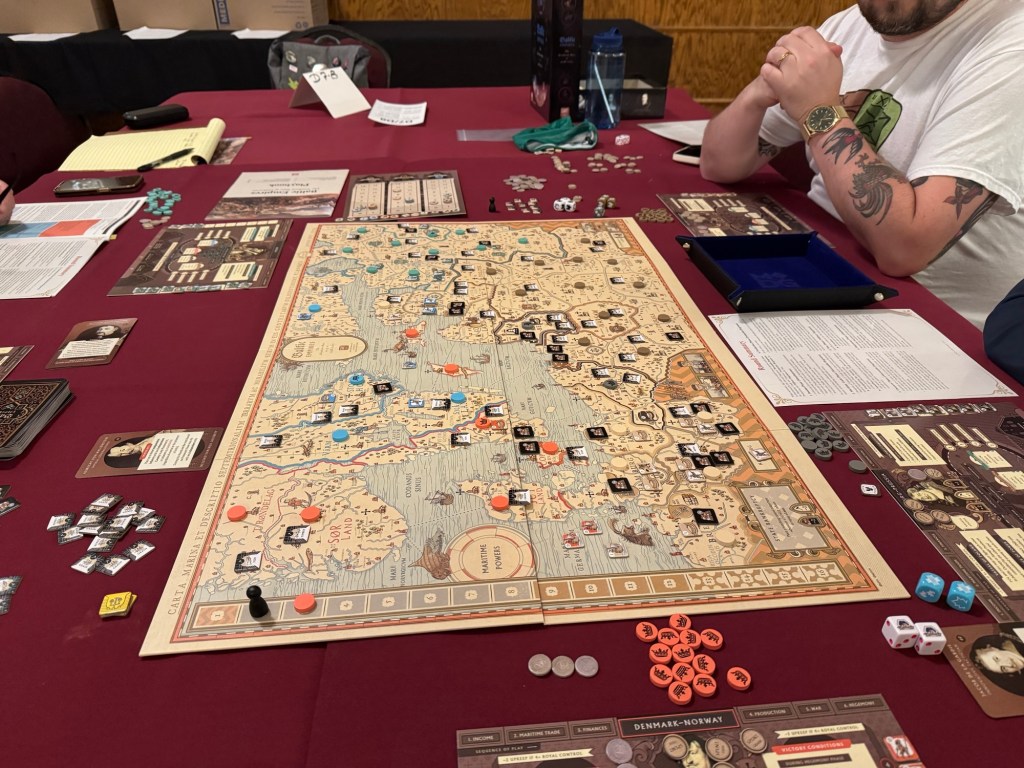
One of my favorite parts about the game was that each turn, 5 Dramatis Personae Cards are randomly drawn from the deck and become available for purchase by the players in the Production phase. These cards have a wide variety of effects, but can be broadly divided into 4 types: those that have permanent effects, those that have one-time effects, those that affect victory conditions and those that provide a special leader unit. These cards are excellent fun and really create somewhat of a race to purchase the best cards before others can acquire them. Now after having said that our draws of cards for the first 2 turns were not good and hardly anyone invested in them but that changed later.
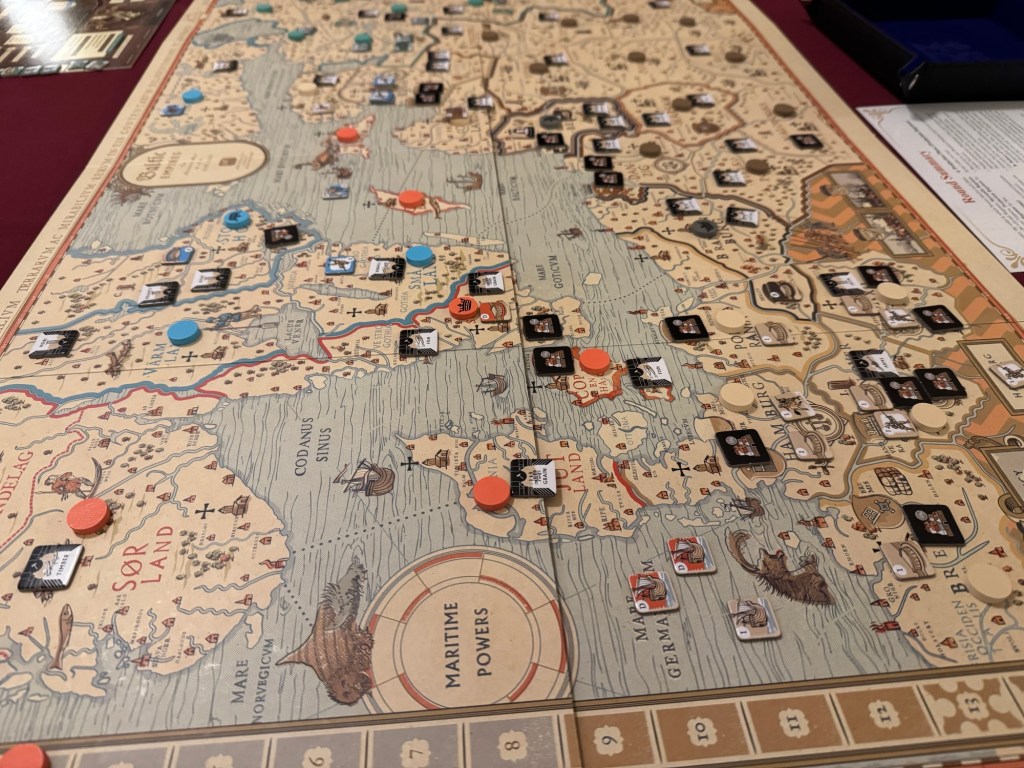
I loved the game and very much enjoyed the lite nature of the game. The economic system is simple, but manages to capture a lot of key elements of this period. Each province has between 0 and 3 resource icons and between 0 and 2 city icons. If a workshop marker is present on a resource icon the province produces 1 of that type of resource and if a city marker is present on a city icon the province produces 1 thaler (the currency of the game). There is one twist though, as provinces under noble control will contribute a maximum of 1 of the resources and 1 of the thalers produced in it to the central administration while the rest is discarded as it goes into the coffers of the local nobility. Only provinces where royal control has been imposed will contribute their full income to the player. In addition to this there are 3 trade center provinces on the map, and these generate extra income for their controlling player as they are able to tax the trade there. Just a great little game that I hope to explore further later.
Alexander’s Poland ran away with it with a Hegemonic superiority victory (Hegemony leader for Mercantile, Production and Military). Great lite wargame similar to Mare Nostrum from Academy Games.
Our next game was a bit deeper and more involved in The Weimar Republic. The game is a Card Driven Game of political struggle in interwar Germany where 4 unique factions compete for dominance including the democratic Coalition, the Soviet-backed Communist Party, Hitler’s National Socialists and the far-right Radical Conservatives. The game covers the Interwar Years between 1919-1933 and represents all of the different fighting factions trying to gain control in Germany’s regions and major cities, to maneuver the political landscape of the Republic, and to dominate through a combination of propaganda, parliamentary elections, street violence and economic influence. This situation sets itself up perfectly for a game to explore the various parties involved.
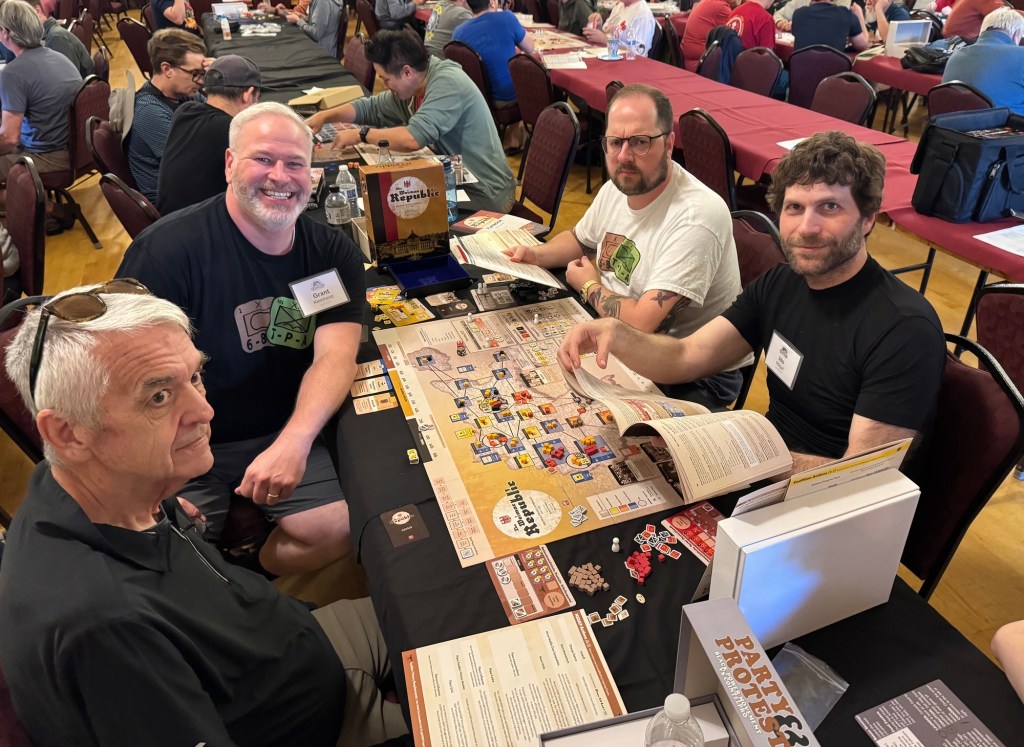
The game makes me think of a COIN Series like game as each faction has their own unique abilities and powers but also win in their own way. The game also visually looks like a COIN game as it uses multi-colored wooden cubes to represent influence in the various districts of pre-WWII Germany.
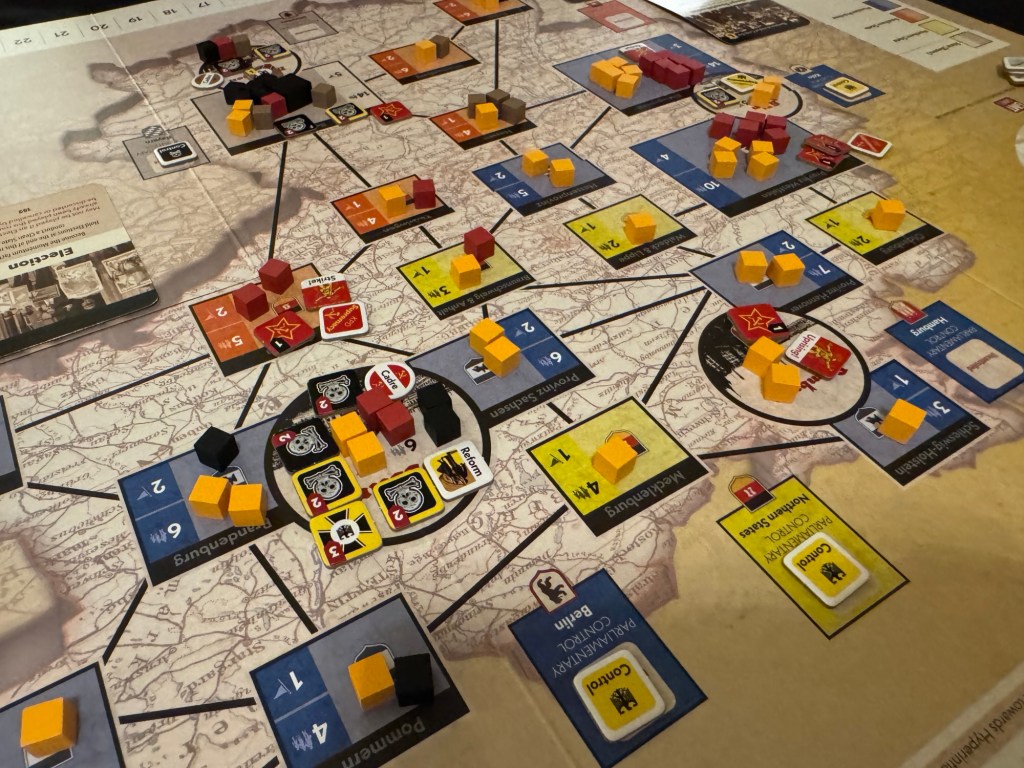
A major focus of the game is the concept of Elections. Each Era has a number of Election Cards (based on the historical number of Elections) that are shuffled into the Event Card decks. When an Election Card is played, both a Regional and a General Election is held at the end of that round. Election scoring is based on players’ Dominance over spaces and Regions, with modifiers such as Middle Class Sympathies, Cadres, military Supremacy, etc. Regional Elections gives Parliamentary Control over the game’s Regions while a General Election can potentially end the game – if anyone but the Coalition wins a General Election, that player also immediately wins the game.
Players draw a hand of cards for each Era and use their AP to conduct Actions. You don’t chose between AP and Event as when you play an Event Card the Event always takes place, unless there are some requirements that aren’t met. You don’t need to play a card every turn – in fact you can’t, as there are fewer cards in a hand than turns in an Era and you may only play one Event Card per turn. However, you always have a basic 1 AP that may be used by itself or in combination with any Event Card played, so during some turns you will be using only that basic point. You can also pass which allows you to discard a card and draw a new one.
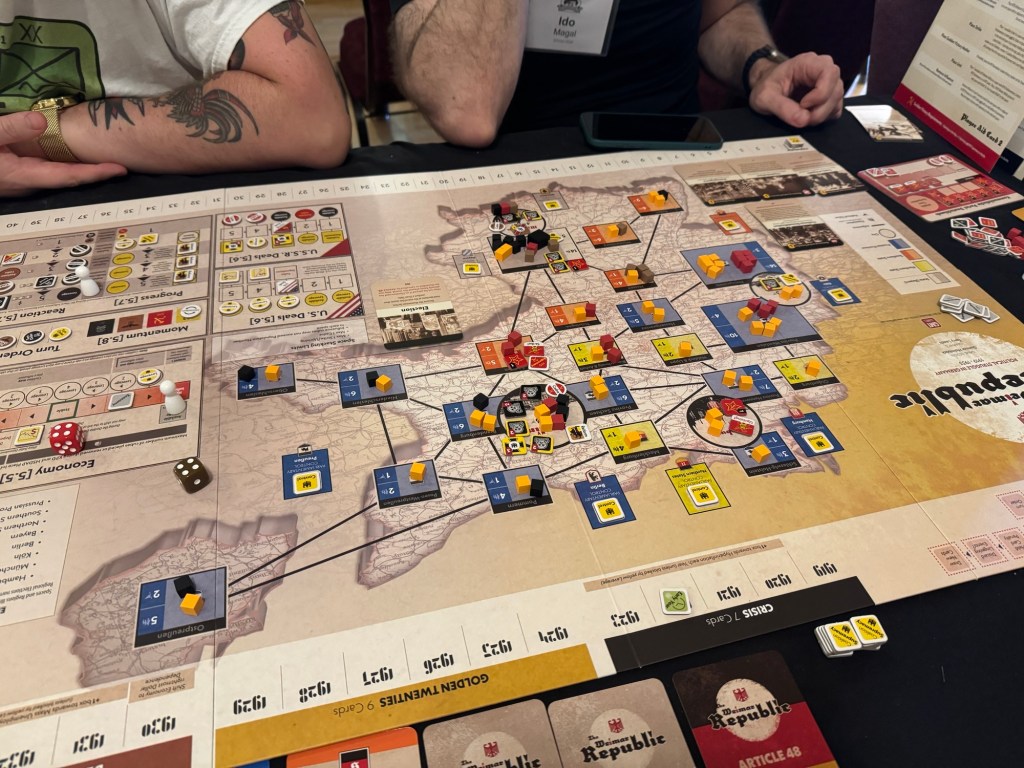
I very much like what I was doing but need to continue to learn the rules so I know what I should be doing. We had a good time and I look forward to another play in the near future. I was able to pull a victory out as the Coalition, which I understand is generally pretty difficult.
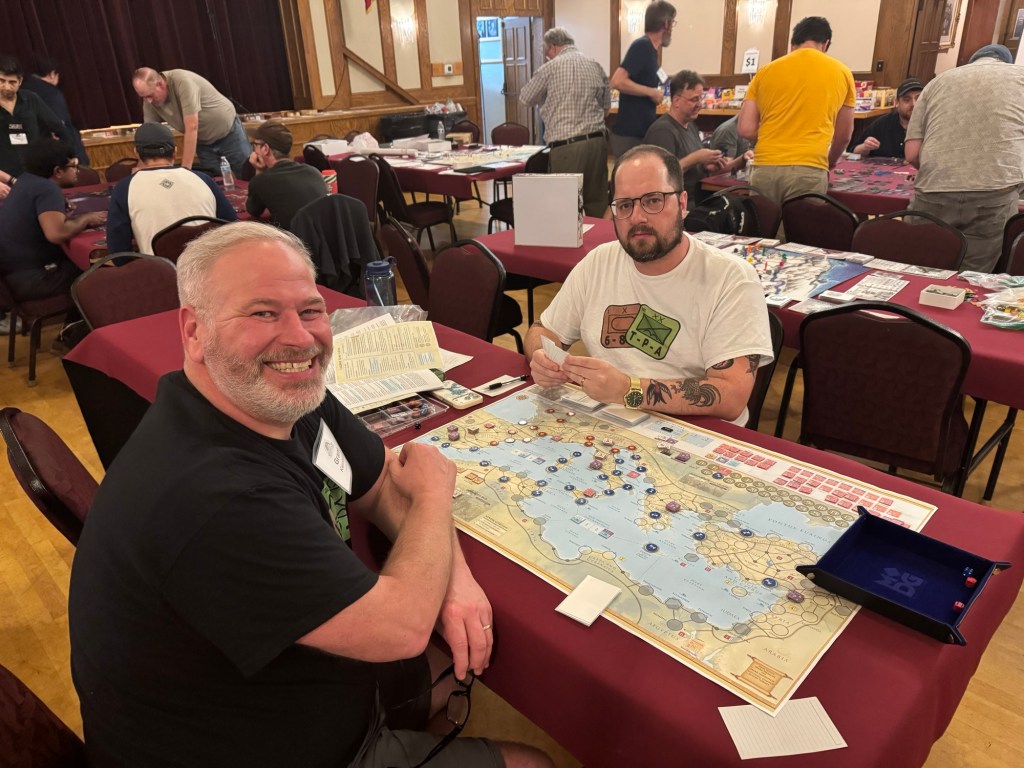
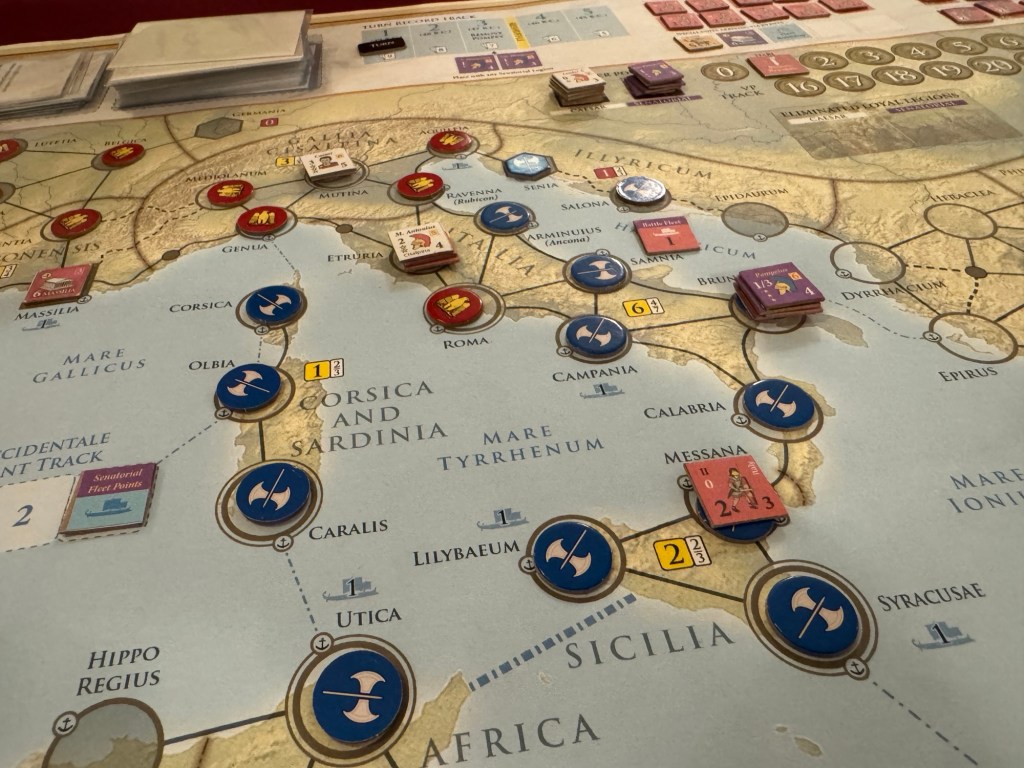
Our final game of the evening was a look at a new and as-of-yet unannounced collaboration between Mark Herman and Mark Simonitch called Caesar: Rome vs Rome. This game is a CDG and uses the same system found in Caesar: Rome vs. Gaul from GMT Games but covers the Roman Civil War where Caesar confronted the Republic and the forces of Pompey.
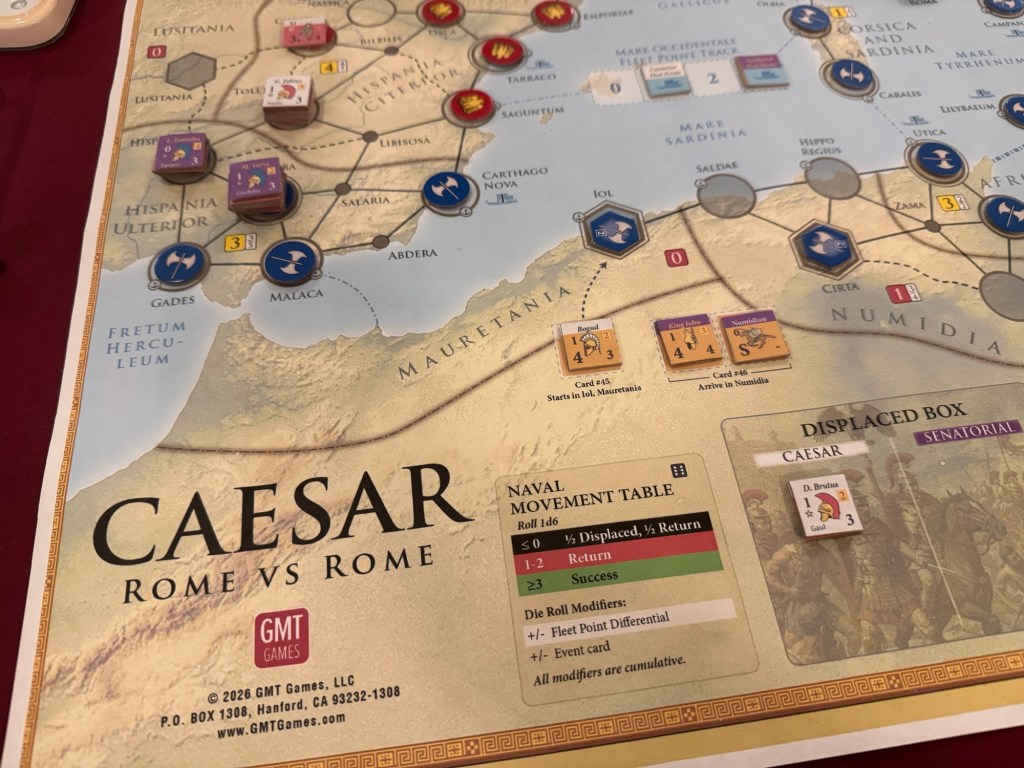
The game really is focused on the struggle for political control of the empire as players will play events, move armies and fight in order to control the minds of the people.
Battles are commons and a major part of the game but the game is very snappy and only lasts 5 turns.
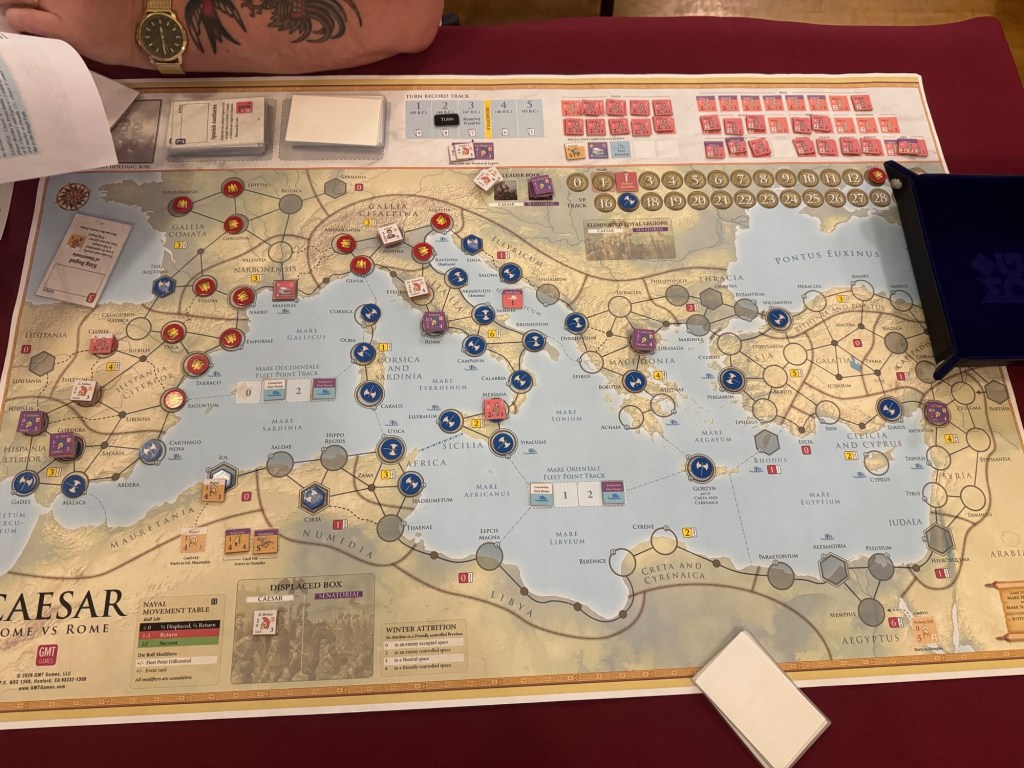
I think that this one is going to be a winner and I very much appreciated Mark Herman showing us the game. I have been told that it will be announced on the P500 in December.
That was our day! 3 big games and lots of good times were had by all. Tomorrow we have an early morning game of Thirty Years of Misery from VUCA Simulations and I also hope to sit down with Darren McGuire to get a look at Checkpoint Charlie from GMT Games and possibly Coast Watchers from GMT Games with Volko. See you tomorrow evening for a synopsis of Day 2.
-Grant

