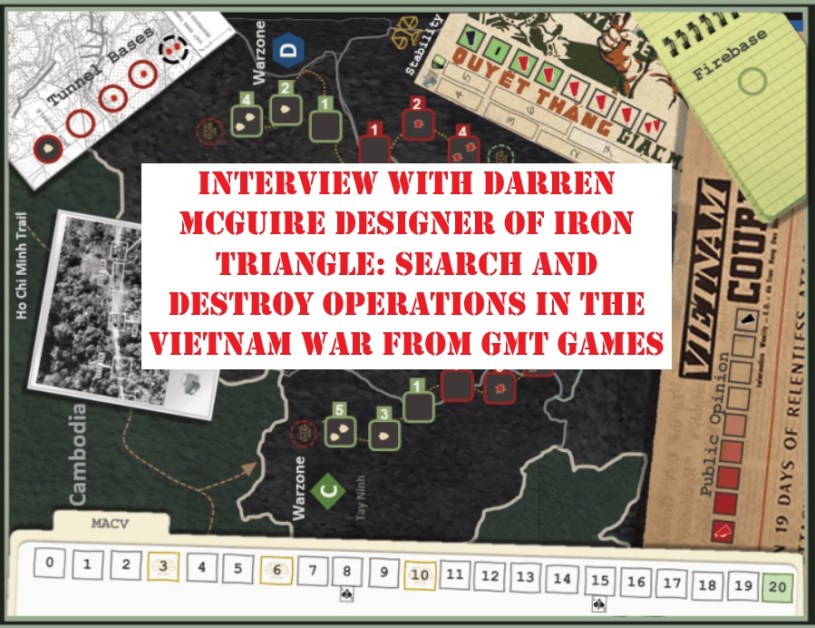
A new series, and we have seen how well series have done at GMT Games, a new designer and a new concept to wargaming (lane battler), I think that this game has great potential and it happens to be focused on one of my most favorite wars to game – the Vietnam War. Iron Triangle: Search and Destroy Operations in the Vietnam War is designed by Darren McGuire and takes a look at the struggle between the United States military and the Viet Cong insurgents as they fight over control of three key “lanes” or regions. I am very much excited about this one and reached out to designer Darren McGuire for some additional information.
*Note: The pictures used in this interview showing the various components and cards, are still in the design and development process and as such rules, event effects and text might still change prior to final development and publication. Also the art and layout of the cards are only for playtest purposes at this point and the game will enter the art department as it nears publication.
Grant: Darren welcome to our blog. First off please tell us a little about yourself. What are your hobbies? What’s your day job?
Darren: Hi Grant, I live not too far from Glasgow in Scotland, which is a board gamer’s delight, by which I mean, plenty of rainy days and dark evenings. By day, I work as a Quantity Surveyor (Cost Engineer) on major water infrastructure projects, dealing with cost control, commercial management and contractual disputes, so it’s excitement all round! Away from work, my wife and four children keep me more than busy.
As you may have guessed, my main hobby is board gaming, which has now expanded into board game design. Unfortunately, my best ideas seem to arrive in the middle of the night rather than at my desk. When I’m not thinking about games, you’ll usually find me following Glasgow Celtic, the best football (soccer) team in the world…well, Scotland at least. Other interests include noodling away on my guitar and getting out for the occasional hike.
Grant: What motivated you to break into game design? What have you enjoyed the most about the experience thus far?
Darren: I am relatively new to board gaming, having played regularly for only four or five years. My growing interest in historical games was sparked by Rodney Smith’s discussion of Cuba Libre in the Discovering the COIN series. After learning and playing the game, and later watching a documentary on the Cuban Revolution, I became fascinated by how game mechanics can represent the political, military and social dimensions of historical events.
This experience led me to appreciate game design not just as entertainment but as a way of communicating history. My interest in creating games developed further through roleplaying games, particularly the Basic Roleplaying system, which inspired me to write and run a Second World War-themed scenario. Seeing others enjoy something I had created was highly rewarding and encouraged me to pursue game design more seriously.
What I enjoy most about design is the iterative process, watching an idea evolve through testing, refining it based on feedback, and carrying lessons learned from one project into the next.
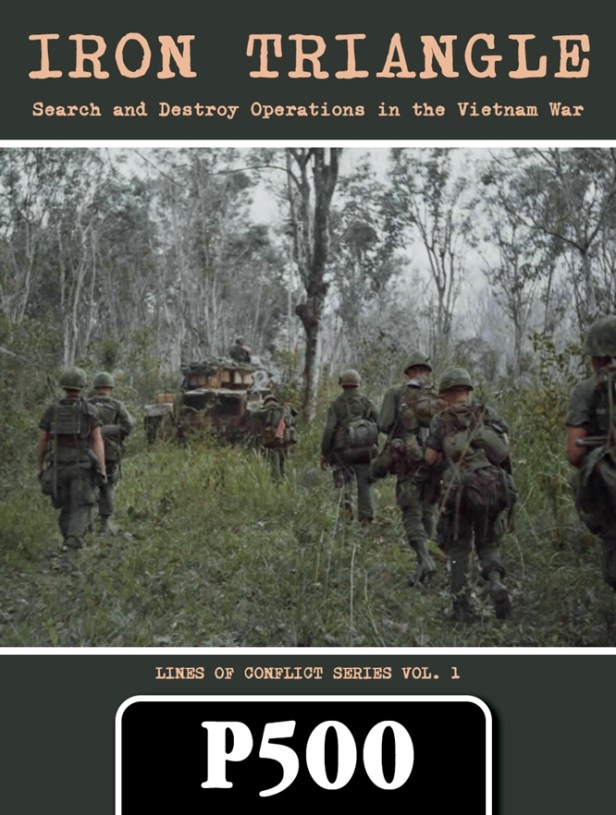
Grant: What is your upcoming Game Iron Triangle about?
Darren: Iron Triangle is a 2-player card battler game about the struggle between US and Viet Cong forces in the III Corps region of South Vietnam during the Vietnam War. Players compete across a series of Operations while also managing the wider military, political and social factors that shaped the conflict.
The US player must balance military success with the need to maintain stability and support for the South Vietnamese government. The VC player, meanwhile, seeks to undermine government authority through guerrilla warfare, hidden infrastructure, and the careful preparation of the Tet Offensive. While battles are fought over individual Operations, success ultimately depends on how effectively players manage resources, control territory, influence Public Opinion and pursue their broader strategic objectives.
Rather than focusing solely on military confrontation, Iron Triangle aims to capture the asymmetrical nature of the war, where political legitimacy could be just as important as success on the battlefield. The result is a fast-paced experience in which decisions can have consequences beyond the immediate fight.
Grant: Why was this a subject that drew your interest?
Darren: I have always been fascinated by David versus Goliath conflicts, where a seemingly weaker side challenges a much stronger opponent. The Vietnam War particularly captured my interest because it was a conflict I initially knew very little about. Like many people, my early perceptions were shaped largely by Hollywood films, but after becoming interested in historical conflict through board gaming, I began to realize there was far more nuance and complexity to the war than popular culture suggests. The more I explored the subject, the more intrigued I became by the political, military and human factors that shaped the conflict.
Grant: What is your design goal of the game?
Darren: My goal is to create a fun and engaging game that feels thematic within what is traditionally quite an abstract genre. I want the mechanics and player decisions to reflect the realities of the conflict, so that the theme is expressed through gameplay rather than simply through artwork or historical flavor text.
Beyond providing an enjoyable experience, I hope players come away with a greater appreciation of the unique challenges faced by both sides in this part of the Vietnam War. The conflict was not decided solely by battlefield success. Political support, public opinion, hidden infrastructure and competing strategic priorities all played important roles. Capturing these tensions within an accessible and entertaining game has been one of the central objectives of the design.
Grant: What from Search and destroy missions in Vietnam was most important to model?
Darren: Two aspects were at the forefront of my mind. The first was capturing the cat-and-mouse nature of search and destroy operations through the card play. These missions were rarely straightforward engagements; instead, they involved a constant struggle to locate, pursue and evade the enemy.
Equally important was ensuring that the tactical outcomes of these operations were connected to their wider political and societal consequences. In Vietnam, success on the battlefield did not always translate into strategic success. Capturing that tension between military achievement and its broader impact on public opinion, political will, and the course of the war was therefore a key design objective.
Grant: What sources did you consult about the details of the history? What one must read source would you recommend?
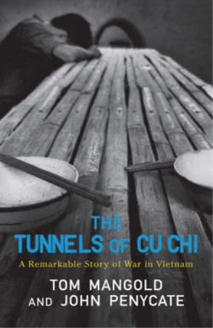
Darren: The principal sources I consulted were:
- The Vietnam War: An Intimate History by Geoffrey C. Ward and Ken Burns
- Vietnam: An Epic Tragedy, 1945-1975 by Max Hastings
- The Tunnels of Cu Chi by Tom Mangold and John Penycate
Of these, I would recommend The Tunnels of Cu Chi as essential reading. The book argues that the Cu Chi tunnel network became one of the most powerful symbols of Viet Cong resilience and ingenuity, demonstrating why overwhelming American military superiority alone could not guarantee victory. That theme had a significant influence on the design of the game. Mechanics such as tunneled cards, Tunnel Bases, and the creation and use of caches are intended to reflect the hidden infrastructure that enabled the Viet Cong to survive, recover and at times overwhelm a conventionally stronger opponent. Capturing this asymmetry between military power and insurgent resilience was one of the central goals of the design.
Grant: What is the goal of the game?
Darren: The VC player seeks to undermine the local population’s trust in the South Vietnamese government. To achieve this, they must win Operations, carefully manage their resources, and, most importantly, plan and execute a successful Tet Offensive.
The US player, meanwhile, has two paths to victory. The first is through attrition, exposing and neutralizing enemy forces. The second is through pacification, placing pacification chits on regional tracks to strengthen government influence. Whichever strategy they pursue, they must contend with the fallout of scorched-earth tactics, maintain control of pacified areas and disrupt the enemy’s Tet Offensive preparations whenever possible.
Grant: What is the layout of the board?
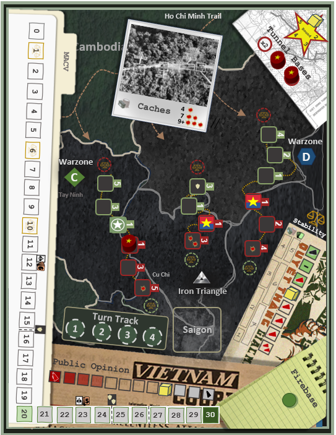
Darren: The operations are divided across three regions, with players contesting one operation in each region during every round. Running alongside these battles is a strategic layer represented on the board, which tracks the overall situation across the theatre. This includes the level of control within each region, regional stability, public opinion, and refugee generation. As a result, success in individual operations can have far-reaching consequences, forcing players to balance short-term military objectives against their broader strategic and political impact.
Grant: What are the “lanes” and how do they work?
Darren: The three lanes represent the key operational regions north of Saigon: War Zone C, War Zone D and the Iron Triangle. Each lane contains a dedicated deck of Operation Cards representing historical Search and Destroy missions conducted in that region during the period.
During each round, players will contest one Operation from each region, fighting simultaneous battles across all three lanes. The outcome of these Operations will influence the wider conflict, affecting the various tracks and areas of the main board. Success on the battlefield can shift regional control, impact public support, alter available resources and shape each side’s broader strategic objectives.
Grant: How does the game use cards? How are the player decks asymmetrical?
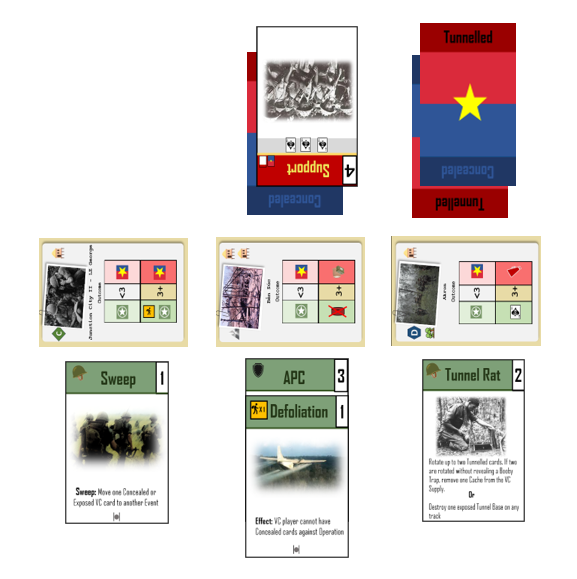
Darren: Each player commands a unique deck of cards representing the units, tactics and capabilities available to their side. These cards are committed to Operations, where players compete for control and the rewards those Operations provide. Every card has a strength value and a special action that can be utilized when played.
The game’s real asymmetry lies in how the VC player can deploy their cards. VC cards may be played in one of three states: Exposed (face-up), Concealed (face-down) or Tunnelled (face-down and rotated). This system forces the VC player to balance protection against flexibility. A Tunnelled card, for example, is much harder for the US player to expose and inflict attrition upon, but it requires additional effort from the VC player to reveal and activate its ability.
These mechanics give the VC player multiple strategic options. They can bluff with hidden forces, launch surprise attacks, prepare units for future engagements or hide powerful cards for the decisive end-of-round reveal. The US player, meanwhile, is rarely certain of the strength or composition of the forces they are facing, creating a constant risk that an attack may not go as planned.
To counter this uncertainty, the US player can resort to scorched-earth tactics, exposing and neutralising enemy forces through attrition. However, this approach has consequences. Such actions generate refugees, a resource that can ultimately be exploited by the VC player to advance their own objectives.
The card system is therefore central to how the game’s theme is reflected in its mechanics. Through hidden information, bluffing and the constant tension between searching for the enemy and avoiding detection, it captures the cat-and-mouse nature of the conflict and the uncertainty faced by US forces throughout the war.
Grant: What different type of cards are included?
Darren: There are several types of cards in the game. The Operation Decks form the core of the conflict, with each card detailing the rewards available for successfully completing that mission. These rewards can include gaining regional control, destroying enemy caches or bases, reducing public opinion or generating refugees, all of which contribute to the wider strategic situation on the main board.
Each faction also has its own unique deck containing units and tactics, with cards featuring different strength values and special abilities. These decks reflect the contrasting approaches employed by the US and VC forces and provide players with meaningful tactical decisions throughout the game.
Currently in development are Commander Cards, which can be employed throughout the course of the game. Each commander provides powerful advantages but also introduces specific drawbacks, requiring players to carefully consider who is best suited to lead their forces at any given stage of the conflict.
Also in development is a dedicated solo mode, being designed by Joe Dewhurst. This system includes a bespoke bot deck for each faction, aiming to deliver a challenging and thematic opponent that captures the strategic priorities and character of both sides.
Grant: Can you show us a few examples of cards and describe how they work?
Darren: Here are a few examples that highlight the key decisions and interactions players will encounter during a round.
Operation Cards
Players battle over three Operation cards during each round. The rewards gained depend on the final Strength differential between the opposing sides.
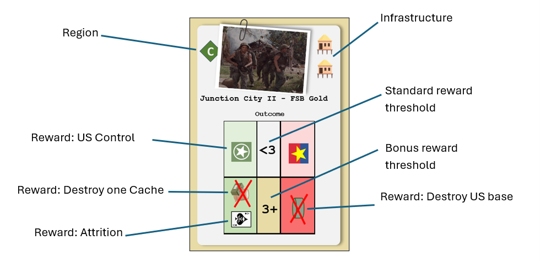
For example, on the Operation shown above, if the VC player ends the round with a Strength differential of 3 or more, they move the control marker on the Warzone C Region Track one space toward Saigon and remove one US Firebase.
Action Cards
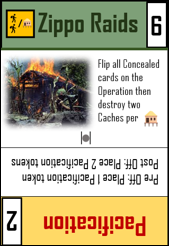
Infrastructure symbols indicate that the Operation takes place in a populated area. When the US player uses Scorched Earth actions, such as Zippo Raids, Refugees are generated as a result of the destruction.
In this example, the Zippo Raids Card generates two Refugees for each Infrastructure symbol shown on the Operation Card and allows the US player to destroy two Caches from the VC supply.
The card also gives the US player the option of playing it rotated to its lower-strength Pacification side. When played this way, the US player may place one Pacification chit on a Region Track if the Tet Offensive has not yet occurred, or two Pacification chits if it has.
This creates an important strategic decision for the US player. They can use the card’s high Strength value to help win the Operation, potentially generating Refugees that the VC can later exploit, or they can focus on Pacification to reduce the effectiveness of VC Tax actions and move closer to their alternative victory condition.
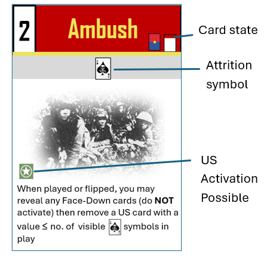
The Ambush Card from the VC Deck illustrates the different states in which a card can be played. It may be played face-down (Concealed or Tunnelled) or face-up (Exposed).
The Attrition symbol represents a key objective for the US player, who seeks to expose and exploit these cards as part of their Attrition victory condition. The US Activation symbol indicates that the card’s action may also be triggered when it is exposed by a US card effect.
This gives the VC player meaningful agency. They can play the card face-up to gain the action immediately, play it face-down and activate it later in the round, or use it as a bluff to lure the US player into exposing it.
These are just a few examples of how the decks interact. The game includes numerous ways for players to influence and counter each other’s cards. K9 Units can negate the US Activation effect, Hueys can move cards and place Firebases, Tunnel Rats can flush out Tunnelled cards and locate Caches, Booby Traps can eliminate Tunnel Rats and Supply cards can place Caches on Operations to increase Strength.
Together, these layered interactions ensure that every card choice can have lasting consequences, creating a tense and highly interactive contest between the US and VC players.
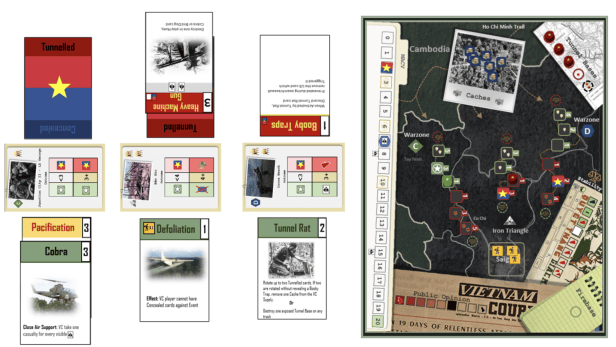
Grant: How are the cards concealed by the VC player? What does this represent?
Darren: VC cards feature symbols indicating whether they can be played face up, face down, or either. Face-down cards represent concealed forces, while rotated cards represent units operating through tunnel networks.
The VC player must use Action Cards, such as Manoeuvre, to flip or rotate cards already committed to a lane. This creates a constant balancing act between revealing powerful effects, such as Ambushes and Night Raids, and protecting the valuable Attrition symbols contained on those cards.
These mechanics also enable bluffing. For example, a low-value Booby Trap Card can be tunnelled, encouraging the US player to believe it is a high-strength Support Card with significant Attrition potential. The uncertainty forces the US player to carefully consider where to commit resources and when to challenge concealed threats.
The VC player must also decide whether to play a card face up and immediately benefit from its effect but exposing it to US attack, or instead commit it face down from the outset and save its reveal for a decisive moment later in the round. This flexibility reflects the hidden nature of VC operations and rewards careful planning and deception.
Grant: What challenges for the US are created by this concealment?
Darren: Attrition is a key US victory path, but many VC Attrition symbols remain hidden on concealed or tunnelled cards. To succeed, the US player must reveal and engage these forces while making difficult decisions with incomplete information, risking costly overcommitment if hidden threats prove stronger than expected.
Military operations can expose VC units, destroy bases and uncover caches, but they often generate Refugees, which the VC can exploit to gain cards, add Tet tokens or reduce Regional Stability. As a result, the US player must constantly balance immediate military success against longer-term political consequences. These mechanics create a tense contest of information and deception, with the VC concealing their strength while the US works to uncover and eliminate hidden assets before they can affect the wider war.
Grant: What is the Tet Offensive draw bag? How is it built?
Darren: The Tet Offensive was the watershed moment of the Vietnam War. Although it did not bring the conflict to an immediate end, it fundamentally altered US strategy and set the conditions for the gradual withdrawal of American forces. Capturing the importance of this moment was a key design goal.
The Tet Bag is one of the most important systems in the game. Following recent design changes, it no longer acts as a simple end-game decider but instead serves as a mechanism that can greatly influence the course of the war. At the start of each round, the VC player secretly decides whether to launch the Tet Offensive by selecting one of two cards: one commits to the Offensive and the other acts as a bluff. This creates uncertainty from the outset of the round, as the US player must react without knowing whether a major offensive is truly imminent. The VC player may retract their decision during the round, but doing so becomes increasingly expensive as the cost in Caches rises with each turn that passes.
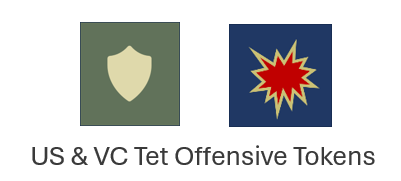
The bag begins with three US tokens and two VC tokens, but its contents constantly evolve throughout the game. The VC can add tokens through Infiltrate actions and by exploiting Refugees created by US operations. The US player, meanwhile, can remove tokens through Round-Up actions and through Attrition in an attempt to limit the impact of any future Offensive.
The primary way for the VC to influence the draw is through the accumulation of Caches. These can be generated through Tax Actions or received as end-of-round supply from the North. When the offensive is launched, the number of available Caches determines how many Tet tokens can be added to the bag, while Tunnel Bases deployed to region tracks act as multipliers, increasing the number of tokens generated from those Caches. Control of key regional spaces provides additional opportunities, with certain track positions allowing a player to add Tet tokens at the end of a round if the Offensive is launched.
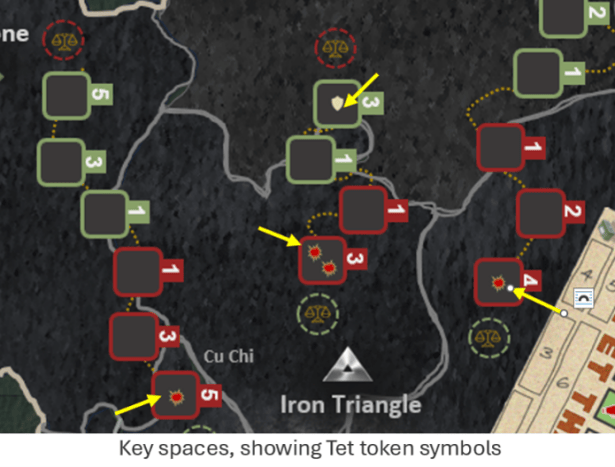
If the VC player commits to the Tet Offensive, the appropriate tokens are added to the bag at the end of the round and five tokens are drawn at random. Each VC token drawn reduces Public Opinion by one step, while each US token drawn increases Attrition by one step. This can create a dramatic swing in the strategic situation. Even if neither victory condition is immediately met, the outcome of the draw can significantly alter the state of the war and shape the decisions available to both players in subsequent rounds.
The timing of the Offensive is therefore a critical consideration. The VC player must decide whether to launch early with limited preparation or delay in order to strengthen the bag’s odds while risking discovery or disruption. The US player, meanwhile, must balance efforts to contain the insurgency on the ground against the need to manage the growing threat represented by the Tet Bag. This creates a constant strategic tension that mirrors the historical conflict.
Grant: What is Public Opinion? How is it changed?
Darren: Public Opinion represents the local population’s perception of the South Vietnamese Government and, by extension, the effectiveness of the US-backed war effort. Managing Public Opinion is crucial, as it forms one of the key strategic battlegrounds in the game.
The primary driver of Public Opinion is Regional Stability, which is determined by the position of Control markers on the regional tracks. As the VC expands its influence and gains control across a region, Stability declines, reflecting a population that increasingly doubts the government’s ability to maintain order and security. Conversely, government control and stability reinforce confidence in the existing regime.
Beyond regional control, both players have additional means of influencing Public Opinion. The VC can erode support for the government by achieving decisive victories in key Operations, demonstrating its strength and undermining confidence in official authority. A successful Tet Offensive can also significantly damage Public Opinion, representing the political shock caused by the scale and visibility of the attacks.
The US player is not without tools of their own. Through Pacification actions, they can improve conditions within contested areas, securing spaces on the regional tracks and creating opportunities to increase Public Opinion. By achieving key objectives and restoring Stability, the US player can demonstrate progress and strengthen support for the South Vietnamese Government.
Grant: What is urban infiltration?
During the build-up to the Tet Offensive, the Viet Cong infiltrated towns and cities across South Vietnam, embedding cadres among the local population. These operatives remained hidden until called upon to conduct terror attacks, sabotage missions, or support the wider offensive once it began. Their ability to operate covertly within urban areas was a key factor in the scale and surprise of the 1968 Tet Offensive.
This aspect of the conflict is represented in the game through a dedicated VC Action card. When played, the card allows the VC player to add a Tet token to the Tet Bag, reflecting the gradual preparation and expansion of the underground network in advance of the Offensive. While the immediate effect may seem modest, repeated use of these actions can significantly alter the balance of the eventual draw.
Grant: How are bases used and what benefits do they bring?
Darren: Bases are another important asymmetrical element of the game. While both factions use bases to influence control of the battlefield, there are significant differences between VC Tunnel Bases and US Fire Bases that reflect their distinct approaches to the war.
In general, bases are deployed to a Regional Track adjacent to a Control marker through the use of Action Cards. Once in play, they allow a player to either reinforce their position or exploit success in an Operation.
A base can be placed defensively on a Region Track between the player and the Control marker. In this position, it acts as a buffer against enemy advances. If the opposing player wins an Operation and would move the Control marker towards their side of the track, the base absorbs one of those control shifts before being removed and returned to its home space. This allows players to protect hard-won gains and makes regional control more difficult to reverse.
Alternatively, a base can be deployed aggressively between the Control marker and an opponent’s side of the track. This represents a player anticipating success and positioning assets to exploit a breakthrough. If the Operation is won, the Control marker effectively leapfrogs the base, allowing it to advance further than it otherwise would. In this role, the base accelerates territorial gains, helping a player press their advantage.
When a VC Tunnel Base is used offensively, it is flipped to its exposed side, representing increased activity and a greater risk of detection. Exposed bases are significantly easier for the US player to locate and destroy.
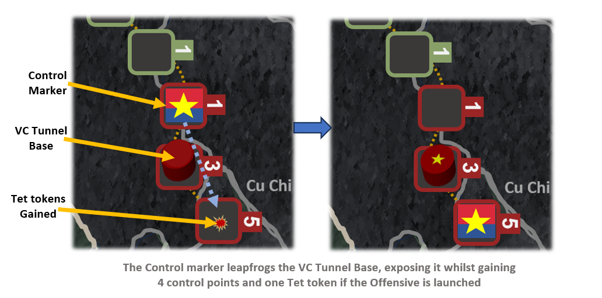
This creates an important strategic dilemma for the VC player. Tunnel Bases are not only valuable for influencing regional control but also contribute to the Tet Offensive system by acting as multipliers for Tet tokens generated through Caches. Committing them aggressively can produce short-term gains on the board, but doing so risks losing assets that could have a major impact on a future Tet Offensive. The VC player must therefore balance the need to consolidate territorial gains against the benefits of preserving their network for a decisive political strike later in the war.
Grant: What role do refugees play in the game?
Darren: Refugees represent one of the key consequences of the counterinsurgency strategies employed during the war. Population displacement was frequently used to separate the VC from the rural population and disrupt their support networks, creating both military opportunities and political challenges.
The US player has access to powerful Scorched Earth Action Cards. These are high-strength cards that can be used to destroy VC Caches and generate Attrition, helping the US pursue one of its victory conditions. However, such operations can also displace civilians, creating Refugees as local communities are caught up in the fighting.
When a Scorched Earth Card is played, Refugees are generated based on the concentration of the local population in the targeted area, represented by infrastructure symbols on the Operation cards. For each Refugee generated, a Refugee token is placed in Saigon.
While these operations can successfully disrupt VC activity, the resulting Refugees create opportunities for the VC player. On their turn, Refugee tokens can be spent in several ways:
- Recruit – Draw additional cards,
- Infiltrate – Add a Tet token to the Tet Bag, helping prepare future offensives.
- Destabilise – Reduce Regional Stability, further undermining confidence in the South Vietnamese Government.
This creates a difficult strategic dilemma for the US player. Aggressive operations may achieve important military objectives by destroying enemy resources and inflicting Attrition, but they can also generate conditions that the VC can exploit for political and organisational gain.
To counter this, the US player has access to Resettlement Action Cards, which reduces the number of Refugees in Saigon. These actions represent efforts to restore stability, provide support for displaced civilians, and mitigate the wider consequences of military operations.
The Refugee mechanic reinforces one of the game’s central themes: success on the battlefield does not always translate into strategic success. Players must consider not only the immediate impact of their actions, but also the longer-term political and social consequences that can shape the course of the war.
Grant: How is victory achieved?
Darren: For the VC, victory is achieved by reducing Public Opinion to the bottom space of its track. This is accomplished through the rewards gained from winning Operations and by successfully planning and executing the Tet Offensive.
The US player has two possible routes to victory. The first is Attrition, achieved by exposing VC forces, revealing Attrition symbols on their cards, and capitalising on those symbols. Successfully pacifying individual regions and repelling the Tet Offensive also support this strategy.
The second route is Pacification. If the US player can fill all the spaces on the lower half of each regional track with Pacification chits, they have successfully stabilised the countryside and strengthened support for the South Vietnamese government. Achieving this level of security and political control results in a US victory.
Grant: What type of experience does the game create?
Darren: The aim is to create a fast-paced and tense experience in which both players must balance the military, political and social aspects of the conflict. While Operations provide the focus for direct confrontation, victory depends on managing a range of competing priorities rather than simply overpowering an opponent.
The game is not intended to be a straightforward tug-of-war over territory. Players must constantly weigh short-term gains against long-term objectives, deciding when to commit resources, when to accept setbacks, and when to focus on the wider strategic situation. Success comes from understanding how the different systems interact and adapting to an ever-changing battlefield, creating a game that rewards careful planning while still maintaining a constant sense of pressure and uncertainty.
Grant: What are you most pleased with about the design?
Darren: I am most pleased with how I have taken a relatively abstract style of game and made it as thematic as possible, capturing not only the military aspects of the conflict but also the political and social factors that shaped it. I am also very happy with the recent design changes, which have expanded the game’s scope and increased the decision space for both players. In particular, turning the Tet Offensive into a flexible strategic option rather than a fixed endgame event has created more meaningful choices for the VC player, while adding greater uncertainty and tension throughout the game. Overall, these changes have made for a richer and more engaging experience without losing sight of the historical themes I wanted to explore.
Grant: What other designs are you working on?
Darren: I have several other card battler designs at various stages of development, covering topics such as the Eastern Front, the Arctic Convoys of the Second World War, the Napoleonic Wars, and the Russo-Chechen War, the latter of which served as a precursor to Iron Triangle. Each design approaches its subject in a very different way, and I am hopeful that the lessons I have learned during the development of Iron Triangle will help me refine and strengthen these projects.
I’d just like to finish by saying thanks for taking the time to reach out and for the opportunity to talk about Iron Triangle.
If you are interested in Iron Triangle: Search and Destroy Operations in the Vietnam War, you can pre-order a copy for $41.00 from the GMT Games website at the following link: https://www.gmtgames.com/p-1215-iron-triangle-search-and-destroy-operations-in-the-vietnam-war.aspx
-Grant

