I think that every single wargamer knows the name Volko Ruhnke. He has designed several great series in the COIN Series, that has now stretched to a full 15 volumes, and then more recently Levy & Campaign Series, which has an astounding 5 released volumes with several others that are announced and about a dozen more in design. He can make a good game for sure! One of our first experiences in wargaming and the first Volko design we played was Wilderness War. He is now at it again with a new design in a continuing newer series called the Recon Series that uses hide and seek elements and hidden blocks to tell the story of the Allied intelligence efforts during World War I during the campaigns around Verdun in 1916. The game is called Drachen: Reconnaissance at Verdun, 1916 and looks to be very interesting and we reached out to Volko to get a look into the design.
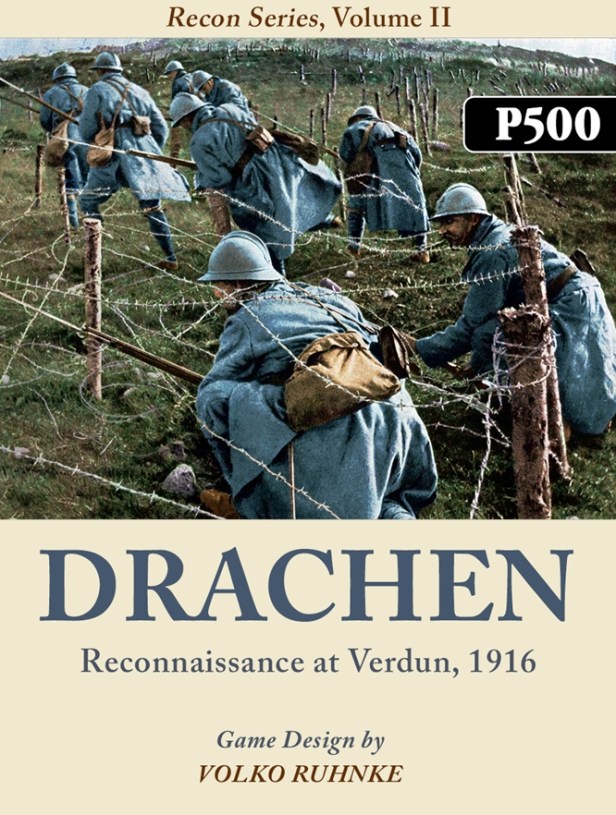
Grant: Volko welcome back to the blog. What is your new upcoming game Drachen about?
Volko: Hi Grant & Alex! Thank you for this opportunity. I love what you guys do.
Drachen continues my new Recon Series, following on to the series’ recently released first volume, Coast Watchers. Volume II – Drachen – is about the struggle for reconnaissance information in a World War I trench battles, specifically, Verdun in 1916.
Grant: What does the title mean and why did you want to use it for this game?
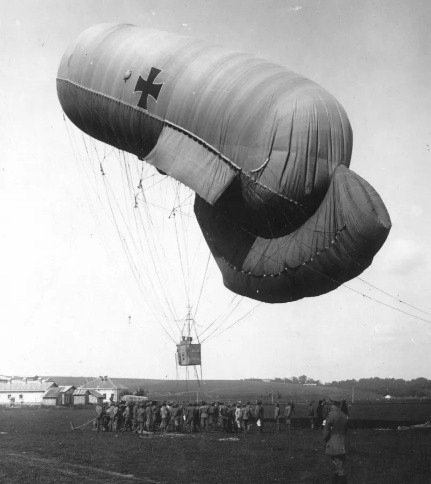
Volko: “Drachen” means “kite” in German and is simply short for “Drachenballon” – kite balloon. The tethered observation balloons famous as targets for balloon-busting fighter aeroplane missions were really the queens of the battlefield in their ability to see what the enemy was up to and guide artillery fire onto enemy targets. They were in effect hydrogen filled kites in that they faced into the wind for stability. On a clear day, even a windy one, a spotter with binoculars in a kite balloon could provide information on enemy movements and positions up to 15 miles away. Tethered to the ground, unlike observer aeroplanes with either no radio or early transmitters only, balloons had instant and secure communications with friendly headquarters or batteries to coordinate fire.
Grant: This is Volume II in the Recon Series. Why does this subject fit your vision for the series?
Volko: I’m looking for the Series to visit settings in which secrets and their discovery really mattered to the outcome of a conflict. The advent of trench warfare on the Western Front was a remarkable moment in land battle because the age-old means of reconnaissance – the horseman – could no longer roam. For the first time, you would know nothing of the enemy beyond the next ridge unless you got up in the air. We gamers have tended to focus on ace-versus-ace duels in the sky. I wanted to explore what all the dogfighting was really about: winning the right to peer down upon your enemy.
Grant: How has your experience with series games assisted you in the development of this Recon Series?
Volko: OK, that’s a big question! I do try to learn, and I have developed some principles for series design:
1) Openness – Make room for other designers to take the series where you never imagined.
2) Complexity – Bigger is not always better. I wrote about this in depth in C3i Nr29.
3) Variety – Make it familiar, not samey. I wrote about that in C3i Nr30.
Regarding variety within a series, it helps to articulate a focus to guide selection of topics, what you keep the same, and what you vary for each setting.
- For the COIN Series, that was the premise that counterinsurgency and other popular conflicts were multifactional, that factional relations were key.
- For Levy & Campaign, it was that medieval warfare was equally complex as modern but in distinct ways, especially regarding command and logistics.
- For the Recon Series, then, it is that secret information – which side protects it or discovers it better – can decide the outcome, at least for certain conflicts.
That said, for me, principle 1) above trumps the other two. Other designers certainly have taken COIN and Levy & Campaign to places beyond my original intent. I hope the same for the Recon Series.
Regarding “bigger is not better” for Drachen in particular, that meant being sure that Volume II did not just add subsystems like more ornaments on a Christmas tree. Rather, I try to drop something unneeded out for every new thing added in. For example, Drachen gets much deeper into resolution of combat than does Coast Watchers, but then Drachen has a much simpler resolution of who won the struggle: just most of 3 Objective cards fulfilled, rather than Volume I’s “victory point salad”.
To keep Drachen “familiar but not samey”, we keep not only the location blocks and open versus secret spotting but also two chit cups for resolution, for example. Where Coast Watchers has Delivery and Patrol cups, Drachen features Air and Group cups to resolve clashes in…well, you can guess where for each.

Grant: What did you need to make sure to model from aerial reconnaissance in WWI?
Volko: The key historical dynamics that I was able to find and felt were important to incorporate in the game include:
- The main purpose of fighter aeroplane engagements as clearing the way for friendly observers and countering enemy observers.
- The difference between just spotting something and being able to loiter long enough to cooperate with guns or take photos.
- Which observation activity would be known to the enemy and which would be secret.
- The importance of attrition in aircraft to observation dominance.
Grant: What sources did you consult to get the historical details correct? What one must-read source would you recommend?

Volko: I scarfed up all I could about Great War trench warfare in general, including the nature and use of observation balloons, how aeroplanes cooperated with artillery, the purposes of trench raids, and so on. Naturally, I particularly dug into how things worked in the Battle of Verdun, which was a great learning laboratory for both sides.
My two key secondary sources were The First Air Campaign by Eric and Jane Lawson, which discusses the evolution of air power in World War I and the special juncture that Verdun was in its development, and Alistaire Horne’s The Price of Glory, still for me the best of the several English-language works on the iconic battle.
Grant: What is your overall design goal and thesis with Drachen?
Volko: The design goal is to take apart how reconnaissance worked in trench battles, with the premise that winning the reconnaissance struggle set up the possibility of winning the kinetic part, the fire and assault.
Grant: Why do you feel that blocks and chit pull are the best ways to tell this story?
Volko: Blocks are an age-old but powerful way to manage secret information on the tabletop, without writing or referees. The Recon Series uses blocks in a new way: not as units that the opponent can see massing and moving across the map but as location information about which you start out seeing nothing and have to act to gain any knowledge of.
Chit pull gives me as designer an ability unparalleled by dice to subtly manipulate probabilities – and to give the players abilities to influence those probabilities – in a relatively simple and inexpensively produced way.
Grant: What other mediums did you consider or explore?
Volko: One question was whether to use “record” markers for players to log what they find. The Japanese player in Coast Watchers has such markers on the board as reminders of what is known of Allied blocks that have stood up hidden again.
In Drachen, there is even more to keep track of: various sizes and types of units and fortifications. And some of what players spot they do so secretly. So Drachen provides a record sheet reproducing the battlefield in miniature, but with room to take notes, plus screens to hide that record, if players want to use them. I considered providing record markers to place on the sheet, but the variety of items to spot mean that it would have been a mess, a big pile of counters to sort through – not worth it when a pencil works fine!
Grant: What different units are available to the players?
Volko: Here is a look at the blocks and counters, including the units represented. By the way, no real art exists yet – these are just my homemade prototypes.…
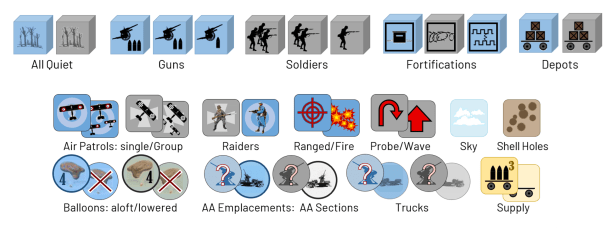
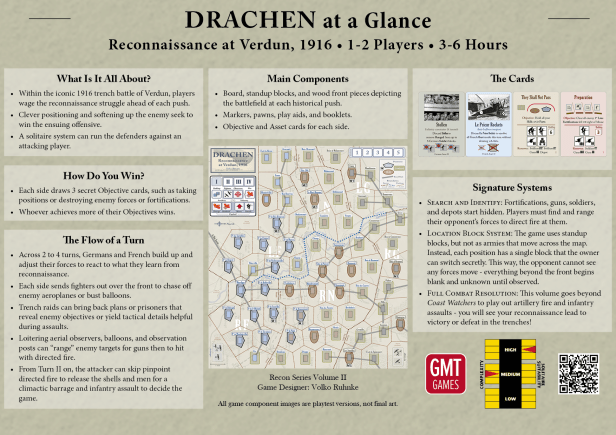
The standup blocks represent the guns, soldiers, fortifications, and depots that fight out the duels between gun batteries and the offensive’s barrage and assault. They build up hidden and are the targets for enemy observation missions. Positioning your hidden blocks will be critical both to make them harder to spot and to get the best use out of them in your plan for combat.
The counters represent those forces carrying out or supporting reconnaissance. They build up openly on the battlefield, except for anti-aircraft emplacements that may be AA sections or just harmless trucks. (Other counters here are markers that support various missions and actions.)
Grant: What is the role of Depots?
Volko: Depot blocks – if they survive unsuppressed – during the offensive resupply guns to fire again or fire at double strength. If the attacker exploits an advance, the depots refill and can again supply guns.
Grant: What are the All Quiet blocks and what do they represent from history?
Volko: “All Quiet” blocks (also nicknamed “trees”) represent just the usual presence of defenses at a side’s positions. So they do not mean empty, rather nothing special to see and shoot at. There are some troops garrisoning the line in what are probably battered trench works, perhaps some wire or field guns. If attacked, at least a few machineguns hidden there will answer.
Grant: What different air assets are available to players?
Volko: The workhouse in the air is the “Air Patrol” – either single or group, the latter more effective but uses up more airframes. Each player has a supply of Air Patrols at their aerodromes (on their mat) and sends them on specific fighter and observer missions or puts them into the Air Cup to add generally to the density of friendly aircraft prowling and protecting the skies over Verdun. Air Patrols suffer loss in action, so you can run out if you don’t manage the air battle carefully, potentially requiring you to recall counters from the cup or the map.
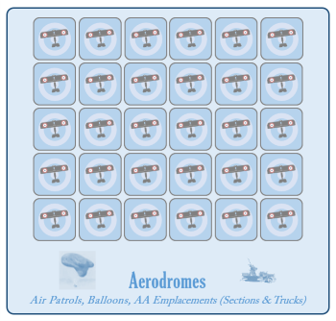
Of course we have balloons too, aloft over friendly positions behind the front line. Enemy balloon-busting fighter missions can destroy them or, more commonly, force them to lower. As noted above, these Drachen are highly effective observers, in the game reaching out to a distance of 4 positions, spotting secretly – you won’t know where your opponent’s balloons are looking unless they range guns in on your blocks – and unlike aeroplane observers automatically succeed in spotting their targets.
On the ground but protecting your balloons and blocks against enemy Air Patrols, you get antiaircraft emplacements – “AA Sections” or dummy “Trucks”. These will make any enemy air missions at or adjacent to them more dangerous. They also occasionally can cause a loss among your own nearby defensive air patrols, representing friendly fire.
The counters for Balloons and AA Emplacements are round to signify that these units can built up, adjusted, and used for free – whereas use of Air Patrols and trench raiders cost actions.
Grant: How are the serial assets used to perform recon? How does this work?
Volko: As reconnaissance and the efforts of fighters to stop it are the focus of the sim, most Air Missions as well as Trench Raids use an articulated chit-pull procedure accounting for a wide range of circumstances.
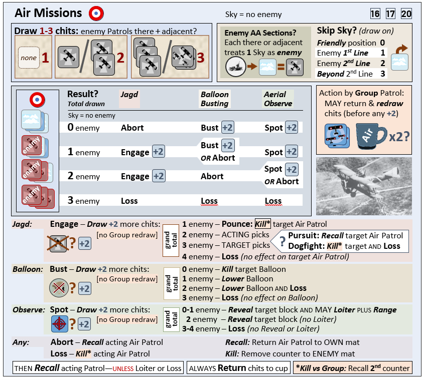
On the Air Missions table, you can see that we account for the presence of the enemy’s defensive Patrols and AA, how deep behind enemy lines you are flying, whether you are using an Air Group, and how many enemy chits you are likely to draw.
Various Asset cards, like “Boelke & Immelmann”, can further affect these results.
Grant: Why do you feel this is so important to the game?
Volko: Most trench warfare games either focus on the assault by infantry and perhaps tanks or cover the air duels going on overhead. But before those assaults and the barrages supporting them kick off, there would have been a critical period in which the sides were struggling to figure out what the enemy was up to and where they were massed. And that is when most of those aerial dogfights would be going on. Drachen pulls all that together to try to illuminate just HOW reconnaissance got done and would then set the course of a “big push”.
Grant: What is the layout of the game board and the purpose of the different shaped fortifications?
Volko: The game board shows the battlefield of Verdun. Area spaces, called “positions”, each hold a single block hiding the forces or fortifications there.
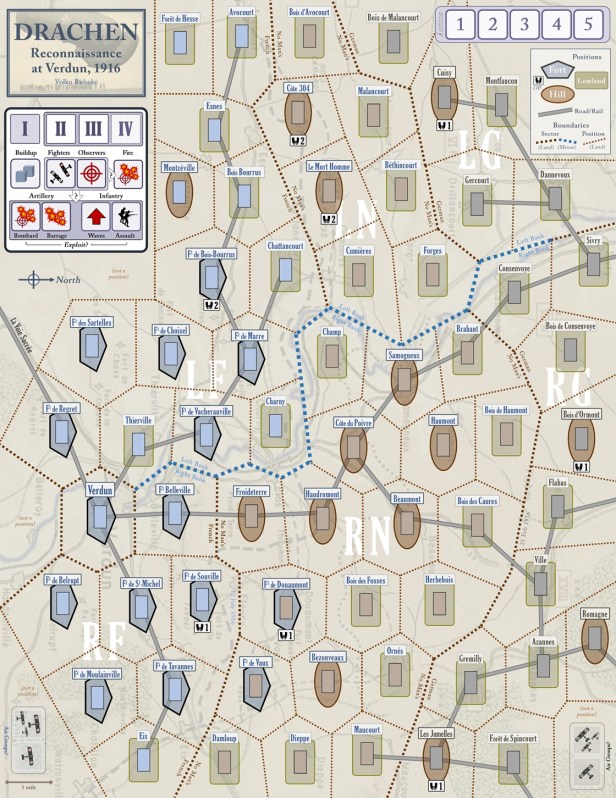
Terrain is either Lowland, Hill, or Fort – the latter effectively on hills too but tougher to crack. Hills and Forts enable guns on them to shoot a little farther, are harder to take by infantry assault, and often are the very targets that the attacker is assigned to seize.
A road and rail network spans the battlefield. Its effect is to limit where depots can be built up.
Land and Meuse River segments separate the positions. Little wooden stick pieces will mark the front along these segments. Positions group into sectors, such as “Left French”, to guide setup and solo play.
A final feature of the map positions is that some are observation posts. They function much like balloons but with far more limited reach, and they can be suppressed by artillery fire.

Grant: What is the general Sequence of Play?
Volko: In each of between 2 and 4 turns total, each side first builds up forces (blocks and counters). Buildup limits are most lenient on Turn I, so players generally need to set a plan of attack or defense then and just adjust positioning on later turns. On Turn II and thereafter, revealed (face up) blocks hide again (stand back up) unless suppressed by enemy fire or under loitering air surveillance. On Turn III and IV – if the attacker has not yet launched an offensive – the defender receives reinforcement in the form of an added block.
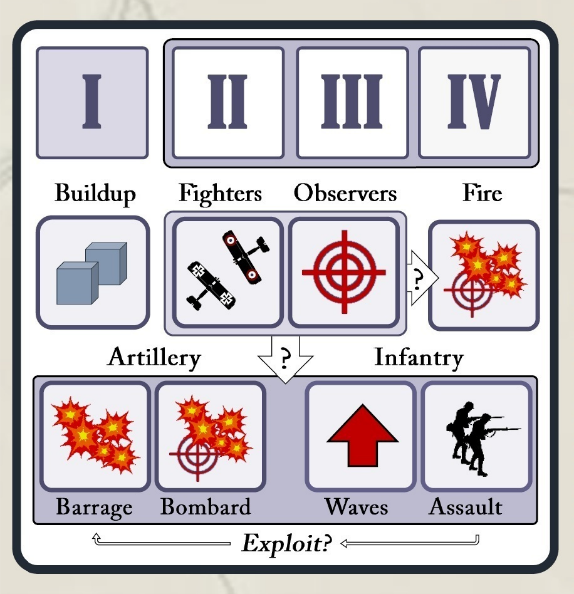
The main part of the turn follows buildup, “Reconnaissance” activity by Fighters then Observers. That includes mounting defensive “Barrier Patrols” and offensive “Jagd” against enemy Air Patrols plus Balloon Busting, then Aerial Observation, Trench Raids, and spotting by Balloons and OPs.
After that, the sides will exchange “Directed Fire” by their guns onto previously “Ranged” targets. Or, on Turn II or later, the attacker can instead launch the offensive that will resolve the game.
Grant: How is victory achieved?
Volko: After the offensive, or after Turn IV in the rare case that the attacker never launches one, Victory depends on who has fulfilled more of their 3 drawn Objective Cards.
Grant: What are the purpose of the Attacker & Defender Objective Cards?
Volko: The simulation premise of the Objective Cards is that reconnaissance is trying not only to discover where the enemy is but what they are up to – what matters to them? Will the attack go for a breakthrough, or are they just trying to pin our forces in place and divert our attention from some other part of the front? Or even less, are they for now just trying to grind down our forces and soften up our fortifications? Is the defender set to hold everything at all cost? Or do they just want to bloody us as we advance?
A second set of questions concerns how big an enemy buildup we are dealing with. The Objective Cards give players more robust forces to carry out the more ambitious task. So that too is an essential element of information that reconnaissance is trying to gauge – what are we up against?
The Objective Cards provide a neat and easy way to set out that secret information. Through recon successes, such as finding out how your enemy’s fortifications or troops are deployed, you can discern what your opponent’s cards may be. And if you invest in trench raiding, your raiders might reveal one or more enemy Objectives for certain.
Grant: What are the various hidden objectives?
Volko: Attacker and Defender each draw 3 cards from up to 9 Objective Cards, most of which are unique tasks hidden from the opponent. Each card not only sets out a task to be achieved but also provides added blocks to that side’s “Reserves” and specifies a number of blocks that the player can build up on the map on Turn I.
One twist is that you don’t have to use a card’s specified forces for that task: the blocks just add to your total available.
A second twist is that particularly successful trench raids can obtain “Plans” that reveal your opponent’s Objective Cards to you: potentially highly useful, as you win not only by achieving your own Objectives but by impeding your enemy’s.
Grant: What different types of these cards are there?
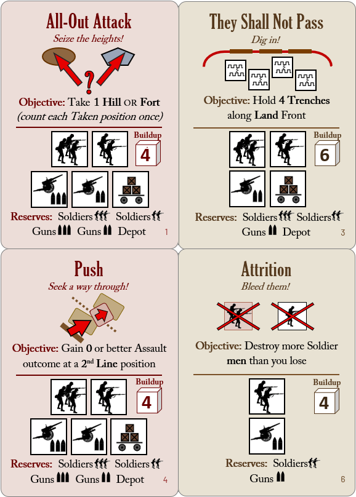
Volko: There is a separate set each for Attacker and Defender. In sets of 3, they go from least to most ambitious/robust, for the Attacker, “Preparation”, “Push”, “All-Out Attack”; for the Defender, “Retrenchment”, “Attrition”, “They Shall Not Pass”. Different scenarios then might limit some of these sets for one or the other side to reflect that stage in the longer Battle of Verdun.
As you can see by the examples, the cards are specific as to their tasks and forces. Generally, the Attacker is either destroy certain defenses, mount strong attacks, or take key positions. The Defender generally is to hold key positions or destroy substantial attacking forces.
Grant: How do players go about accomplishing these?
Volko: A key premise of the game is that reconnaissance success unlocked success of an offensive push. So in the game, you won’t earn VP or whatever for how you run your reconnaissance effort. Rather, knowing what your enemy has where – and “Ranging” those targets for accurate fire by your gun – will set up the combat success that you will need to fulfill more of your own Objectives.
But you will need to add to that skillful positioning of your forces and fortifications to make use of the information that you gather, and then the right decisions when and where to uncover your guns to fire or send your infantry waves into assaults and counter-assaults.
So the game is about reconnaissance but also how that feeds into running trench war combat.
Grant: What challenges does each side face in their objectives?
Volko: Since fulfilling your Objectives flows from how you handle the entire Sequence of Play, they really distill all the game’s challenges. But specific challenges to do with the cards include that the easier tasks come with skinnier forces to fight with, and that you start out unaware of what your opponents Objectives are. That latter can be critical, as even decent performance against the goals in front of you may not be enough to win if your opponent does even better at their secret tasks.
Grant: How do offensives work?
Volko: When the Attacker decides to launch the Offensive, both sides first get to recover some of their suppressed positions. Then each side’s guns, Attacker first, can “Barrage” to suppress enemy positions without needing Ranging by observers, just using more shells. Then each side can “Bombard” Ranged targets to Suppress them more efficiently or destroy them outright (as in the earlier “Directed Fire” phase).
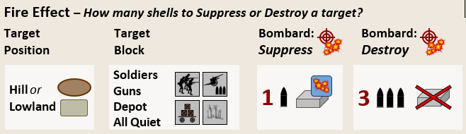
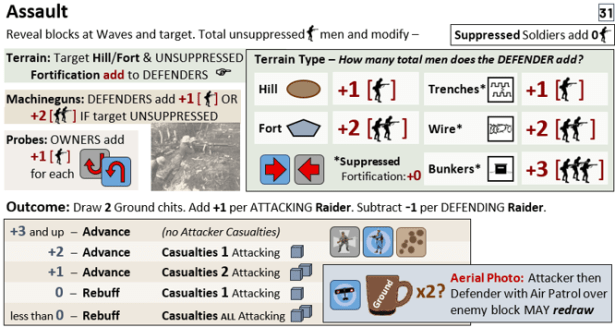
Then players place “Wave” markers to commit where infantry Assaults and counterattacks will occur. For the Attacker, these will attempt to take the defender’s frontline positions. Those get resolved rather simply, including a draw from the Ground cup to give at least some chance for a weaker attack or defense to succeed.
If any such Assault does succeed in taking ground, the attacker may “Exploit” – meaning one more round of Artillery and Infantry combat, usually to try to seize a 2nd-Line position.
Grant: How many players is the game designed for? Is there a solitaire mode?
Volko: Drachen is a 2-player game. A larger number of players, divided into 2 teams, has worked well at the many demos that I have done.
There is a solitaire mode that enables a solo player to take the Attacking side in all the scenarios, whether German or French. It uses instructions and scenario setups found in the Playbook, a “Defenses” display to guide hidden block buildup, and a deck of 18 “Army HQ” Cards to help run Defender actions.
Grant: What opportunities for deception and signaling are there?
Volko: Great question! A point of the Recon Series is to feature not only secret information but both open and secret collection of that information – in part to enhance such opportunities for deceptive signals.
In Drachen, you will have plenty of secret information about which to mislead your opponent. And, critically, you will have potentially or automatically open information that you can transit selectively in order to mislead. Some ideas…in the game, you can:
- Put a few Soldiers to get spotted where you do not intend to assault, or fortifications that suggest Objectives that you did not draw.
- Range targets that you cannot actually or do not intend to Bombard.
- Deploy air defenses in areas that are unimportant to you.
And so on. Circumstances and your imaginings are the only limits!

Grant: What do you feel the game models well?
Volko: I am quite pleased with how the flow of the game models trench warfare’s set-piece buildups, the contest for control of the skies, the danger and importance of busting balloons and launching trench raids, the tit-for-tat artillery duels, including the danger of firing and exposing your batteries too soon, and more. In short, Drachen plays out on the table my mental model of WWI trench battles.
Grant: What are you most pleased about with the design?
Volko: The biggest thrill for me is that the design has held the interest of a talented corps of testers for many moons and many plays – and that it seems to get universally positive reactions at con demos. Ted Raicer has done wonders to bring out the fascinating aspects of the Great War, but even now trench battles don’t get the spotlight among us wargamers that I feel they warrant. And Verdun does not even have British or Americans (outside some volunteer fliers). So I’m proud that Drachen is adding to our hobby’s examination of WWI’s Western Front in between the famous mobile phases of 1914 and 1918.
Grant: What other designs are you contemplating or already working on in this series?
Volko: I already have a playable prototype for Volume III, and it even has seen some playtests. I call it Masher and it is set in Vietnam. Perhaps a topic for another visit here!
Thanks again for this opportunity to talk about the Recon Series!
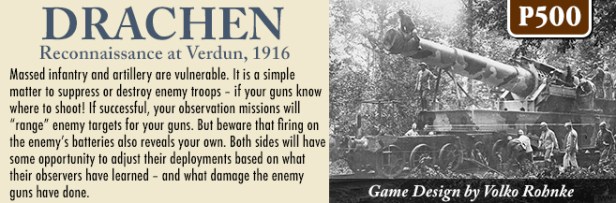
I think that this new series, and this game particularly, look really interesting and I am all in on the subject matter and the approach. Also, the game offers 8 main scenarios and a solo learning situation spanning German and French offensives within the titanic 10-month Battle of Verdun. I did just receive my copy of Volume I in the Recon Series called Coast Watchers but have not had a change to get it to the table as of yet. I will rectify that sooner rather than later.
If you are interested in Drachen: Reconnaissance at Verdun, 1916, you can pre-order a copy for $79.00 from the GMT Games website at the following link: https://www.gmtgames.com/p-1162-drachen.aspx
-Grant


I am definitely interested in the Recon series, and would like to get them… eventually.
The Masher game would interest me more than WW1.
LikeLiked by 1 person
Great interview! I had a chance to play Drachen with Volko at SD HistCon North in July as well as Hunt for Blackbeard. Coast Watchers is currently on my table. Needless to say, I’m a big fan. Volko designs games that I find innovative and truly interesting. The games are engaging and frequently involve lesser known conflicts or aspects of more well known conflicts. I want to not only have fun while I play the games, but I want to learn about the history of the conflicts depicted. Volko is always spot on in this regard with his games.
LikeLiked by 1 person