With this My Favorite Wargame Cards Series, I hope to take a look at a specific card from the various wargames that I have played and share how it is used in the game. I am not a strategist and frankly I am not that good at games but I do understand how things should work and be used in games. With that being said, here is the next entry in this series.
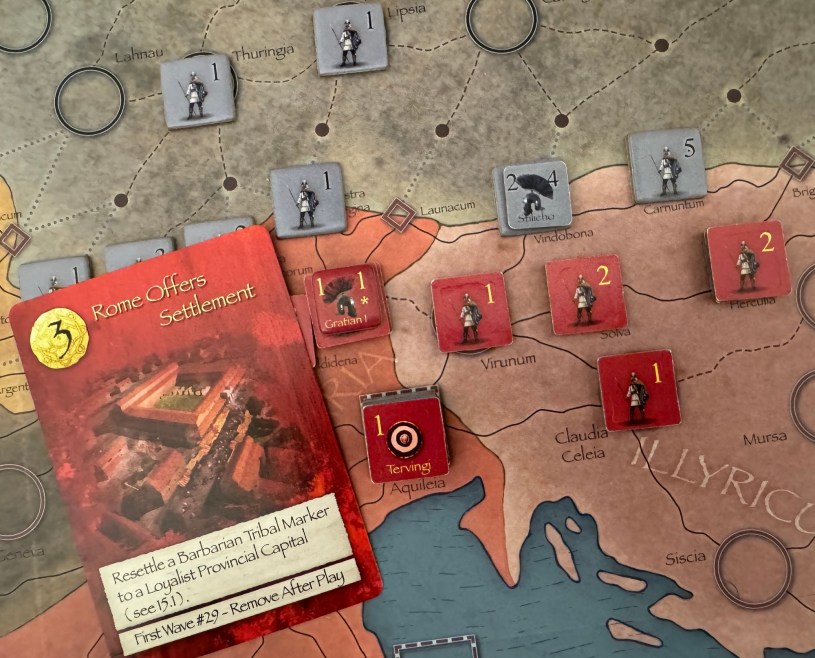
#80: Rome Offers Settlement from Barbarians at the Gates, The Decline and Fall of the Western Roman Empire 337 – 476 from Compass Games
Barbarians at the Gates, The Decline and Fall of the Western Roman Empire 337 – 476 from Compass Games is a Card Driven Game for two players set during the final hundred plus years of the Western Roman Empire as the Barbarian tribes in the north came down with a vengeance as they clashed with civilization and carved out their place amongst it. The time period covered in the game is from the death of Constantine the Great (337 AD) to the deposition of the last Western Roman Emperor by Odoacer in 476 AD. The Roman player will command the Roman Legions loyal to the failing central authority and those Germanic peoples who have settled peacefully inside the Roman Empire, while the Barbarian player leads Usurper Emperors, and controls the migrations of the Germanic peoples, who are the Barbarians at the Gates. This game is really quite good and feels very much like a wargame even though it is a Card Driven Game. There are lots of opportunities for troop movement, combat and maneuver. And I really liked that. The game is a Card Driven Game and the use of cards is all important and very well done. Each player has their own unique deck of cards that are used and these cards are sometimes removed from those decks when played for an event and also new cards will be added to the deck after each turn. The cards played during a player’s impulse which are not used for the Event are then used for their Operation Points value. These Operation Points can be used for many purposes including Activating a leader, Forced Marches, Raiding, Reinforcement, Migration and Successful Usurpation.
The real trick to the cards is to plan out how you are going to use them to your advantage but also how best to use them. Activating Leaders is very important as you can then move them to attack, defend, change control of areas and other actions. Activating a leader depends on their strategy rating (the lower the strategy rating, the better). When a leader activates from a card, they receive a number of Action Points which can be used for movement (1 over highway, 2 over rough or river connections, 3 over strait or for naval movement), continuation after battle (a kind of advance after combat), changing control over unfortified spaces and sieges of fortified spaces. But the cards also are very mean spirited. What do I mean by this? Well, in our first play, I was carefully using my cards to build up my armies to fend off the initial attacks of the Barbarian hordes. I also had begun to build somewhat of a super stack as well to attempt to foray into England and take on the Barbarians there. As I did this building up, I was unaware of the nasty nature of some of the cards. Some of the cards, both for the Barbarians and Romans, allow a play that will turn a single leader and their entire stack into either a Usurper or a Pacified Barbarian Settlement. Both are equally nasty and you have to keep in mind that you can have your best armies simply taken from you and turned to your enemy.
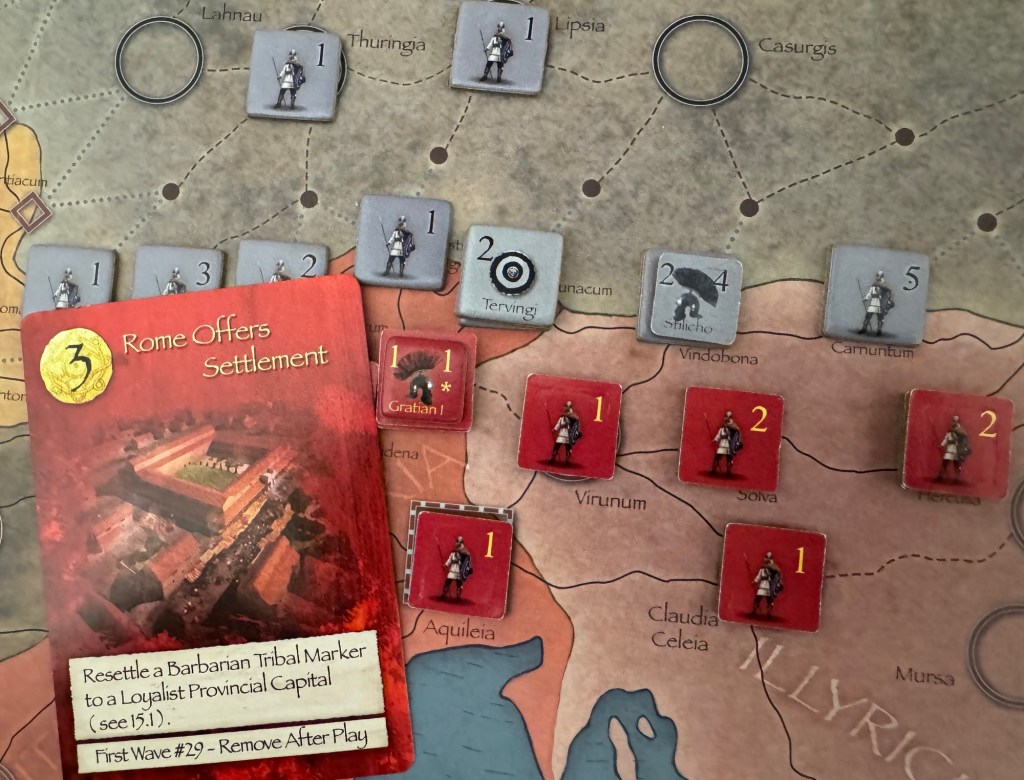
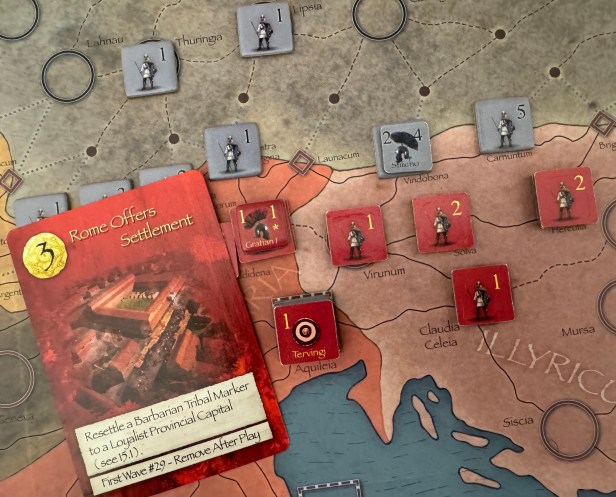
And this concept of taking your best armies away from you, either as the Roman player or the Barbarian player, is well demonstrated with the play of the Rome Offers Settlement card. This card literally allows the Romans to resettle a Barbarian Tribal Marker, along with any combat units with the marker to a Loyalist Provincial Capital. The play of this card at the right (or wrong) time can lead to serious issues on the front lines. Playing the Rome Offers Settlement card simulates foederati diplomacy, allowing the Roman player to integrate migratory tribes into the empire and to gain access to additional manpower to defend the frontier. The mechanical effects include that the selected Tribe will now be aligned with Rome and becomes allied to the Romans. This will lead to the Barbarian Control Marker being removed from the target tribe’s space on the Tribal Alignment Track. The real benefit is that the Roman armies don’t have to risk loss and time in fighting the Barbarians targeted but also provides somewhat of a defensive buffer as the settled tribes will serve as a guard on the frontier, protecting specific Roman provinces and providing a strategic military advantage against other hostile invaders. This card is very important and can be considered essential for the Roman player, as allying with these tribes limits barbarian raiding opportunities and provides crucial resources needed to survive later waves of invasions. Also the preservation of army strength gives an immediate benefit to other ongoing campaigns against other invading tribes. I love this card and the concept from history that it attempts to inject into the gameplay.
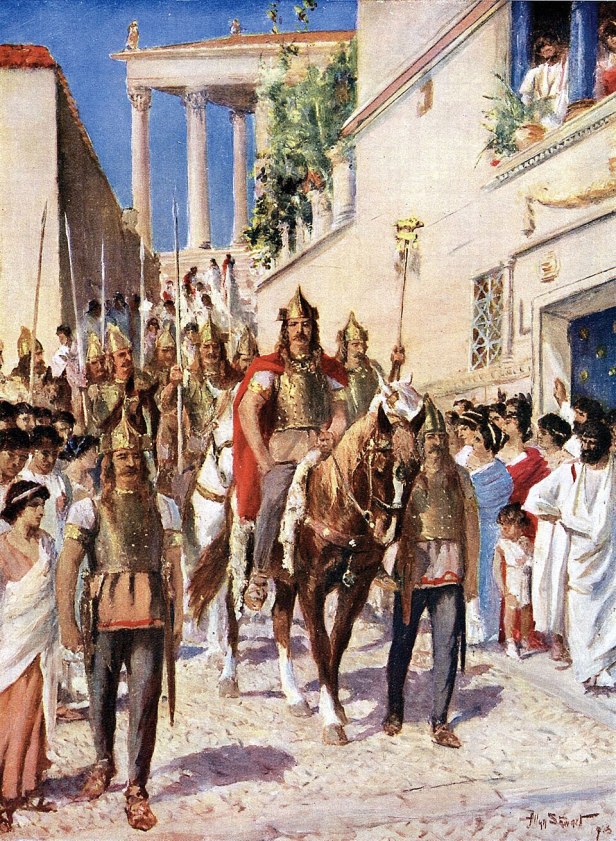
Foederati were peoples and cities bound by a treaty, known as foedus, with Ancient Rome. During the Roman Republic, the term identified the socii, but during the Roman Empire, it was used to describe foreign states, client kingdoms or barbarian tribes to which the empire provided benefits in exchange for military assistance. The term was also used, especially under the empire, for groups of barbarian mercenaries of various sizes who were typically allowed to settle within the empire.
The term foederati had its original usage and meaning extended by the Romans’ practice of subsidizing entire barbarian tribes such as the Franks, Vandals, Alans, Huns and the Visigoths, the last being the best known, in exchange for providing warriors to fight in the Roman armies. Alaric I began his career leading a band of Gothic foederati. At first, the Roman subsidy took the form of money or food, but as tax revenues dwindled in the 4th and the 5th centuries, the foederati were billeted on local landowners properties, which became identical to being allowed to settle on Roman territory. Large local landowners living in distant border provinces on extensive villas, which were largely self-sufficient, found their loyalties to the central authority, which were already conflicted by other developments, further compromised in such situations. As loyalties wavered and became more local, the empire then began to devolve into smaller territories and closer personal fealties.
Here is a look at our unboxing video:
We also did a video review and you can watch that at the following link:
I also wrote a First Impressions post on the game and you can read that at the following link: https://theplayersaid.com/2022/11/08/first-impressions-barbarians-at-the-gates-the-decline-and-fall-of-the-western-roman-empire-337-476-from-compass-games/
In the next entry in this series, we will take a look at Baron von Stueben Trains the Continental Army from Washington’s War from GMT Games.
-Grant

