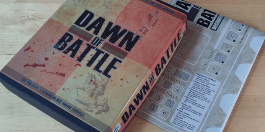
A few years ago, Worthington Publishing released a new game called Dawn of Battle designed by Mike Nagel. The game was HUGE size wise containing dozens of playable historic scenarios. The game allows players to refight various historical battles from 1500 BC to 1500 AD or a range of 3,000 years of combat. Players take the roles of the great commanders of history, including Xerxes, Alexander the Great, Julius Caesar, Saladin, and William Wallace. Since that time, Blue Panther has agreed to print the game in a new Designer’s Edition and also have added some new content to an already large amount of scenarios and counters. Recently they announced a new Scenario Pack Expansion, which includes MORE scenarios, called Dawn of Battle: Epic Combat! and well it appears to be pretty EPIC! We reached out to Mike to get some inside information about the expansion.
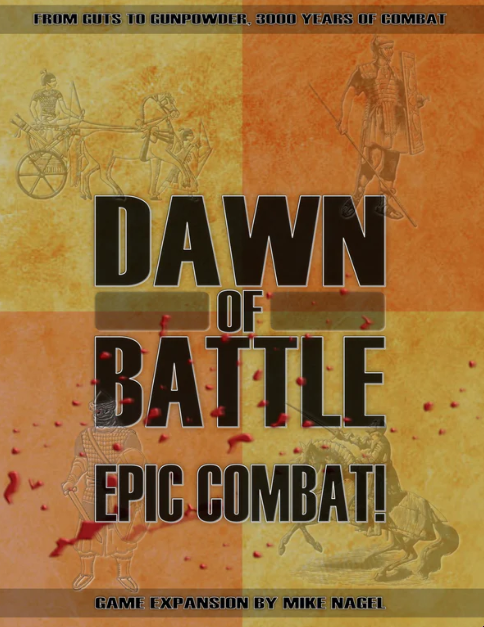
Grant: Mike welcome back to the blog. What is your new expansion Dawn of Battle: Epic Combat!?
Mike: I’m always happy to contribute. Thanks for the opportunity!
Dawn of Battle: Epic Combat! is the only true expansion for Dawn of Battle: Designer’s Edition. By that I mean that it comes with another map as well as more counters and terrain tiles. It’s likely the only expansion that the game is going to get as it fulfills the vision that I have for the game system. Beyond this, it’s all scenario packs…many, many scenario packs.
Grant: For those not familiar, what are the hallmarks of the Dawn of Battle Series?
Mike: Dawn of Battle is a game system of low to moderate complexity that allows players to recreate any battle from roughly 1500 BCE to 1500 CE, although I have strayed a bit further in both directions. As Alan Emrich described the game when he was helping me develop it, it covers everything from guts to gunpowder. The game was derived from my previous design Ancient Battles Deluxe (which Alan published with Victory Point Games). That game was inspired by the old Bill Banks game Ancients (published by Good Industries and 3W). While designing this latest iteration, I had several critical factors in mind. The first was accessibility. The game had to be relatively easy to get into in terms of rules density as well as setup time. The second was accuracy. Despite the scope of the game requiring a certain amount of abstraction, I still wanted to ensure that identifiably historical results could be achieved. The third was portability. The game, which is something of a “hobby in a box,” needed to be able to be pulled off a shelf and easily transported to a game club or convention. The fourth was relative affordability. Given the economic pressures of the day, I wanted to ensure that players really got their money’s worth. Finally, of course, the game has to be appealing and above all, fun to play. I believe I’ve nailed every factor with Dawn of Battle.
Grant: What do you hope to add to the series with the Epic Combat! Expansion?
Mike: One thing that Dawn of Battle cannot do out of the box are the massive battles you see teams of folks playing at conventions. It’s a 2-player game. The goal of Epic Combat! is to present both an option to play Dawn of Battle with up to eight players at a time, but also challenge two players to successfully fight out massive battles as well. Epic Combat! provides the components and structure to do that.
Grant: Why do you feel the system needs this addition?
Mike: A couple of reasons. First, and likely the most expected, is that an epic battles option is available for Richard Borg’s Command & Colors Series. Since Dawn of Battle is similar in scope and scale (but light years away in design and play), it makes sense to offer an option as well. The other reason is that the addition of additional units and terrain tiles allows for greater flexibility in scenario design for those who want to give their own favorite battles a whirl.
Grant: As a team focused game, how do teammates work together? What is the division of leadership between the players in this team approach?
Mike; Let’s assume a maximum load of four players per team. Three of the players are field commanders, represented on the map with their own leader unit. The fourth player acts as the commanding general. Each field commander gets his own action point during a turn to do with as he pleases. Any additional points are granted to the field commanders by the commanding general. The field commanders may not offer suggestions to other field commanders during play. The commanding general allow this, but at a cost.
Grant: What is the new map included in the expansion? What type of terrain is included?
Mike: The map is the same as the map in the base game. The two are mated along a short end to form the epic playing surface. If players ever wondered why one edge of the map had half-hexes rather than a pretty border, now you know. This was the plan from the outset. The terrain tiles are more of the same: woods, hills, rough, and enough rivers and streams to cross the entire length of two maps.
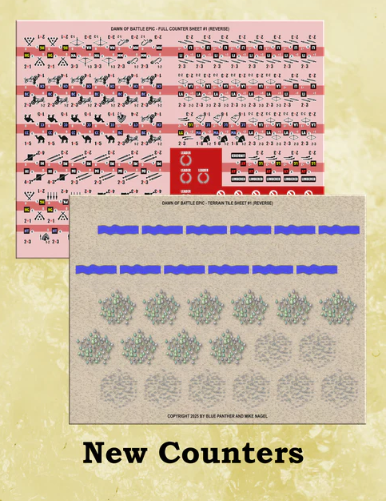
Grant: There are also additional counters. Are these more and different units or just more of those in the base game to create larger battles?
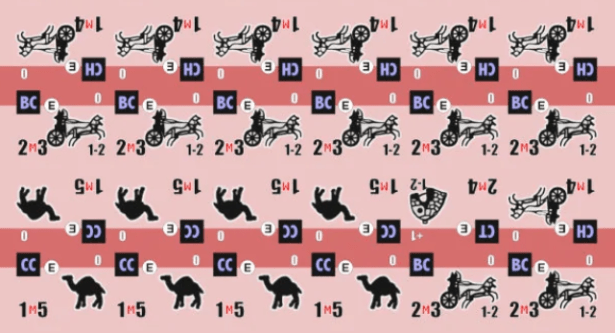
Mike: The counters are also more of the same, beefing up the inventory with a couple of twists. First is the addition of an ‘e’ indicator on each counter, which serves two purposes. One is to distinguish the expansion counters from those from the base game. The other is to allow these counters to be used in a different manner than their counterparts, according to a scenario special rule. Say a variety of Heavy Infantry that might be more mobile than other HI. This adds even more flexibility to scenario design. The second twist is the inclusion of several errata counters that correct misprints from the early printings.
Grant: What is the upgraded command system?
Mike: The command system is much the same, with action points being used to activate formations to perform specific tasks or enhance combat or die results. Where things differ a bit is in how command range works, since there are many more units spread over twice the area.
Grant: How are Command Cards used?
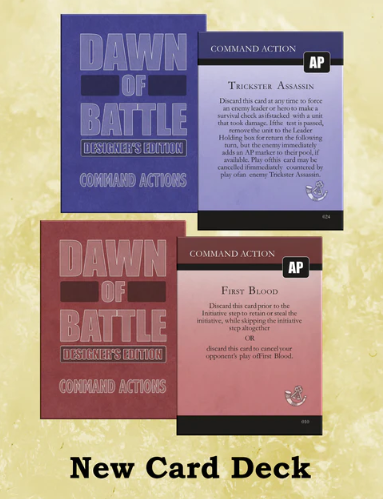
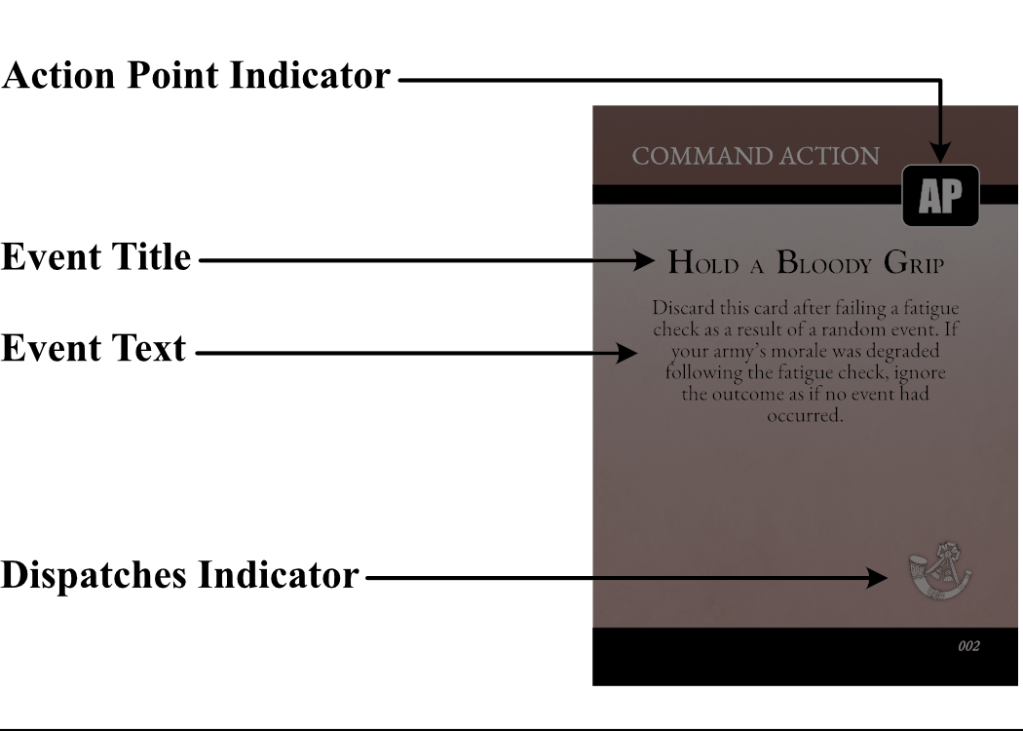
Mike: Command Cards are used by the commanding general. At the beginning of a battle, each commanding general can select a number of these cards to start with. The general is gambling on which cards might be the most useful. There is also a chance that additional cards may be acquired during play. Each card can be used for one of three purposes. The printed event can be used as noted, the card can be discarded as an extra action point, or it can be discarded as a “dispatch,” which allows play stop and players to confer (this is the only time field commanders can interact).
Grant: Can you share with us an example of these Command Cards and explain their layout and anatomy?
Mike: Pretty straightforward.
Grant: What are courageous heroes? How do they work?
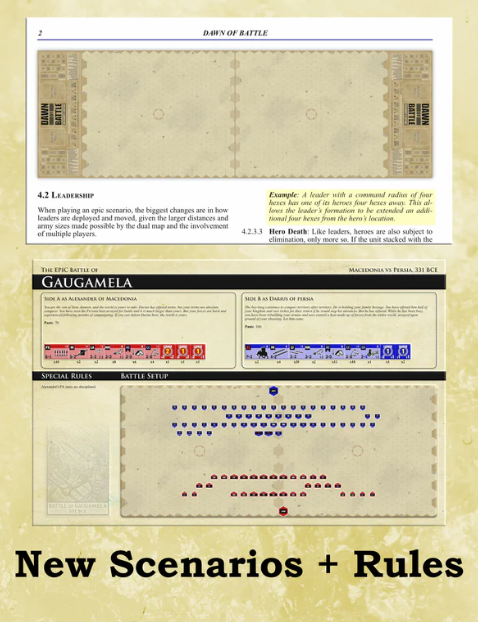
Mike: Heroes are the solution to the real estate problem. With so many more units and space, how do you keep them under control? It seemed too clumsy to simply state that command radii were doubled. This made some leaders really strong while not making weaker leaders strong enough. What heroes do is extend a leader’s printed command radius so long as the hero is within that radius. Say a leader with a radius of 2 positions a hero two hexes away (still within the leader’s radius). The hero now inherits a command radius of 2, thus extending the leader’s radius out to 4 hexes. This allows leaders to manage much larger formations. A leader “spawns” a number of heroes equal to their command rating at the beginning of each turn. Heroes can also be used as individual leaders outside of a leader’s command, providing more flexibility of action during a turn.
Grant: Are these generic personas or based in history?
Grant: Like leaders, these are abstracted personalities. It’s up to the scenario background and the leader capabilities to dictate who’s who.
Grant: What epic-sized scenarios are included with this expansion?
Mike: There are 6 total epic-sized scanarios:
Qarqar, 853 BCE
Gaugamela, 331 BCE
Sentinum, 295 BCE
Raphia, 217 BCE
Pydna, 168 BCE
Pharsalus, 48 BCE
Grant: What errata corrections for cards and counters are included for the base game?
Mike: There are about a half dozen units (Light Infantry and Light Archers) that were improperly printed in the first several copies of the base game. Additionally there are about a half dozen cards that were reworded a bit for clarity, so not really errata per se, but still included. There is a chance that the replacement cards are not identical in size to the rest of the cards in the action deck, so unless the cards are sleeved, using them could be more trouble then they’re worth. Mileage may vary.
Grant: What do you feel the series models well?
Mike: I believe the series does a fantastic job at simulating ancient combat. From the clashing of shields to exploitation on the wings, it all works really well. It’s also a lot less luck-dependent than other ancient combat games. This is the game that ticks all of the proverbial boxes for me. That’s the best part of being a designer: making games I want to play!
Grant: What type of new experience does Epic Combat! create? What are you most pleased about with the expansion?
Mike: One of the things I noticed while designing and testing the expansion is that it provides even more of an (ahem) epic sweep to the battles by allowing the armies to spread out further. The heroes and Command Cards also really ramp up the command and control experience. Although I’ll mostly be sticking to standard scenario design going forward, when I want to really ramp things up and there’s space on my table, epic is a great time!
Grant: What other designs are you contemplating or already working on?
Mike: I’ve still got quite a few irons in the fire. Given its great success so far, I’ve started working on Off the Line, Volume II – Winter War that pits the Soviets against the Finns with some cool new features coming to the system. Of course, by the time this is posted, the fifth scenario pack for Dawn of Battle should be available (that’s 120 scenarios so far!). I’ve got a sci-fi skirmish game coming out soon called MASS Impact. Following that is a light dueling game called Have at You! All of these will be printed by Blue Panther. I also hope to have an ancient naval game called Navarchoi published by Legion Wargames soon(ish) and several Flying Colors games are on GMT’s pre-order list. Of course, I’ve also got several other projects on the design table, but more word on those later. I can’t give all my secrets away!
Now, back to the design table…thanks again for the opportunity to share.
Keep in mind that Dawn of Battle: Epic Combat! requires the base game of Dawn of Battle: Designer’s Edition to play, which is sold separately.
If you are interested in Dawn of Battle: Epic Combat!, you can order a copy for $50.00 from the Blue Panther website at the following link: https://www.bluepantherllc.com/products/dawn-of-battle-epic
-Grant

