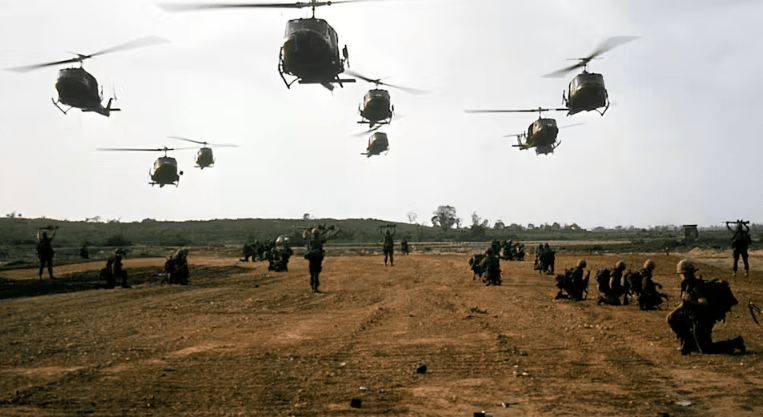
One of my favorite wars to game is that of the Vietnam War. Part of that is because I was born in the early 1970’s and heard a lot about this war for the rest of that decade and throughout my teenage years. I remember watching the short lived television series Tour of Duty. I also read the graphic novel series The ‘Nam from Marvel Comics. But, my interest really grew after watching movies such as Apocalypse Now and Platoon. I always asked myself, how are you expected to fight a war where you don’t know who the enemy is? But also part of the attraction for me is that the war is anything but conventional. The combatants were diametrically different, the powerful and well funded United States of America and their technology and special forces versus the Viet Cong, a rag tag group of insurgents, and the mighty North Vietnamese Army funded and supported by the Chinese. This war also was set amongst the backdrop of social upheaval and cultural change at home with anti-war protests, freedom for all being sung as a marching song and desegregation and civil rights taking center stage. We have played plenty of games set in this conflict and I want to share my Best 3 Games with…Vietnam!

3. Hearts & Minds: Vietnam 1965-1975 from Worthington Publishing
We really enjoy Card Driven Games and try to play as many of them as we possibly can get our hands on. Also, as I said in the intro, we also enjoy Vietnam wargames. So, when we had a chance to play a CDG on the Vietnam War, it was a no brainer! I got this game for Christmas about 6 years ago and it was a used copy of the 1st Edition published by Worthington Publishing. There is a 2nd Edition out there but I really don’t know what the differences are. Since that time, there also is a new 3rd Edition from Compass Games and it looks really good. But that is neither here nor there.
In Hearts and Minds: Vietnam 1965-1975, players will play as either the US/ARVN forces (with some units from NATO as well as ROK) against the Communist forces which include NVA regulars and VC hidden units. The game has multiple scenarios and covers the entirety of the Vietnam War from 1965 all the way through 1975 as the U.S. forces left and only the ARVN remained to attempt to stem the red tide coming down into South Vietnam.
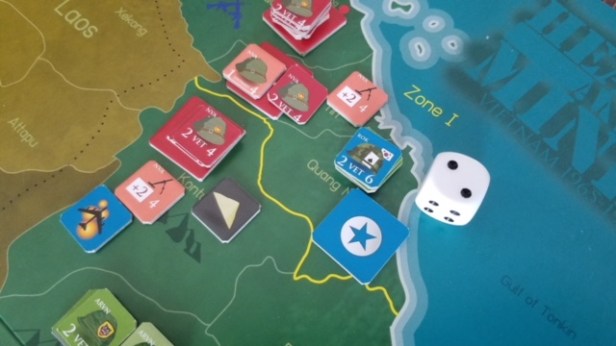
Players have a hand of 5 cards each round from which they will play 4 that provide Resource Points to perform various actions including activating units to move up to their movement allowance, attacking enemy units, doing bombing missions, pacifying areas or forcing a political change. Each faction has their own deck, the Communist deck is red, the Allies is blue and then there are black cards that are neutral. Players will make their decks from their color and mix in half of the black cards. These cards represent the meat of the game and are the vehicle to make the game progress. The Resource Points are spent to perform the actions mentioned above and also can be used to buy the printed event on the card just played. Sometimes this event will have lasting effects for the entire game, such as the Commando Hunt card that allows Bomber missions to target Laotian border provinces and also allows more than 1 bomber to bomb any given province, or will have a one time effect such as Junction City, that allow you to spend more than one saved Resource Point in a given turn as long as all Battle and Political Control Change actions take place in Zone III. These cards are well done and the game boils down to the efficient use of the hand that you are dealt. Sometimes, you will be given cards with high RP’s of 4 or 5, which will allow you to make a lot of progress with various actions including moving forces, battling the opposition and making political changes. But, there will be times when your draws are not great and you have a hand full of low value RP cards but they might have interesting and very useful events that you must take advantage of. In essence, you have to play the cards you are dealt and make the best go of things. This can be both fun and frustrating but always keeps things interesting and requires that you plan and execute on that plan.

Battle is pretty simple as well as all the counters are pretty much the same for both sides. Each counter has an untried side and a veteran side (with either a 1-6 or 2-6 for ARVN and US troops or a 1-4 or 2-4 for NVA and typically a 1-1 for VC units) and then there are support units such as mortars, artillery, tanks and helicopter gunships. When a players units are located in a province with enemy units, a contested area is created where the players can fight by buying a battle round for the cost of 1 RP. If the battle doesn’t conclude, another battle round can be purchased with an additional RP until the player no longer has RP’s. Units in a province simply total up their battle factors (located in the bottom left corner of the counters), roll a die and consult their specific faction’s Battle Table. The results are the damage that must be applied and fire is considered simultaneous. The results include a specific number of units that must be eliminated but also sometimes has a capital R that means the player must either lose one unit or pay a saved RP. The blue table is slightly better than the red table, but not by much.
The really neat part about the battles is that units can evade before the battle starts with a roll, which becomes more difficult in certain terrain types and also has negative results for even attempting, such as the loss of a unit. This part can be very frustrating for the Allied player as he has finally corned the wily NVA and VC and they then slip right through his fingers with a favorable roll.
How does the game end? Well, players will be fighting each other for control of provinces and for casualties that will affect the will of the fighting powers and adjust the Political Will Track. This track factors in how each side feels about the war and their attitude to continued hostilities. Each scenario has a set level for an immediate victory, which frankly will never happen, and an end scenario number, which is more reachable. The Political Will Track really sums up the game for me and the feelings that many had about the Vietnam War. It seemed that escalation of bombing, more U.S. Troops on the ground and bloodshed didn’t equate to a victory. But simply meant the fighting would linger until one side or the other eventually would give in.
I recommend this game wholeheartedly for anyone that likes CDG’s and for anyone that is interested in a holistic approach and treatment of the Vietnam War. My only negative about this game is that it appears to be very hard for the Communists to win. That is probably an assessment after only one play as we both really didn’t know what we were doing but it is a concern of mine that I would like to see in future plays. It just felt very difficult to do anything that was meaningful with the resources they have and they are also outclassed in combat so that is a concern as battle is a big part of the game. Still a very solid representation of the Vietnam War and frankly a very interesting design by John Poniske.
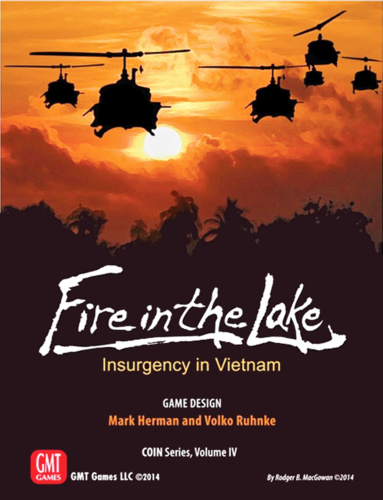
2. Fire in the Lake: Insurgency in Vietnam from GMT Games
The COIN Series uses cards in a very different way from other CDG’s. These cards are not necessarily the driver of the action but more assistive to the actions of the players by setting eligibility and also providing powerful events. The Event Cards are more often than not, very powerful. They either give you a continuing bonus on future Operations and Special Activities (as in the case of the volumes that include the various Capabilities) or allow you to take Operations and Special Activities more times that round than you would normally have been able to had you not chosen the Event and more often than not, at no cost! Also, because of the power of the cards and their ties to one or more factions, you can take the Event which allows you a huge advantage, only to see that very powerful Event reversed with the next Event or with a regular Operation. This is very frustrating but is one of the major reasons that I love the card-assisted element of the COIN Series.
Fire in the Lake from GMT Games just really sums up the the Vietnam War experience to me and Volko’s magnum opus is Fire in the Lake, without a doubt, as it attempts to answer the question of who the enemy is and does a fantastic job. Fire in the Lake: Insurgency in Vietnam is Volume IV of the COIN Series and teams up two amazing designers in Volko and Mark Herman. The game is an asymmetric treatment of the Vietnam War and pits four players against each other, as even allies want to win the war, but win it in their way. The US Player has control of lots of powerful forces that can utilize Air Lift, Assaults and Sweeps to drive the insurgent guerilla forces of the Viet Cong and NVA back into the jungles but the VC and NVA have tools at their disposal to evade these heavy handed tactics such as tunneled bases, the terrain itself including jungles, rivers and mountains, and the Ho Chi Minh Trail. The US Player must also watch his own back as his ally, the ARVN, is more interested in patronage and lining their pockets with US dollars than necessarily winning the war through brute force. This game design takes into account all of the difficulties with this quagmire of a war and time, and through the cards used to assist the game moving forward, inserts key events such as drug use, protests at home, booby traps and the Tet Offensive.
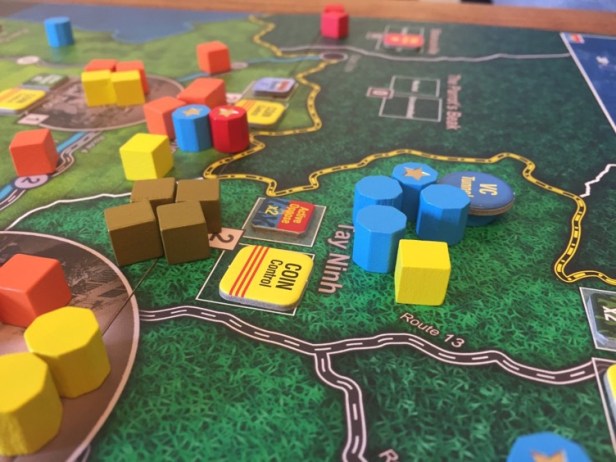
If you haven’t played Fire in the Lake, please do yourself a favor, and do so. It is an exquisite experience that will test you on so many levels and leave you exhausted at the end of the effort while yearning for more. But, don’t go into it thinking it will be easy as it will not be and is sure to have you pulling your hair out as you attempt to win this war. Great theme. Great game play. High quality components and a well thought out design. To get a little more insight into why this game is so great, please read my article on Why I find the COIN Series to be Fantastic! I use several examples of the game play from Fire in the Lake to prove my point.
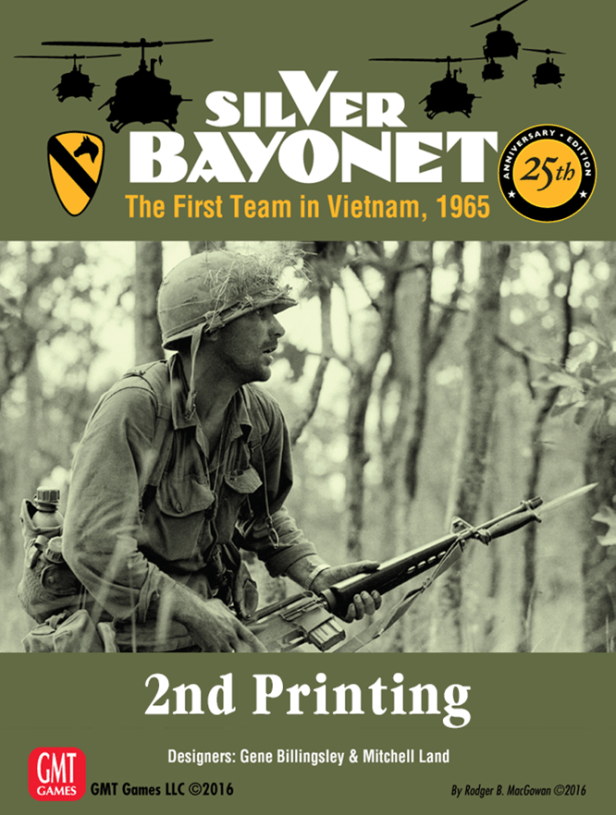
1. Silver Bayonet: The First Team in Vietnam, 1965 from GMT Games
I own and have read the book We Were Soldiers Once..and Young by Lt. Gen. Hal Moore and was fascinated by the story he told of his brave soldiers who fought the first major battle of the Vietnam War. How they went into the Ia Drang Valley and ran into nearly 2,500 NVA regulars who were spoiling for a fight and who outnumbered them 2.5/1 and how that fight lasted 5 days from November 14th through November 18th. I was also amazed at the new tactics used by the 7th Cavalry in using helicopters to jump from landing zone to landing zone to remain maneuverable enough to fight a conventional war that we were comfortable with against a non-conventional enemy in the Viet Cong and the North Vietnamese Army who didn’t want to fight our way. When the new 25th Anniversary Edition of Silver Bayonet was announced I was excited to experience this war and was glad when my friend Alexander P500’ed the game and we got a chance to play it.
So, this isn’t some monster game that covers the whole of the Vietnam conflict, but covers the entirety of the Silver Bayonet campaign. The initial landings of the 1st Cavalry Division are just 1 of 11 or 12 scenarios/campaign games included in the box. It covers 4 days and uses a handful of units in brutal close assaults.

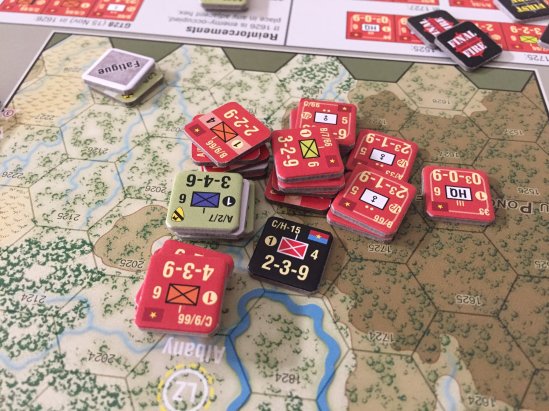
Something that I was pleasantly surprised about was that a good number of the scenarios can be played solitaire because most of them don’t involve using the hidden aspects of the game (NVA hidden movement, US secret helicopter basing and staging, etc.). The complexity of the rules, and sub rules, as well as all of the different phases means that the game is very cerebral. There’s a lot to consider, and units/combats might not function in ways that you’re used to in other games. With one stack attacking another you are very unlikely to wipe the other player out. The CRT just isn’t built for that. If you use maneuver combat then the NVA will flee to the hills and then just come back at you. However, NVA assaulting American troops is also deadly, because in assaults the defender inflicts hits first. We found ourselves often in bloody stalemates, with the Americans just barely hanging on for dear life. The US had access to big artillery pieces as well as many points of airstrikes, which learned through hard experience need to be stacked all together in precision strikes in order to do any kind of damage. All of these things lead to just a fascinating, and in my opinion, extremely accurate representation of the type of combat, fought on the jungled hills of South Vietnam. This game felt real and as we played we could really begin to get into the narrative of the situation and even in some small manner, feel the same frustration and disappointment that the US must have felt in fighting an un-fightable enemy! For that alone, I am extremely impressed and cannot wait to play more and just explore the depth that the rest of the scenarios have to offer.
If you can’t tell, I love this game. It’s deep, rich, and flavorful, just like a good curry. There’s volume in the box, so much stuff to play with. The components are unbelievably good value. Something that didn’t feel too great was the importance of the coordination rolls. The NVA would have handed the US their ass early on day 3 if they hadn’t utterly failed this coordination roll. In failing, they were unable to attack with their best stacks that had been meticulously moved into position for the final assault to take LZ X-Ray. And while I understand what it represents, which is is great, but it seemed very ‘swingy’, because it happened on several of my activations during our plays. Coordinating the amount of NVA troops commanded in the jungles whilst being bombarded day and night isn’t an easy thing to do, but that it boiled down to a single d10 roll felt like a little bit of a let down. I might be house ruling a 2d6 method to make that roll less randomly distributed. I also get that over the course of a full campaign those kind of things would have evened themselves out, but in a short scenario like that it kind of felt like bad luck. That being said: It’s still a good model for the command situation, so there is that. Just maybe find a way to be less random?
Well, those are my 3 favorite games focused on the Vietnam War. I have played several others but feel that these 3 best demonstrate what it is like to be in an unwinnable and unmanageable situation that quickly spirals out of your control. What are your favorite Vietnam War games?
As an added bonus, here are links to a few Vietnam related posts that I did during the pandemic on the Music of the Vietnam War:
The Music of the Vietnam War – Playlist Suggestion for Wargames Part 1 – 1964-1969
The Music of the Vietnam War – Playlist Suggestion for Wargames Part 2 – 1970-1975
Post Publishing Edit: I was asked why Purple Haze from PHALANX didn’t make the list and here was my response:
Oh no. It was amazing. We absolutely love the theme and the feel of that game. Fantastic representation of the Vietnam War. Warfighter Vietnam from DVG is also very good.
A few other smaller games I have played and liked on the subject was Fortunate Sons from High Flying Dice Games, Long Cruel Woman from High Flying Dice Games and Dien Ben Phu from Legion Wargames (although not the US war in Vietnam but a great game). Just only wanted to spotlight 3.
-Grant


my two favorite games about this conflict are Downtown: Air War Over Hanoi, 1965 – 72 and Vietnam 1965 – 1975.
they both present some really unique designs and communicate the complexity and confusion of the conflict really, really well. they are both on the heavier side i suppose but well worth the investment of time and energy.
i hope Downtown gets a new edition at some point as it’s become somewhat difficult to obtain but it’s very special. the recent second edition of Vietnam 1965 – 1975 is fantastic. it’s mostly just a huge production value upgrade over the original Victory Games version from 1984 with errata included.
LikeLiked by 1 person
Vietnam 1965 – 1975 is such an amazing game, both for the shorter scenarios and the campaigns I am not sure I can accept this list, but really there are some great games for the period and as you just said “with Vietnam” in the title, Dien Bien Phu: The Final Gamble has got to be a contender as well. (Although set before what we think of the Vietnam War)
LikeLiked by 1 person
Own it but have not had a chance to play. It is very intimidating though. Like the VC hiding in the jungle.
LikeLike
I would add to this Puple Haze. 😏👍🏻
LikeLiked by 1 person
An excellent game for sure. And we loved it very much and have played most of the main box scenarios. I love the narrative generated and the story that comes out of it. A very worthy game that should be on this list. But there were also other good games that just didn’t make the cut. These 3 are the tip top of the summit of Vietnam War games.
LikeLike
Hope you get this. I always have trouble signing into WordPress for some reason. An annoyance that stops me from posting usually. (I’m 77 old and crotchety, I acknowledge it)
Hi Grant. Interesting article. I served two tours in Vietnam, the first was a combat tour with the 1st Infantry Division.
Silver Bayonet and Fire in the Lake are landmark games as far as I’m concerned. Very fine.
I also admire Vietnam 1965-1975. Virtually unplayable (the campaign) due to length but its certainly a sprawling epic simulation befitting the legacy of the real thing.
Never tried Hearts and Minds – it looks a bit too simplistic for my taste (probably I’m wrong). I am going to try and work a test run of it.
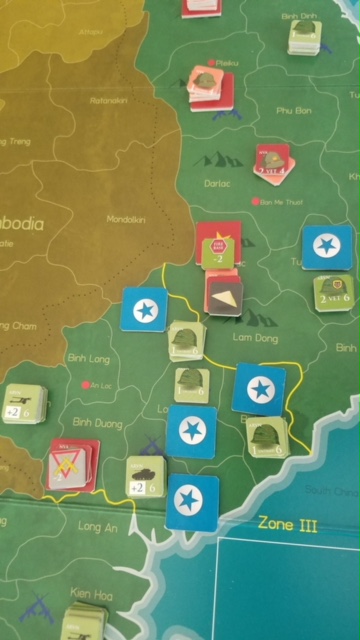
One bit of minutiae that caught my eye, the map picture accurately depicted the existence of Binh Long province just north of Binh Duong province. Binh Long was combined into Binh Duong by the communists after the war and I appreciate the accuracy of this map (this was the AO for the 1st Division). I don’t think I’ve ever seen Binh Long province on any other game map.
I was surprised to learn there’s only 30% of us left (Vietnam veterans). Tick-tock. The canon of Vietnam war games is a lasting legacy for the history. It’s one way to keep alive the history for future generations (I hope).
Robert Reese, Dallas, GA
LikeLiked by 1 person
Thanks for your comments and for your service.
LikeLike