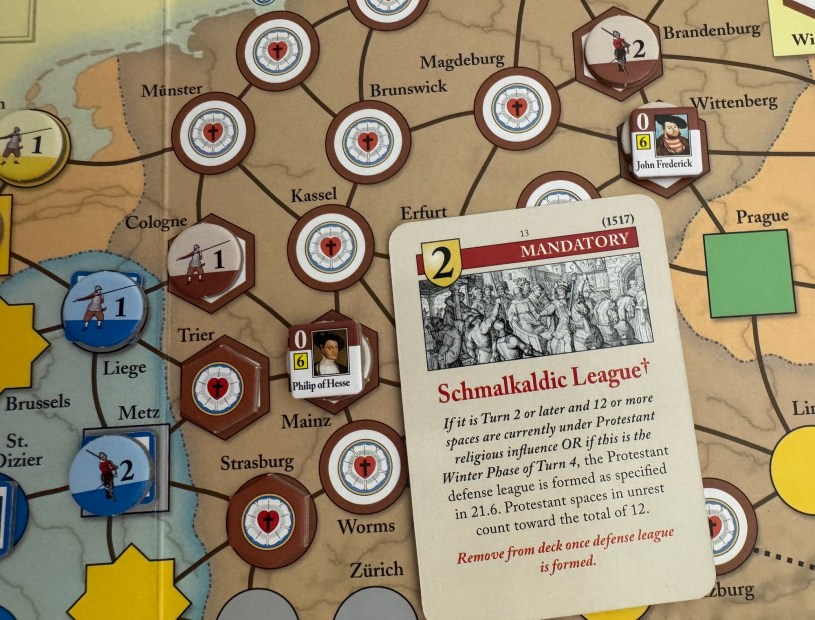
With this My Favorite Wargame Cards Series, I hope to take a look at a specific card from the various wargames that I have played and share how it is used in the game. I am not a strategist and frankly I am not that good at games but I do understand how things should work and be used in games. With that being said, here is the next entry in this series.
#77: Schmalkaldic League from Here I Stand: Wars of the Reformation, 1517-1555 from GMT Games
Here I Stand: Wars of the Reformation 1517-1555 is an experience packaged in a game that attempts to boldly cover the political and religious conflicts of early 16th Century Europe. The game focuses on the struggle of religious reformers such as Martin Luther, John Calvin and Ulrich Zwingli as they battle the Papacy for changes in their views of God and religion. But it is more than just the Holy War as it deals with the other European countries involved in the affairs of the time including France, England, the mighty Hapsburg Empire and the Ottoman Empire in the east. They all played a role in the process of the Reformation and the design brilliantly weaves this all together into an interesting and engaging experience. The game also covers other plot lines and events of the period, including wars, marriages and ascendancies to thrones, using a unique Card Driven Game (CDG) system that models both the political and religious conflicts of the period.
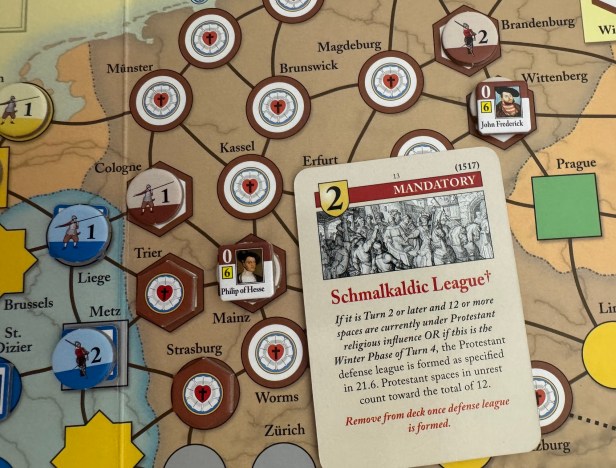
Today, I want to take a look at a very interesting Mandatory Event card that really shakes things up for the Protestant player in the Schmalkaldic League. This Mandatory Event basically transforms the Protestant player and changes their focus slightly as they now become somewhat of a military power. I use the term “military power” here lightly as they really are not that powerful and this event is really more of a wet blanket thrown onto their spiritual bonfire as they now will have to worry about gearing up for attacks from their neighbors to try and take away their victory points through wresting control of their Electorates from them, which grant extra Victory Points. The Schmalkaldic League Mandatory Event is only triggered when the Protestant has religious influence in 12+ spaces from Turn 2 on, or if not, then automatically by the end of Turn 4.
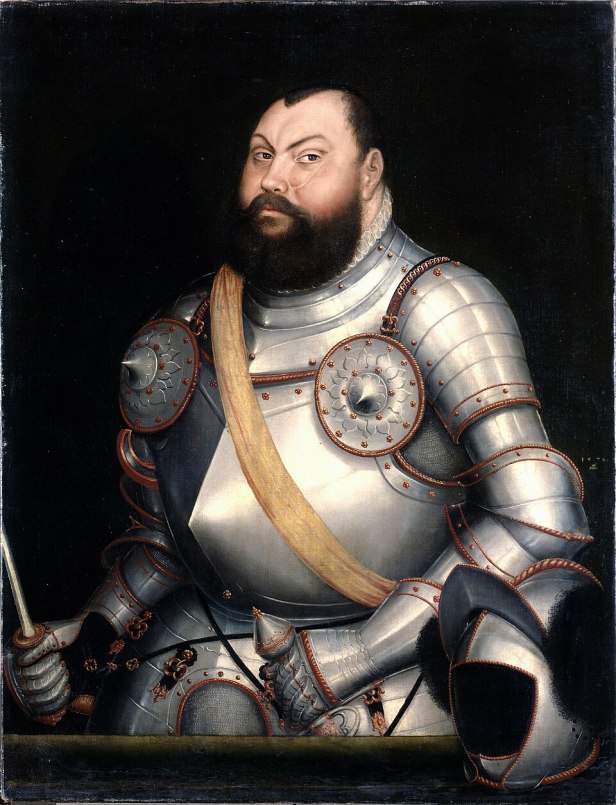
The Protestant player gaining the ability to create and command military units, including both regulars and mercenaries, is somewhat of a boon as you can now move your troops around the board gaining additional dice for Conversion attempts if those units are adjacent and also the electorates under Protestant religious control, specifically those marked as Protestant home spaces, instantly come under Protestant political control and grant 2 VP for each Electorate up to a maximum of 12 VP total if all 6 are under control. Talk about a turning point…albeit a turning point with some difficulties. The leaders granted to the Protestants are also not very good and do not gain extra dice during combat and frankly cannot command large armies. These leaders include John Frederick and Philip of Hesse.
Frankly, I try my best to hope and pray that the Schmalkaldic League card doesn’t come out during the first 4 turns and then will be triggered only during the Winter Phase of Turn 4. This gives the Protestant player some time to expand and attempt to get all of those important VP generating Electorates under their control to set themselves up nicely. But once it happens you will find that you are spending your scarce resources in the form of Command Points on things like recruiting units, moving those units and preparing for attacks. This takes away from your ability to focus solely on spreading the faith and can be a real drag on that effort. But, you take the good with the bad in this game and I have learned to deal with it over the years and turn it into something that benefits me.
The Schmalkaldic League was a military alliance of Lutheran principalities and cities within the Holy Roman Empire during the mid-16th century. It received its name from the German town of Schmalkalden, where the group was founded in 1531. Although created for religious motives soon after the start of the Reformation, its members later came to have the intention that the League would replace the Holy Roman Empire as their focus of political allegiance. While it was not the first alliance of its kind, unlike previous formations, such as the League of Torgau, the Schmalkaldic League had a substantial military to defend its political and religious interests.
The League’s members agreed to provide 10,000 infantry and 2,000 cavalry for their mutual protection. They rarely provoked the Holy Roman Emperor Charles V directly but confiscated church land, expelled bishops and Catholic princes and helped spread Lutheranism throughout northern Germany.
Martin Luther planned to present to the League the Smalcald Articles, a stricter Protestant confession, during a meeting in 1537. He attended the critical meeting in 1537 but spent most of his time suffering from kidney stones. The rulers and princes even met in the home at which Luther was staying. Though Luther was asked to prepare the articles of faith that came to be known as the Smalcald Articles, they were not formally adopted at the time of the meeting, but in 1580, they were included in the Book of Concord.
In the next entry in this series, we will take a look at Hamburger Hill from Fire in the Lake: Insurgency in Vietnam from GMT Games.
-Grant


The single most impactful card in HIS! I like to get to 11 Protestant spaces (ideally already including all the electorates) in turn 2, then use turn 3 to charge my batteries (get the German bible almost done, maybe the English or French New Testaments as well, and carry over two – hopefully strong – cards) before going absolutely wild in reforming Germany in turn 4. Chances are good the Schmalkaldic League finds me at 25 or 30 Protestant spaces and poised to be a contender for victory!
LikeLiked by 1 person